
I have loved history since my teens, but for most of my business life geopolitics was never really part of my analytical framework. For roughly fifteen years, I thought about companies primarily through two lenses: macroeconomics and technology. Understand the economic cycle, understand where technology was moving, and you could explain a large part of what was happening to industries and firms.
Something changed for me in 2020.
The pandemic exposed just how interconnected the global economy had become, but also how physical many of those connections still were. Behind the abstraction of globalization sat semiconductor fabs, pharmaceutical plants, shipping routes, energy systems, rare-earth processing, industrial machinery, medical supplies, and basic materials that most businesses had spent decades treating as if they would simply always be available.
Suddenly they were not.
That was the moment I started looking at the global economy differently. What appeared to be a highly distributed and digital system was sitting on top of a surprisingly small number of physical dependencies. A disruption in one geography could stop factories thousands of kilometres away. A shortage of one component could immobilize entire industries. Governments could suddenly decide that something previously treated as an ordinary commercial input was strategic.
For me, that triggered a much deeper exploration of geopolitics. Not as a separate discipline sitting beside business analysis, but as something that increasingly had to sit above it.
In retrospect, the preceding three decades were the historical exception. After the end of the Cold War, businesses operated during an extraordinary period of globalization under a largely US-led international order. Supply chains stretched across political boundaries because companies could largely assume that trade, capital, technology, energy, and information would continue moving across them. You could build a serious business framework while paying relatively little attention to spheres of influence, strategic dependencies, industrial sovereignty, or the possibility that governments might deliberately restrict access to critical technologies.
For most of history, that would have been a strange assumption.
Political power, geography, access to resources, and control of strategic infrastructure have shaped commerce for centuries. What was unusual was the period in which many businesses could behave as if they did not.
The realization hit me almost like a flash in 2020: there was no going back to a world in which geopolitics could remain outside the business framework.
And the years since have only reinforced that view. Semiconductors became instruments of state power. Energy security returned to the center of European strategy. Supply chains were reorganized around resilience and political alignment. Advanced manufacturing became industrial policy. AI infrastructure became an electricity and sovereignty question. Space infrastructure became increasingly entangled with communications, navigation, intelligence, and warfare. Biology began moving closer to the same strategic frontier.
This changed the hierarchy of my own analytical framework.
I used to think primarily from macroeconomics into technology and then into business. Increasingly, I think the causal chain has to begin one level higher:
Geopolitics → Macroeconomics → Technology → Business.
Geopolitics increasingly defines what can move, where it can be built, who can access it, and under what conditions. Those decisions shape capital flows, energy prices, industrial policy, trade, and monetary dynamics. Those macro conditions determine where technologies can scale. And only then do those technologies cascade into industries, companies, business models, and competitive advantage.
That does not mean geopolitics determines everything. It means that a framework for understanding technology and business is increasingly incomplete if it ignores the political and physical system underneath them.
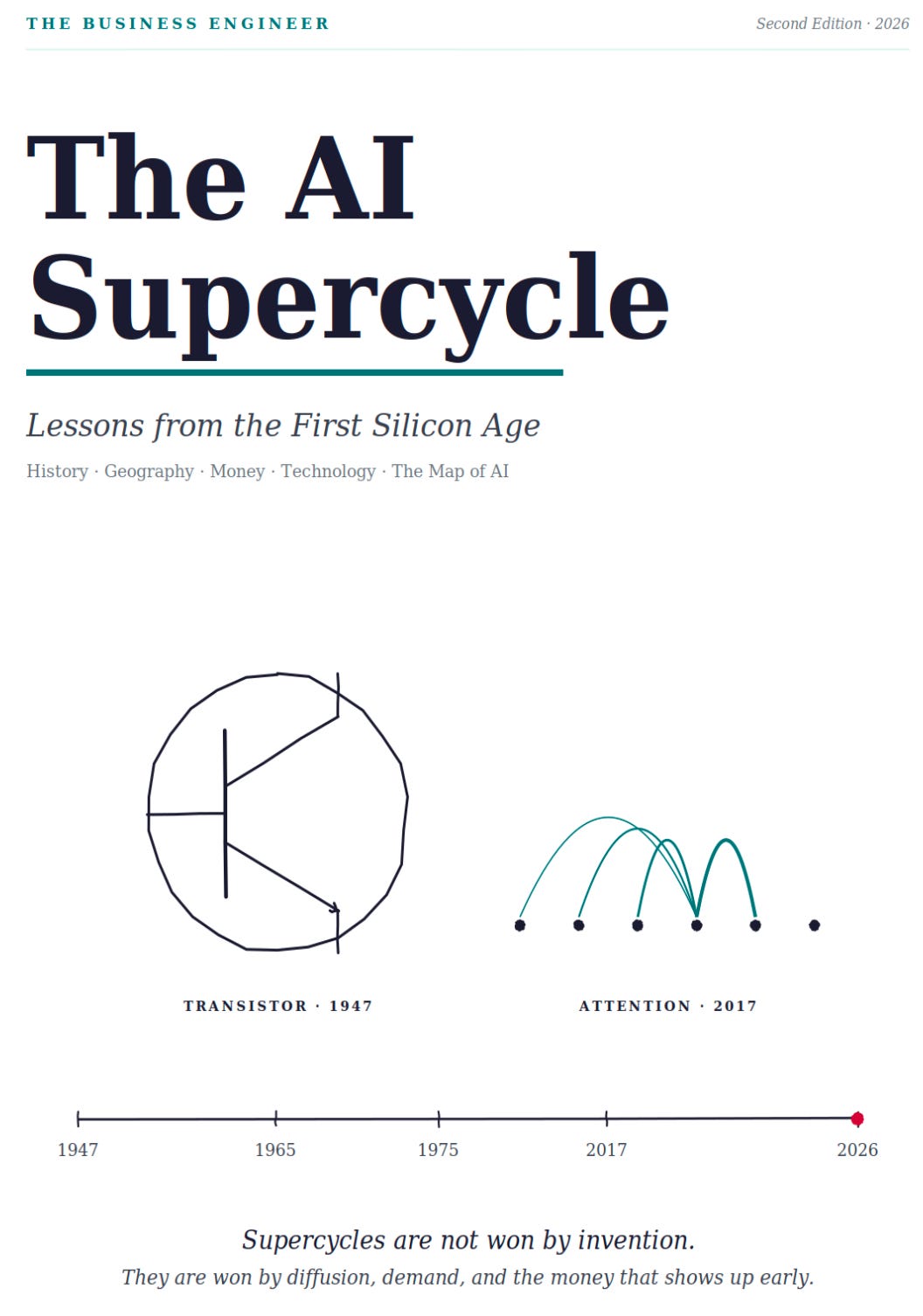
This is also one of the reasons I eventually spun The AI Supercycle out of The Business Engineer. What began for me as an attempt to understand AI increasingly became an attempt to understand the much larger system forming around it: compute, energy, semiconductors, infrastructure, capital, industrial policy, space, biology, and the geopolitical competition that increasingly connects all of them.
AI may be the most visible technology of this cycle.
But the cycle itself is much larger than AI.
So let me tell you the full story of how I see the next decade unfolding.
This is the rise of techno-geopolitics. Technology is no longer something that can be analysed separately from geography, infrastructure, state power, and strategic dependencies. The two are becoming one system.
That is also why I’m republishing my Map of AI workshop alongside this piece. The workshop lays out the broader analytical framework behind this argument: how I map the AI stack, where the real physical and technological bottlenecks sit, how power moves across those layers, and why understanding AI increasingly requires understanding the geopolitical system underneath it.
The piece explains the thesis. The map shows you the system behind it.
At Małaszewicze, on Poland’s border with Belarus, freight trains arriving from the east stop for a reason that predates almost everything they carry. Europe’s standard railway gauge is 1,435 millimetres. The former Soviet network uses 1,520. Containers travelling overland from China therefore have to be lifted from one rail system and placed onto another before continuing west.
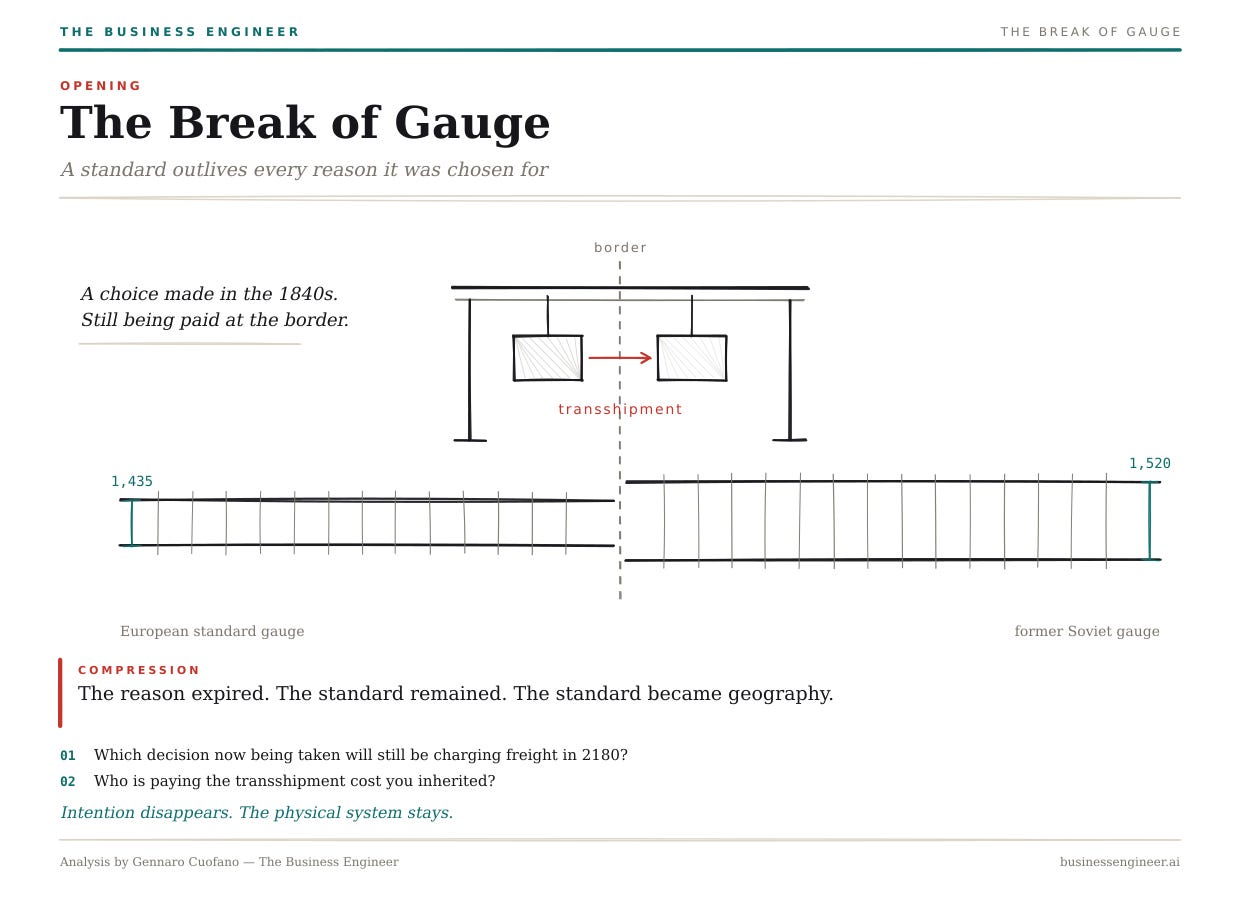
The difference dates back to decisions made in the nineteenth century. Russia’s first major trunk railway adopted a wider gauge for engineering and commercial reasons that belonged to its own time. The familiar story that it was chosen deliberately to slow an invading army is largely mythology, although the difference later did complicate military logistics. The important point is simpler: the original reason disappeared, but the standard did not. Nearly two centuries later, cranes are still moving containers because of it. The reason expired. The standard remained. Eventually, the standard became geography.
That is one of the ways technology becomes geopolitical. Not because technology determines history on its own, but because certain technologies turn decisions into infrastructure, infrastructure into standards, and standards into dependencies that can survive the circumstances that created them. Once enough capital, regulation and operating practice accumulate around a technical choice, changing it becomes expensive enough that the choice stops looking like a choice at all.
This is why I think calling what is happening today an “AI race” is too narrow. Artificial intelligence is not arriving by itself. It is colliding with two other technological domains, space and biology, while all three increasingly draw on the same underlying resources: compute, electricity, specialised manufacturing, physical infrastructure and government permission. That intersection is the more important thing to watch.
A single important technology can create an industry. Several technologies converging on the same physical and institutional bottlenecks can begin creating a map. I call that a junction.
What Makes a Technology Geopolitical
Most technologies never become geopolitical in any meaningful sense. The spreadsheet transformed business. The shipping pallet transformed logistics. The zipper transformed manufacturing. None substantially changed which states could coerce other states. Economic importance is therefore not enough. Technical sophistication is not enough. Even massive social impact is not enough.
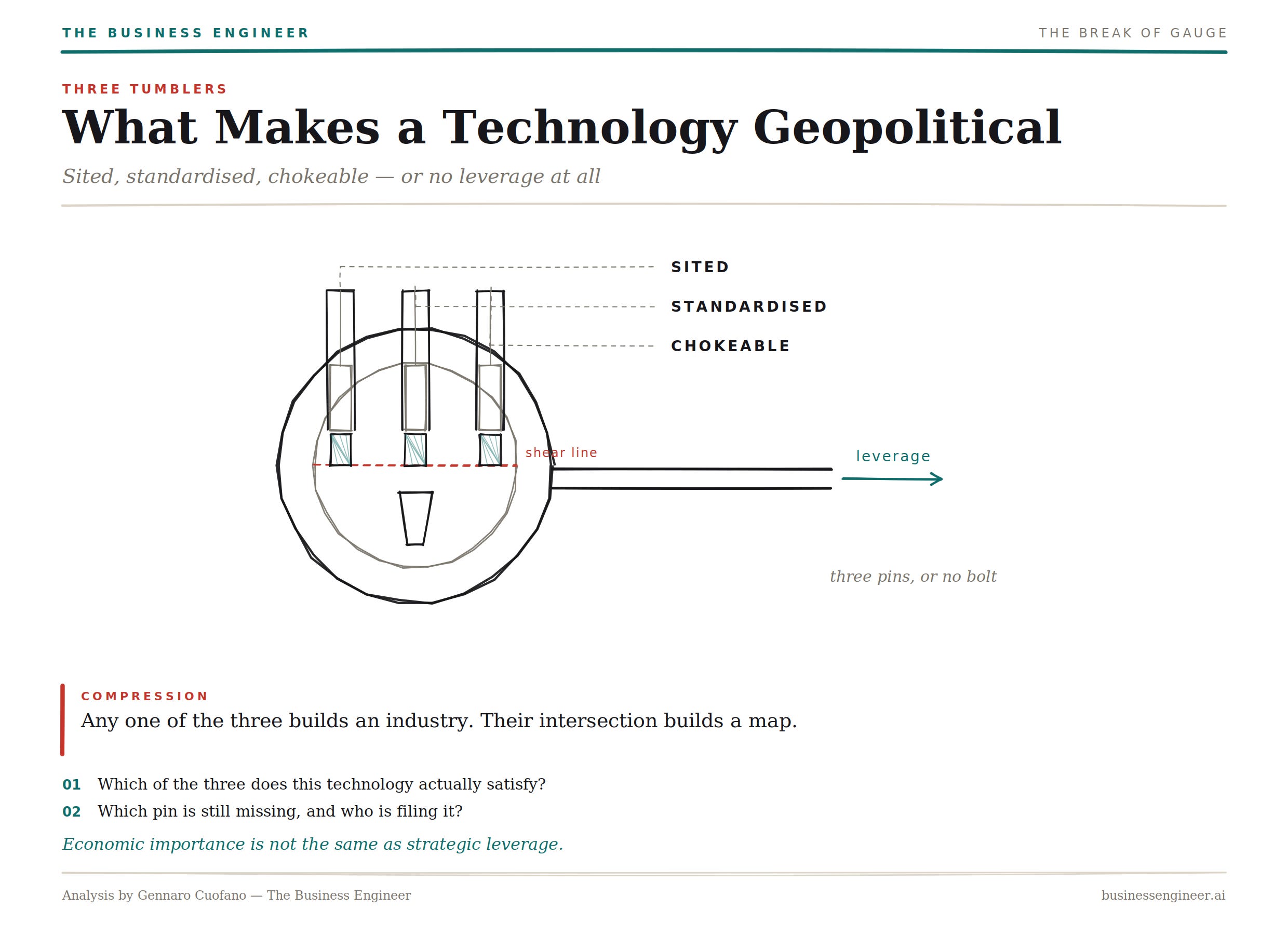
A technology starts entering the geopolitical order when three properties overlap. First, it has to be sited. Some important part of the system must physically exist somewhere, at enough cost and scale that moving it is difficult. Software can move almost instantly. A power grid cannot. Neither can a semiconductor fab, deepwater port, launch complex, enrichment facility or gigawatt-scale compute campus. Once enough capital hardens into concrete, geography returns.
Second, the system has to be standardised. Railways need a gauge. Electricity needs voltage and frequency. Shipping needs container dimensions. Networks need protocols. Semiconductor controls need technical thresholds. Biology needs screening standards. Standards look like engineering decisions while they are being written. Once infrastructure accumulates around them, they determine who fits naturally inside a system and who has to pay to cross its boundary.
Third, the system has to be chokeable. Somewhere in the chain there must be a step that relatively few actors can perform. Whoever controls that step can grant access, price it, condition it or withdraw it.
Siting creates geography. Standards create compatibility. Chokepoints create leverage. Their intersection creates something more than an important market: it creates political power.
There is a second-order effect as well. Once a technological junction becomes large enough, it begins changing which forms of power are cheapest to project. It also changes war itself: who can fight, what can be targeted, how quickly force moves, how deeply military production reaches into the civilian economy and, eventually, whether direct war between the strongest actors remains thinkable.
Four previous junctions built much of the geopolitical world we still inhabit.
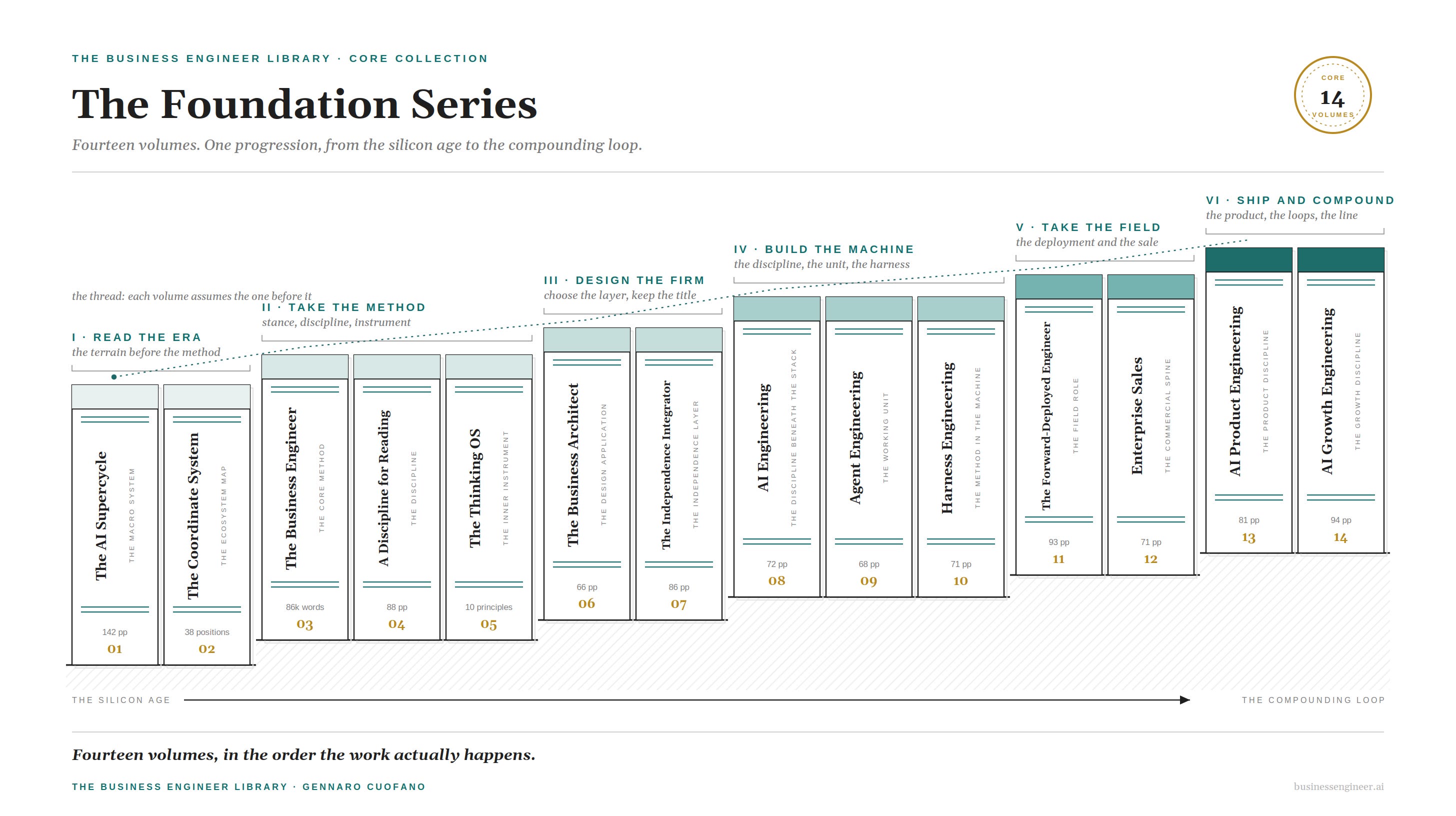
For the last three years, I’ve been rebuilding the Business Engineer’s curriculum from the ground up. That curriculum has now become the foundation of a new discipline, with the entire series taking shape around it.
If you’re already a paid member, simply reply to this email, and we’ll send it your way.