

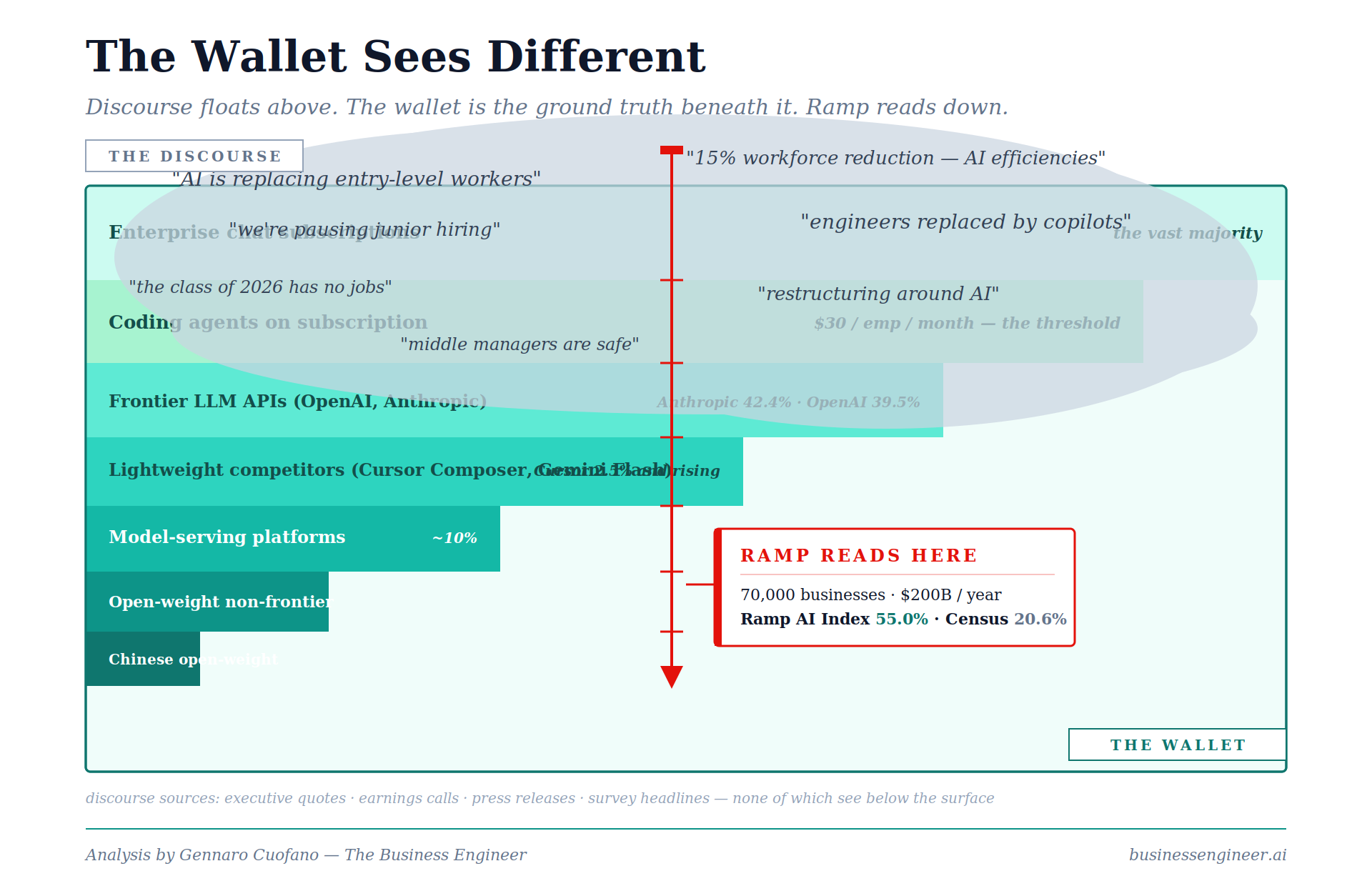
The public discourse on AI adoption is a story about what people say — CEOs on earnings calls, executives in surveys, model developers on podcasts. Ramp’s data is a story about what firms actually do, where they route the payment, what shows up on the card and the bill. Those are different objects. And in mid-2026, they are telling different stories at once: the wallet says firms that adopt AI intensely are hiring more, restructuring away from middle management, and quietly forcing a sovereignty crisis on the American model companies that the discourse hasn’t caught up to yet.
But the deeper story is what Ramp’s data does to the Map of AI itself. Every layer of the nine-layer physical-through-governance stack I’ve been building through the Q2 2026 earnings and filings cycle — TSMC and ASML in The Fed and the Mint, SK hynix’s F-1, Kimi K3’s networking inversion, the sovereign kill switch — sits downstream of the enterprise demand signal Ramp is now the only public dataset to measure directly. Ramp is not on the map. Ramp is what tells us whether the map is being built right.
This piece is what I took from a live interview with Ara. It is longer than usual because the conversation covered more ground than usual, and because the data affects every layer of the stack I’ve been mapping.

The Wallet Layer
Orient — Why this conversation matters right now
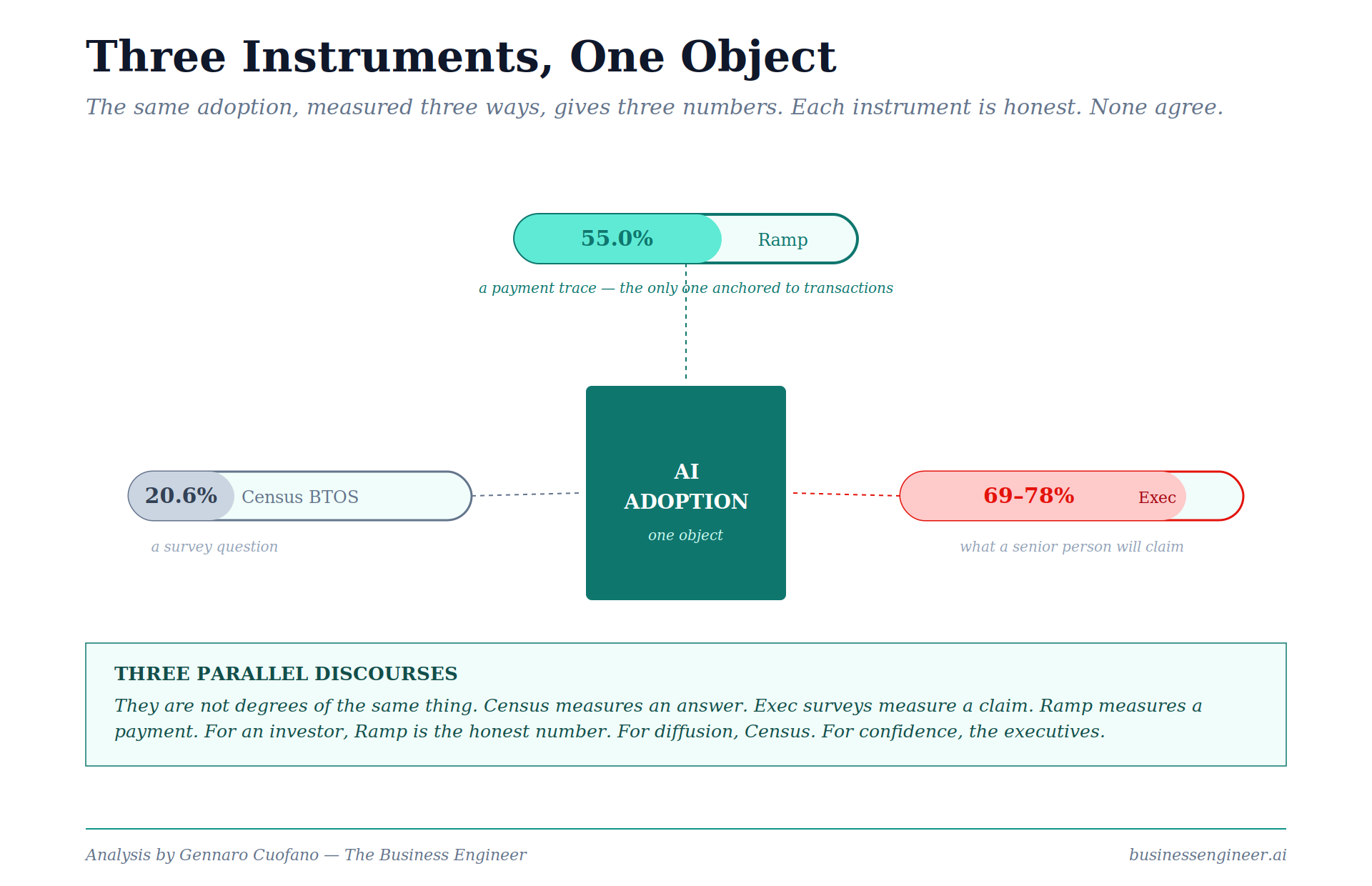
There are three loud, structurally incompatible measurements of AI adoption in mid-2026, and they are all treated as authoritative depending on who is speaking.
The Census Bureau’s Business Trends and Outlook Survey puts paid US business AI adoption at around 20.6 percent. Executive surveys — the Yotzov et al. cross-country enterprise survey, the Atlanta Fed Survey of Business Uncertainty — put it at 69 to 78 percent. Ramp’s AI Index, published against a base of firms whose card and bill payments Ramp processes, puts it at 55.0 percent.
Same country. Same month. Same technology. Three answers that are each internally coherent and each measuring a different object.
This is the first thing worth naming. The AI adoption discourse is not a discourse. It is at least three parallel discourses stacked on top of each other, each with its own numeric spine, and most public writing about AI treats them as interchangeable when they are not. Ramp measures adoption that leaves a payment trace. Census measures adoption that leaves an answer to a survey question. Executive surveys measure what a senior person is willing to report about their firm to a researcher. These are not degrees of the same thing. They are different things.
Ara’s team has done the honest bookkeeping. In the paper Ramp Economics Lab published on June 30, 2026 — A New Look at AI’s Impact on Jobs: Firm-Level AI Spending and Workforce Adjustment, by Ara Kharazian, Lisa Simon of Revelio Labs, and Ryan Stevens of Ramp — the authors describe Ramp’s series as “a revealed-adoption measure for a selected, business-spend-active firm population.” That is a careful phrase. It admits that Ramp’s number is not the population number. But it also insists that Ramp’s number is the only one anchored to observed transactions, not to what people are willing to claim.
For an investor deciding whether to underwrite the AI capex cycle, Ramp is the honest number. For a policymaker asking whether AI is diffusing across the economy, Census is closer. For a journalist writing about executive confidence, the executive surveys are what you want.
I want to sit with this before we get to the paper’s findings, because the paper’s findings only make sense against the right measurement layer. The story about high-intensity adopters growing headcount 10 percent — which is where everyone will focus — is a story about the Ramp population. It is a story about firms that spend meaningfully on AI vendors and get workforce data joined via Revelio. It is not a story about all American firms. Ara is careful about this and the paper is careful about this, and both times I asked him about generalization his answer was some version of “the population that matters most for the frontier question is the population we’re measuring.”
That is a defensible position, but it is worth stating plainly. The wallet layer, as of mid-2026, is beginning to acquire its own analytical vernacular — a set of concepts that only make sense against payment data and that will over time either colonize or supplant the survey-based vernacular. This conversation with Ara is one of the earliest signals that the vernacular has arrived. In the same way the semiconductor industry acquired its own vernacular — nodes, yields, cycle times, capex payback — that eventually structured how anyone serious talked about the industry, the AI industry is now acquiring the vernacular of adoption depth, threshold spend, per-employee intensity, model-serving share, sovereign optionality. Ramp is the vendor of that vernacular’s first authoritative dataset.
The threshold and the middle manager
The headline finding of the Kharazian-Simon-Stevens paper is that firms adopting AI with high intensity grow their headcount roughly ten percent over the two years following adoption, while firms adopting with low intensity see no difference from the control group at all. It is not a gradient. It is a step function.
What the paper says in a footnote, and what Ara made vivid in the interview, is that the threshold isn’t as high as most enterprise buyers assume. The median firm in the high-intensity group in the first three months of adoption spent about thirty dollars per employee per month. Not thousands. Not “token maxing,” in Ara’s words. Thirty dollars, plus the operational choice to use the technology in an integrated way — multiple models, multiple teams experimenting, some AI-specific implementation for a specific function. The gains, he said, do not require heroic spend. They require the right implementation, and the willingness to experiment across models rather than settling into one enterprise chat subscription.
That’s the first honest counter-narrative moment of the conversation. If you’re an enterprise buyer being sold on the idea that you need to write an eight-figure check to get AI value, the wallet-level evidence says otherwise. What separates the firms getting gains from the firms getting nothing is not spend intensity in the raw sense. It is depth of integration at moderate spend.
A footnote worth flagging: Ara observed that at one point earlier this year, Ramp saw per-employee AI spend growing at 13 percent month-over-month for the median AI-spending firm. That is a compound growth rate no enterprise budget survives. Even Ara said it out loud: “that growth rate is not sustainable.” Which means that any firm sitting on a single enterprise subscription with unlimited token consumption is going to hit a budget conversation sooner rather than later, and that budget conversation is exactly the pressure point that pushes firms toward multi-vendor stacks, cost-aware routing, and the Ramp Router product we’ll come back to.
The threshold, then, is not a spend threshold in the way that budget-conscious buyers hear it. It is an integration threshold. Coding agents on subscription plus a few AI-specific implementations for functions where you know the ROI is real — Ara gave the example of voice agents for customer service — is where the gains start. Enterprise chat subscriptions alone are where the gains do not start.
But the more consequential finding — the one that only became visible when Ara said it plainly in conversation — is what happens to the workforce composition inside those high-intensity firms.
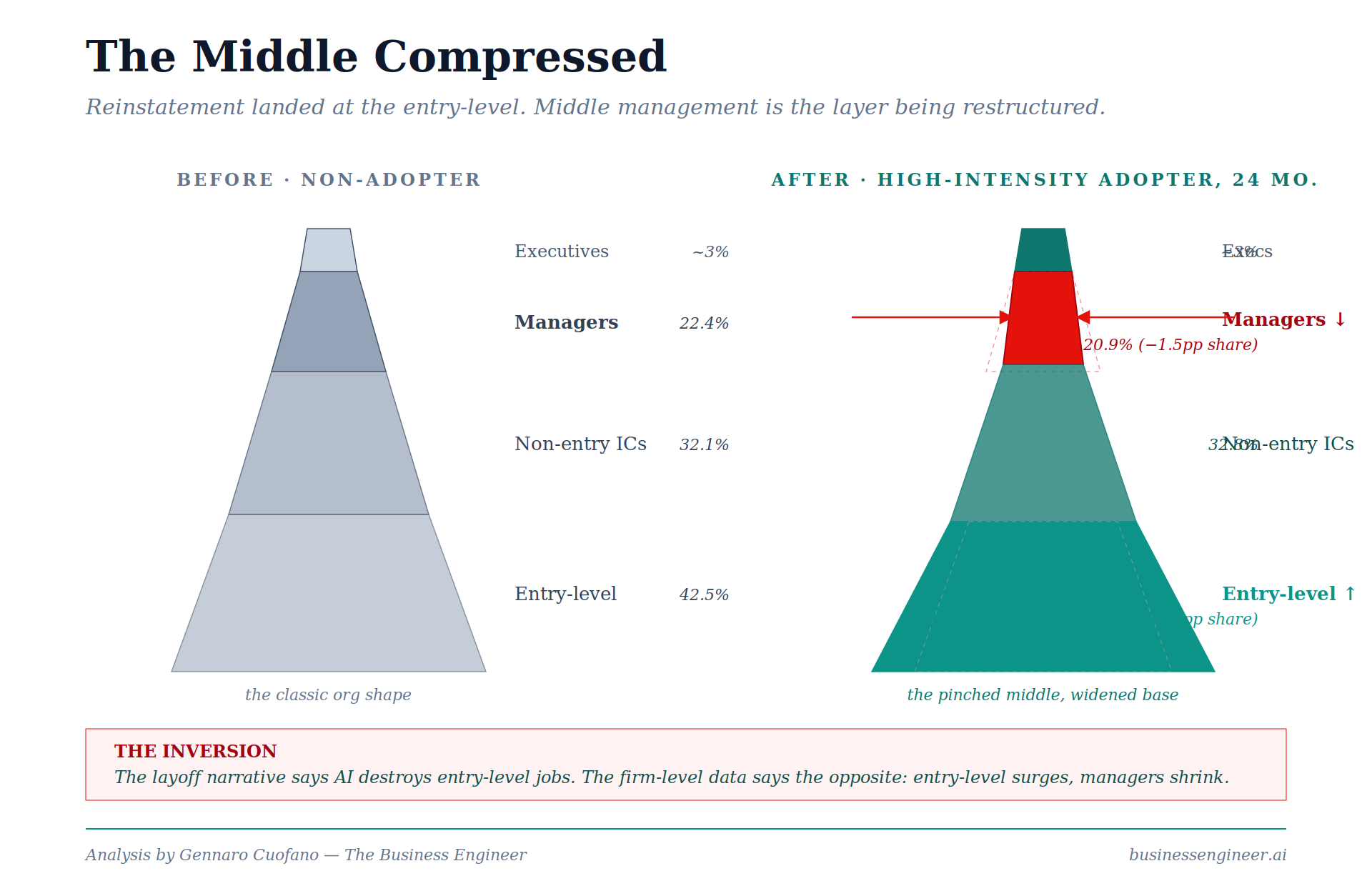
Entry-level headcount rises twelve percent. Total headcount rises ten percent. So entry-level is not just growing; it is growing faster than the firm. The share of the workforce that is entry-level is going up. And on the other side, manager-level employment is declining relative to control. The paper reports this in Table 4 as roughly a 1.5 percentage-point drop in manager share at high-intensity adopters. In the interview, Ara translated it: firms that adopt AI intensely are also restructuring their management styles. Individual contributors who know how to use the technology don’t need as much training or mentorship. They don’t need as many people to sit between them and the direction.
Two things follow.
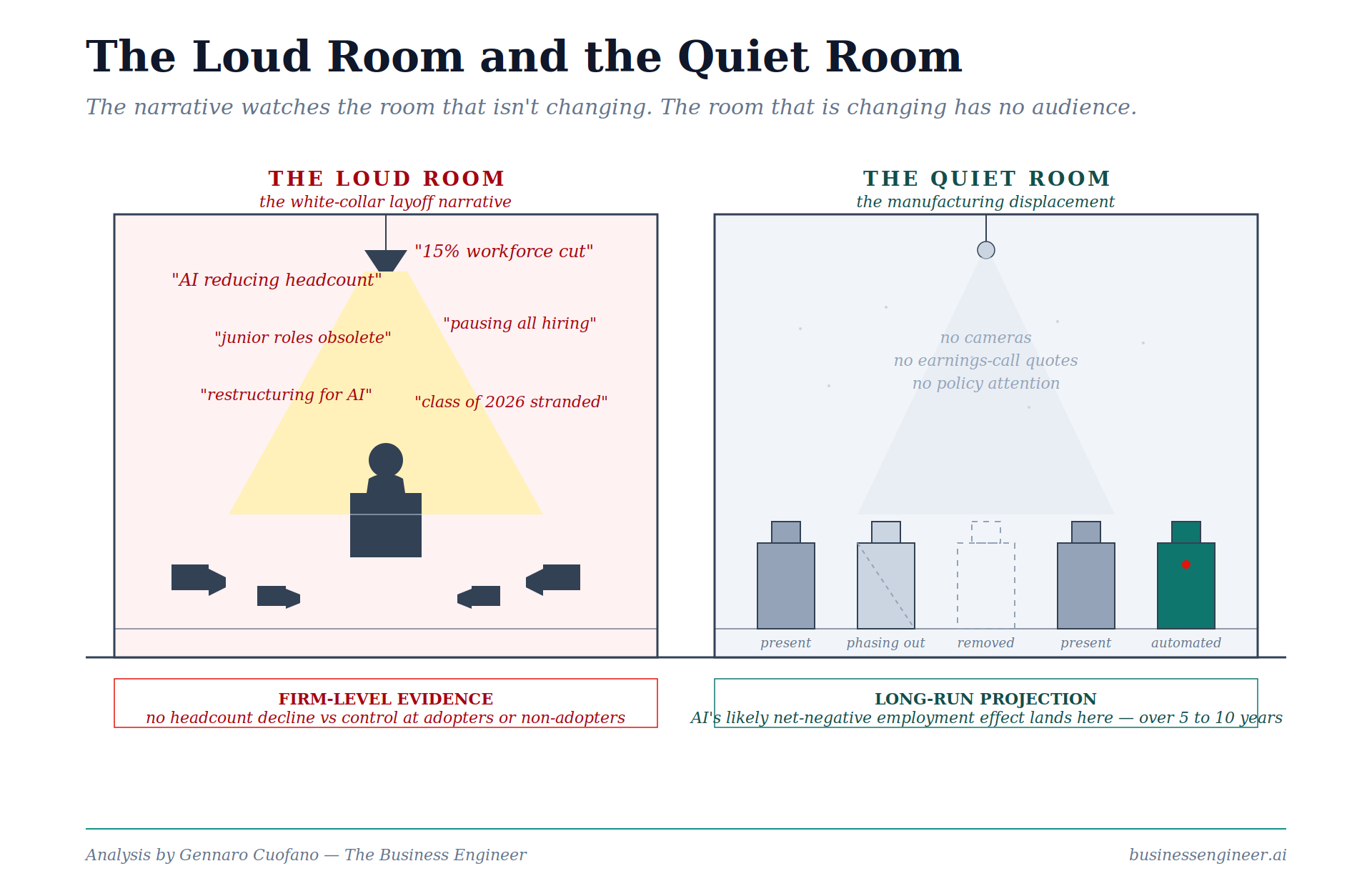
The first is that the CEO layoff narrative — the framing where AI is destroying entry-level jobs and turning the workforce into a barbell of senior humans plus machines — is empirically inverted in the Ramp-Revelio data. Adopters hire more juniors. Not fewer. The Class of 2026 story circulating in the discourse right now has no support at the firm-level layer that actually pays for AI.
The second is that the layer being displaced is the one nobody wants to talk about, because it consists of the executives most likely to be quoted on earnings calls about AI strategy. The middle manager is the actual casualty of intensive AI adoption at the firm level. Not the intern. Not the entry-level engineer. The person who was hired to sit between the entry-level engineer and the vice president, whose job was translation and coordination and mentorship — that person is being restructured out of the org, quietly, while the same firm continues telling the press it is pausing junior hiring due to AI.
The reinstatement effect that Daron Acemoglu and Pascual Restrepo theorized — that automation waves create new complementary work that partially absorbs displaced labor — appears to be happening here. But it’s happening at the entry-level and IC layers, not at the coordination and mentorship layers. The firms that go through the threshold don’t need as many humans to coordinate the humans who are working with AI. They need more humans working with AI. That is the picture Ramp’s data draws, and it is not the picture the discourse is drawing.
Ara added a small point at the very end of this thread that I want to pull forward. Sales headcount at high-intensity adopters rose 10.3 percent. Engineering rose 7.3 percent. Customer service rose 6.3 percent. But the standout — after entry-level — was the growth in forward-deployed engineer-type roles. That title barely existed as a category five years ago. It now shows up in the Revelio data because both Anthropic and OpenAI have built out their own forward-deployed teams, and mid-market enterprises are hiring their own hybrid roles that sit between business and AI implementation. This is the Palantir FDE playbook re-emerging as the missing labor category the AI adoption cycle needs. Worth watching separately — and worth noting that the forward-deployed role is exactly the kind of hybrid domain-expert-plus-technical-implementer that neither the frontier labs’ harnesses nor traditional consulting firms have been able to scale.
The sovereign turn
The strongest new frame in the conversation was not in the paper. Ara raised it while explaining why Ramp had just shipped a Router product.
The setup was economic. American model companies, Ara argued, “have not been responsive to business demand for cheaper models.” So there is a business case for model-agnosticism on cost alone — being able to switch providers, or run several in parallel, keeps competitive pressure on the vendors and prevents the lock-in that OpenAI and Anthropic are structurally incentivized to build. Standard multi-vendor argument. Familiar territory.
Then he added the piece that isn’t standard.
There is now, he said, a business case to be country-agnostic — to source models from more than one jurisdiction — because the United States has demonstrated recently that it can impose export controls on AI models. Which means a European enterprise, a NATO ally, a company that is not adversarial to the US in any way, is one policy shift away from having its AI access revoked. If you have built your product on OpenAI’s API, and your firm is based in Frankfurt, or Milan, or Stockholm, you are living with counterparty risk that has nothing to do with model quality or price.
I want to sit with what this means, because it is under-appreciated in the AI strategy discourse and it is the deepest structural point Ara made during the whole conversation.
Every serious European CTO now has to think about AI adoption the way a treasurer thinks about a single-bank relationship. It is a concentration risk. Not because OpenAI or Anthropic are bad partners. Because the government upstream of them can, at any moment, force a bad outcome. Ara was clear: this is not a company-level concern. It is a jurisdiction-level concern. And it applies to every non-US enterprise the moment they build something meaningful on a US-only stack.
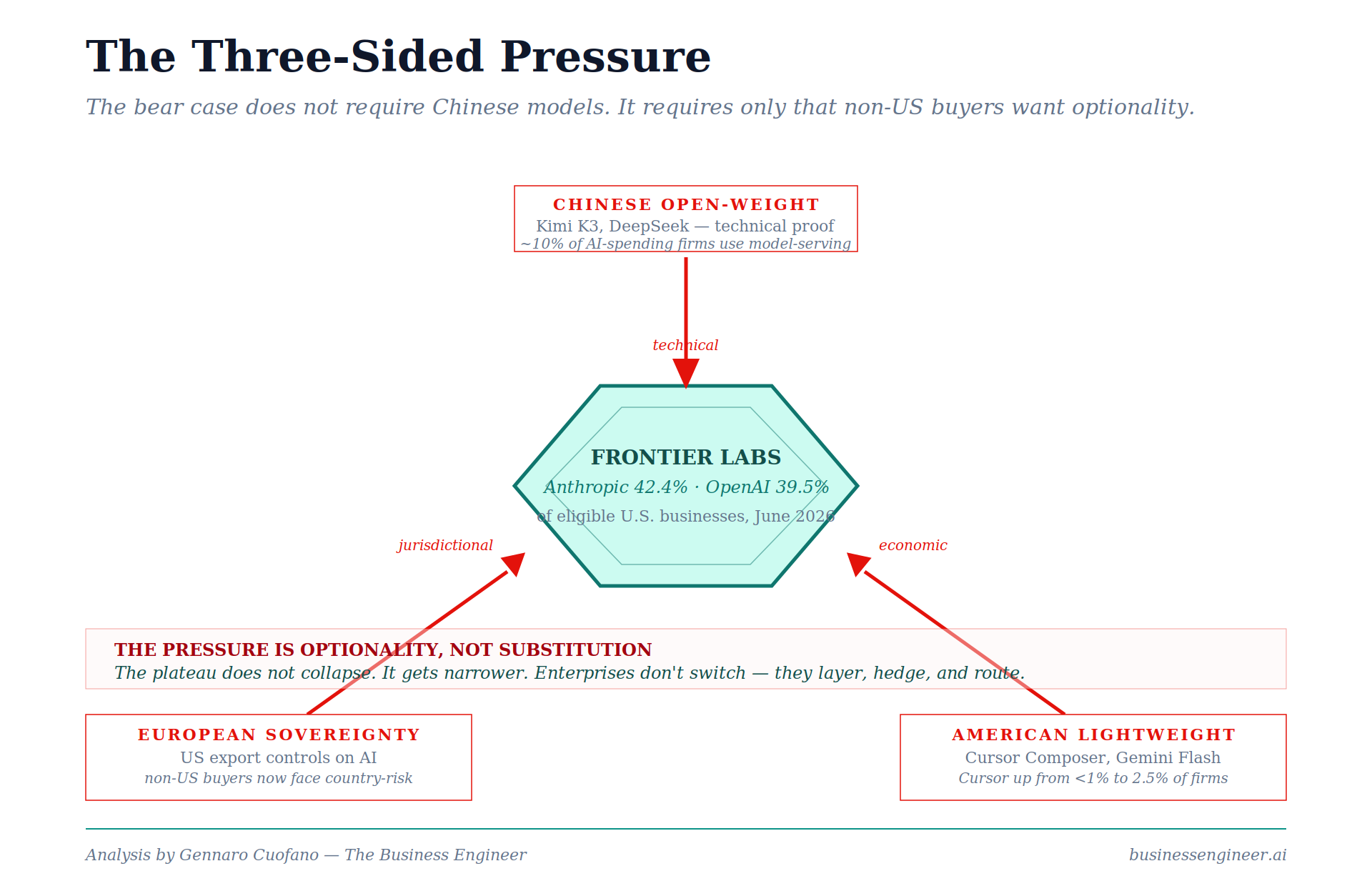
This is the real bear case for the American model duopoly, and it doesn’t require Chinese models to be technically excellent, or even widely adopted. In Ramp’s own data, model-serving platforms — the category that would include self-hosted Kimi K3 or DeepSeek deployments through Fireworks, Baseten, Together, OpenRouter — sit at about ten percent of AI-spending firms. Chinese models specifically are a small share of that ten percent. That share is growing, but it is not yet meaningful in the median enterprise’s stack. Ara was clear: firms are not switching away from OpenAI or Anthropic. Even the firms adding open-weight or Chinese models are continuing to grow their spend on the American frontier. It’s addition, not substitution.
But that’s the current picture. The sovereignty concern doesn’t require substitution to bite. It only requires that European buyers, and other non-US enterprises, want optionality. Optionality is a hedge, not a switch. And it shows up in the wallet as the pressure to be model-agnostic, jurisdiction-agnostic, and provider-agnostic — which is exactly the pressure that produces a Router.
Ara’s own bear case had a further move that I want to make sure lands. He was careful to note that the pressure on OpenAI and Anthropic does not need to come from Chinese models at all. American companies are launching their own lightweight, high-performance models. Cursor’s Composer model — Cursor’s in-house build on top of open-source foundations — is the clearest example. In Ramp’s data, spend on Cursor Composer has grown from under one percent of firms to about 2.5 percent, and it’s growing faster than spend growth on the frontier labs. Google’s Gemini Flash, another lightweight sibling model, launched fresh Flash iterations in the last several weeks and is being embedded into Search, Google Workspace, and enterprise routing scenarios. Neither Cursor nor Gemini Flash carries any of the regulatory or reputational headwinds of running a Chinese model in production. As Ara put it, “no one bats an eye if they hear you’re using Cursor.” No enterprise buyer has to explain to their board why they are self-hosting a model from a geopolitically inconvenient jurisdiction. Cursor is downstream of American infrastructure. Google Flash is Google. These aren’t sovereignty problems.
So the frontier labs face pressure from three directions at once. Chinese open-weight releases as a technical proof point. American lightweight competitors as an economic proof point. And European enterprise buyers as a jurisdictional proof point. Only the first is in the news. The other two are already in the wallet.
There is a further complication worth noting. Ara mentioned, almost in passing, that recent reporting suggests the Chinese government may be considering not releasing the open weights of the most powerful next-generation Chinese models. If that materializes — and it is speculative for now — then the technical pressure vector from the north weakens, and the jurisdictional pressure vector from Europe becomes proportionally more important. If China stops publishing its frontier, then the sovereign hedge for European enterprises stops being “Kimi K3 or DeepSeek at home” and starts being “European frontier models built via distillation.” Which brings us to distillation itself.
Both Ara and I spent a few minutes on this. A live open-weight release — even if you don’t have access to the very latest Fable frontier from Anthropic or GPT-6 series from OpenAI — combined with API access to a frontier model like Opus 4.8, allows a serious builder to bootstrap a substantial fraction of frontier capability through distillation. “You can bootstrap 40, 50, 60 percent of the frontier through distillation,” was roughly the framing. Not 100 percent. Not close to a Bitter-Lesson-defeating replica. But a substantial fraction, and one that gets meaningfully useful for many downstream tasks. Ara added that the specific innovations Kimi K3 publicizes — long-context attention, mixture-of-experts routing at high sparsity, low-precision quantization for serving — are almost certainly also being deployed inside the closed labs’ internal pipelines, we just don’t hear about them because there’s no incentive to publicize. The gap between what Kimi publishes and what Anthropic builds internally is probably smaller than the headlines suggest.
That last observation is worth pausing on. It’s a version of what I wrote about in The Kimi Delusion — the Publicity ≠ Novelty principle. What is visible in the discourse as a shock is often not a shock in the pipeline. Kimi K3 published techniques that closed labs may already be using. The publication is the news event. The technique is not.
The router as revealed strategy
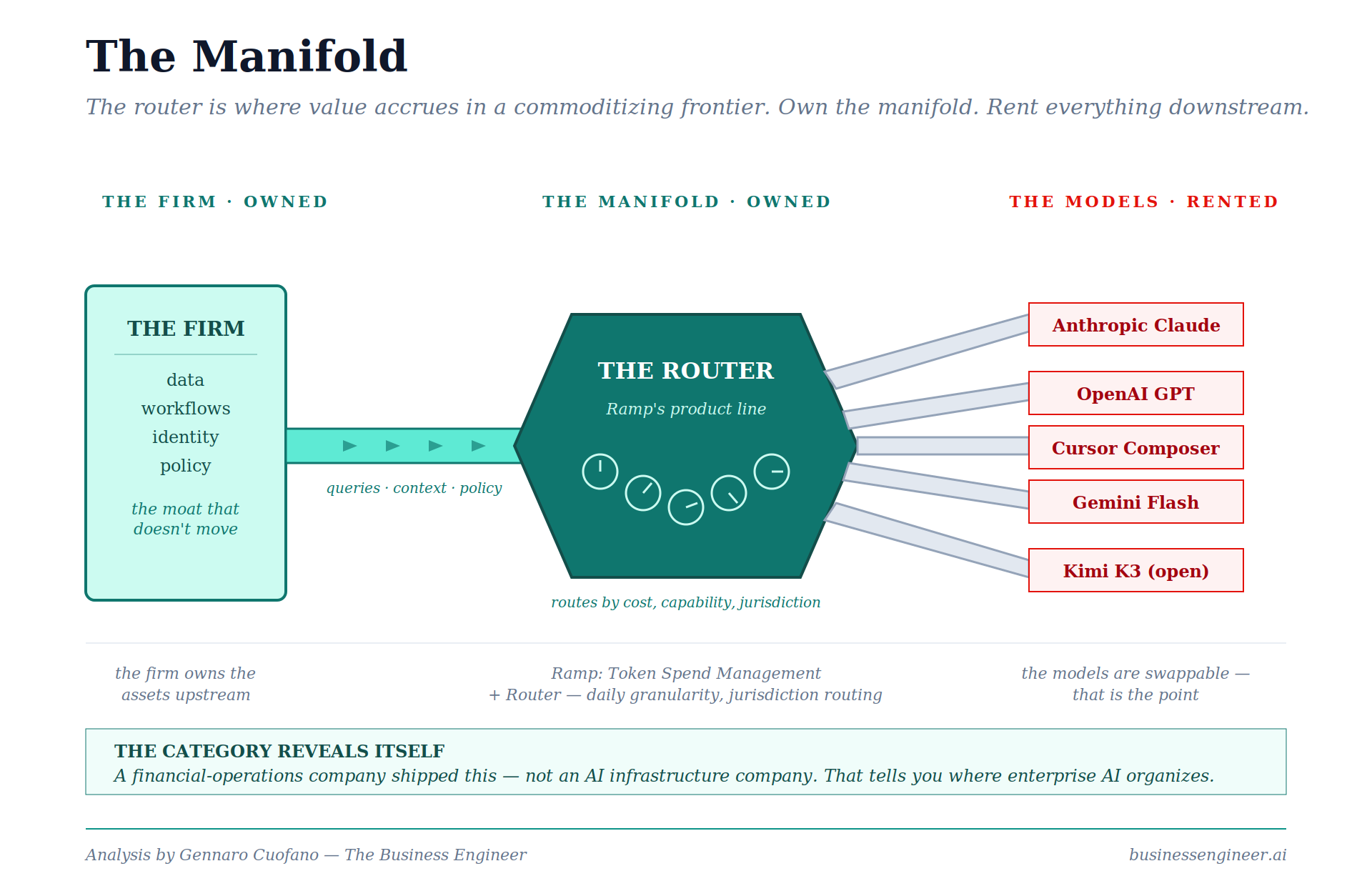
Which brings us to what Ramp itself is doing.
Two Ramp product moves stood out in the interview. The first was Token Spend Management — a product where firms connect their OpenAI and Anthropic APIs directly to Ramp so they can track their token spend at daily granularity, with recommendations for how to optimize it and alerts on runaway spend. The second was the Router — Ramp’s newer product for intelligent model routing across vendors, launched only a few days before the interview.
Both are, on the surface, financial-operations products. Ramp helps firms manage spend. Managing AI spend at the token layer is a natural extension of that. Fine.
But look at what they collect. Token Spend Management gives Ramp a daily-granularity dataset that reaches back to a firm’s historical AI spend before they even joined Ramp — the historical usage is pulled from the connected API rather than reconstructed from card statements. It captures contextual metadata that receipt-level card data cannot carry: fast mode versus thinking mode, per-user spend patterns, model choice by workload, per-endpoint routing. Ara was explicit that this will eventually become one of Ramp Economics Lab’s primary reporting datasets. Which means the payment layer is thickening. Ramp is moving from observing the transaction to sitting closer to the actual usage.
And the Router is even more revealing, because a Router only exists if you believe firms will genuinely want to swap models on the fly for cost, capability, or jurisdiction reasons. Ramp shipped it. Which is Ramp betting that model-agnosticism is not a hypothesis about how enterprise AI adoption might evolve. It’s a hypothesis about how it is evolving, right now, at scale. If the bet were wrong, Ramp — a public-market-scrutinized financial operations company, not a speculative AI startup — would not be building the product.
There is a corollary here worth naming. A router is a piece of infrastructure whose value increases as the frontier commoditizes. If Anthropic and OpenAI remain the only two credible general-purpose model vendors, a router is a nice-to-have. If Cursor Composer, Google Gemini Flash, open-weight Chinese releases, and eventually European sovereign models all become credible options for different workloads, a router becomes essential. The fact that Ramp — a financial operations company, not an AI infrastructure company — is the one shipping this suggests the router-as-a-category is where enterprise AI actually organizes itself. Not at the model layer. Not at the agent layer. At the routing layer.
This maps cleanly onto what I’ve been calling the Owned/Rented Barbell. Enterprises will own the capabilities they need to control — data, workflows, identity, routing decisions — and rent everything else. Frontier LLMs are rented. Open-weight inference is rented. What you own is the router that decides which one gets the query, when. And Ramp is now positioning to be that router for a meaningful slice of the mid-market.
A brief technical aside. The Router as a category is not new — LiteLLM, OpenRouter, Portkey, and a handful of others have been building versions of it for over a year. What is new is the distribution. Ramp has 70,000 businesses and $200 billion of annual spend flowing through its platform already. It is not competing for adoption from a cold start. It is inserting the router into a payment surface those firms already use. That is the same play the credit card networks made against wire transfer thirty years ago and the same play Stripe made against manual settlement fifteen years ago. Distribution beats capability when capability is close to commodity, and model routing is close to commodity. The wallet is telling us something about where the moats are moving.
The white-collar mistake
Two moments of counter-narrative honesty stood out toward the end of the interview. Both worth surfacing at length, because they are the parts of Ara’s thinking that most sharply diverge from the conventional AI-economics discourse.
The first was his frustration with the “AI creates jobs by building data centers” argument. His response was blunt and worth quoting close to the original phrasing. Data center construction creates construction jobs. Any construction creates construction jobs. Citing that statistic as evidence of AI’s economic benefit is, in his words, the kind of thing that “people kind of know is bullshit” — and it fuels bias against AI rather than defending it, because it looks like a scramble for justification. The public is not stupid. If the best case for AI’s economic benefit is the trench-digging at Stargate and the shed-building outside Phoenix, the case is not being made.
I want to sit with why this argument keeps getting made anyway. It is being made because the public case for AI’s ROI is not yet well-supported at the aggregate level. It requires firm-level data of exactly the kind Ara’s team has now published, but that data is very new — the paper came out on June 30, 2026 — and public discourse hasn’t yet metabolized it. Meanwhile, the boosters at the model companies and their equity-market allies need some number to point to. Data center construction is the number they can point to, so they point to it. Ara’s argument is that this is actively counterproductive: the number does not defend AI, it embarrasses AI. And the correct number to point to — that firms adopting AI intensely grow ten percent faster over two years — is now available, at least for the Ramp population. That should be the number.
The second moment was more surprising. Ara said, almost in passing, that AI might ultimately have a net negative effect on manufacturing employment, not white-collar work. Not because current models can do manufacturing tasks — they cannot. But because the same kind of automation compounding that has hollowed out manufacturing employment for the last fifty to one hundred years will continue, and AI is the next input into that compounding. Vision models get integrated into robotic assembly. Language models get integrated into supply chain routing. Agent frameworks get integrated into logistics planning. The manufacturing floor, over a five-to-ten-year window, is where the sustained automation gains will land. Meanwhile, the entire policy discourse is focused on white-collar displacement. Which is, at least in the current Ramp-Revelio data, not what is happening at high-intensity adopters. White-collar entry-level headcount is rising. What is happening quietly, in manufacturing, is not being measured with the same intensity because the discourse doesn’t demand it.
There’s a policy inversion here worth naming carefully. The white-collar layoff story is loud and, at the firm level, empirically weak. The manufacturing displacement story is quiet and, over any five-to-ten-year window, probably strong. The public conversation is calibrated to the wrong risk. And that mis-calibration will cost workers who are least positioned to be defended by the current discourse.
This is a point that lands even harder in a European context, which the conversation drifted into for a few minutes. Gennaro brought up his own recent travel across Italy — how European infrastructure, much of it built in the 1960s and 1970s, has visibly aged, and how the skill base for physically maintaining and rebuilding that infrastructure has partially been lost in a generation that trained heavily as knowledge workers. If AI’s real long-run effect is on physical work while European labor markets have de-industrialized, the mismatch between where the impact lands and where the workforce actually is could be worse in Europe than in the US. That is a distributional argument, not a productivity argument, and it belongs in the policy discourse much earlier than it currently is.
Small nimble, large learned, medium squeezed
There’s a subplot to Ara’s thinking that I want to lift out separately, because it doesn’t fit neatly into the sovereign or router threads but it maps onto something that has been showing up across recent BE editorial threads about the Uncaptured Enterprise.
Ara’s read on firm-size effects goes roughly as follows.
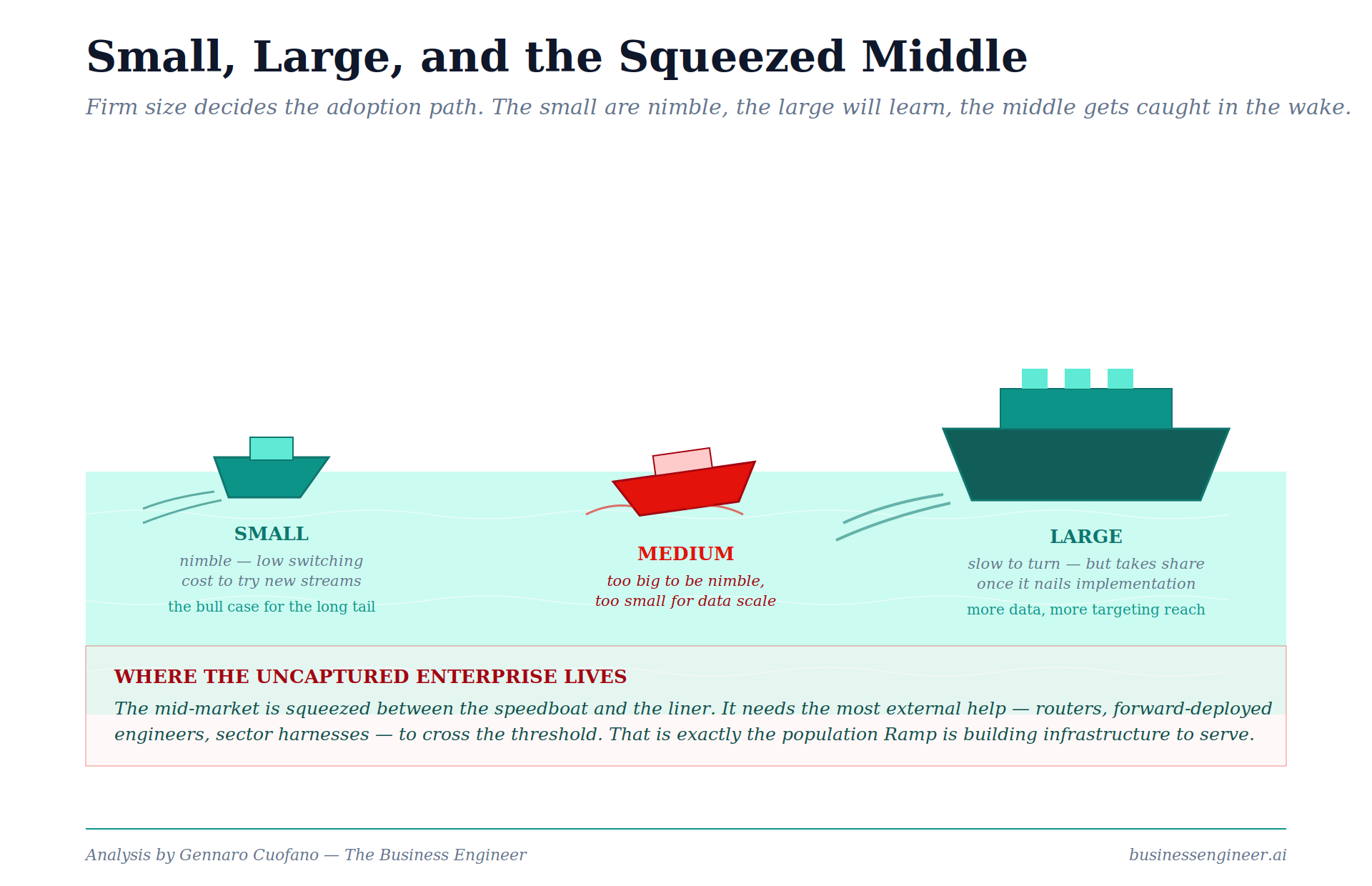
Small businesses have an unambiguous advantage in the current adoption window. They are nimble, they can experiment across models with low switching costs, their fixed cost of trying a new revenue stream is now dramatically lower because AI collapses the marketing, customer-support, and content-generation costs that used to be prohibitive at their scale. Ara referenced a Stripe statistic showing an exponential rise in solo businesses reaching the million-dollar revenue mark. Voice agents, targeted advertising generation, customer support automation — these are all things a solo operator can genuinely do now that were impossible three years ago. This is the bull case for the long tail. And it is showing up quietly in the wallet as small businesses with meaningful AI spend and no traditional enterprise-buyer profile.
Large enterprises face a harder starting condition but a bigger endgame. They cannot experiment as fast because their data governance, procurement processes, and integration surfaces make every AI implementation a nine-to-twelve-month project. But once they figure it out — and Ara’s framing here is important — they will take market share from smaller firms via more effective AI-driven marketing. Larger firms have more data, more customer segments to target, more owned distribution surface. Once they nail implementation, they use AI to run tighter marketing and sales at every touchpoint. Small businesses caught off guard by that will see revenue erosion even if they themselves are using AI, because the larger firm is using AI more comprehensively.
Medium firms are squeezed. They are too large to be nimble, too small to have the data or fixed-cost base that makes enterprise-scale AI implementation pay off. Ara did not spell this out as bluntly as I am, but it follows from his framing. The mid-market is where the Uncaptured Enterprise thesis lands hardest. This is the population that has neither the small-business nimbleness advantage nor the enterprise data-scale advantage and will need the most external help — routers, forward-deployed engineers, third-party governance layers, sector-specific harnesses — to cross the threshold.
If you are running strategy at a mid-market firm right now, this is the shape of the problem. And it maps onto what Ramp is quietly building infrastructure to serve.
The Map of AI Rewired
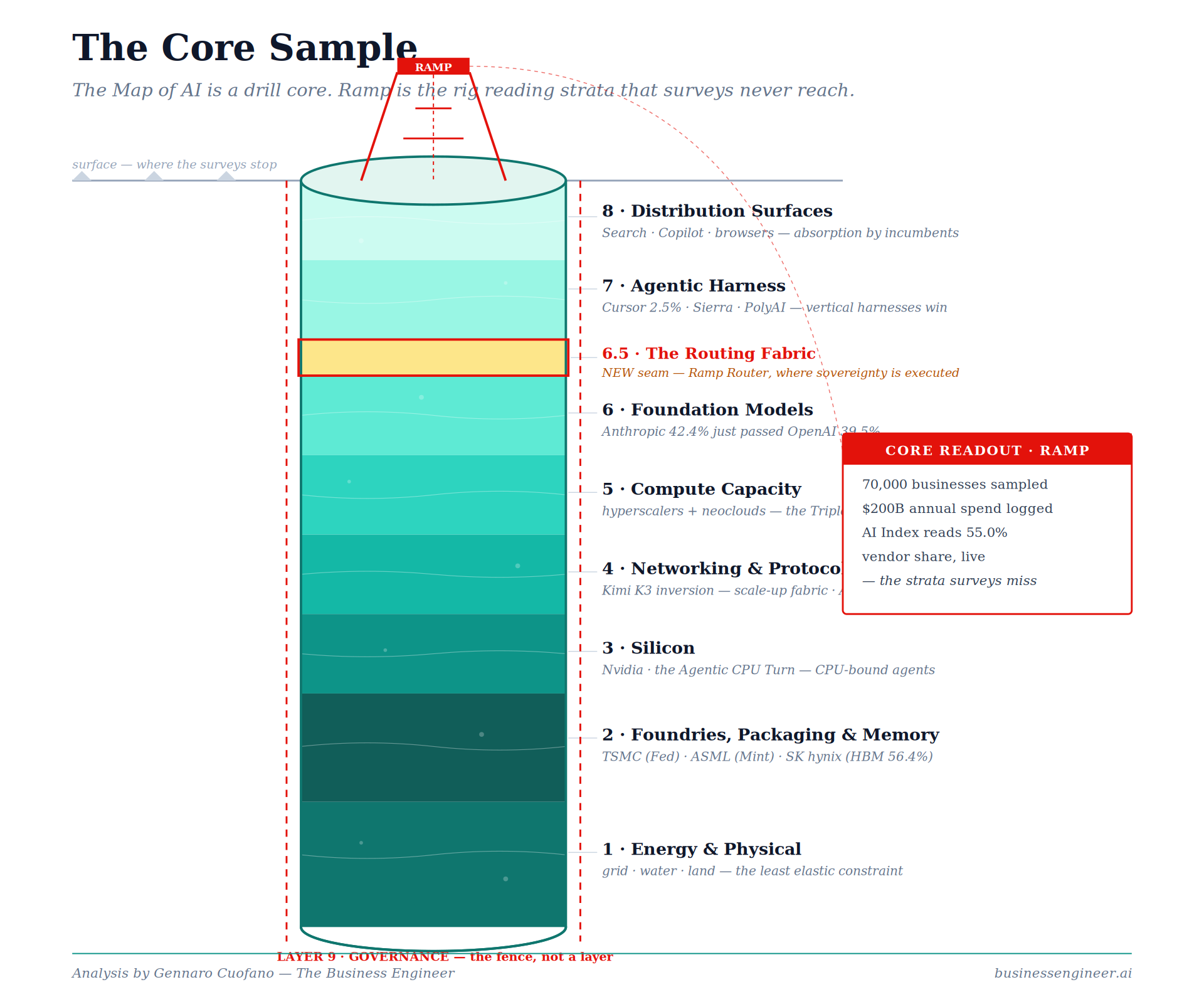
I want to zoom all the way out for a section. The Ramp interview lands in the middle of a broader mapping project I’ve been running through the Q2 2026 earnings and filings cycle. Nine layers, from the physical stack through governance. The map has been built one layer at a time — TSMC and ASML in The Fed and the Mint, SK hynix through the F-1 read, Nvidia and the Agentic CPU turn, Kimi K3 and the networking inversion, the Nadella-series coalitions, the June 13 kill-switch piece on the governance fence.
Ramp’s data does something none of those layers do individually. It anchors the demand signal that determines whether every capex commitment above it gets returned. Every hyperscaler capex commit, every TSMC HPC guide, every ASML EUV backlog, every SK hynix HBM ramp trades on assumptions about enterprise adoption downstream. Ramp is now the only public dataset with a live indicator of whether those assumptions are being met.
Let me walk the map layer by layer and update each layer’s thesis with what Ramp now shows.
Layer 1 — Energy & Physical
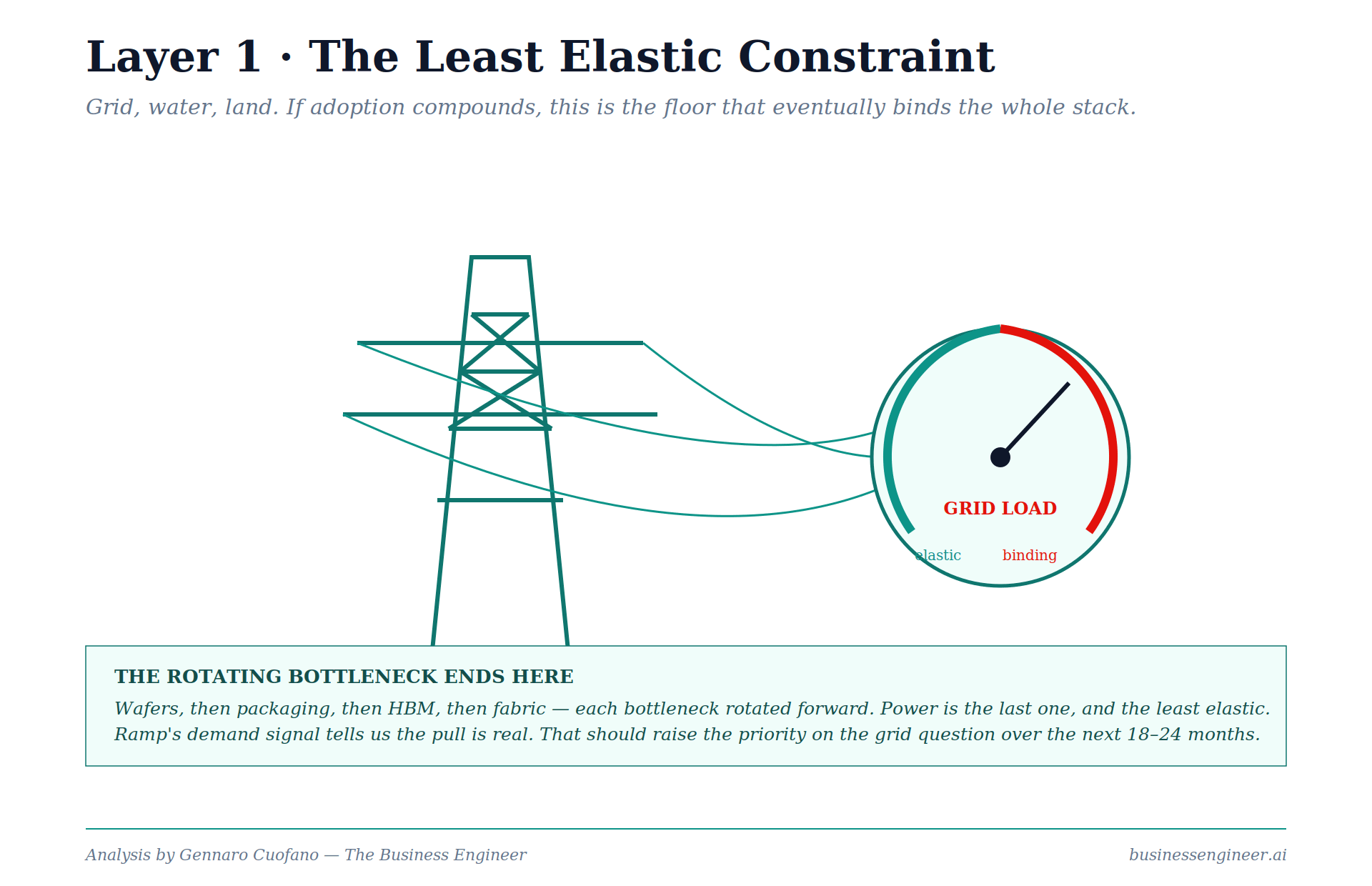
The foundation of the AI physical stack is power, water, and land. Layer 1 is the layer where enterprise AI adoption becomes physical constraint: every incremental token consumed at the Ramp population’s growth rate translates, eventually, into incremental grid draw. Ara didn’t discuss this layer directly, and it is the layer furthest removed from Ramp’s telemetry. But there is one specific link.
If Ramp’s per-employee AI spend series continues to compound at anywhere near the 13 percent month-over-month rate observed at peak, and if the model-serving inference share grows from ~10 percent of AI-spending firms toward 15-20 percent by end of 2027 — which is the current trajectory — then Layer 1 constraints on grid capacity, transformer supply, and water availability become the binding limit on the whole stack. This is the Rotating Bottleneck thesis from The Fed and the Mint playing out. Wafer supply was the bottleneck. Then advanced packaging. Then HBM yields. Then networking fabric. And eventually power, which is the least elastic of all these constraints and the one where the political economy fights are loudest.
Ramp’s data tells us the demand pull is real. That should adjust priors on how urgent the power question is over the next 18-24 months.
Layer 2 — Foundries, Packaging, and Memory (TSMC · ASML · SK hynix)
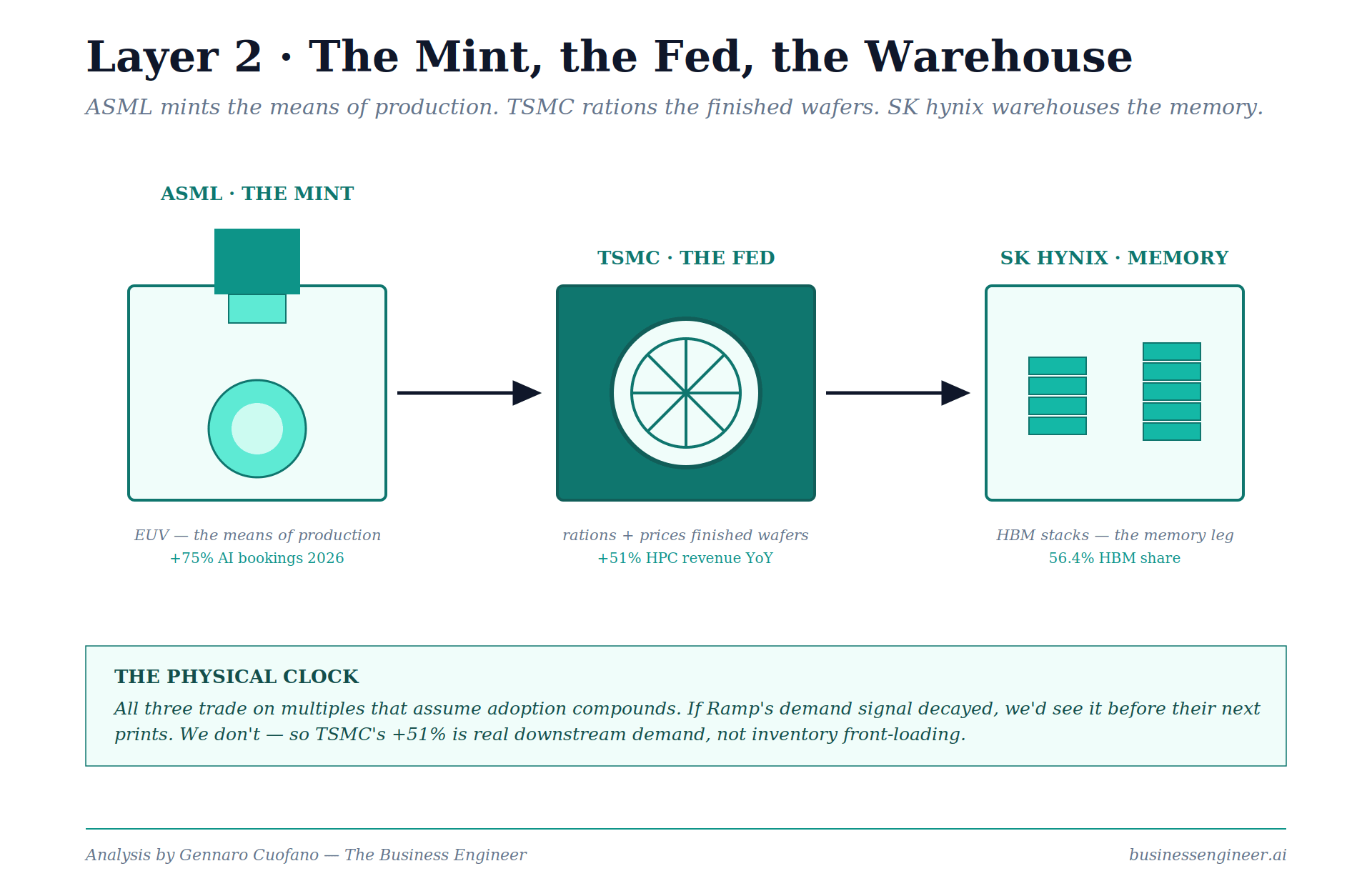
In The Fed and the Mint, I laid out TSMC as the Federal Reserve of AI (Layer 2b, allocates finished wafers, prices, rations) and ASML as the Mint (Layer 2a, produces the physical means of chip production). Both are trading in mid-2026 at multiples that assume enterprise AI adoption compounds. Ramp is now the honest broker on whether that assumption is being met.
Three specific reads.
TSMC’s High-Performance Computing revenue growth in Q2 2026 came in at +51% year-over-year, with AI accelerators contributing the majority. Two ways to read that number. Either it reflects genuine downstream demand, or it reflects a small number of hyperscaler front-loaded orders that will decay when the buildout matures. Ramp’s data now weighs in. Enterprise AI adoption is not decaying. Ramp AI Index moved from ~46 percent in January 2026 to 55 percent in June — an 8-9 percentage-point rise in six months, with Anthropic’s line accelerating rather than plateauing. If enterprise demand were decaying, we would see it in Ramp before TSMC’s next earnings. We don’t. Which means TSMC’s Q2 number is unlikely to be inventory front-loading. It reflects real downstream demand, and the next four quarters should extend the trend.
ASML’s +75 percent AI-related bookings for 2026 depend on the same downstream chain. If enterprise adoption compounds through 2026-2027 at anything like the current rate, ASML’s guide is comfortable. If it stalls, ASML has 6-9 months of visibility before customer pushouts show up in bookings. Ramp is now the leading indicator of that pushout event. The Q2 print gives us a snapshot. The monthly Ramp updates give us a live gauge.
SK hynix, the third piece of the Layer 2 physical stack, filed its F-1 on June 24, 2026 with numbers that quantified the memory leg of the story. Q1 2026 revenue W52.6 trillion (~$34.5 billion), up 198 percent year-over-year. HBM at 56.4 percent global market share. DRAM at 77.3 percent of Q1 sales. FY2025 adjusted EBITDA margin 62.9 percent. Top customer 23.9 percent of 2025 revenue (almost certainly Nvidia). This is what the peak of the memory leg looks like at peak revenue-per-wafer.
Ramp’s contribution to the SK hynix thesis is quiet but important. The model-serving inference cohort in Ramp’s data — the firms spending $248 per employee per month at the median, 23× the median AI spender — is precisely the population that consumes the most memory-heavy inference workload. Every firm that crosses from chat-subscription-only to model-serving is a firm that pushes demand into SK hynix’s order book, indirectly through hyperscaler and cloud-provider procurement. The share of Ramp’s population in model-serving is growing. That translates into HBM demand with a 6-12 month lag.
Layer 2 is the layer where the Three Clocks framework from The Fed and the Mint runs hardest. Physical clock: TSMC/ASML/SK hynix building at the pace of concrete and optics and clean-room capacity. Financial clock: hyperscaler capex-financing through debt-heavy structures like Oracle’s neocloud stack. Efficiency clock: Kimi K3 and distillation and MXFP4 quantization compressing the workload footprint. Ramp adds the Adoption Clock — the pace at which enterprise demand actually materializes. If the adoption clock keeps pace with the physical clock, Layer 2 is validated. If it stalls, Layer 2 is over-built. Ramp is the honest broker on whether the four clocks are in sync.
Layer 3 — Silicon (Nvidia and the Agentic CPU Turn)
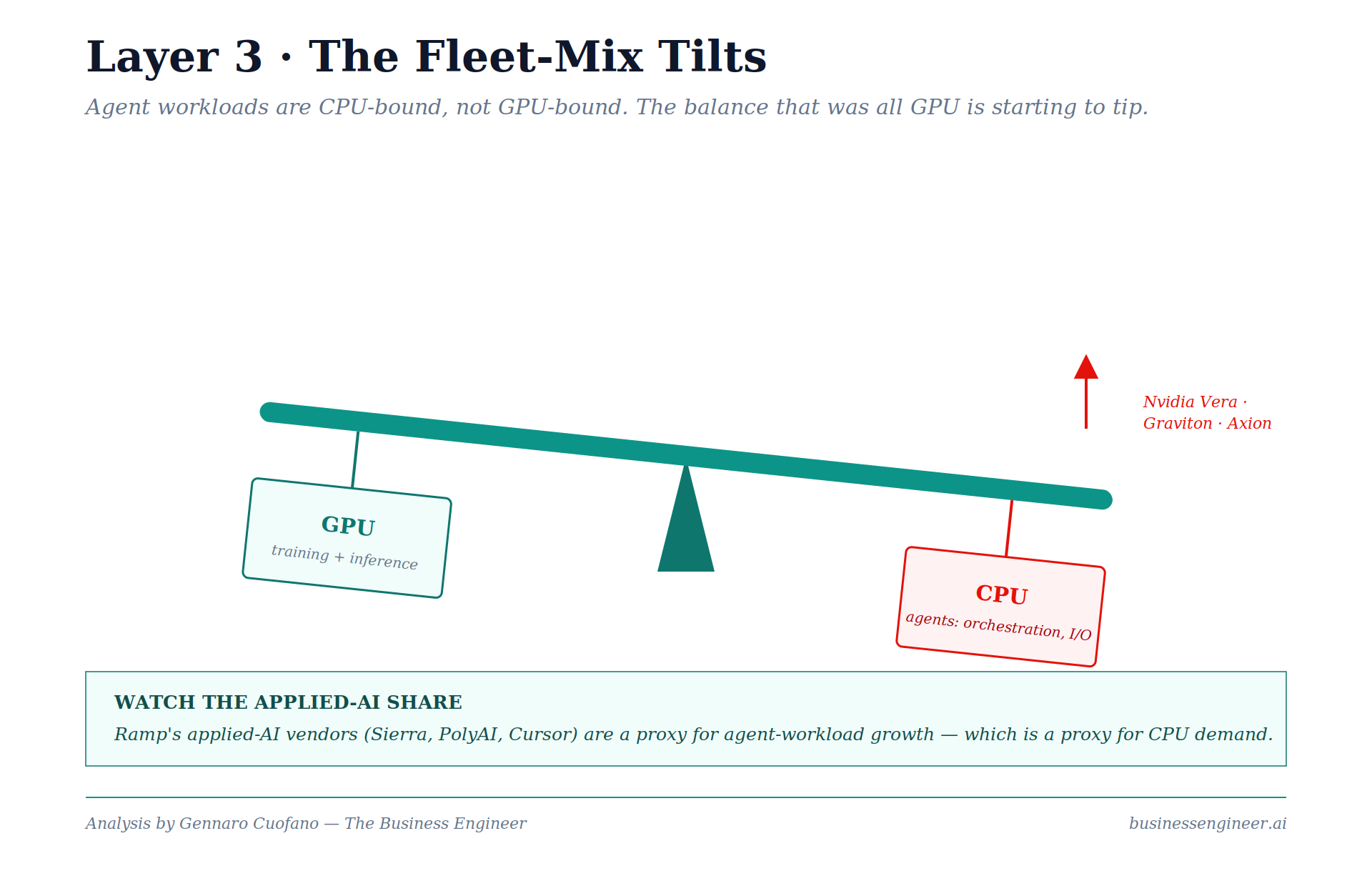
Layer 3 is where the wafers become chips. Nvidia dominates. AMD and hyperscaler-custom silicon compete for the fraction Nvidia doesn’t lock in. And the Agentic CPU Turn — Nvidia Vera launched May 31 as the “CPU for agents,” Graviton5, EPYC Venice, Google Axion, Microsoft Cobalt, Arm’s AGI CPU — is the underappreciated 2026 story: agent workloads are CPU-bound, not GPU-bound, and the fleet mix problem is emerging as the Supercycle’s first phase mismatch.
Ramp’s data touches this layer in one specific way. The growth of forward-deployed engineer roles and agent-implementation categories in Ramp’s vendor share — Sierra and PolyAI (voice agents), Cursor Composer (coding agents), Granola (notetaking) — is a leading indicator of agent-workload growth. Agent workloads, unlike inference workloads, are dominated by orchestration, tool-calling, memory management, and I/O. That is CPU work, not GPU work. Which means the AI adoption pattern Ramp is measuring is quietly biased toward workloads that will pressure Layer 3 silicon manufacturers in a specific direction: more CPU capacity, more high-bandwidth memory, more efficient scale-up interconnect.
The read for Layer 3 investors: watch Ramp’s applied-AI vendor share separately from its model-serving share. Applied AI is a proxy for agentic workload growth, which is a proxy for CPU demand in the fleet mix. If applied AI compounds faster than model-serving through 2026-2027, the CPU-turn thesis strengthens.
Layer 4 — Networking & Protocols
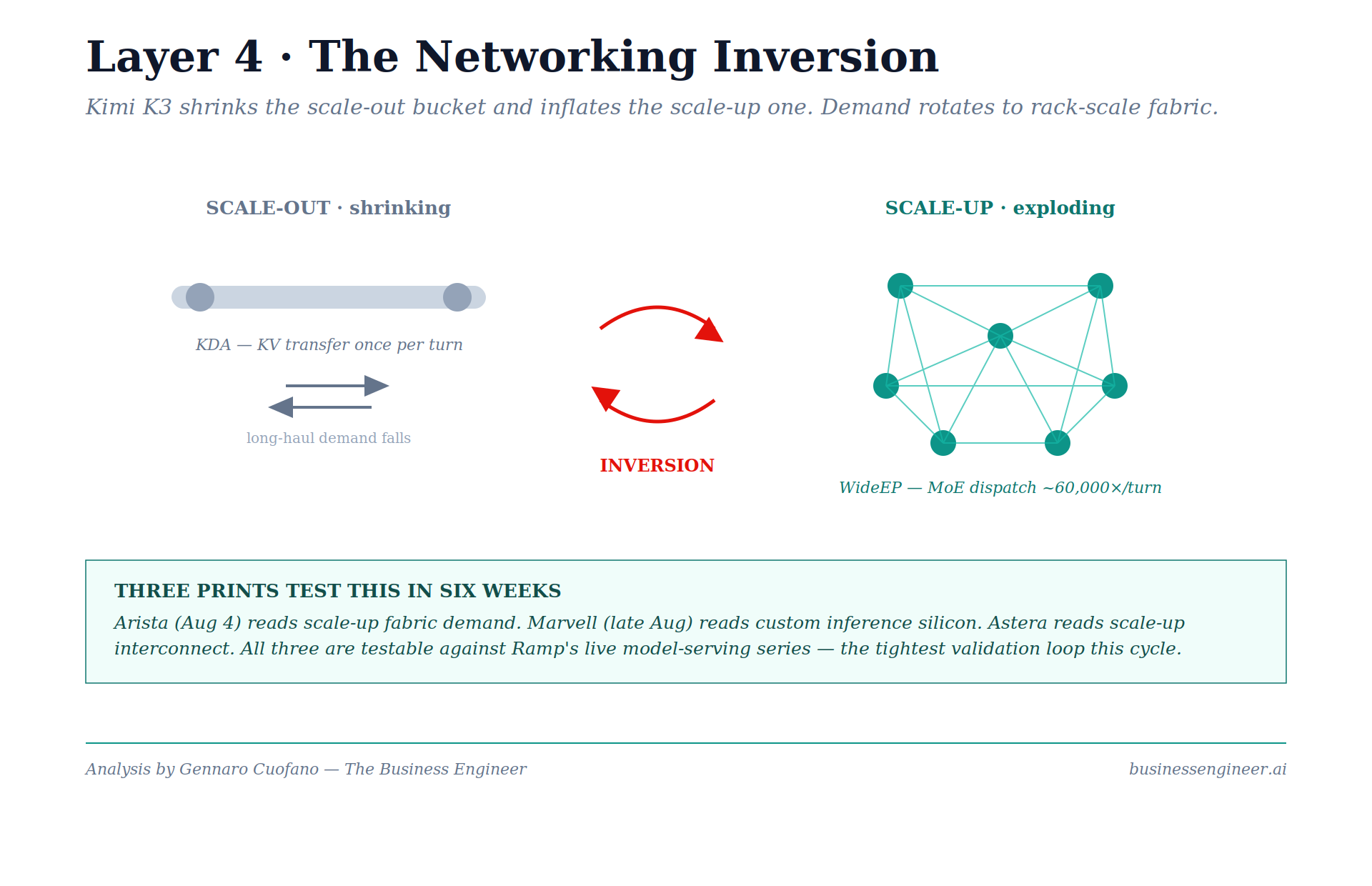
The Kimi K3 piece framed the Networking Inversion as the deepest structural mechanism revealed by the K3 release. KDA (KV-attention decomposition) cuts scale-out KV transfer to once per turn, but WideEP (mixture-of-experts dispatch/combine) runs approximately 60,000 times per turn on scale-up all-to-all fabrics. K3 shrinks the scale-out bucket and inflates the scale-up bucket. The consequence: demand rotates from long-haul networking toward rack-scale fabric.
Ramp’s data doesn’t touch this layer directly. But the model-serving inference series is the leading indicator for it. Enterprises running open-weight or hybrid workloads on their own inference infrastructure demand exactly the scale-up fabric Kimi K3’s architecture requires. If Ramp’s model-serving growth compounds, expect the demand signal to reach the networking layer with a 3-6 month lag.
Two specific catalysts worth watching in the Q2 2026 earnings cycle:
Arista Networks reports on August 4. Arista is the cleanest public read on data center scale-up fabric demand. If Ramp’s model-serving spend is running hot, Arista’s guide should validate the networking-inversion frame. If Arista disappoints, either enterprises are staying on hyperscaler-managed inference (bearish for standalone networking) or Ramp is over-representing the tech-forward tail (bearish for the frame).
Marvell prints in late August. Custom silicon for hyperscaler inference is directly downstream of the same demand signal Ramp shows. Marvell’s guide will read on how much of the model-serving load is running on custom silicon versus Nvidia-standard configurations.
Astera Labs, the pure-play scale-up interconnect company, prints slightly later. If K3’s networking inversion is playing out, Astera should show acceleration.
Three networking prints in six weeks, all testable against Ramp’s live model-serving series. That is the tightest empirical validation loop the Map of AI has produced this cycle.
Layer 5 — Compute Capacity (Hyperscalers and Neoclouds)
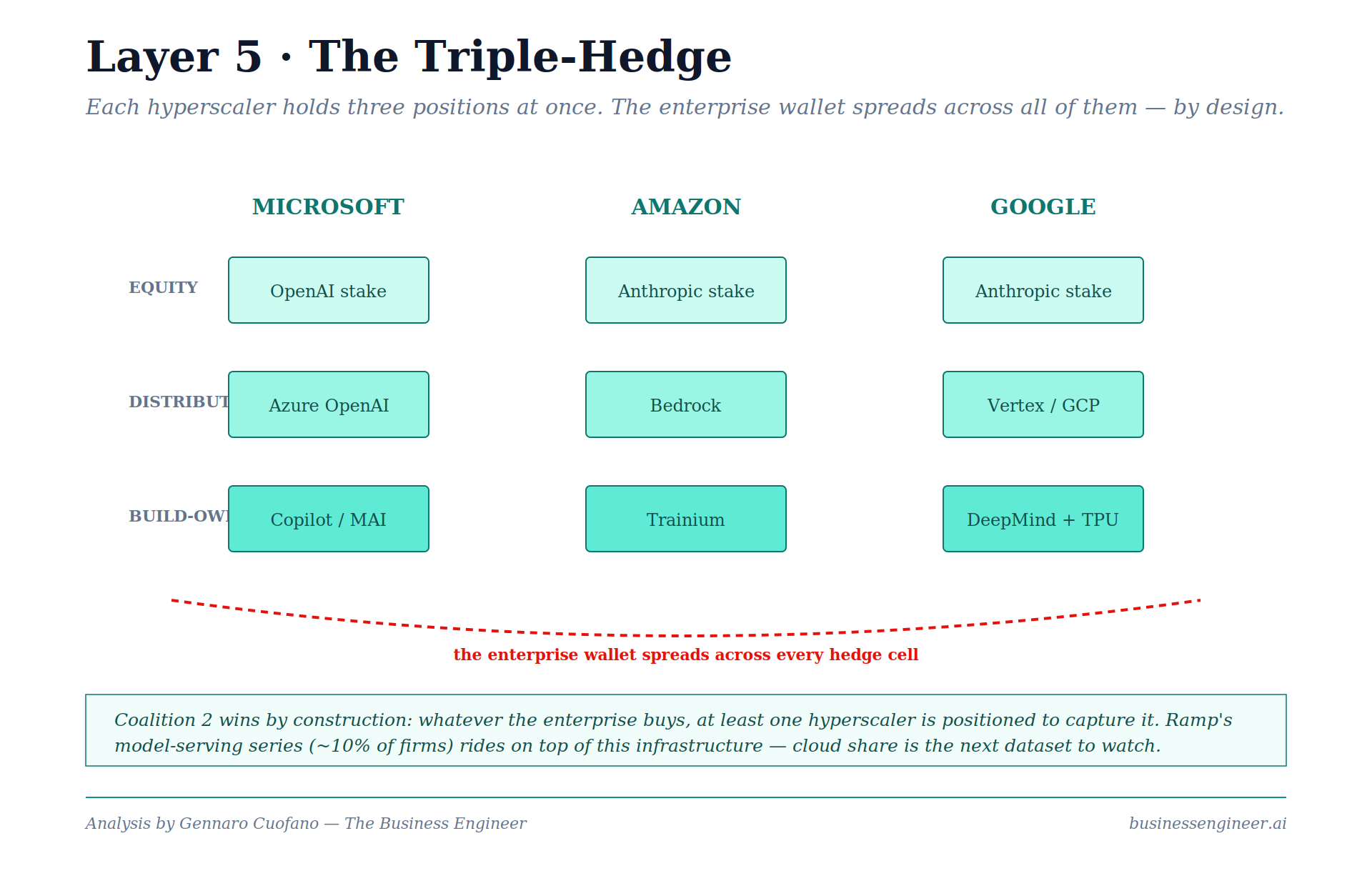
Layer 5 is where the physical stack becomes the compute-service stack — AWS, Azure, Google Cloud, Oracle, and the emerging neocloud tier (CoreWeave, Nebius, Crusoe, and others). The Nadella-series Coalition 2 (Enterprise Infrastructure Alliance) frame from the Five C’s Definitive piece maps this layer as the political battleground where enterprise buyers negotiate for portability and against lock-in.
Ramp’s data enters this layer through the vendor-share on cloud infrastructure. The Spend Index shows Cloud Computing as a distinct category that has been rising steadily since mid-2025. But Ramp doesn’t yet publish hyperscaler-level share within Cloud Computing. That is the next dataset I’d expect Ramp Economics Lab to publish, and it will be immediately consequential: it will let us see whether AWS, Azure, or GCP is winning share of the enterprise AI wallet independent of what each hyperscaler discloses in earnings.
For now, the read is indirect. Ramp shows model-serving platforms at ~10 percent of AI-spending firms. Those model-serving platforms sit on top of hyperscaler infrastructure (mostly AWS and Azure at present, Google GCP catching up on the Gemini side). Growth in model-serving translates into growth for whichever hyperscaler each platform runs on.
The Hyperscaler Triple-Hedge from the Nadella series is worth invoking here. Microsoft holds an equity stake in OpenAI, a distribution deal on GPT via Azure, and a build-your-own capability through Copilot. Google holds Anthropic equity, distribution via Google Cloud, and DeepMind internal. Amazon holds Anthropic equity, distribution via Bedrock, and Trainium. All three hyperscalers are structurally hedged across the model layer. What Ramp’s data tells us is that the enterprise wallet is spreading across all these hedge positions simultaneously — which is exactly what the hyperscalers architected. Coalition 2 is winning by construction.
Layer 6 — Foundation Models
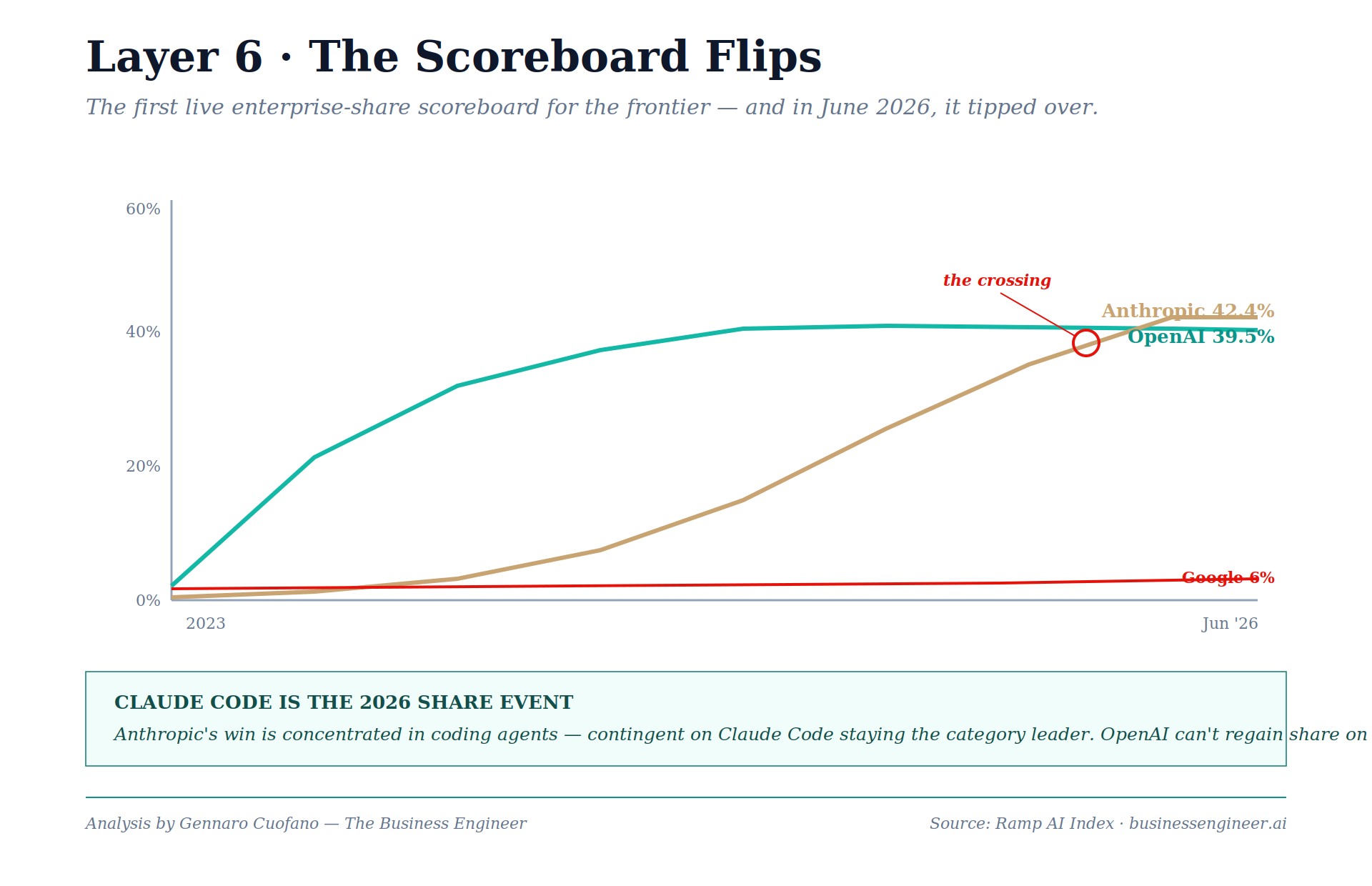
Ramp’s most transformative contribution to the map is here. For the first time, we have a live enterprise-share scoreboard for the frontier labs.
Anthropic at 42.4 percent of eligible businesses. OpenAI at 39.5 percent. Google at 6 percent. xAI trace. DeepSeek negligible. That is the mid-2026 shape of the enterprise-AI vendor market. And it is not what most analyst reports were forecasting six months ago. The market had assumed OpenAI’s lead was durable and expanding. Ramp shows the lead has narrowed and, in June 2026, tipped over.
Four implications for Layer 6.
Claude Code is the enterprise-share event of 2026. Anthropic’s acceleration is not evenly distributed across the model layer. It is concentrated in developer tooling, and Claude Code is the specific vector. Enterprise adoption of coding agents on subscription — Ramp’s second-widest wallet stratum — is where Anthropic’s growth is coming from. This is not a general-purpose model win. It is a category-specific win in the highest-value enterprise workload. Which means Anthropic’s dominance is contingent on Claude Code remaining the coding-agent category leader. If Cursor Composer, Codeium, or a new open-weight alternative displaces Claude Code specifically, Anthropic’s enterprise share becomes vulnerable.
OpenAI’s plateau at ~40 percent means the enterprise share is finite in the near term, and the two frontier labs are approaching a stable duopoly split. The next 5-10 percent share war will happen either in specific verticals (customer service, marketing, sales) or via the lightweight competitors like Cursor Composer that don’t sell against the frontier directly. OpenAI cannot regain share on the current product portfolio. It needs a Claude-Code-equivalent category win in a workload where it does not currently lead.
The Chinese models are not the story yet. Ramp’s data says this clearly, and it is worth repeating because the discourse got it wrong. Model-serving platforms carry Chinese weights, and that’s ~10 percent of AI-spending firms. Chinese models specifically are a small share of that. The July 17 chip selloff catalyzed by K3 was not driven by any observable enterprise-adoption shift. Ramp confirms the Kimi Delusion thesis from the demand side.
The two-speed frontier plays out through observer-dependence. The Depth Stack piece framed AI customization as a five-layer stack (Prompt / Context / Behavioral / Weights / Architecture) whose ground shifted in mid-2026 via three signals: Kimi K3 open-frontier release, Karpathy joining Anthropic pre-training, continual learning as candidate paradigm. Ramp’s data confirms that the depth stack looks different from different observer positions. American enterprises operate at the top of the stack (prompt/context/behavioral) and rent everything below. Chinese enterprises operate deeper (weights/architecture) but with narrower distribution. European enterprises, without a domestic frontier lab, occupy the arbitrage position: open Chinese weights + American infrastructure + European sovereignty framing. The wallet reveals which observer position each enterprise has chosen.
Layer 6.5 — The Routing Fabric (a newly-named layer)
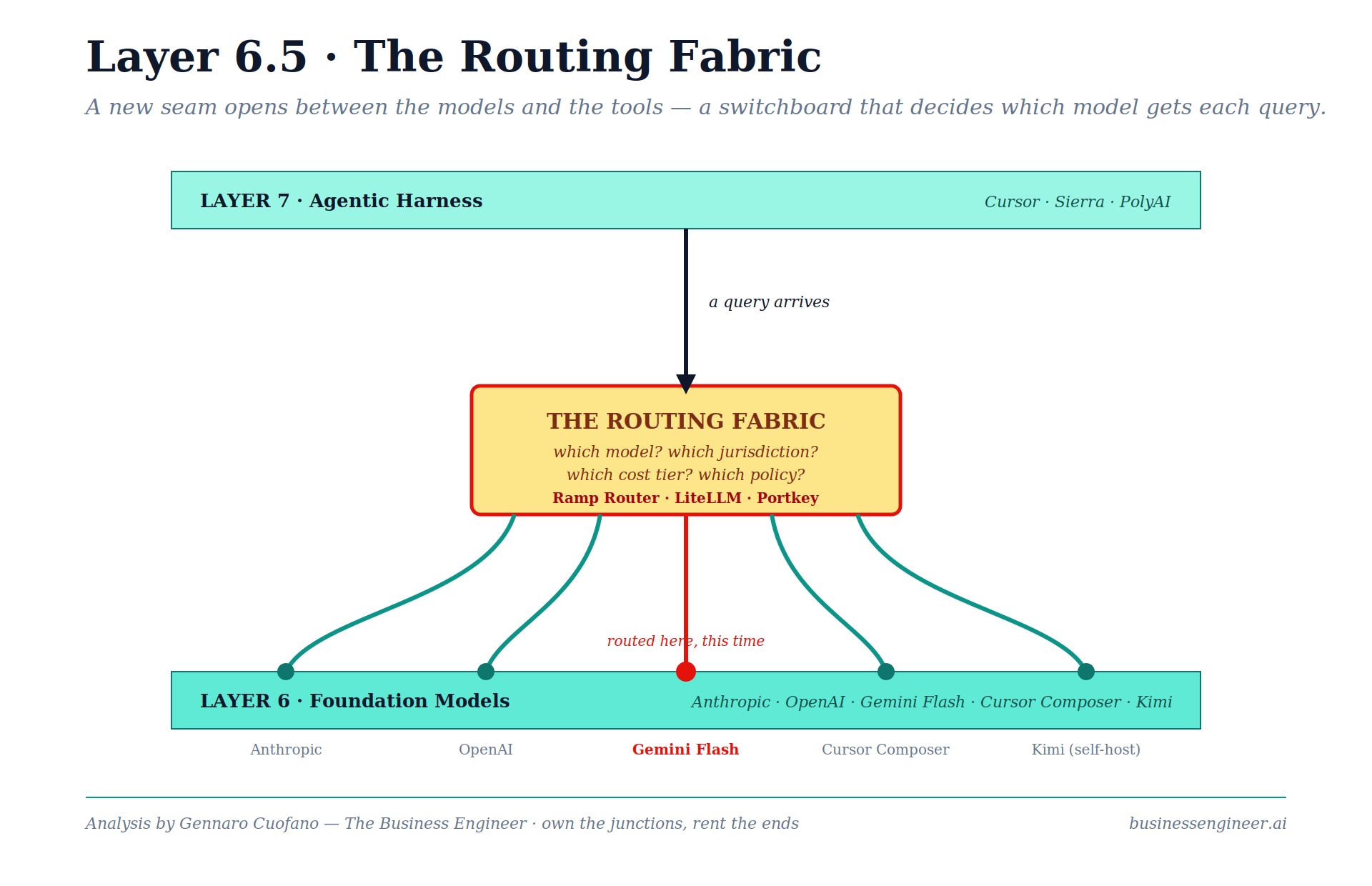
Ramp Router forces me to add a half-layer between Foundation Models (Layer 6) and Agentic Harness (Layer 7). Call it the Routing Fabric.
Routing has existed as a technical function for over a year — LiteLLM, Portkey, OpenRouter, plus internal routing built into most agent frameworks. What is new in mid-2026 is that routing has become a category with distribution advantages and enterprise buyers ready to purchase it as a distinct product. Ramp Router is the flagship of this category emergence.
The Routing Fabric sits at the layer where multi-vendor decisions get made. Which model handles this query? Which jurisdiction can host this data? Which cost tier applies? Which policy governs? These decisions used to be embedded inside individual application code. They are now becoming externalized to a routing platform because the number of viable models, jurisdictions, cost tiers, and policies has grown large enough that per-application logic is unmaintainable.
Three things follow.
The Routing Fabric captures the most defensible position in the enterprise AI stack. Model prices commoditize. Serving infrastructure commoditizes. Even agent frameworks, over time, commoditize. But the routing decision — which model, which jurisdiction, which policy, for which query — captures the firm’s data-governance, cost-optimization, and compliance logic all at once. That is where the moat lands. This is the Own the Junctions, Rent the Ends principle from the Nadella-series making an explicit appearance.
The Routing Fabric is where sovereignty concerns actually get implemented. The Sovereign Turn is not implemented at the model layer (models are what get routed) or at the serving layer (serving hosts what’s already been routed). It is implemented at the routing layer, where the decision “route this query to a US model or a European alternative” gets executed at runtime. Every European enterprise that takes sovereignty seriously will end up building or buying a routing fabric. Which is why Ramp shipping a Router now is not opportunistic — it is timing-perfect.
The Routing Fabric will be contested. Hyperscalers are building their own routers (Bedrock’s model-choice layer, Azure AI Foundry’s routing capabilities, Vertex’s model garden). Independent routers (LiteLLM, Portkey, OpenRouter) will compete on capability. Payment platforms (Ramp) will compete on distribution. Governance platforms (compliance-first vendors) will compete on policy. Expect this layer to see the most vendor-count expansion of any layer on the map through 2027, and expect the winners to be determined by distribution and by which vertical stack (Coalition 1, 2, or 3) each vendor is aligned with.
Layer 7 — Agentic Harness
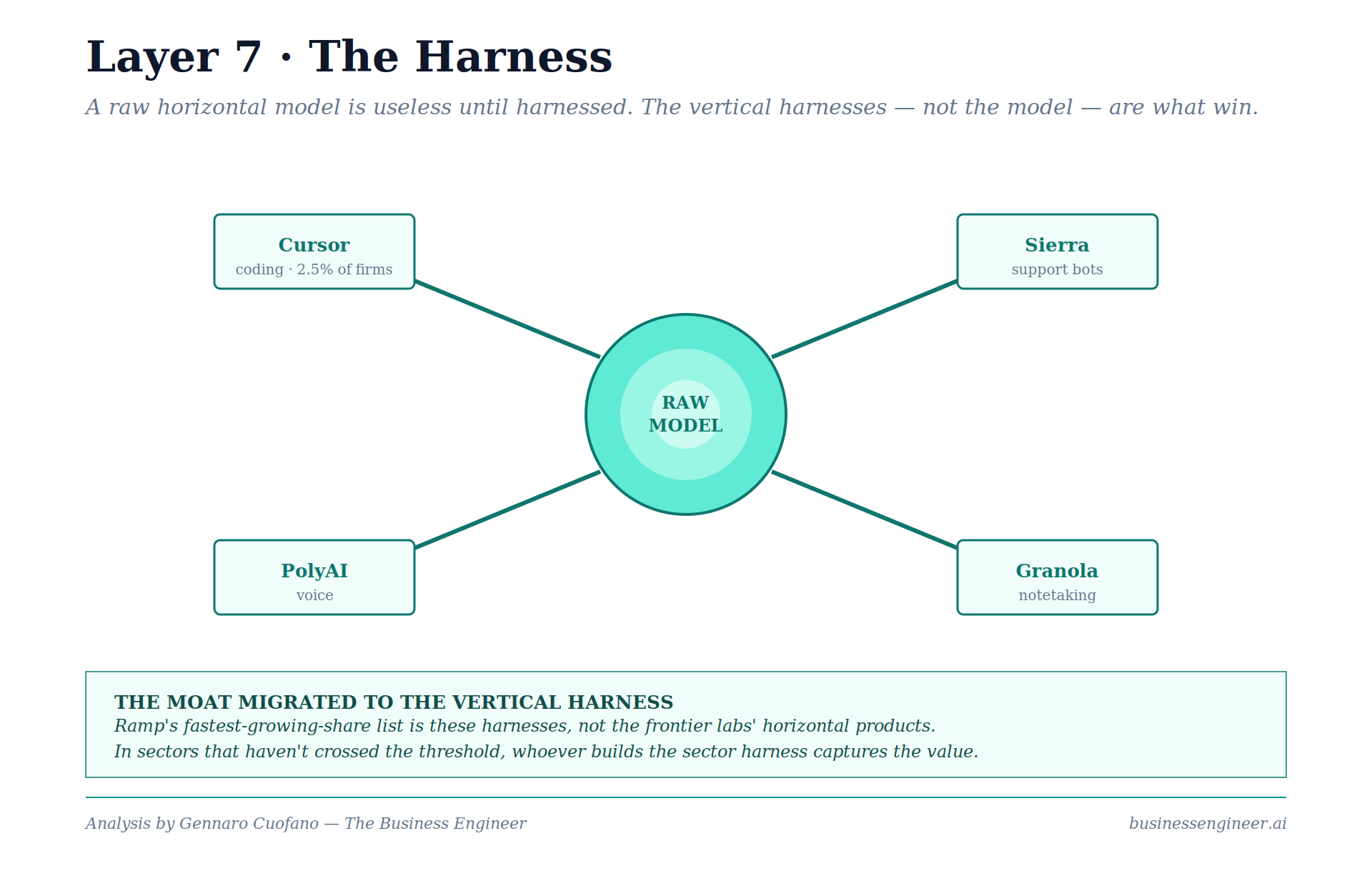
Layer 7 is where models become useful applications. Cursor, Sierra, Granola, PolyAI, Higgsfield — the applied-AI ecosystem. Ramp’s Top Software Vendors table for July 2026 puts these companies in the fastest-growing-share list, which is a live proof of the Uncaptured Enterprise thesis: the frontier labs’ horizontal products are being displaced (at least in specific verticals) by sector-specific harnesses that solve the integration problem the frontier can’t.
Two specific reads.
Cursor Composer is the enterprise-share dark horse. From under 1 percent to 2.5 percent of firms in a period where the frontier labs grew from ~35 percent to 55 percent aggregate share. Cursor’s growth rate is faster than the frontier labs’ growth rate. If that continues, Cursor becomes a serious enterprise-share competitor within 18 months. And Cursor sits inside the American ecosystem, so it doesn’t carry sovereignty concerns. It’s the natural hedge for a European buyer who wants American infrastructure without frontier lab lock-in. Cursor is the specific vendor most likely to benefit from both the Sovereign Turn and the middle-manager compression — because Cursor is exactly what an IC-plus-AI workflow looks like when the middle-manager translation layer is thinned out.
Applied AI is the layer where sector-specific harnesses emerge. PolyAI (voice/support), Sierra (support bots), Granola (notetaking), Higgsfield (video) — these are the beginnings of the vertical harness ecosystem the Uncaptured Enterprise thesis has been anticipating. In sectors that haven’t yet crossed the adoption threshold — healthcare, construction, retail, manufacturing — the vendors that build sector-specific harnesses will capture disproportionate value because they solve the integration problem that the horizontal frontier labs cannot.
This is the Harness Theory frame from the Open Harness thesis playing out in real time in the Ramp vendor data. The moat has migrated from models to harnesses, and now the harnesses that are winning are the vertical ones, not the horizontal ones.
Layer 8 — Distribution Surfaces
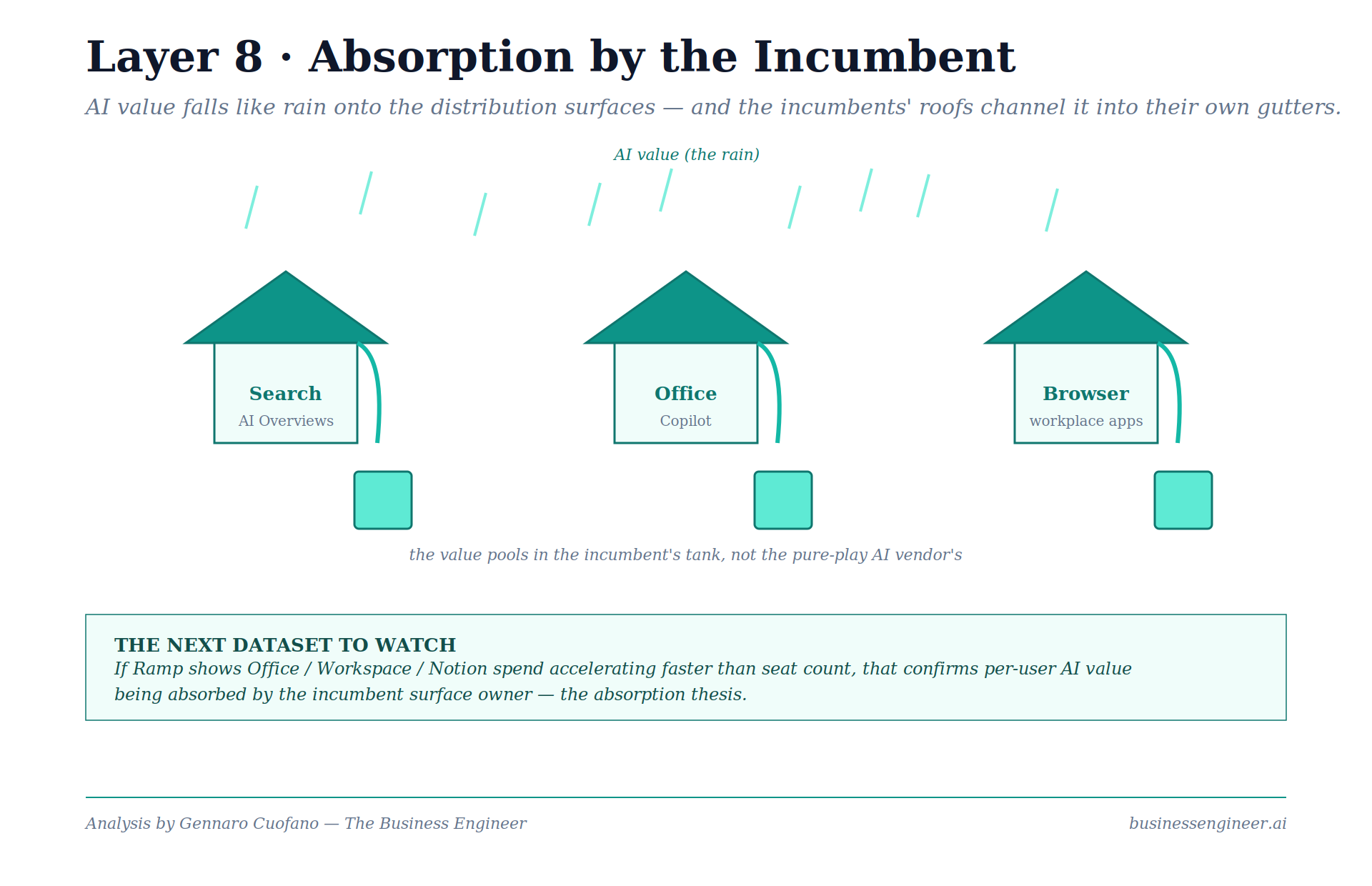
Layer 8 is where AI reaches end users. Search, browsers, operating systems, workplace applications — Google Search with AI Overviews, Microsoft Copilot in the Office surface, Apple Intelligence, ChatGPT’s own consumer surface, Perplexity, Anthropic’s Claude.ai.
Ramp’s data doesn’t directly measure Layer 8 consumer distribution. It measures enterprise wallet, which is Layers 6-7 primarily. But there is an indirect signal worth naming: the vendor-share data on productivity applications. Microsoft Office/Copilot spend, Google Workspace spend, Slack (now Salesforce) spend, Notion, Airtable — all of these are Layer 8 surfaces increasingly with AI embedded. If Ramp’s data starts to show enterprise spend on Office/Workspace/Notion accelerating faster than seat-count growth, that’s a signal that per-user AI-embedded value is being priced and paid for. That would confirm the Distribution Surface Absorption thesis — that AI value at Layer 8 gets absorbed by the incumbent distribution surface owners rather than by pure-play AI vendors.
This is worth watching closely. Ramp Economics Lab has not yet published a per-user Layer 8 telemetry series, but it is the natural next dataset. Once they do, the Layer 8 competitive picture becomes measurable in real time.
Layer 9 — Governance (the Fence, Not the Ceiling)
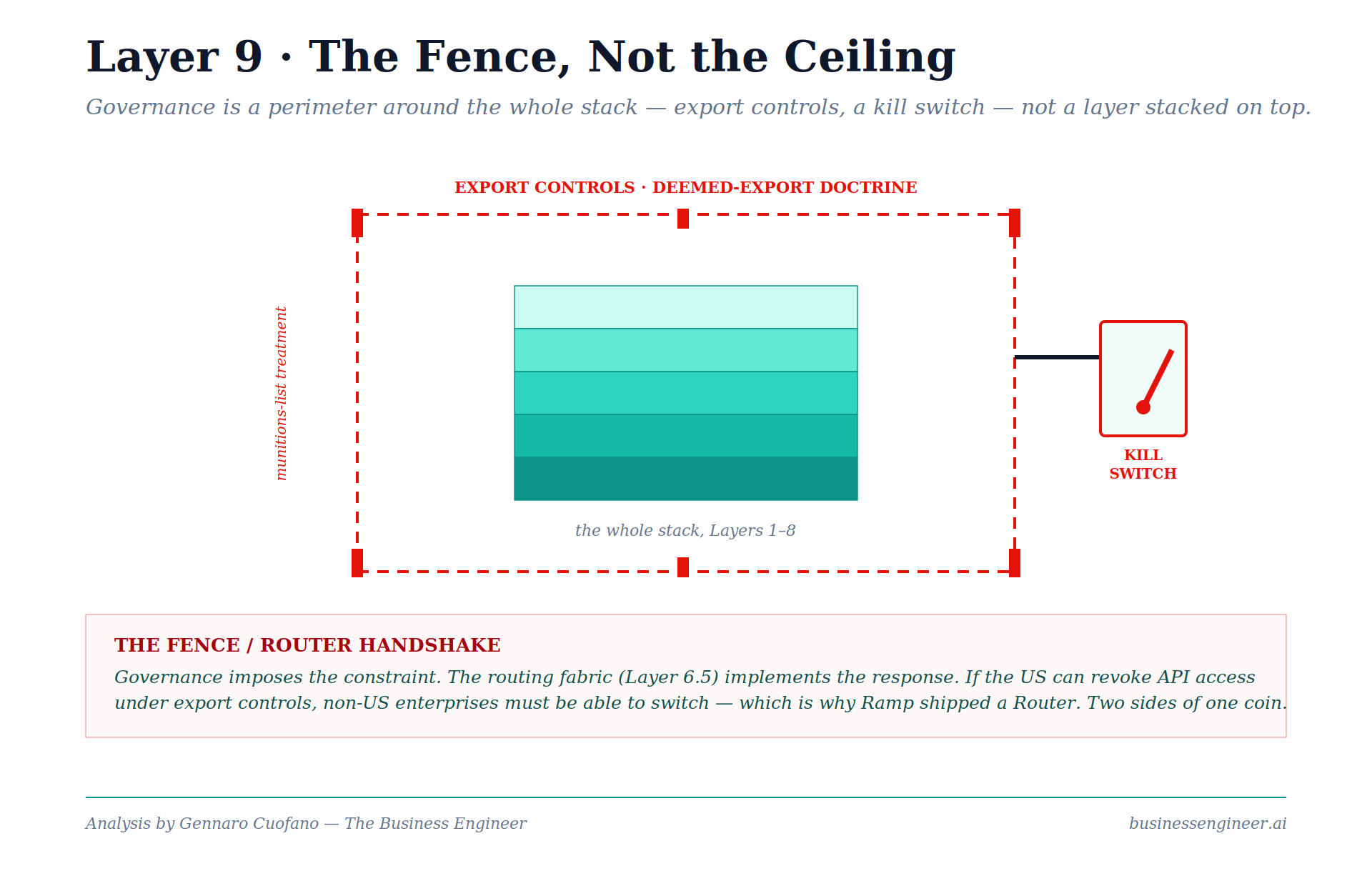
The June 13, 2026 piece The Geopolitics of AI Has a Kill Switch established the governance layer as a fence around the stack, not a ceiling on top of it. Export controls on frontier models, deemed-export doctrine applied to model weights, munitions-list treatment of certain capabilities, atomic-energy-style dual-use restrictions on inference infrastructure. These are governance mechanisms operating at Layers 1-8 simultaneously.
Ramp’s data has one specific implication for Layer 9. The Sovereign Turn — Ara’s unprompted geopolitical frame — is the demand-side response to the Layer 9 fence. If the US governance apparatus can revoke API access to frontier models under export controls, then non-US enterprises must build routing fabrics that let them switch to non-US models. Which they are now doing. Which is why Ramp shipped a Router.
The fence and the router are two sides of the same coin. Governance imposes the constraint. The routing fabric implements the response. That is the Layer 9/Layer 6.5 handshake, and it is now measurable in the wallet.
One further note. In the Regime-Agnostic Enterprise piece from the Nadella series, I laid out the survival playbook for enterprises operating under coalition warfare between governance regimes. Ramp’s data confirms that playbook is being executed, at least by the tech-forward Ramp population. The regime-agnostic enterprise is not a hypothetical. It is what the wallet-level data shows enterprises becoming.
The Fourth Clock — The Adoption Clock
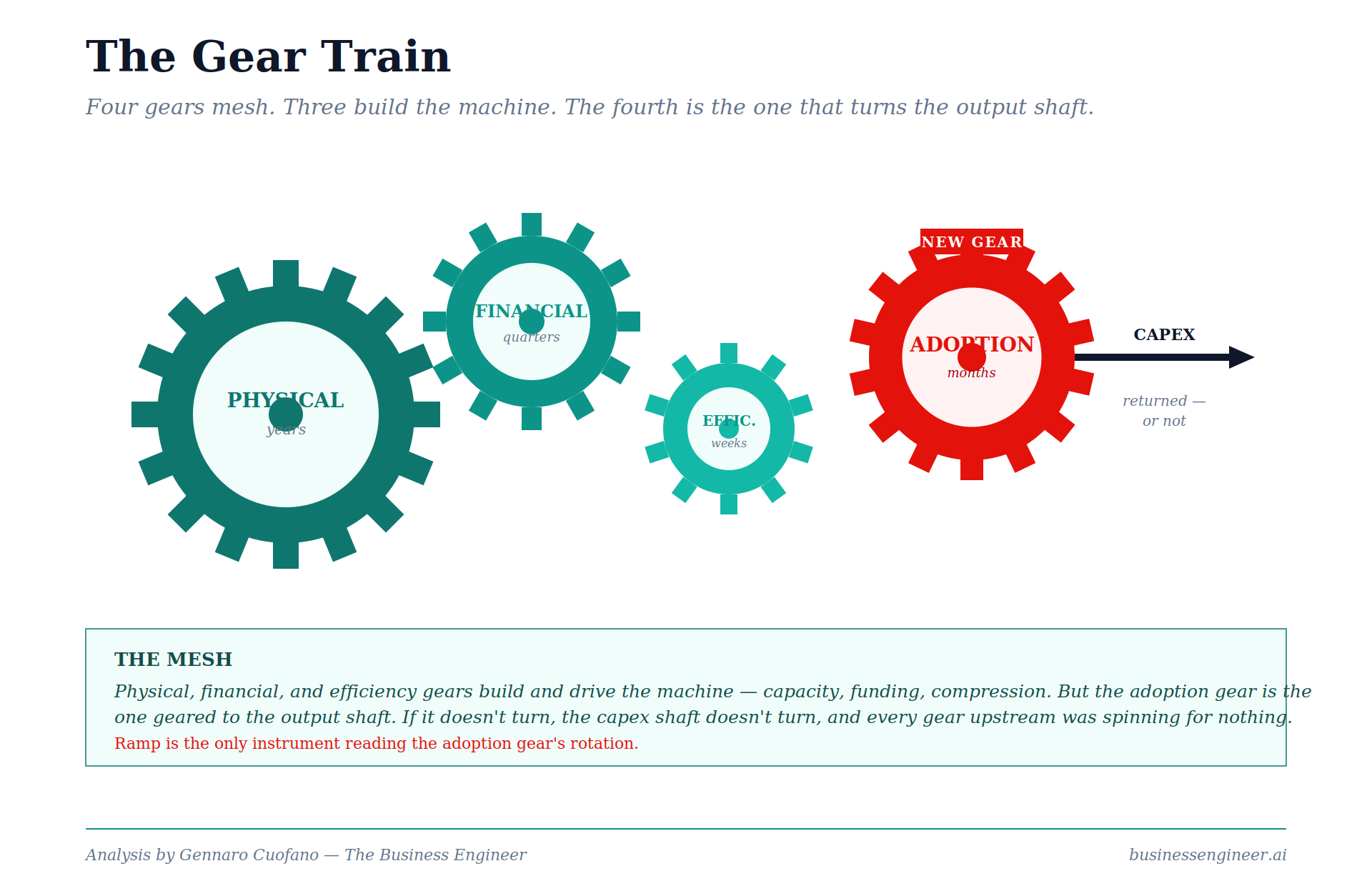
In The Fed and the Mint I laid out three clocks running against the same underlying capex cycle. The physical clock (TSMC, ASML, SK hynix — the pace of concrete, optics, clean rooms). The financial clock (hyperscaler debt-funded capex, neoclouds, Oracle-style intertwinings). The efficiency clock (Kimi K3, distillation, MXFP4 quantization compressing the workload footprint).
Ramp forces a fourth clock to be named. Call it the Adoption Clock.
The Adoption Clock runs at the pace of enterprise decision-making. It is measured in months for individual firms and quarters for cohorts. It is neither the pace of concrete nor the pace of Kimi. It is its own axis, and it determines whether the physical clock’s capex gets returned.
Four possible synchronization patterns:
In-sync (base case, current data). Adoption clock, physical clock, financial clock, efficiency clock all compounding at rates that mutually validate. Enterprise adoption grows fast enough to consume the compute capacity the physical clock builds. Physical capacity grows fast enough to meet enterprise adoption. Financial capacity funds the physical buildout. Efficiency compresses the workload footprint faster than adoption expands, keeping the physical clock from over-building. This is the world Ramp’s June 2026 data describes. Everyone wins.
Adoption stalls (bear case, unrealized). Enterprise adoption plateaus before the physical clock’s capex is paid back. Hyperscalers over-build. Nvidia demand softens. TSMC HPC guides come down. This is the Kimi-Delusion-as-actual-catalyst scenario. Ramp’s job is to detect this early. Currently no sign of it.
Adoption accelerates past physical (bull case, partially realized). Enterprise adoption grows faster than the physical stack can accommodate. Prices rise. Capacity queues form. Governance interventions accelerate. This is the world of 2023-2024 in miniature, but now measurable. If Ramp’s per-employee spend series compounds through 2026-2027 at anything like the 13 percent MoM peak Ara mentioned, this becomes the operating regime.
Efficiency clock outpaces adoption clock (Kimi-Delusion long-tail). Compression from K3, distillation, and quantization outruns the demand-side expansion. Per-token costs collapse faster than per-firm usage expands. Model economics improve for enterprises but revenue growth at the frontier labs plateaus. This is the scenario that makes the frontier labs squeeze even without adoption stalling. The Regime-Agnostic Enterprise is the beneficiary; frontier lab margins are the loser.
Ramp is the honest broker on which of these four scenarios is actually playing out. Watch the monthly updates. Watch the model-serving series specifically as the divergence indicator between adoption growth and efficiency-driven cost compression.
The Sovereign Layer — A Named Axis Across All Layers
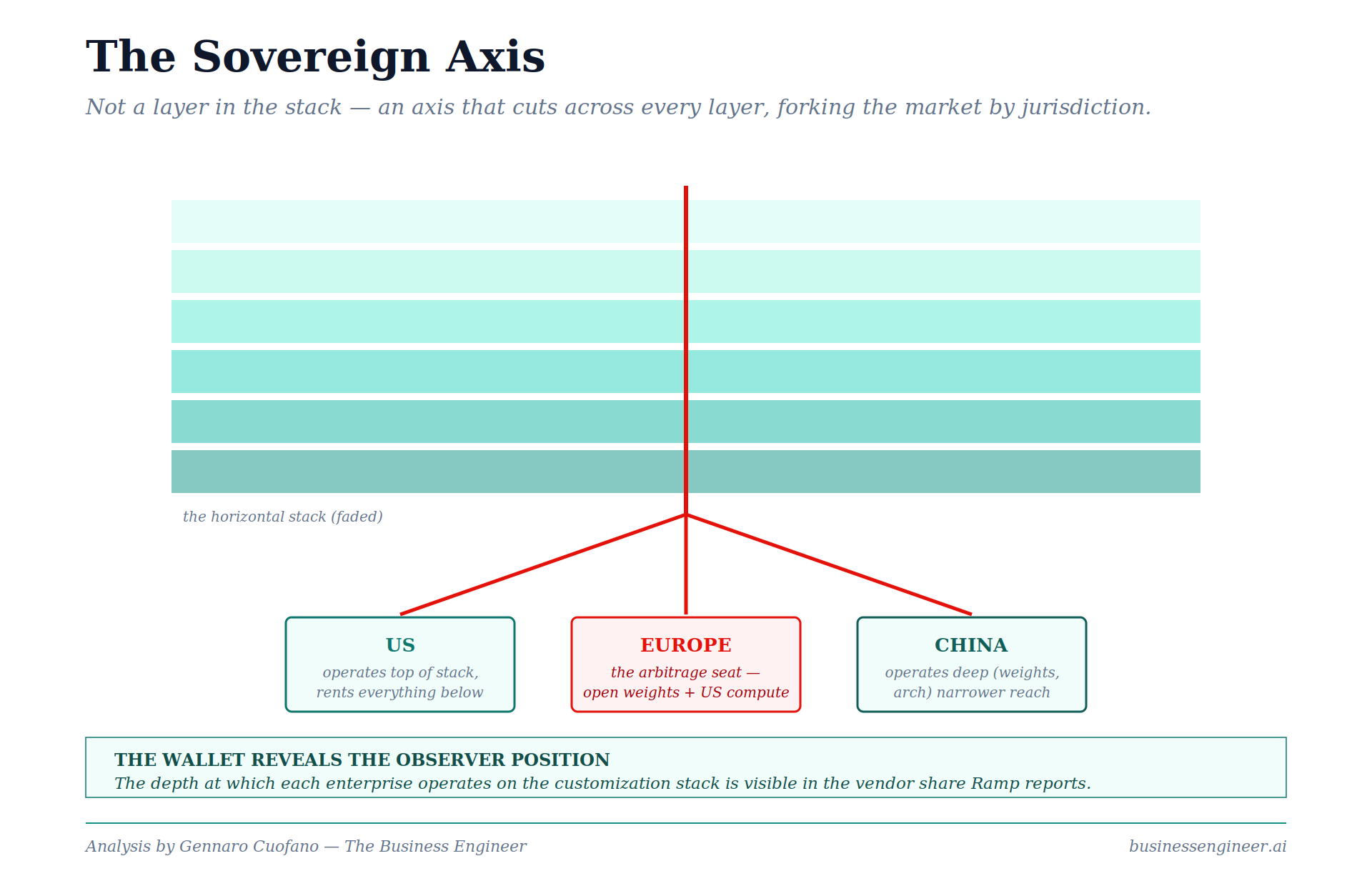
The Sovereign Turn is not a layer in the vertical stack sense. It is a demand-shaping force that operates across every layer, and it will increasingly determine which enterprises choose which vendors independently of technical or cost considerations.
Three things it does across the map.
It splits the model-layer market (Layer 6). US frontier labs face a de facto ceiling on non-US enterprise adoption, because non-US buyers now have to underwrite export-control risk. That ceiling may not be visible in mid-2026 data — it takes time to show up — but it is now real. Watch European enterprise Anthropic/OpenAI adoption specifically over 2027 for the ceiling to become visible.
It creates a European-model-vendor opening (Layer 6, Layer 7). European enterprises will demand sovereign options, and the sovereign options do not currently exist at scale. Whoever fills that gap over 2027-2028 will capture a rapidly growing wallet. Mistral, Stability, and one or two yet-to-emerge European frontier labs are positioned. Distillation from open Chinese weights combined with European infrastructure is the specific technical path. The Depth Stack piece names this as the European arbitrage — open Chinese weights + American compute + European sovereignty framing.
It elevates the routing layer (Layer 6.5). If sovereignty concerns force multi-vendor multi-jurisdiction stacks, the routing decision becomes even more valuable. Which is exactly the position Ramp just moved into.
The Sovereign Turn is not new to my thinking — it was implicit in the Regime-Agnostic Enterprise piece from the Nadella series. What is new is that Ara said it out loud, from inside Ramp, in the same conversation where Ramp announced a Router product. The frame and the product line up too cleanly for the frame to be dismissible.
Where Ramp Sits on the Map
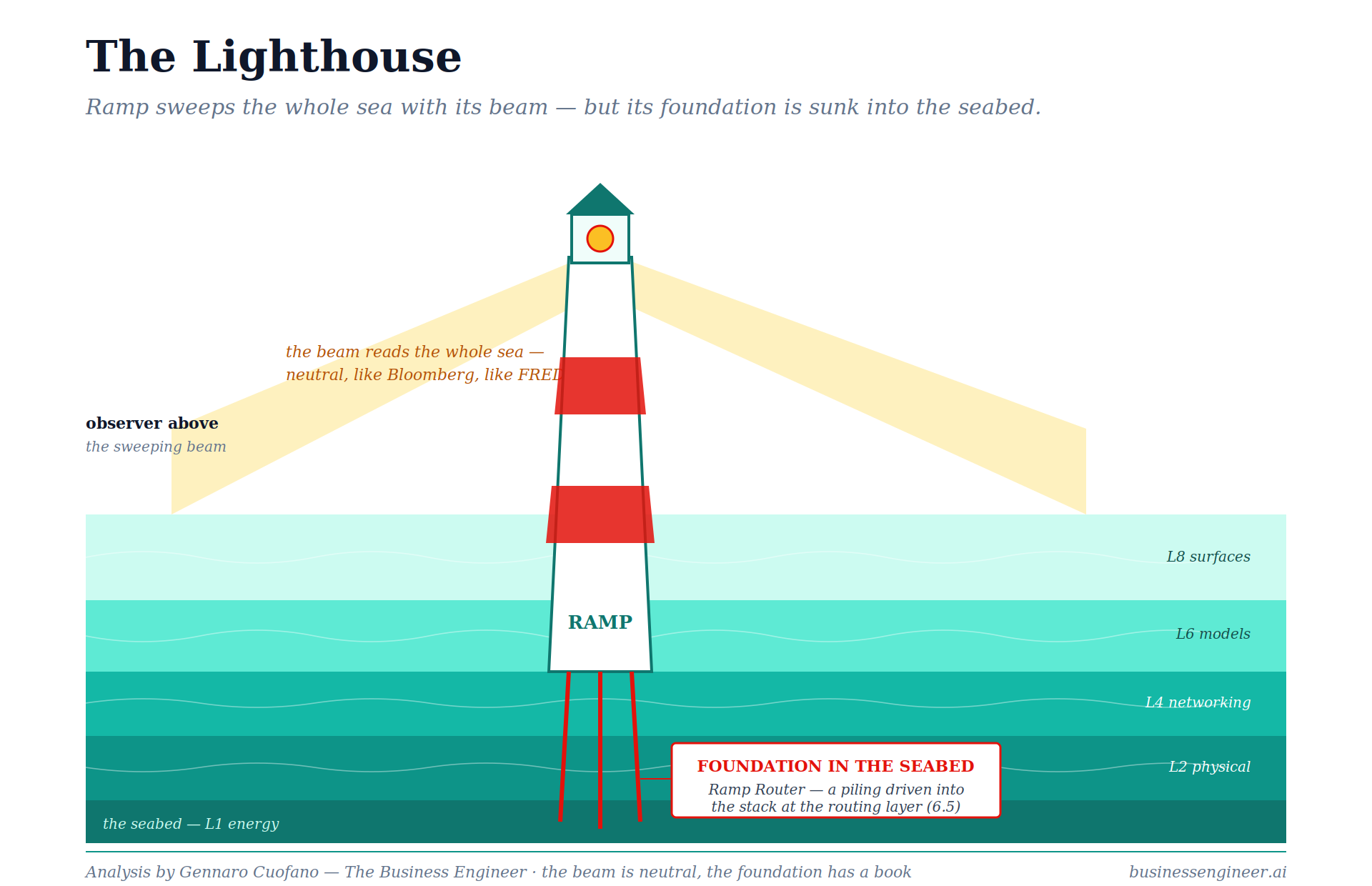
If I had to place Ramp itself on the map, it would be in two places at once.
As a passive observer. Ramp Economics Lab is the telemetry layer above the enterprise stack. Not a layer within the AI stack, but the layer that observes the stack. This position is closer to Bloomberg on the financial map or FRED on the macro map than to any AI-native company. It is a research-and-data platform whose distinctive asset is its measurement position, not its technical stack. Every serious AI-economic argument over the next five years will either use this data or be dismissed for not using it. The FRED Test — whether a claim survives contact with Ramp’s telemetry — is going to become a real methodological standard.
As an active participant. Ramp Router positions Ramp as a Layer 6.5 competitor. That is a genuine product-level bet inside the AI stack, and it has to be counted as such. It puts Ramp in competition with LiteLLM, Portkey, OpenRouter, and — eventually — with hyperscaler-provided routing that Amazon, Microsoft, and Google are all quietly building.
The two roles are in some tension. A passive observer wants to be trusted as neutral. An active participant has a book. Ramp will need to manage that tension carefully as the company grows into both roles. If it manages it well, Ramp becomes something like the AWS-of-payment-plus-routing — a piece of infrastructure that everyone uses and nobody thinks about. If it manages it badly, the router product compromises the credibility of the research, and the research becomes marketing for the router.
This is not a small strategic tension. It is worth watching how Ara’s team handles publication choices going forward. My prior on this: they will manage it well, because the research team is structurally separate from the product team, and because Ramp’s business model does not require Router to be the primary revenue driver. Router is strategic positioning. The research is credibility. They cross-reinforce, but only if the research remains data-honest.
Coalition Realignment — Where This Puts the Nadella Framework
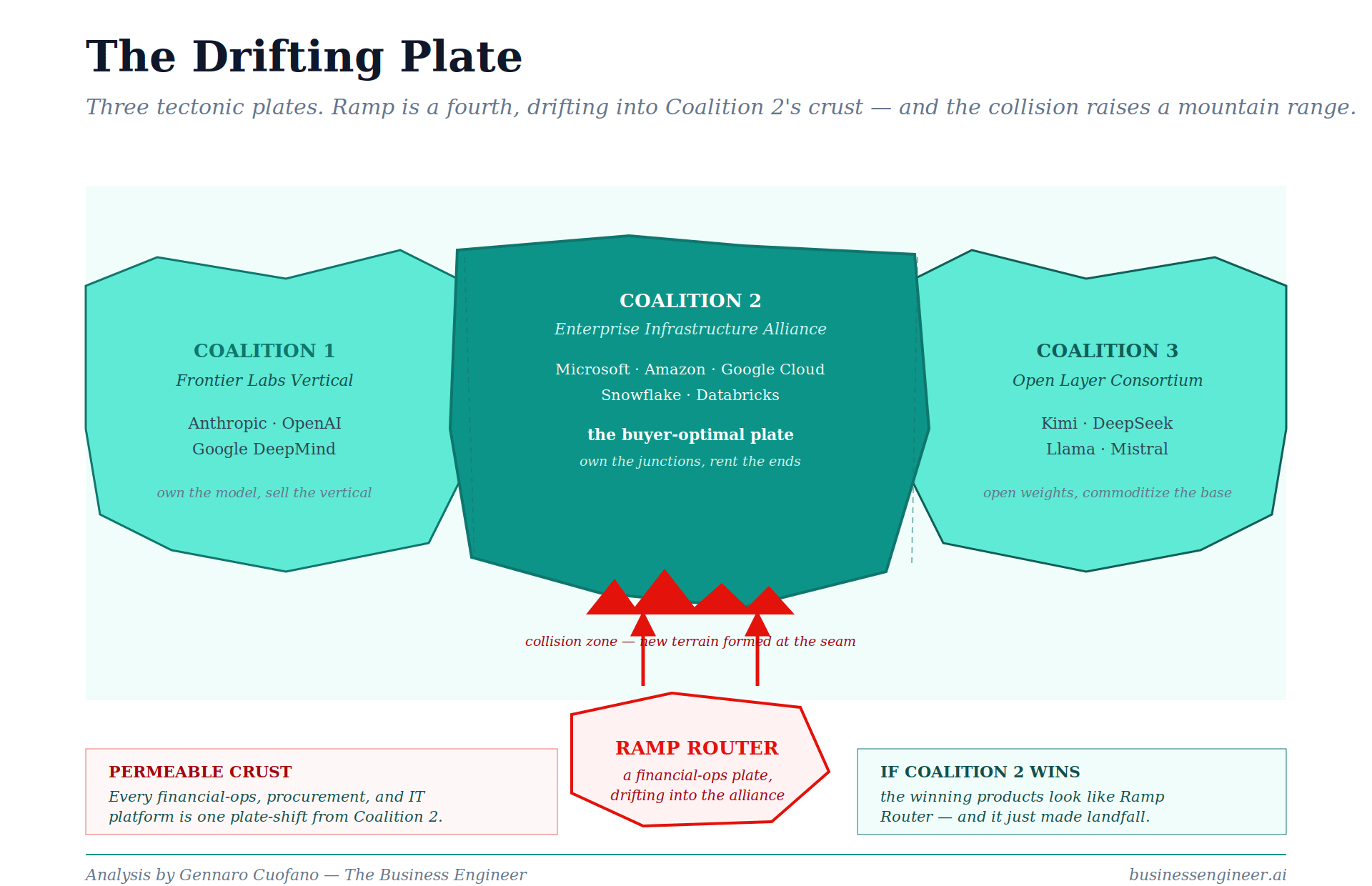
The Nadella-series framework — Three Camps (Coalition 1 Frontier Labs Vertical, Coalition 2 Enterprise Infrastructure Alliance, Coalition 3 Open Layer Consortium) — needs updating in light of Ramp’s play.
Ramp is a Coalition 2 move, executed by a company most people wouldn’t classify as a Coalition 2 player. That is worth noting. The coalition boundaries were always going to be permeable. What Ramp shipping a Router shows is that they are already being crossed by companies whose business model happens to be adjacent to the routing decision. Expect more of this. Every financial-operations, procurement, and IT-management platform is one product decision away from being in Coalition 2.
In the Five C’s Definitive piece I identified the Buyer-Optimal Coalition as Coalition 2 by default — the coalition that maximizes buyer optionality, portability, and jurisdictional flexibility. Ramp Router validates this. The buyer-optimal position is exactly what Ramp Router sells: swap models, swap jurisdictions, swap cost tiers, without lock-in. The Own the Junctions, Rent the Ends principle from the same piece is literally the product spec of Ramp Router.
If Coalition 2 wins, the winning products look like Ramp Router. And Ramp Router just shipped.
Activate
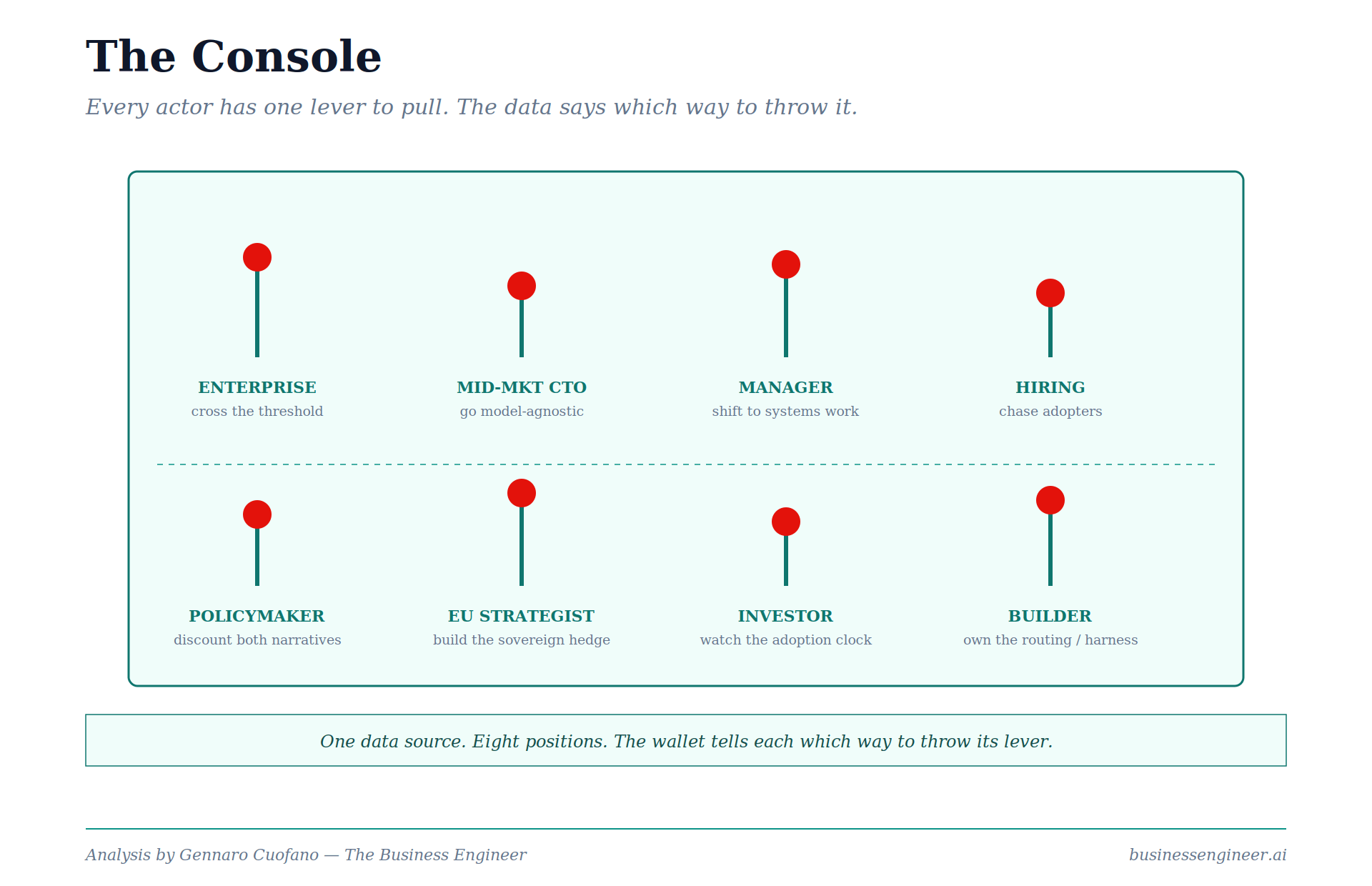
Different actors read all of this differently. Let me be explicit about who does what.
If you are inside an enterprise trying to figure out what to do: Cross the threshold. Thirty dollars per employee per month, applied through coding agents on subscription, plus one or two AI-specific implementations for functions where you know the ROI is real (voice agents for customer service was the concrete example Ara cited), plus a willingness to run multiple models across multiple teams. That is the shape of firms that see gains. Enterprise chat subscriptions alone are the shape of firms that see nothing. If your current AI adoption strategy consists of a Copilot license across the org and nothing else, you are structurally in the low-intensity group. That is not a spend problem. That is an integration problem. Spending more without changing integration will not move you.
If you are a mid-market CTO: Assume model-agnosticism is the base case. Not as a hedge. As the default. If you are a non-US enterprise, this is now a governance requirement. If you are a US enterprise, it is a cost-and-optionality argument. Either way, the multi-vendor stack is where things are heading, and the Router category — whether Ramp’s, or someone else’s — will be structurally important within a year. Start evaluating router platforms now, not after your first surprise vendor-pricing shift. And when you evaluate, look at distribution as much as capability. LiteLLM and Portkey have deeper technical routing tools. Ramp has the payment surface already integrated into your ops stack. Both work. The right choice depends on how deep in the technical stack your team wants to operate.
If you are a manager whose job is coordination: Read the middle-manager finding seriously. Your role is under structural pressure at high-intensity firms. This does not mean you will lose your job. It means the definition of your job is changing, and the compression Ara identified will be dramatic at firms above the integration threshold. The manager roles that will survive are the ones that shift toward systems work — designing the workflows that ICs plus AI can run — and away from translation work. The IC plus AI does not need as much translation. If your day is spent explaining what senior leadership wants to junior staff and vice versa, your job is at risk. If your day is spent designing how the org’s AI-enabled workflows actually work, your job is safer than it has ever been.
If you are hiring: The entry-level surge is real, and it is not just a Silicon Valley phenomenon. Firms with high AI spend are hiring more juniors, more customer service, more sales, more engineering, more admin. If you are trying to fill mid-market roles right now, look at high-intensity AI adopters in your sector before you look at traditional talent competitors. They are hiring across the board. And look specifically at the emerging forward-deployed role — the hybrid business-plus-technical implementer who sits between the customer and the AI system. That role is where the compensation growth is happening, and the talent pool for it is genuinely tight.
If you are a policymaker: Discount both narratives currently dominating the discourse. The CEO layoff narrative is empirically weak at the firm level; the layoffs are happening for reasons that would have justified layoffs anyway — sector rotation, interest rates, over-hiring in 2021, board pressure. AI is the story executives are telling because it is available, not because the mechanism has been established at the firm level. And discount the “data centers create jobs” defense of AI too. Ara is right. It doesn’t land. It shouldn’t land. The correct number to point to is the ten-percent headcount growth at high-intensity adopters. That is a defensible claim. Construction jobs at data centers is not. On the manufacturing displacement question — start caring about that now, not in five years. If AI’s real long-run effect is on physical work while the labor discourse focuses on knowledge work, workers most exposed will be under-defended when the effect arrives.
If you are a European enterprise strategist: The Sovereign Turn is real. You cannot build your product entirely on US frontier APIs and expect the same operating environment in 2028 that you have in 2026. Optionality is the play. Start allocating budget for multi-jurisdiction model access, for on-prem inference options, and for the routing layer that lets you switch without breaking your product surface. European frontier models built via distillation from open weights are a plausible middle path. This is a serious strategic conversation to have with your board this quarter, and every quarter until you have a working sovereign hedge.
If you are an investor: Ramp Economics Lab has quietly become the most useful public dataset for tracking AI adoption in real time. Every AI-related equity call from here forward should include a check against Ramp’s numbers. Every capex thesis for hyperscalers depends on downstream adoption assumptions Ramp is now measuring directly. Every model-vendor thesis is testable against Ramp’s vendor-share data. Use it. Also: pay attention to the Adoption Clock directly. Ramp AI Index growth rate, per-employee spend growth rate, model-serving share growth rate. These are your leading indicators for the physical-layer prints six to twelve months out. Arista August 4. Marvell late August. SK hynix through the F-1 update cycle. Watch the adoption clock; then watch the physical prints. If they diverge, the map is bending.
If you are a builder building AI infrastructure: Study the Router category. It is the least-crowded layer with the highest structural leverage right now. The technical bar is low relative to models or agents. The business bar is entirely about distribution — which is exactly why an incumbent like Ramp is so well-positioned to compete. If you can find a distribution advantage in a specific vertical (healthcare, financial services, manufacturing, government), a vertical router is a defensible business. Horizontal routers will consolidate to two or three players (Ramp, one hyperscaler-native, one Coalition-3-native). Vertical routers will proliferate.
If you are a founder building an applied-AI harness: The Uncaptured Enterprise thesis is confirmed by Ramp’s vendor-share data. Sector-specific harnesses win. Sierra, PolyAI, Granola are the templates. Pick a vertical the frontier labs’ horizontal products don’t serve well. Build the harness. Distribute through the routing fabric (yours or someone else’s). Own the domain logic, rent the model.
Frames
Mental models
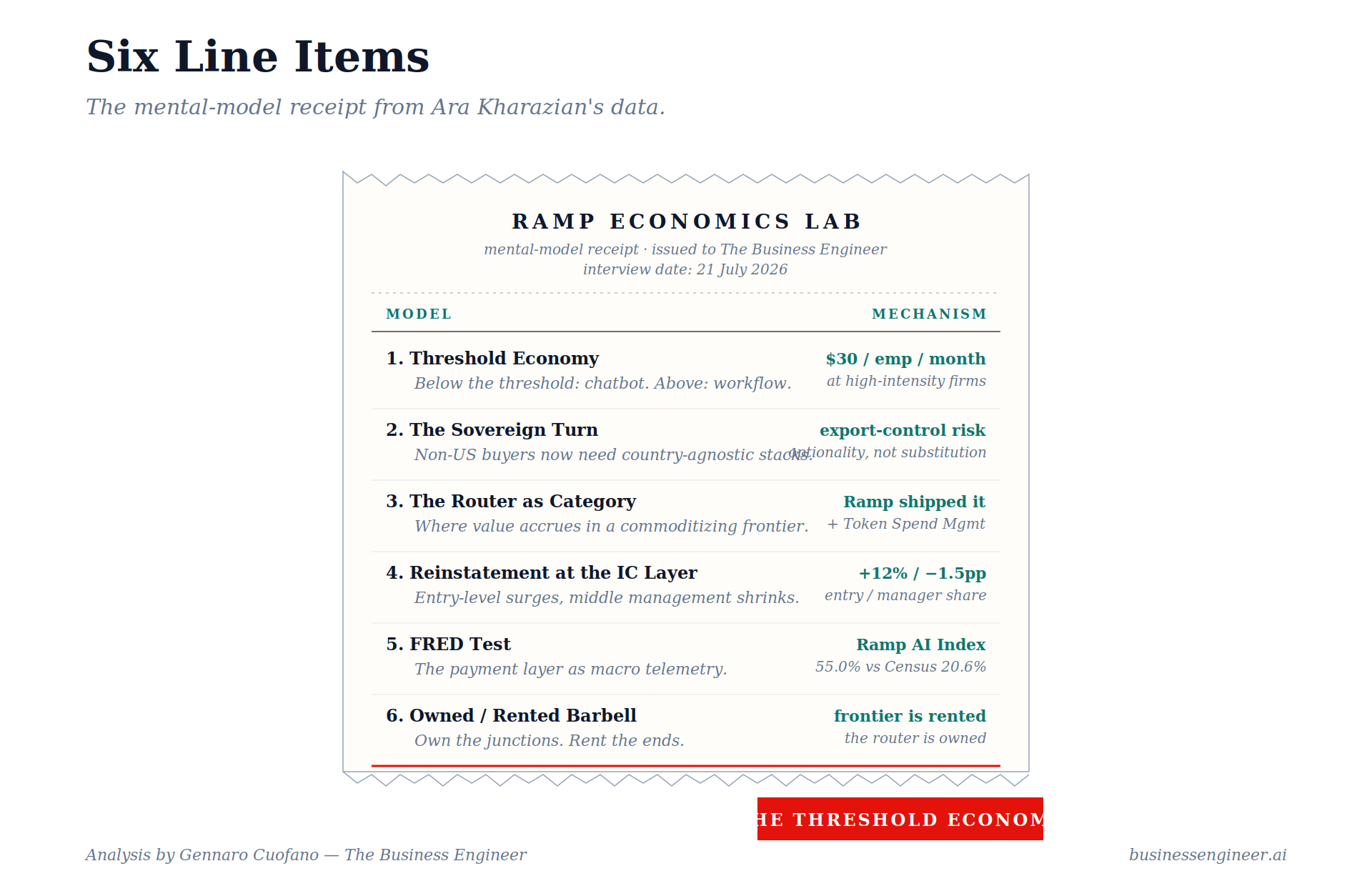
Seven models to file this against. They compose. They are not independent claims.
The Threshold Economy. Not every firm gets AI’s gains. Only firms that cross an integration threshold do. Below the threshold: chatbot. Above the threshold: workflow. The threshold is not primarily about dollars. It is about depth of integration and willingness to run multi-vendor stacks. Firms that cross it grow ten percent over two years. Firms that don’t cross it see nothing. This is the empirical finding of the Kharazian-Simon-Stevens paper and the operating principle that structures everything else that follows.
The Sovereign Turn. Enterprise AI buying is bifurcating along jurisdictional lines. US export controls, EU sovereignty framing, Chinese open-weight availability, and American lightweight competitors are all pushing enterprises toward model-agnostic and country-agnostic stacks — even without substitution happening yet in the wallet. Optionality is the driver, not switching. The bear case for the American frontier labs is that non-US enterprises will demand this optionality, and the router-and-hedge infrastructure to serve it is now being built.
The Router as Category (Layer 6.5). The infrastructure that decides which model gets which query is emerging as the layer where enterprise value accrues in a commoditizing frontier. Not the models. Not the agents. The routing decision, and the data that informs it. Ramp is now building this. So are LiteLLM, Portkey, OpenRouter, and others. Ramp’s distribution advantage — 70,000 businesses and $200 billion of spend already flowing through — is the reason to watch Ramp specifically. Distribution beats capability when capability is close to commodity.
Reinstatement at the IC Layer. AI does displace work at high-intensity adopters. It displaces coordination and mentorship work — middle management — while creating complementary demand for entry-level ICs who are AI-native. This is the classic reinstatement effect operating at a specific layer, not across the whole firm. The layoff narrative is looking at the wrong layer. The layer that is losing headcount is above the layer everyone is telling stories about.
The FRED Test. Ramp’s AI Index and its emerging Token Spend Management dataset are quietly building the first real-time telemetry layer for the AI economy — comparable to what the St. Louis Fed’s FRED, ADP’s National Employment Report, or the ISM manufacturing survey do for the broader economy. The measurement infrastructure matters. Every serious argument about AI’s economic effect over the next five years will either use this data or be dismissed for not using it. The transition from “Ramp publishes an interesting index” to “Ramp is where the AI adoption number comes from” is roughly twelve to eighteen months away, on my read.
The Owned/Rented Barbell. Enterprises own the assets they need to control — data, workflows, identity, policy, the routing decision — and rent everything they don’t. Frontier LLMs are rented. Open-weight inference is rented. Model-serving infrastructure is rented. What is owned is upstream (the firm’s data and workflows) and midstream (the routing manifold that decides which rented model gets which owned query). Ramp is positioning as the midstream owner-of-the-router for a meaningful mid-market slice. Expect this to be the dominant enterprise-AI architecture pattern by end of 2027.
The Adoption Clock (fourth clock). The physical clock, financial clock, and efficiency clock from The Fed and the Mint now share the frame with a fourth: the adoption clock. It runs at the pace of enterprise decision-making. Measured monthly in Ramp’s data. Determines whether the physical clock’s capex gets returned. Currently synchronized with the physical clock. Divergence between the two is the single most important macro-AI signal to track over the next 18-24 months.
These seven models compose into a single strategic frame. The Threshold Economy sets the empirical baseline. The Sovereign Turn identifies the strategic pressure. The Router as Category identifies where value accrues. Reinstatement identifies which workforce layer is actually shifting. The FRED Test identifies the measurement authority. The Owned/Rented Barbell identifies the architectural response. The Adoption Clock identifies the macro-cycle synchronization variable. Together they describe the shape of mid-2026 enterprise AI: a bifurcation between firms that cross the threshold and firms that don’t, between jurisdictions that own their AI stack and jurisdictions that hedge, between models that get commoditized and routing decisions that don’t, between adoption paces that validate the physical capex and adoption paces that leave it stranded.
If you file this piece against your existing BE mental library, it lives close to the Uncaptured Enterprise frame, the Verification Bottleneck thread, the Regime-Agnostic Enterprise piece from the Nadella series, and the Fed and the Mint Three Clocks framework. It reinforces the Fed and Mint framework by adding the Adoption Clock. It sits as sibling to the Kimi Delusion piece — where Kimi Delusion is the supply-side counter-narrative on the July 17 selloff, this piece is the demand-side counter-narrative on the CEO layoff story. And it extends the Depth Stack observer-dependence frame by showing that observer position is visible in the wallet — the depth at which each enterprise operates on the customization stack is measurable through the vendor share Ramp reports.
The honest frame
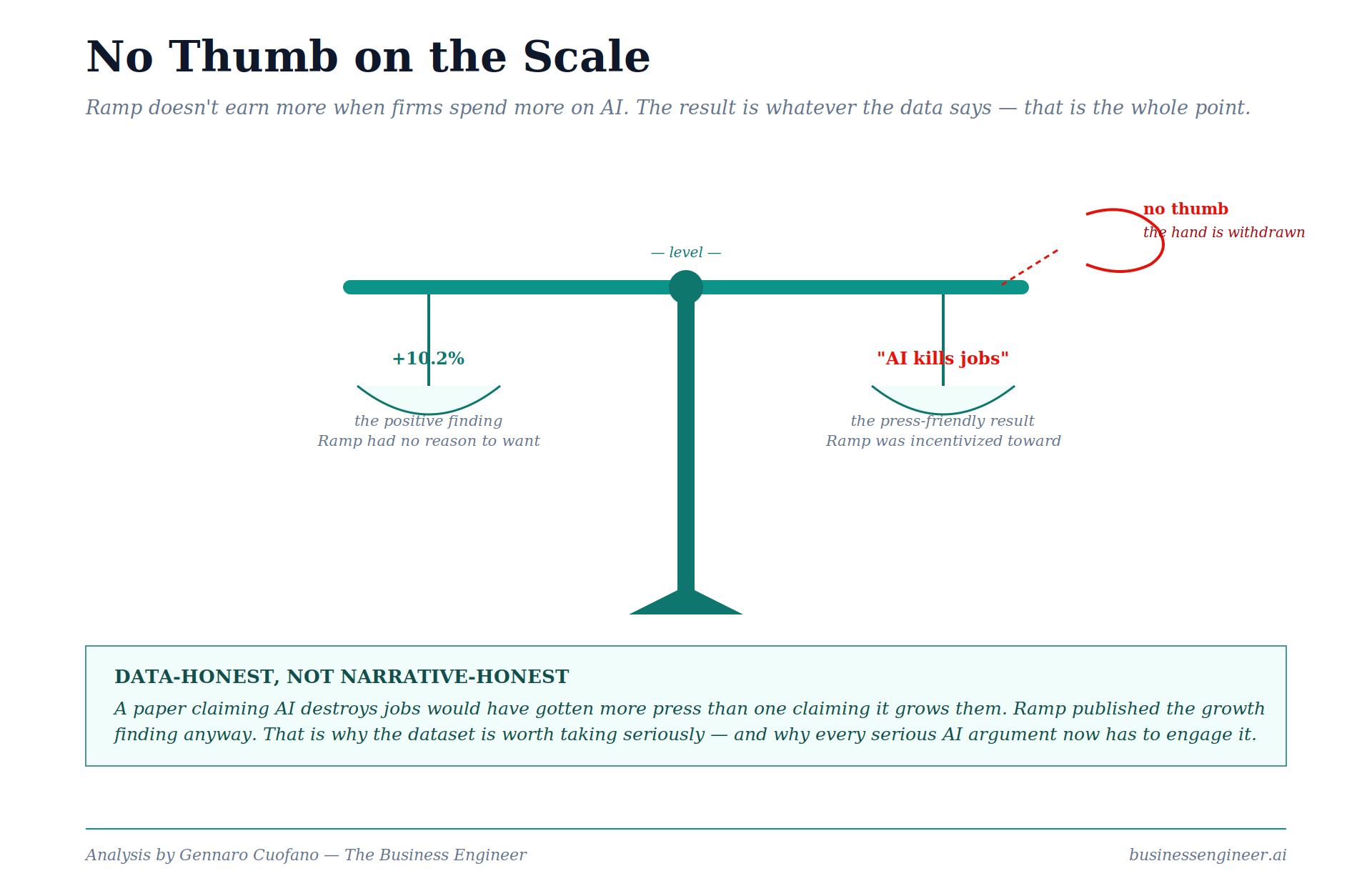
At one point in the conversation Ara said something worth ending on. He said the benefit of Ramp doing this research, rather than OpenAI or Anthropic, is that Ramp has no incentive to say anything positive about AI. Ramp doesn’t make more money when firms spend more on AI. Anthropic and OpenAI obviously do. Ramp’s jobs paper found that AI adoption grows headcount. That was a positive result. But Ara noted, wryly, that he was actually incentivized to find the opposite — because a paper claiming AI destroys jobs would have gotten more press coverage than a paper claiming it grows them.
That is the frame this whole conversation should be understood through. The wallet-level data is telling us a story that is neither the boosterism of the model companies nor the doom of the executive-quote layoff narrative. It is telling us that a small set of firms are quietly getting real gains, that the gains show up as growth rather than displacement, that middle management is the layer being restructured, that the frontier labs face pressure from three directions their PR hasn’t yet acknowledged, that the Router category is emerging as the enterprise-AI architectural moat, and that the payment layer is beginning to organize itself into the same shape.
None of that fits neatly into either camp of the current AI debate.
The AI Supercycle framework I run this publication on rests on three assumptions I want to name against Ara’s data explicitly.
First, that AI diffusion is a long cycle, structurally more like the semiconductor era than the internet era, measured in decades not quarters. Ramp’s data is consistent with this — the time between adoption and gains is 6 to 12 months, and the compounding continues through 24 months without plateau in the current data window. This is a diffusion story with a slow burn. It is not a lightning strike. And it maps onto the six-layer geopolitical outer stack (Geopolitical, Economic, Energy & Resource, Infrastructure, Hardware, Software) that the semiconductor era anchors more naturally than the internet era does.
Second, that the enterprise is uncaptured — that the value of the AI cycle will not accrue entirely to the model layer and will over time migrate upward toward whoever owns the workflow, the data, the routing decision, and the trust surface. Ramp’s Router product is one of the first pieces of infrastructure explicitly built against this thesis. Watch it. And watch the vertical harnesses (Sierra, PolyAI, Granola) that are extending the same logic into sector-specific applications.
Third, that the cycle will unfold under four simultaneous clocks — physical, financial, efficiency, and now adoption — and the ability of the physical clock’s capex to be repaid depends on the adoption clock keeping pace. Ramp is the honest broker on the adoption clock, and Ramp is telling us that the clock is compounding, that a threshold effect exists, that the ten-percent headcount finding is real, and that the discourse describing this cycle is measurably lagging the wallet.
I want to close on Ara’s own note. He was asked at the end of the interview what makes his research distinctive, and his answer was that he tries to publish what the data actually shows regardless of whether it is controversial or intuitive. That framing — data-honest rather than narrative-honest — is what makes Ramp Economics Lab worth taking seriously as a source. Every serious AI-economic argument over the next five years is going to have to engage with this dataset. Every AI-strategy investor call is going to have to check against these numbers. Every policymaker asking whether to intervene in the labor market on account of AI is going to have to reckon with the fact that the firm-level evidence, at least for the population Ramp measures, is at odds with the executive-quote story. Every enterprise strategist has to reckon with the fact that the sovereign turn is not a hypothetical, it is showing up in the wallet, and the router category is now shipping in response.
The Map of AI, as I’ve been building it through the Q2 2026 cycle, has nine layers. Ramp adds a tenth — the telemetry layer — that sits above the stack and reports on what the stack is doing. The Adoption Clock is the tenth layer’s primary output. And the Adoption Clock is the variable that will determine whether every commitment made above and below it, from ASML through Layer 9 governance, actually clears.
The wallet sees different. And starting now, so should we.
Recap: In This Issue!
Ramp is becoming the real-time gauge of enterprise AI adoption. Unlike surveys that measure what executives say, Ramp measures actual AI spending through payment data. This provides one of the first transaction-based views of enterprise AI adoption.
High AI adoption correlates with business growth, not contraction. Firms that deeply integrate AI grow headcount by around 10% over two years, while low-intensity adopters show little measurable difference. The key differentiator is implementation quality rather than AI spend alone.
The integration threshold matters more than budget. Companies do not need massive AI budgets. Moderate spending (roughly tens of dollars per employee per month) combined with workflow integration, coding agents, and function-specific deployments generates the strongest returns.
The labor market narrative is more nuanced than “AI replaces jobs.” Ramp’s data suggests:
Entry-level hiring increases.
Engineering, sales, and customer service continue growing.
Middle management faces the greatest structural pressure as AI reduces coordination overhead.
Forward-Deployed Engineers (FDEs) emerge as one of the fastest-growing roles. Organizations increasingly need hybrid technical-business operators who can implement AI inside business workflows, following the model pioneered by companies like Palantir, Anthropic, and OpenAI.
AI buyers are increasingly demanding model optionality. Enterprises are becoming:
model-agnostic,
provider-agnostic,
and increasingly jurisdiction-agnostic.
This is driven not only by pricing but by geopolitical concerns around API access and export controls.
The Router becomes a strategic layer of the AI stack. Ramp’s new Router product reflects a broader shift: as models commoditize, value moves toward intelligently routing workloads across multiple models based on cost, performance, and sovereignty requirements.
OpenAI and Anthropic face pressure from three fronts simultaneously:
Chinese open-weight models.
Lightweight American competitors (e.g. Cursor Composer, Gemini Flash).
Enterprise demand for sovereign, multi-vendor architectures.
None individually displaces frontier labs today, but together they reduce lock-in.
Anthropic is leading enterprise momentum. Ramp’s enterprise data shows Anthropic overtaking OpenAI in enterprise penetration, largely driven by Claude Code and developer workflows rather than general-purpose chat usage.
Chinese models remain strategically important but commercially limited today. Their primary impact is increasing competitive pressure and encouraging open architectures rather than replacing OpenAI or Anthropic inside enterprises.
The “wallet layer” validates the AI infrastructure thesis. Ramp’s enterprise adoption data supports continued demand for:
hyperscaler AI infrastructure,
Nvidia GPUs,
HBM memory,
networking,
and AI datacenter investment.
Enterprise demand is still accelerating rather than plateauing.
The AI Supercycle gains a fourth clock. Beyond physical infrastructure, financing, and efficiency improvements, the author introduces an Adoption Clock—the pace at which enterprises actually implement AI. This becomes the critical indicator for validating AI infrastructure investments.
Small businesses and large enterprises benefit differently.
Small firms gain speed and experimentation advantages.
Large firms eventually leverage proprietary data and distribution.
Mid-sized companies are the most exposed, lacking both agility and enterprise scale.
Manufacturing may ultimately experience greater AI disruption than white-collar work. While public debate focuses on office jobs, the long-term automation opportunity appears larger across physical industries through robotics, vision systems, logistics, and industrial AI.
Ramp is evolving into AI’s “FRED.” Just as FRED became a standard source for macroeconomic data, Ramp’s transaction-level AI spending data could become the reference dataset for measuring enterprise AI adoption and validating broader AI investment theses.


