

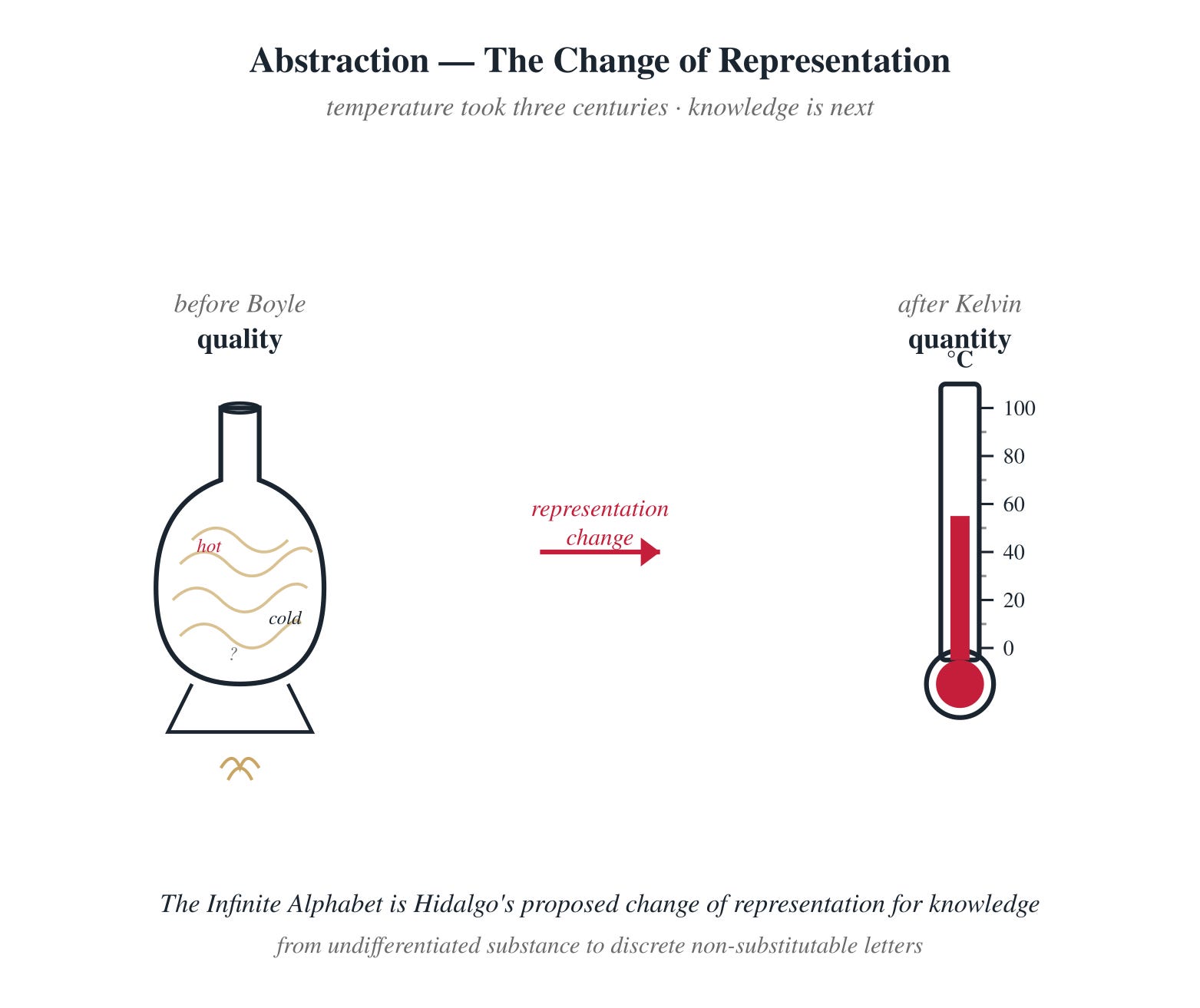
Every real paradigm shift in economics comes down to a change of representation. Temperature was a quality for two thousand years before it became a quantity. Aristotle wrote about it as a mixture of two opposing invisible fluids, hot and cold, the way we now write about the mixture of colors. It took Boyle, Fahrenheit, Black, Joule, and Thomson — spread across three centuries — before temperature became a number.
Information followed the same trajectory. Colloquial word for millennia. Then Shannon, 1948, and information became a measurable quantity with formal properties. The entire twentieth century of computing, communications, and biology rebuilt itself on the new representation.
Knowledge is next in this sequence, and the Infinite Alphabet is Hidalgo’s proposed change of representation. It is the argument that knowledge stops being a single undifferentiated substance the moment you look at it closely, and that if we want to understand how the economy actually works — how it grows, how it moves, how it produces value — we need vocabulary for a substrate that is discrete, non-substitutable, and combinatorial.
Hidalgo’s intellectual journey into this frame is worth naming. He published Why Information Grows in 2015. Between 2015 and 2019 he prepared a Harvard course on the principles governing the growth, diffusion, and value of knowledge, discovering — in his own words in our conversation — that there was a “larger context” of historical precedent his prior work had been operating inside without seeing. He signed the book contract in 2022, wrote it in two years, and published it in 2025. The Infinite Alphabet is the mature framework. It rests on two supporting structures.
Three types answer what knowledge is.
Factual knowledge — Rome is the capital of Italy. “Little sound bites that collect a little bit of truth,” in Hidalgo’s phrasing. This is what pretraining corpora largely contain, and what RAG systems handle well.
Conceptual knowledge — the detective’s theory that connects the bullet hole, the 3 AM phone call, and the blood sample into a coherent story. This is what reasoning models are trying to be.
Procedural knowledge — running the DNA sequence in the lab. This is where agentic AI is landing.
Three properties answer how it behaves.
Non-rival — copying does not deplete. Teach me a song, you still know it. This is the property that makes AI economically explosive.
Tacit vs. explicit — you can watch lectures about basketball, but if you don’t play with people who are good, you will never be good.
Non-fungible — a candy-factory chemist and an oil-mine geophysicist both have chemistry knowledge, but neither can do the other’s job.
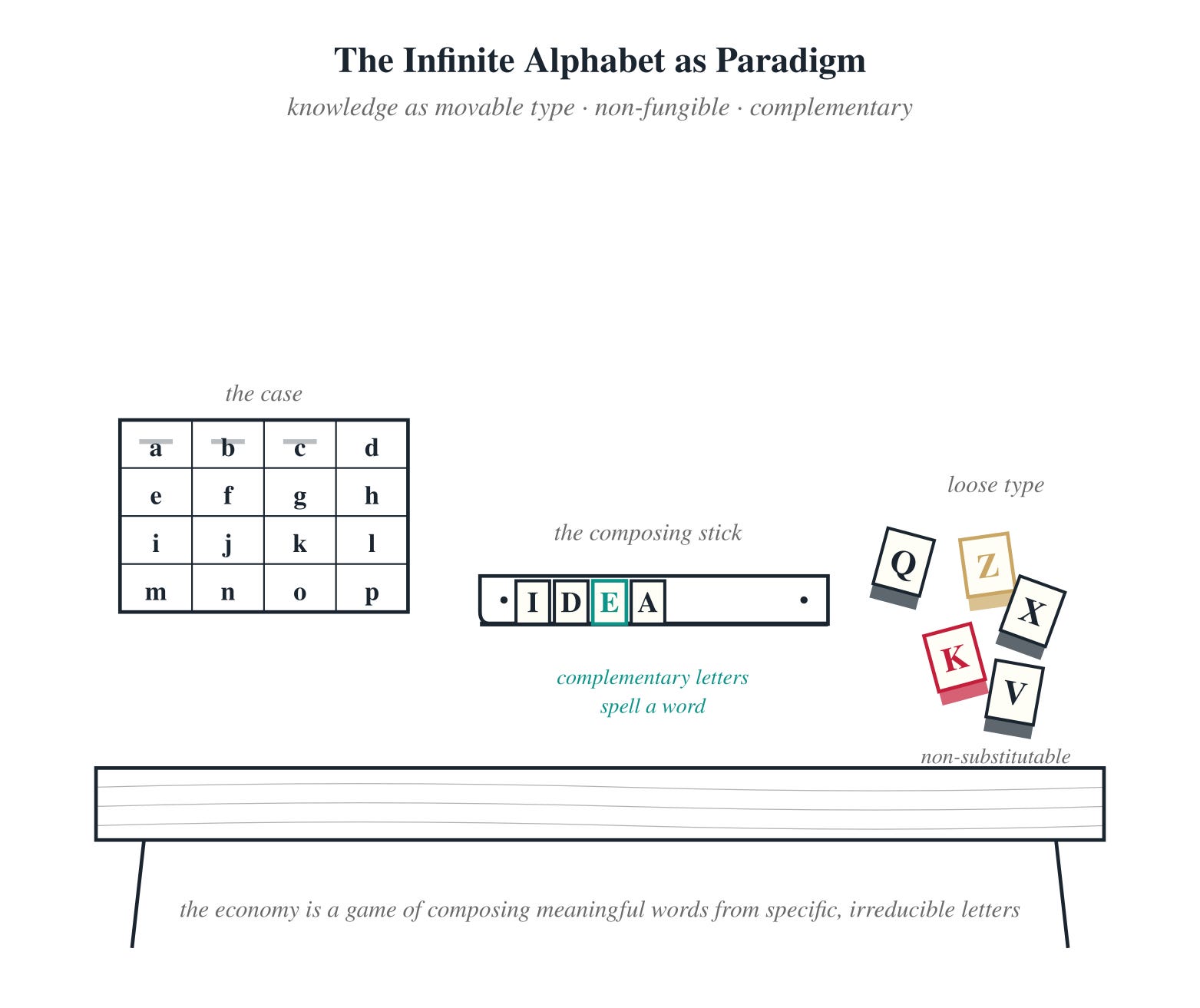
The metaphor is Scrabble. Not one big undifferentiated pile of letters that all mean the same thing, but an alphabet of specific, non-interchangeable pieces. Each capability is a letter. Each product, firm, or industry is a word built from a specific combination of those letters. The economy is a game played across geographies and centuries where players attempt to spell increasingly complex words using letters that are constantly being invented, forgotten, and traded.
The claim of this piece is that Hidalgo’s representation change is the right lens through which to read the two frameworks anyone building in AI right now already carries in their head — the AI Supercycle and the Map of AI. Both frameworks become sharper, more predictive, and more actionable when you stop treating “AI” as a homogeneous mass and start treating it as a Scrabble game played simultaneously on nine boards.
Also follow Cesar on X or LinkedIn.
You can also follow his work on Datawheel.
The Infinite Alphabet as Paradigm
Hidalgo’s articulation in the interview was compressed but precise:
“It’s not a single thing. It’s not like a big jello that is undifferentiated, but a lot of little components that are complementary but you cannot substitute one for the other. So they’re like Scrabble tiles.”
Read that sentence twice. The whole edifice sits on the two words at the center: complementary and non-substitutable.
Complementarity means the letters need each other to form words. A on its own is not English. A single tile does not make a game. The economic value of any single letter is nothing until it is combined with the right other letters, in the right order, at the right scale.
Non-substitutability means you cannot swap one for another. A candy-factory chemist cannot do the job of an oil-mine geophysicist. A frontier-model researcher cannot do the job of a chip-packaging engineer. Both possess “chemistry knowledge.” Both possess “engineering knowledge.” The categories are so broad they are useless. The actual letters are specific and locked to specific practices.
Hold these two properties together — complementary + non-substitutable — and three consequences fall out immediately.
The economy is combinatorial, not additive. More “knowledge” does not produce more output unless the specific letters combine into words the market can use. This is why intelligence-heavy economies do not automatically grow, and why capability-heavy AI models do not automatically produce enterprise value.
Specialization is inevitable. Since letters are non-substitutable, players end up mastering only a few of them each. Individuals become specialists. Firms become specialists. Cities and countries become specialists. The distribution of who-holds-which-letters becomes an economic geography in itself.
Value lives at the joints. The letters are cheap. The combinations are where value emerges. The historically dominant firms are not the ones who mastered a single letter — they are the ones who assembled the most useful combinations of letters others held separately.
The physical letters AI does not yet touch
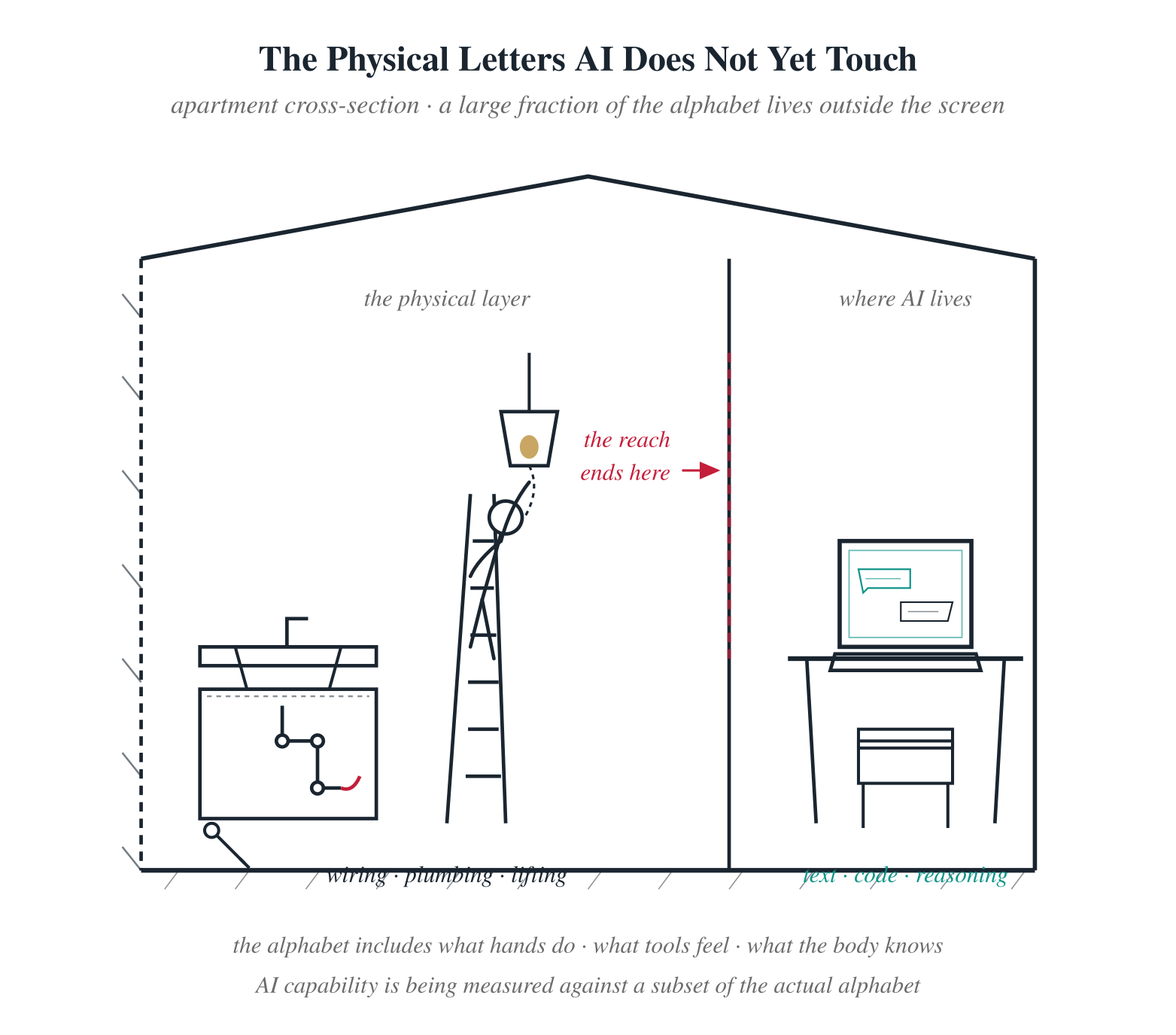
Hidalgo made a point in the interview that is worth putting on the record because it puncturеs a specific kind of AI-industry hubris. He had just moved apartments the previous weekend. A dishwasher hose got squished during transit. He needed to identify and replace it. He could photograph the part. He could not, from a chair, do the physical repair. The lamp he was hanging from the ceiling — no chat model helped with the ladder shake.
A large fraction of the alphabet is physical. Electrical work, plumbing, tiling, load-bearing carpentry, mechanical repair, the tacit knowledge of a surgeon’s hand, the rhythmic knowledge of a chef’s stir — these are letters in the alphabet, and none of them have entered the AI-legible portion of it yet. Robotics may cross that frontier in the coming decade. Until then, the AI industry’s obsession with the letters it can see is a systematic underestimate of the letters that still run the actual economy.
The point matters for how you read every AI industry chart. When capability curves appear to be closing in on human performance, that closure is being measured against the fraction of the alphabet AI can currently address. The unmeasured fraction is much larger.
The AI Supercycle Through the Infinite Alphabet
The AI Supercycle argues that we are in a 30–50 year civilizational transformation, structured as three nested cycles running at different clocks: a 5–10 year short cycle inside a 10–20 year medium cycle inside a 30–50 year long cycle. It is a framework designed to hold simultaneously the fact that AI is a real durable transformation and the fact that the current market is a bubble, without collapsing either.
Under the infinite alphabet, the framework becomes mechanistically legible.
The S-curve stack, confirmed on air
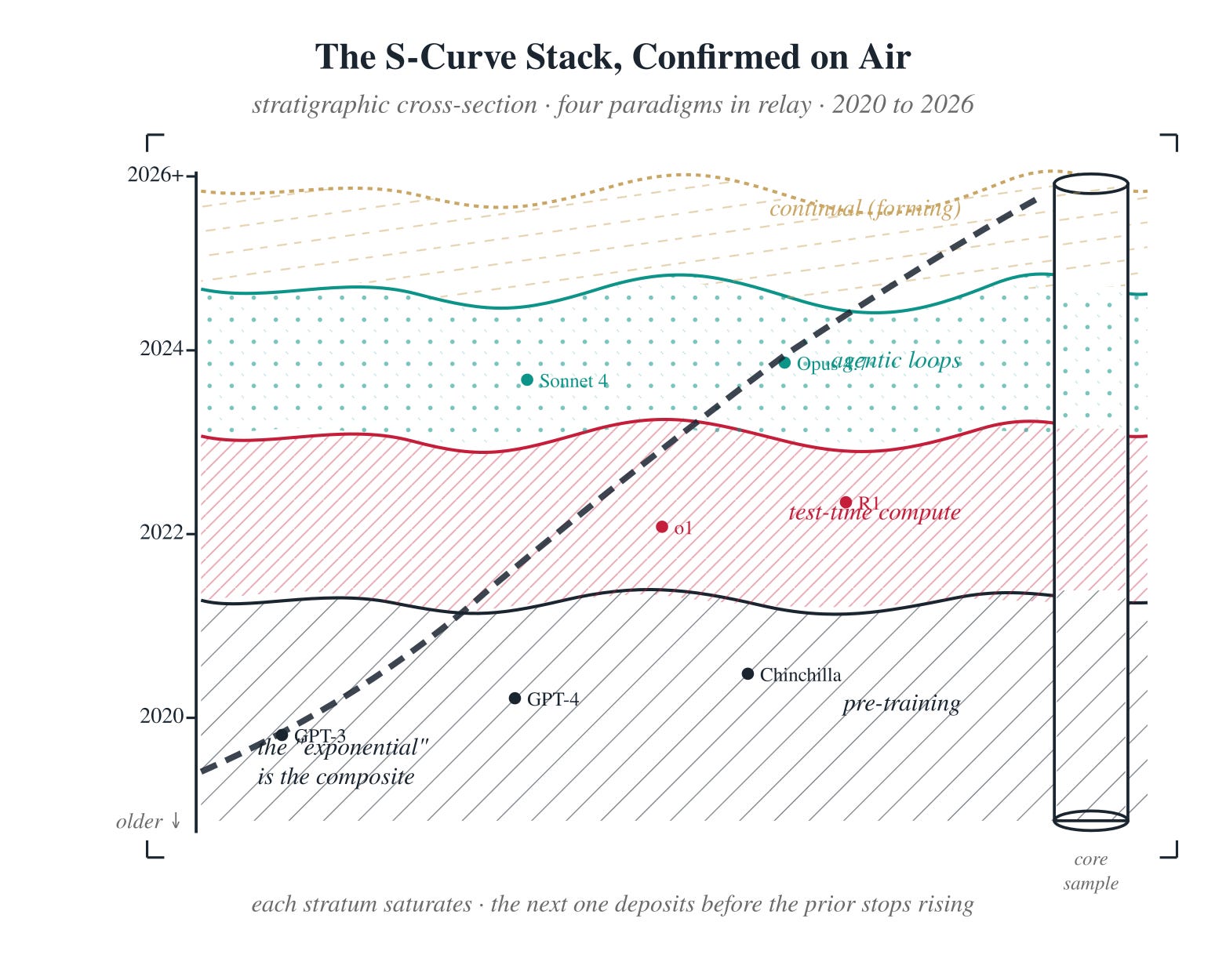
The load-bearing exchange of our conversation happened here. Hidalgo laid out the standard Thurstone-Wright result: at the level of individuals and teams, learning follows a bounded power law — fast at the start, slower thereafter, until doubling the practice to gain one more unit of proficiency becomes uneconomic. But at the level of industries and economies, the aggregate looks exponential. Moore’s Law is the canonical example. So is the price of light. So is genetic sequencing.
The mechanism is that the exponential is not a single curve. It is a cascade of overlapping S-curves, each individually bounded, each handing off to the next before the prior one saturates.
I put the AI-industry version of this to Hidalgo directly on the record. We have run four scaling paradigms in relay between late 2022 and mid-2026:
Pre-training (2020–23)
Test-time compute and reasoning (2024–25)
Agentic loops (2024–26)
Continual learning (emerging, 2026 onward)
Each of these obeys Thurstone. Each individually peters out. The reason the industry appears to be on a straight exponential line is that the next curve started producing capability faster than the prior one could saturate.
Hidalgo’s reply was direct: “Exactly, it’s a bunch of S-curves that are overlapping.” The best strategy for any player — individual, firm, or nation — is to make sure they are on the next curve, because a new one will always come and displace those who mastered the current one.
This is the mechanical foundation of the AI Supercycle thesis. The three-year AI industry looks like the last seventy years of transistor manufacturing compressed by a factor of twenty. The exponential appearance is the sum of finished curves plus starting curves. When a starting curve fails to arrive, the exponential stops — not gently, abruptly.
The bubble-vs-supercycle paradox, resolved
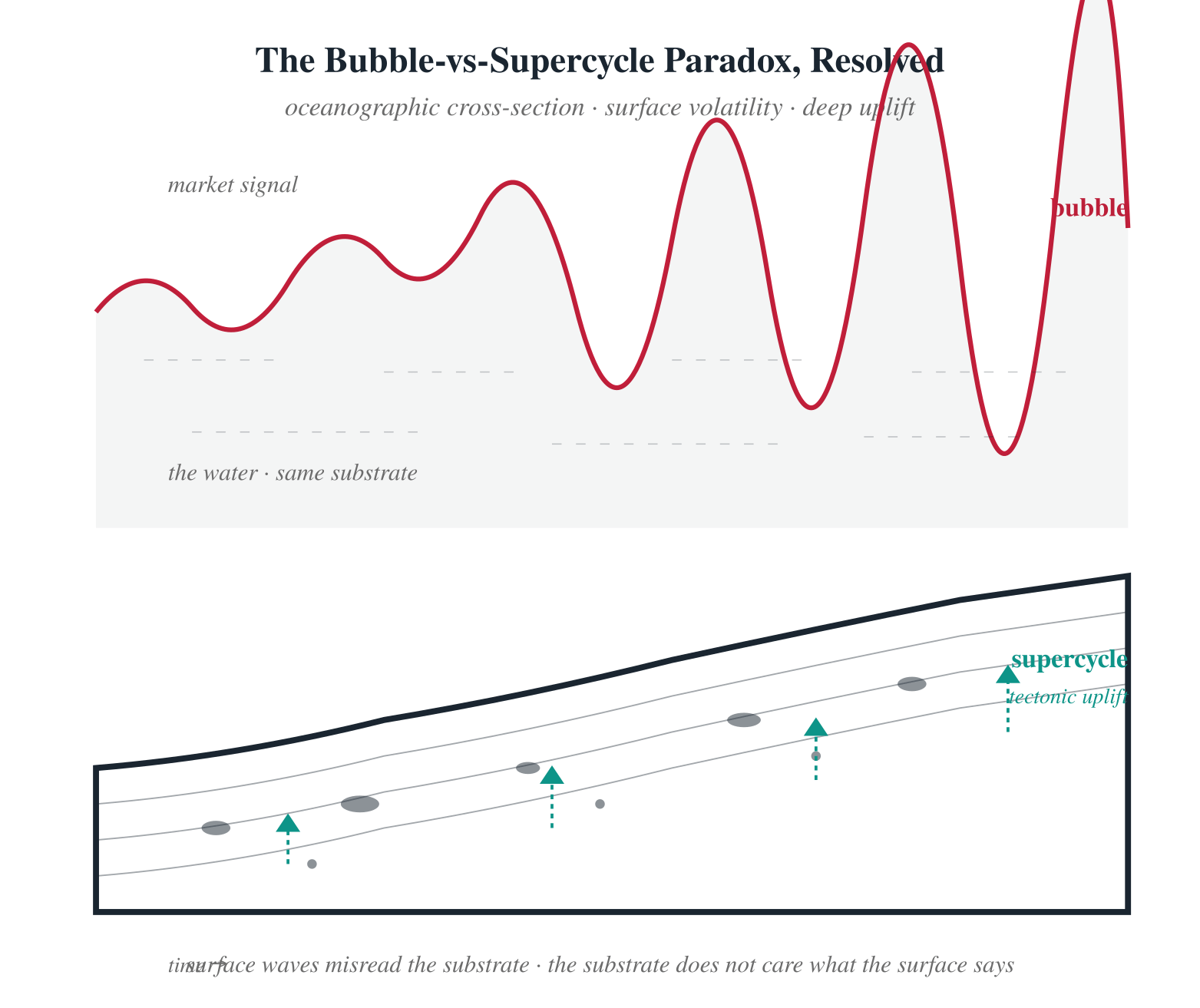
The bubble is what happens when capital treats non-fungible knowledge as fungible. When the market prices “AI” as a single asset class, it is making the jello error at scale. Every AI company gets valued as if it shared the same substrate, the same customers, the same defensibility. In alphabet terms: every word in the market is treated as if it were spelled from the same three letters.
The supercycle is what is actually happening underneath the bubble. The alphabet is expanding. New letters are being invented. Old letters are being commoditized. Firms are re-sorting into new positions on the alphabet, and the sort will take a generation to complete.
Both statements are true simultaneously. The bubble is the price signal misreading the substrate. The supercycle is the substrate itself, which does not care what the price signal says.
The three nested cycles as rates of alphabet change
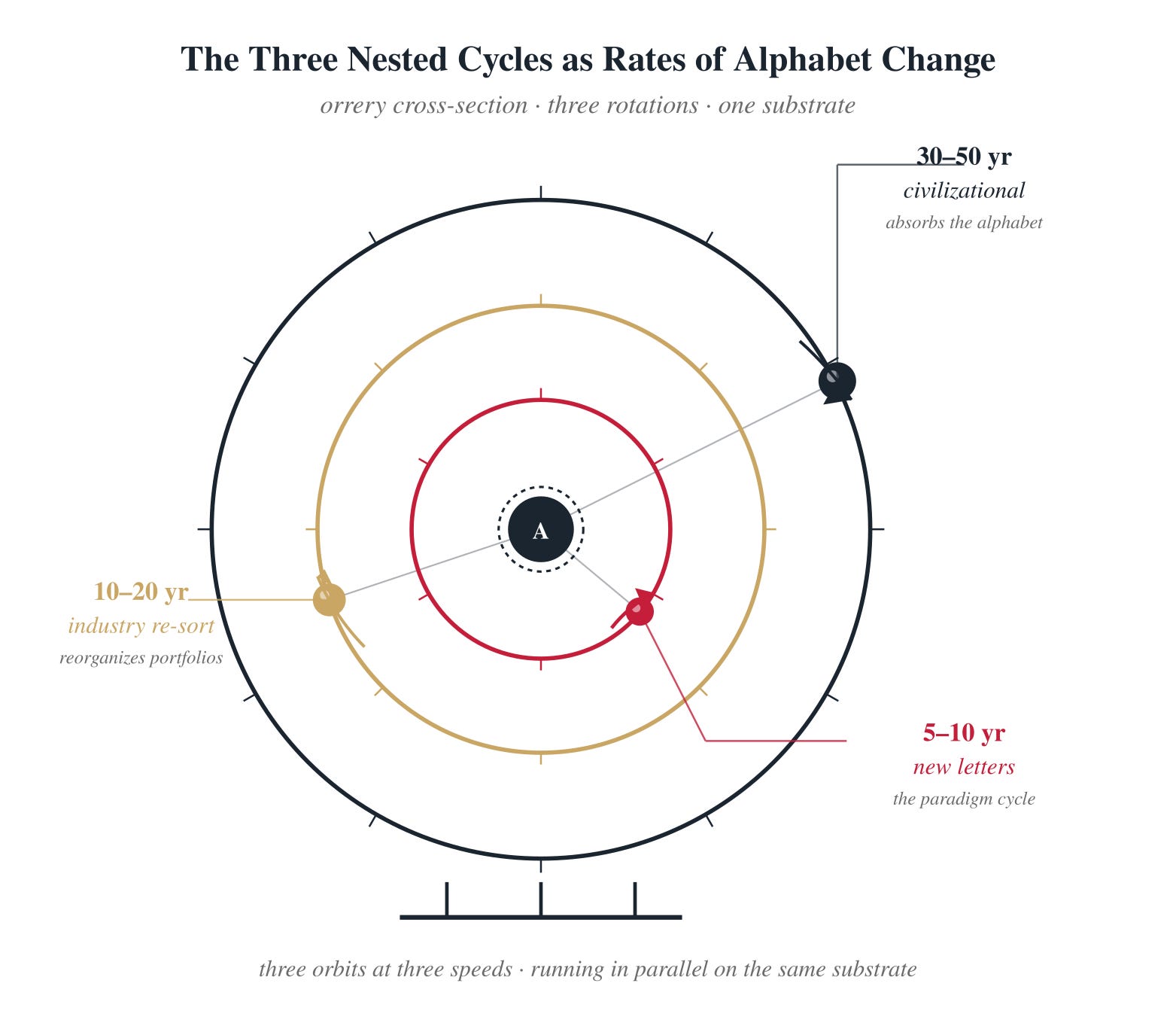
Each of the three cycles corresponds to a different rate of alphabet change.
The 5–10 year short cycle is the rate at which new letters enter mainstream production. Pre-training scaling was one letter. Test-time compute reasoning is another. Agentic loops is a third. Continual learning will be a fourth. Each new letter appears every 12–18 months, gets picked up by everyone within two years, and becomes table stakes within three. This is the cycle that produces the sense of “AI moving fast.”
The 10–20 year medium cycle is the rate at which industries re-sort their letter portfolios. Media reshapes around the new letters. Finance reshapes. Legal reshapes. Retail reshapes. Each industry moves at its own pace, but the aggregate reshaping runs on a two-decade clock, because it requires organizational restructuring, workforce transition, and regulatory adaptation. This is the cycle that produces the sense of “AI is transforming the economy.”
The 30–50 year long cycle is the rate at which the alphabet itself becomes part of the ambient cultural substrate. The way electricity did between 1880 and 1930. The way the internet did between 1990 and 2020. The final phase where the letters stop being “AI letters” and become just letters. This is the cycle that produces the sense of “civilizational transformation.”
The three cycles are not phases in sequence. They are running in parallel, at different clocks, on the same underlying alphabet. The short cycle spits out new letters. The medium cycle re-sorts who holds them. The long cycle absorbs the whole apparatus into the substrate of civilization.
The Zero Industrial Revolution — printing press as the timescale anchor
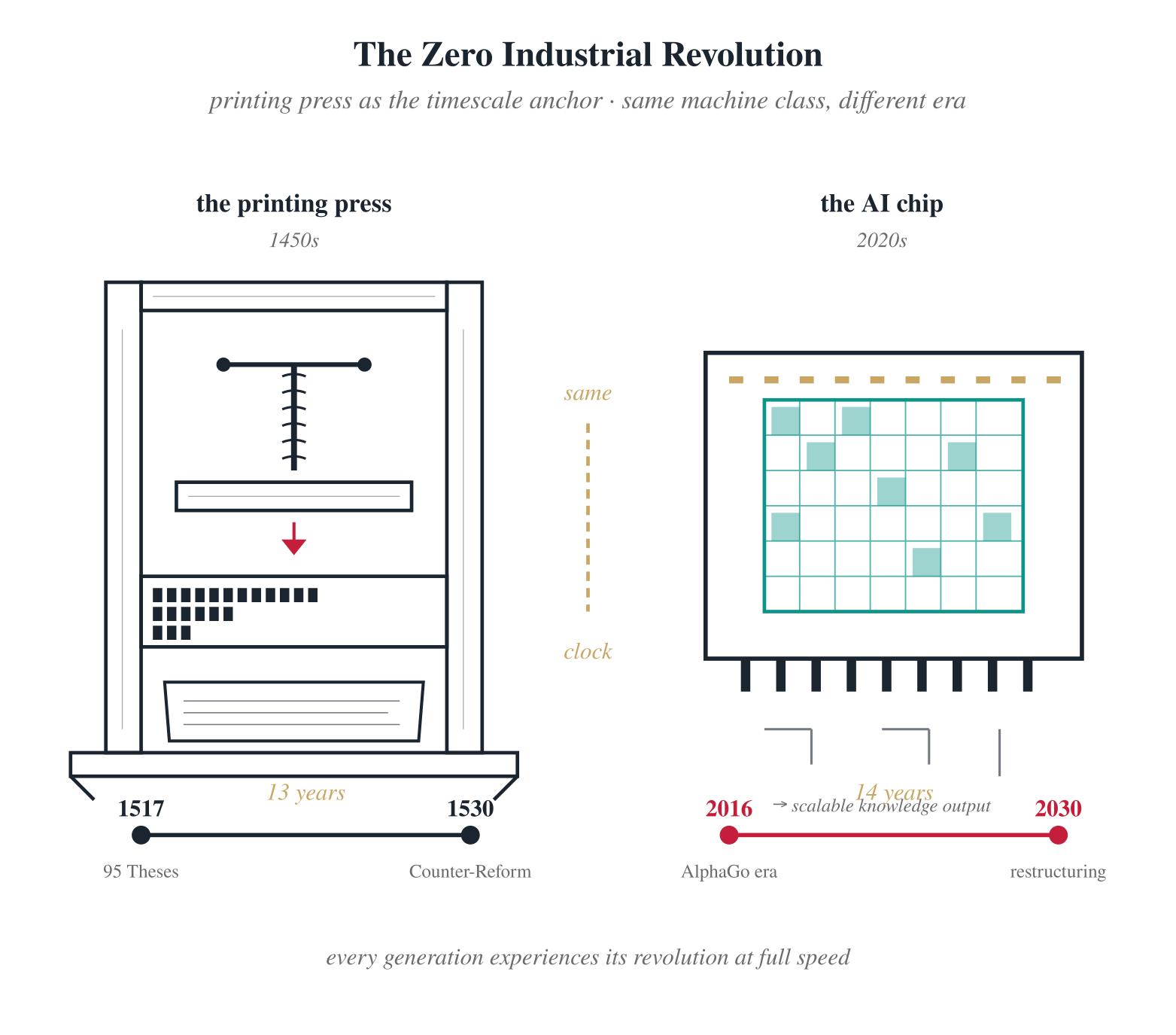
Hidalgo’s most compressed historical argument in the interview was to reframe the printing press as the “Zero Industrial Revolution” — the original scalable-product transformation, running earlier than the steam-and-textile revolution and generating a comparable economic surface.
The mechanism was extraordinary. A printed book in the 1400s cost a fraction of a house. Five people in a basement, printing for four years, could produce the value of three hundred houses. The economics were entrepreneurial in exactly the way software would be five centuries later. Print shops proliferated across Europe within fifty years of Gutenberg. The knowledge diffused from the Frankfurt/Mainz cluster along the Rhine and outward. By the late 1400s the per-capita number of print shops had stabilized — printers were competing to survive, and cheap easy-to-print items like church indulgences became the profitable margin work.
Then Luther, 1517. Ninety-five theses. Millions of copies sold — “even for today’s standards a lot,” in Hidalgo’s phrasing. By the 1530s, less than fifteen years later, Europe was in the middle of the Counter-Reformation. Institutions built over a thousand years were fundamentally restructured in a decade and a half.
Hidalgo’s calibration: if you match AI 2016–2030 against Reformation 1516–1530, the two transformations run on the same clock. This is not a metaphor. It is a schedule. Two thousand sixteen because that is when the AlphaGo/DeepMind moment landed and the modern AI era began institutionally, not because ChatGPT is the correct start point. And the perceived slowness of past revolutions, in Hidalgo’s phrasing worth quoting almost in full: “we tend to think that life is fast because the speed of memory is really quick... but the world is always going at full speed.”
The printing press felt exactly like AI feels now, to the people living through it. And they had no idea, in 1520, whether they were at the beginning or the end.
The absorptive-capacity bottleneck — the eight-month Claude Max subscription
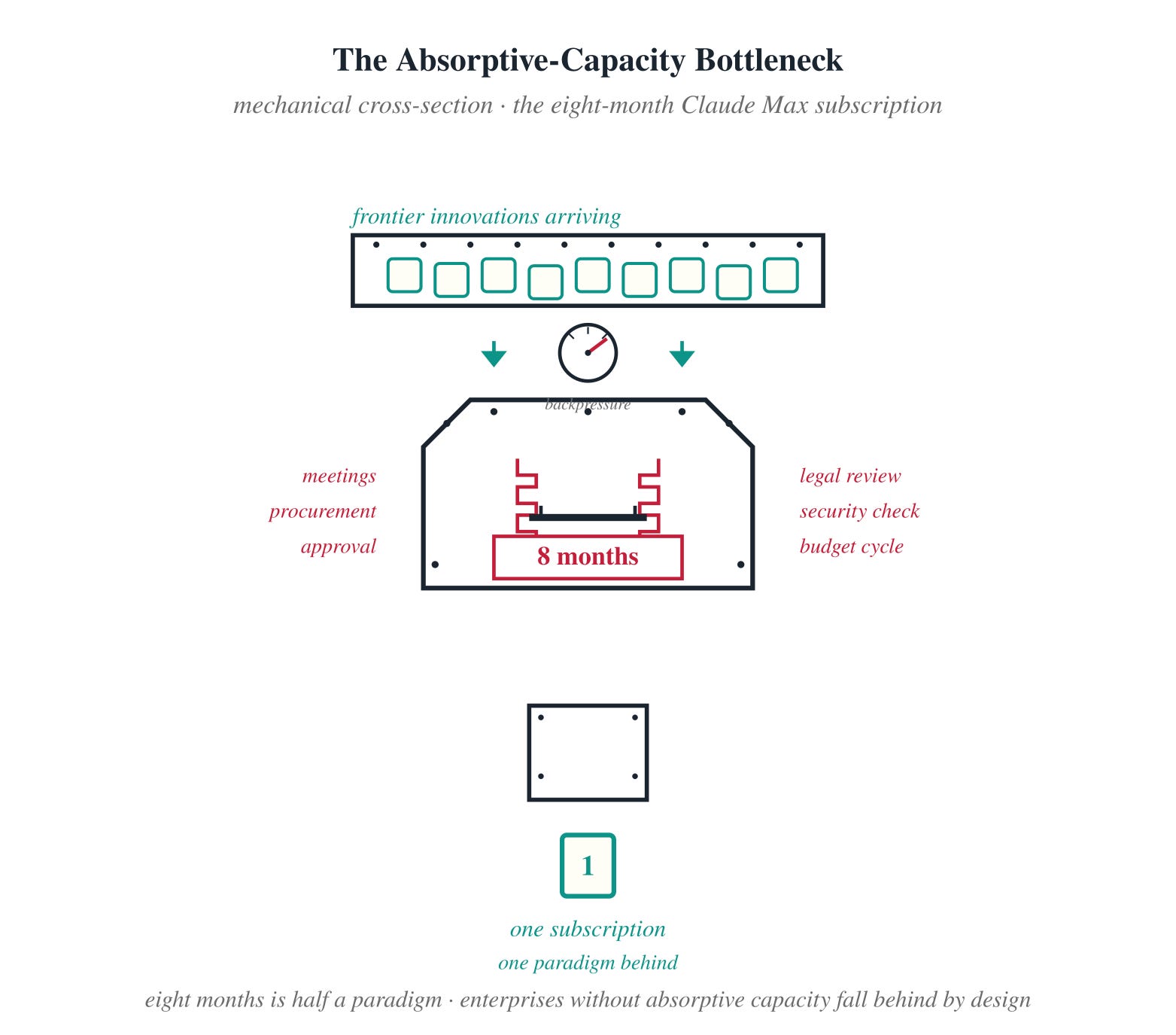
I raised in the conversation a phenomenon that anyone working with large enterprises will recognize: individuals on the frontier have moved to sub-agents, MCP servers, and agentic loops, while the enterprises around them still treat AI as a chat window. Hidalgo answered with a Sony story from 1948.
Masaru Ibuka was trying to build a tape recorder in postwar Japan. He had seen the American version, but had no manual. Working with a frying pan, black-market chemicals, and hemp paper, he and his team reverse-engineered magnetic tape. The point Hidalgo drew from the story is that absorption of external innovation requires internal capability that pre-exists it. Ibuka’s team had radar and telecommunications engineers from the war. Without that absorptive capacity, the American tape looked like magic. With it, it looked like a problem to solve.
The concept is Cohen and Levinthal, 1990: firms invest in R&D not primarily to produce research, but to become able to absorb the research others produce.
Hidalgo’s own example from our conversation — cutting, and directly quotable — is that if you are in an organization where “it takes you like eight months of meetings and procurement nightmares to get one Claude Max subscription, well, you’re going to fall behind.” In an S-curve stack world where each curve runs 12–18 months, eight months is half a paradigm. Any enterprise that pays that tax is systematically behind by one full cycle at all times.
The absorptive-capacity gap is the reason enterprise AI adoption feels like a different technology from frontier AI. It is not that enterprises are stupid. It is that they have not built the internal capability to reverse-engineer, and their procurement infrastructure was designed for a paradigm where innovation moved on quarterly cycles rather than fortnightly ones.
Disruption and architectural knowledge — the airport-baggage warehouse
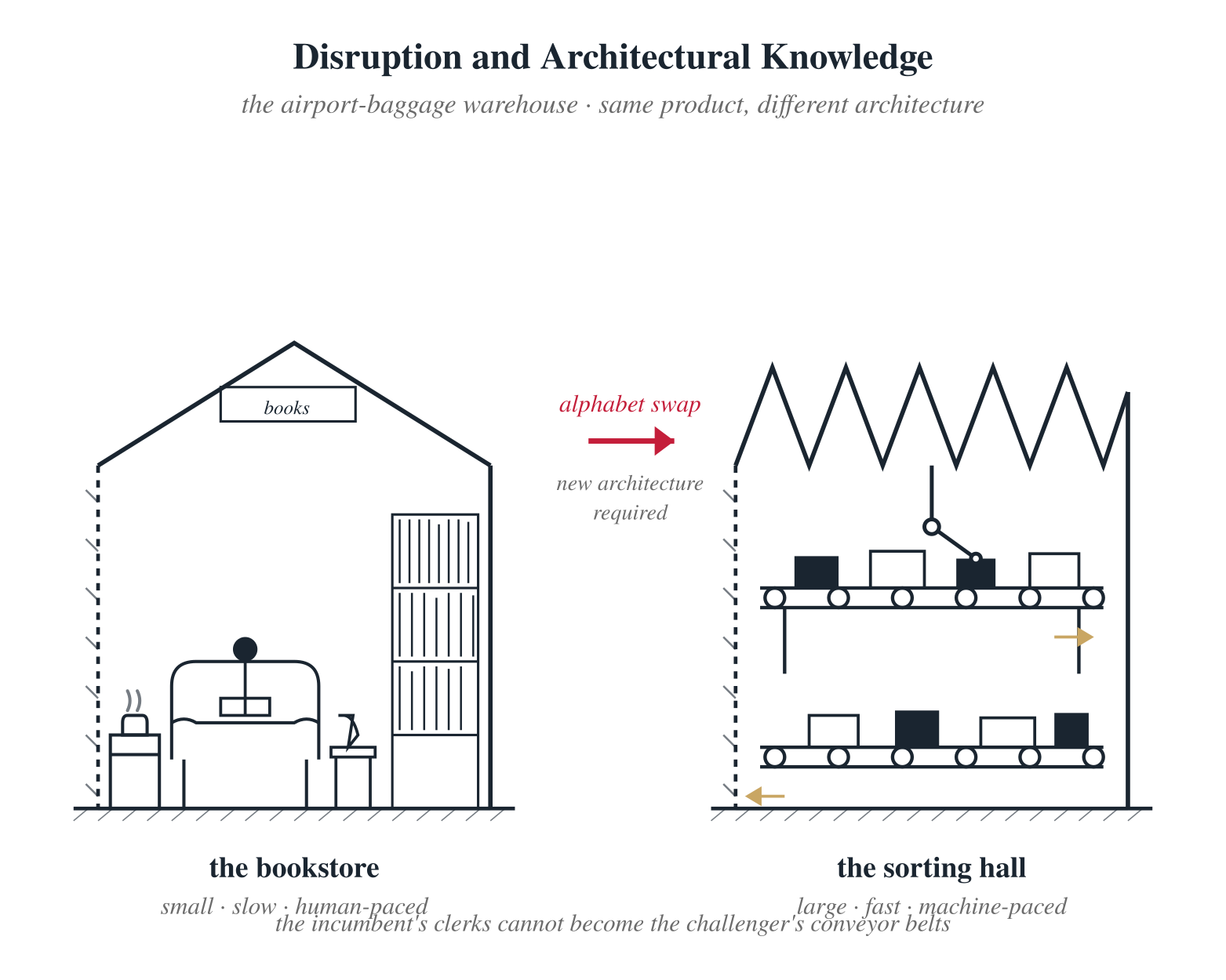
The classic supercycle transition signal — the moment when an incumbent’s dominance evaporates because the ground beneath the product changed — is not a competitive event under the infinite alphabet. It is an alphabet event.
Blockbuster did not lose because Netflix had better movies. Blockbuster had clerks who knew how to open a store, greet customers, and restock shelves. Netflix from day one was organized around shipping DVDs directly, with different roles, different communication patterns, different operational architecture. As Hidalgo put it in the conversation, an Amazon warehouse “looks more like the part of an airport where you are sorting bags than a place where you drink coffee.” The transformation from “we rent movies” to “we ship DVDs” was not an adaptation. It was an alphabet swap.
The current AI corollary: any enterprise that tries to bolt AI onto an existing workflow is spelling their old word with a new tile inserted. It rarely works. The organizations that succeed with AI are the ones that treat it as an alphabet event — a reason to rebuild the workflow, the roles, and the operational architecture from scratch around what the new letters make possible.
The Map of AI Through the Infinite Alphabet
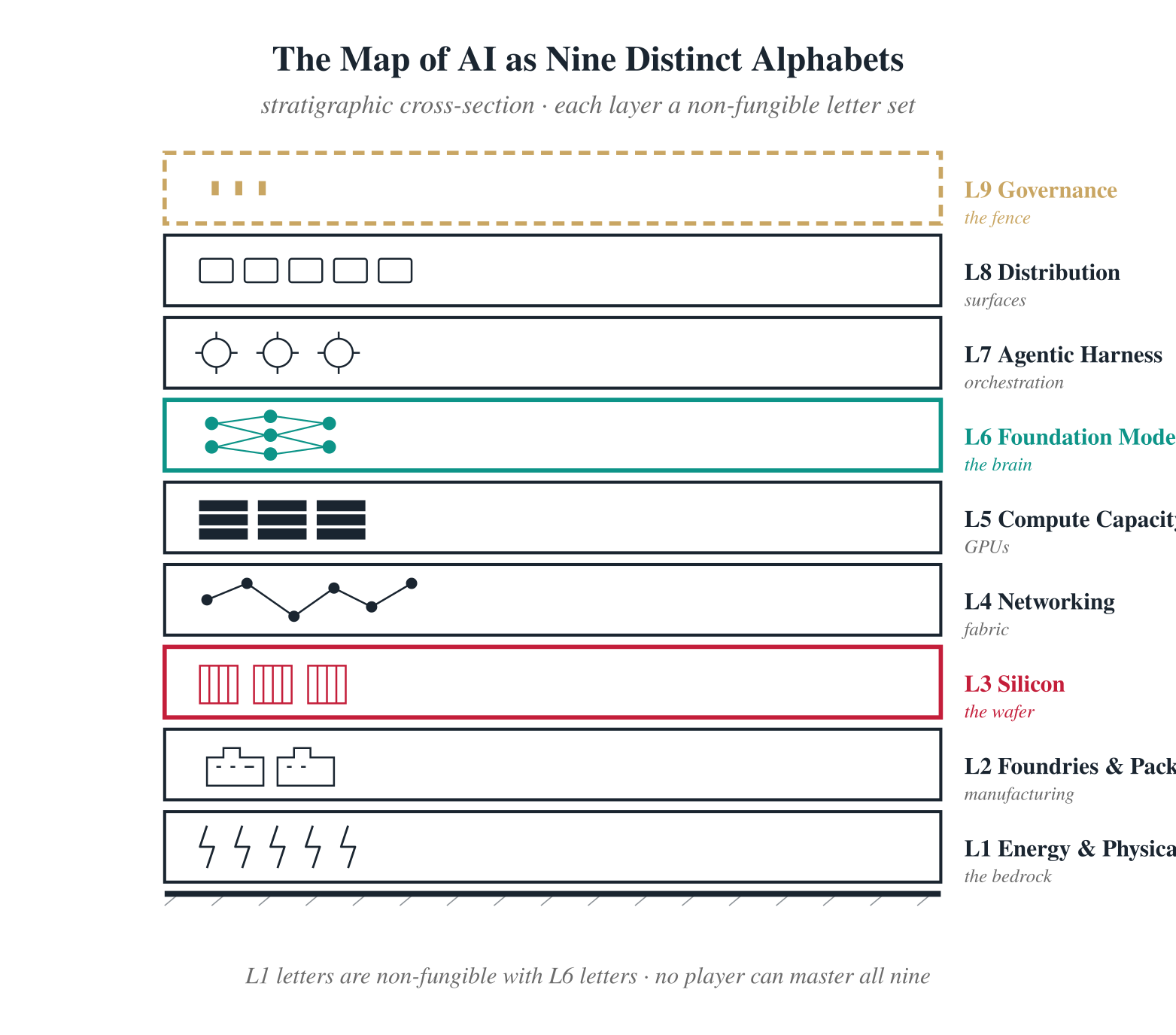
The Map of AI describes the industry as a nine-layer stack — Energy & Physical, Foundries & Packaging, Silicon, Networking & Protocols, Compute Capacity, Foundation Models, Agentic Harness, Distribution Surfaces, and Governance. Each layer is a distinct arena, with its own physics, its own binding constraints, its own profit pool, and its own players.
Under the infinite alphabet, each of the nine layers becomes a distinct alphabet.
This is not a semantic reframing. It is a structural claim. The letters at Layer 1 (Energy & Physical) are non-fungible with the letters at Layer 6 (Foundation Models). A firm that has mastered thermal management, power delivery, and land acquisition for gigawatt-scale sites holds a specific alphabet of letters that cannot be substituted for the alphabet held by a firm that has mastered transformer architecture, pretraining data curation, and RLHF. Both are “AI” businesses. Neither can do the other’s job. Neither can even legibly evaluate the other’s work at the depth required to compete.
Three consequences follow.
No player can master all nine alphabets
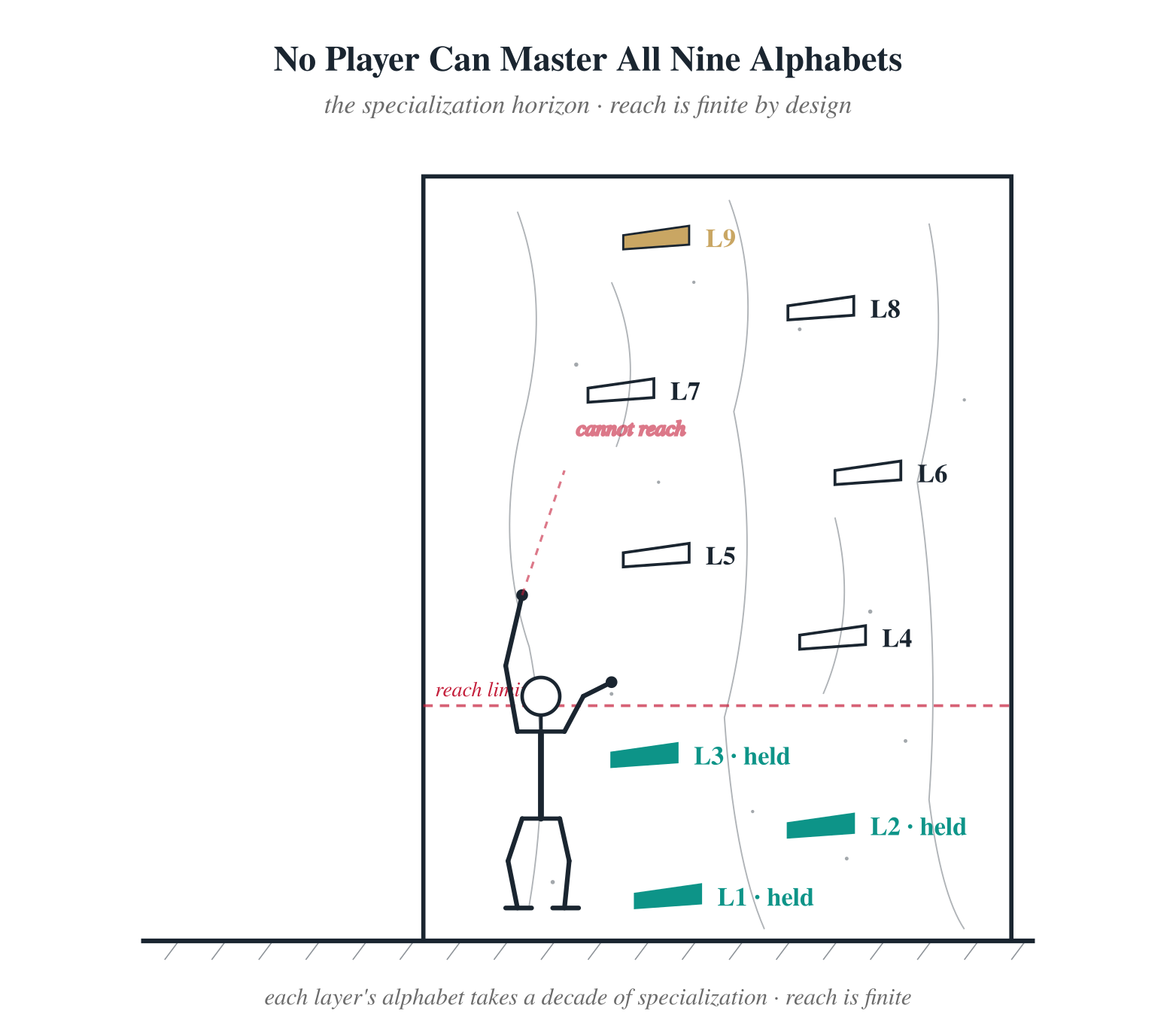
The historical incumbent instinct — vertical integration across the stack — assumes the letters are compatible. Under the infinite alphabet, they are not. Each layer’s mastery requires a decade of specialization inside that specific alphabet. A firm that tries to hold Layer 1 through Layer 9 ends up mediocre at all of them, because the tacit knowledge required for silicon does not transfer to distribution, and the architectural knowledge required for foundation models does not transfer to energy siting.
This is why the vertical-integration attempts of the current cycle keep hitting the same wall. The firms that appear to be spanning multiple layers are almost always specialists in one layer who are renting access to adjacent ones — the way NVIDIA rents distribution through hyperscalers, and OpenAI rents compute from Microsoft.
Knowledge agglomerates — it does not diffuse
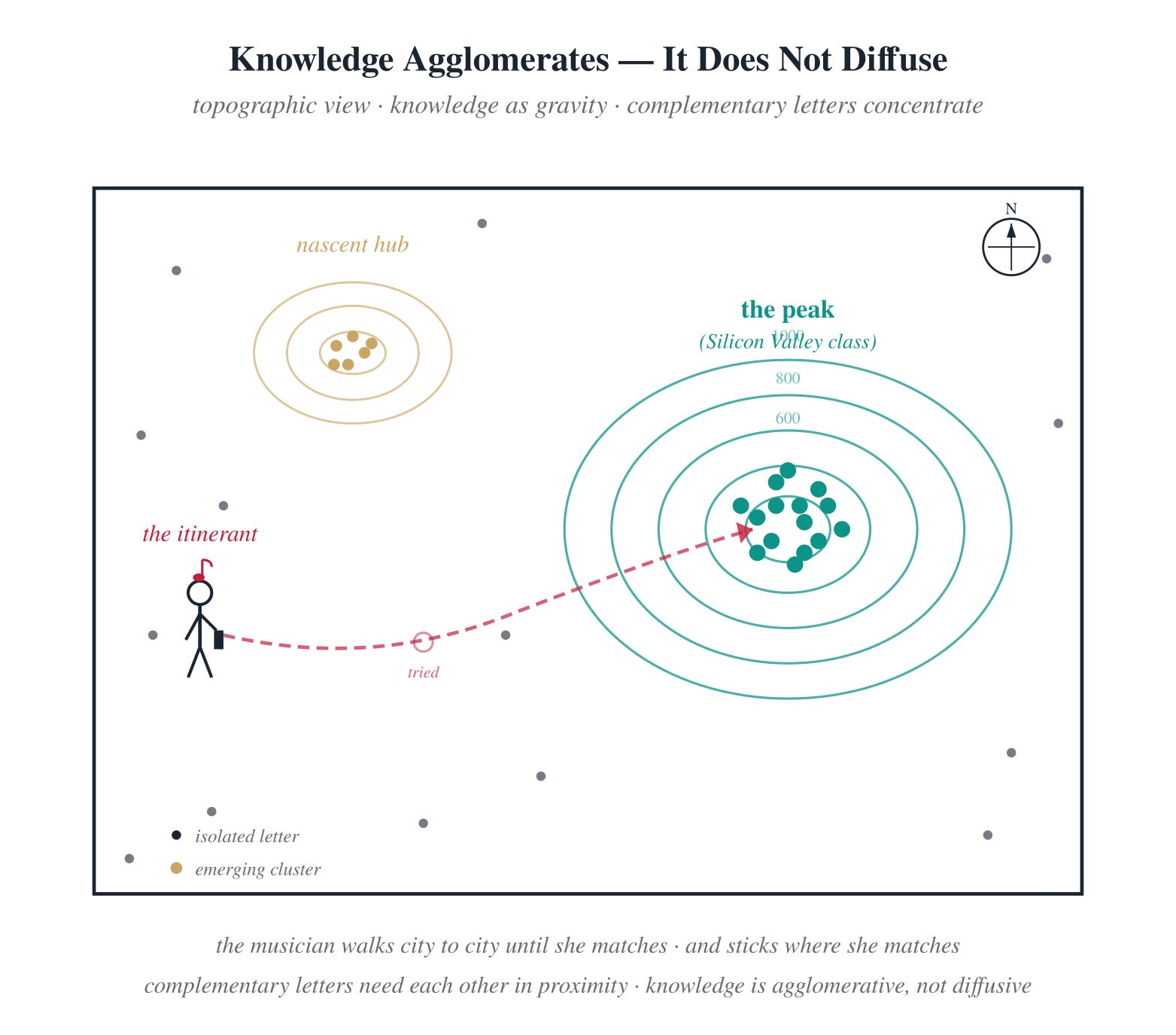
Hidalgo’s musician analogy is the cleanest articulation of why knowledge concentrates in specific geographies and refuses to spread through investment alone. Imagine an itinerant musician who plays a specific instrument in a specific style, walking city to city looking for other musicians whose instruments complement hers and whose style matches. She fails, fails, fails — until she finds the place where she matches, and she stays.
Knowledge is agglomerative, not diffusive. This is why Silicon Valley remains Silicon Valley, why Shenzhen remains Shenzhen, why Paris and Cambridge and Tel Aviv and Bangalore concentrate. The complementary letters are already there. New letters seek out existing ones. Once the density is built, it compounds.
The policy corollary is devastating for the “AI city in the desert” thesis:
Yachay, Ecuador. A billion dollars invested in building a city of knowledge in the high Andes, two hours from Quito. Went nowhere. The letters were not there and could not be summoned by real estate.
Neom, Saudi Arabia. Five hundred billion dollars for a linear city in the desert. As of mid-2026, being repositioned as a data center. Hidalgo’s aside in the interview was pointed: the project’s ambition collapsed into infrastructure because the human alphabet never showed up.
Zhongguancun, Beijing. The counter-example. China did not put money into buildings in empty places. It focused on central business districts that already had density, created funds that invested in companies rather than campuses, and targeted sectors at the beginning of a window of opportunity. It worked.
The diagnostic is generalizable. Any AI-cluster policy that spends on physical infrastructure in a place without pre-existing complementary letters is Yachay. Any policy that invests in companies where the density already exists is Zhongguancun. The name changes each generation; the outcome does not.
The forgetting rate — 3 to 6 percent per month
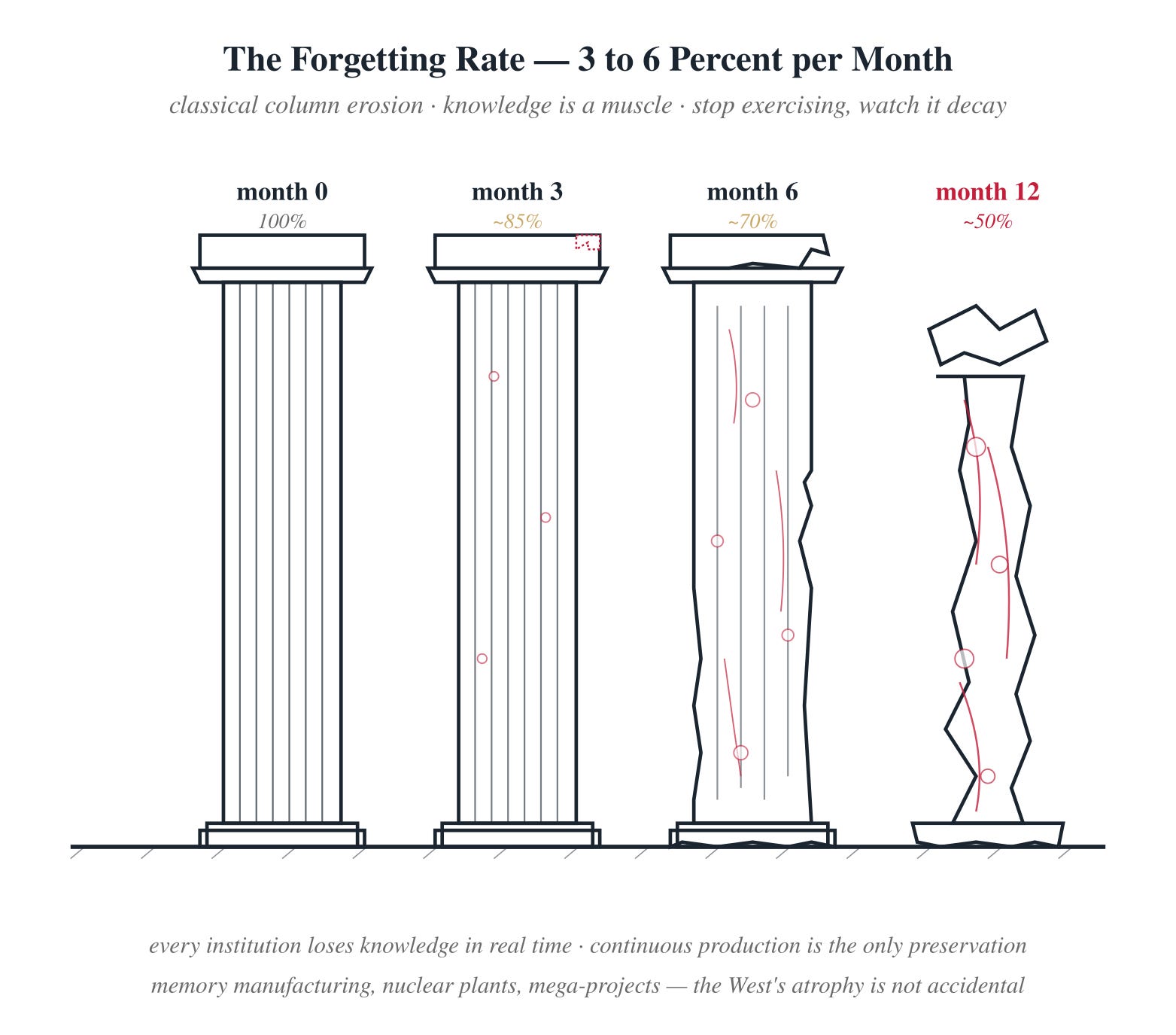
The most quotable statistic in the interview, and one I have not seen circulate anywhere else: firms lose 3 to 6 percent of their knowledge every month. Hidalgo cited this from research on organizational forgetting, and referenced his own January 2026 Financial Times article on the topic.
The number compounds. At 3% monthly, 30% annual attrition. At 6% monthly, over 50%. The reason we do not perceive this loss is that learning offsets it in real time. Stop learning for eighteen months, and half the institutional knowledge is gone.
Hidalgo’s phrasing was surgical: “knowledge is like a muscle — the moment that you stop exercising, it becomes weak.”
The consequences ripple across the AI stack in ways that are becoming visible right now.
Memory manufacturing. In our conversation I raised the current build-out of AI-era cloud infrastructure — data centers designed for CPUs having to be rebuilt for GPUs. The unexpected bottleneck is memory. As Hidalgo noted, for decades the industry treated memory as solved and stopped innovating. Now only three companies make memory for GPUs, and demand is dwarfing supply. The forgetting was not passive; it was the market signaling that memory was a commodity, and the commodity signal caused the muscle to atrophy.
LCD panels as the general case. Hidalgo used LCD panel generations as the illustrative case. High-complexity products go through generational cycles. Firms that miss a single generation drop out of the market permanently, because the accumulated tacit knowledge required to compete has grown faster than they could catch up. Consolidation from many firms to a handful is the terminal state.
Nuclear plants and mega-projects. The West stopped building nuclear at scale in the late 1970s. Forty-plus years of continuous forgetting has produced the current situation: the West has to relearn nuclear construction, and it is genuinely difficult, because the knowledge is gone. The same pattern is visible in rail, high-voltage grid engineering, high-precision machining, mega-bridges. Meanwhile China, which has been building continuously for thirty years, holds these alphabets fluently.
The muscle argument means preservation requires continuous production, not archival. You cannot warehouse capability. You cannot document your way out of forgetting. The only way to keep a letter of the alphabet is to keep writing it.
The three geometries as combinatorial strategies
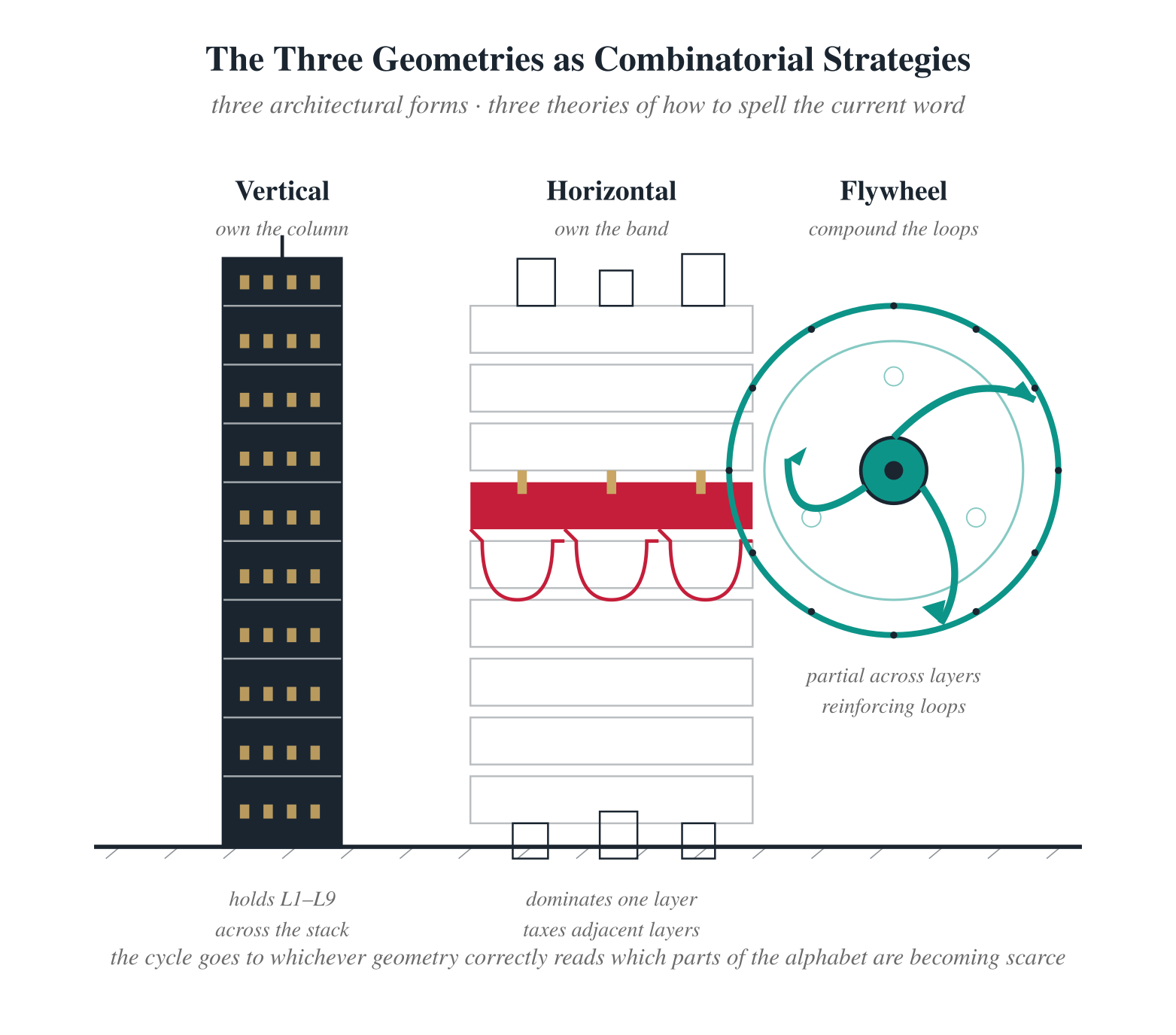
The observation that three distinct cross-stack geometries — vertical, horizontal, and flywheel — dominate the current cycle is exactly the pattern the infinite alphabet predicts.
Vertical geometry (Google’s owned column) is the strategy of holding a full set of letters across as many layers as possible. It maximizes control but concentrates all the alphabet-acquisition cost inside one firm. It works only for firms with two decades of accumulated cross-layer capability.
Horizontal geometry (NVIDIA’s rent-extracting band) is the strategy of dominating one layer’s alphabet completely, then charging every player at every adjacent layer for access. It maximizes leverage but exposes the firm to any competitor who develops equivalent letters in the same layer.
Flywheel geometry (SpaceX-style multi-engine compounding) is the strategy of holding partial alphabets across several layers that reinforce each other, so each layer’s letters make the next layer’s letters more valuable. It maximizes compounding but requires enormous patience and cannot be replicated by acquisition.
These are not three ways of doing the same thing. They are three fundamentally different theories about how to spell the current word of the industry. Each geometry bets on a different structural feature of the alphabet. The cycle will not go to whichever firm builds the best model. It will go to whichever geometry correctly reads which parts of the alphabet are becoming scarce.
Governance as fence, not letter
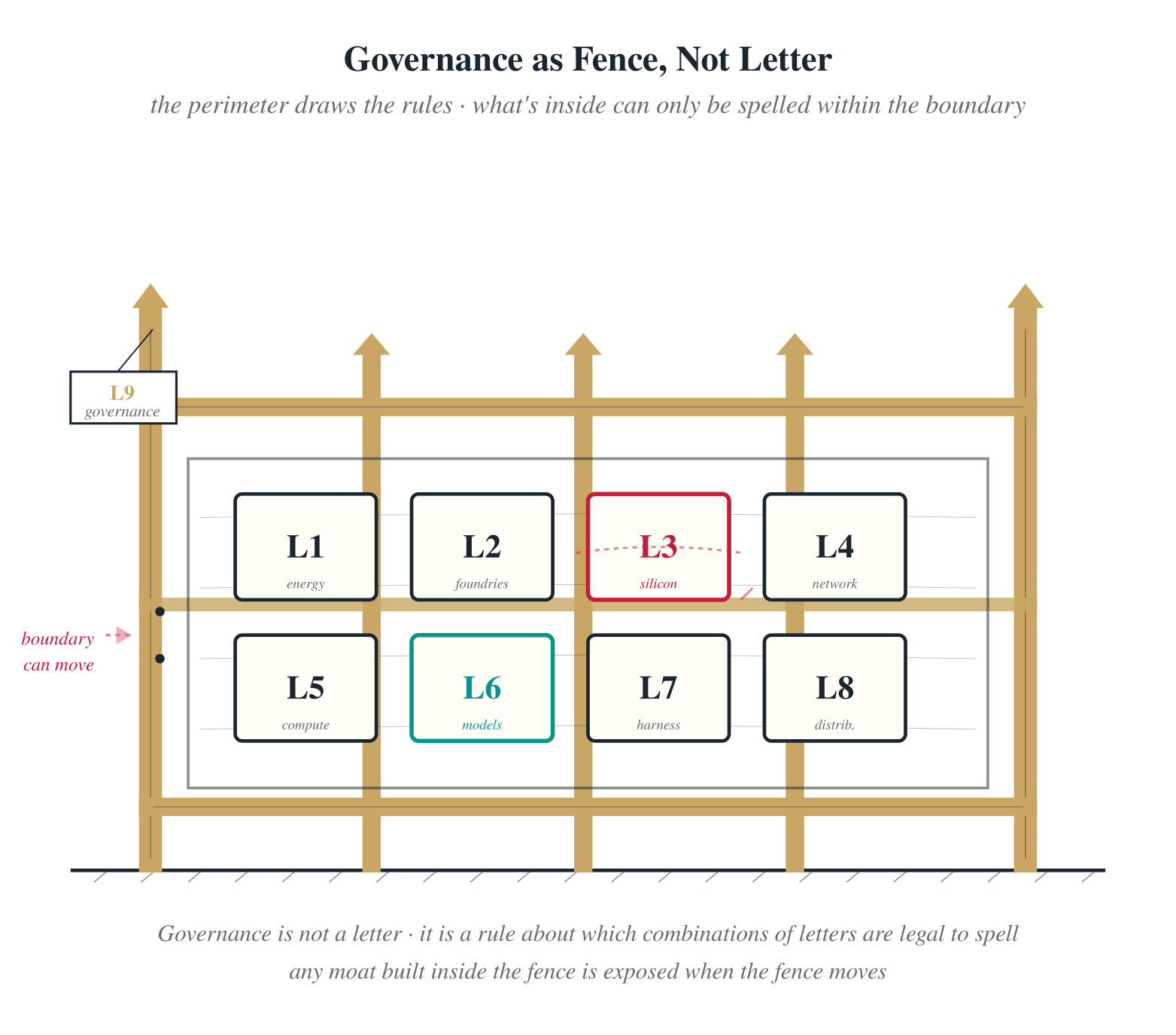
The most subtle claim in the Map of AI is the treatment of Layer 9, Governance. It is drawn as the ninth layer, but it does not behave like a layer. It behaves like a fence around the other eight.
Under the infinite alphabet, this makes precise sense. Governance is not a set of letters. Governance is a set of rules about which combinations of letters are legal to spell. Export controls on advanced silicon are not a Layer 3 problem. They are a rule about which Layer 3 letters can be combined with which downstream letters by which players in which jurisdictions. Content policy on frontier models is not a Layer 6 problem. It is a rule about which Layer 6 letters can be combined with which Layer 8 distribution surfaces.
The strategic implication is severe. Any firm building a moat inside the eight technical layers is building it inside a fence whose boundaries can be redrawn overnight. Governance is not a layer to be dominated. It is a constraint to be modeled, and firms that do not model it as a first-class variable in their strategic planning are exposed to a shock they cannot see until it lands.
What the Alphabet Predicts
Two clean predictions fall out of the frame once you hold it steady.
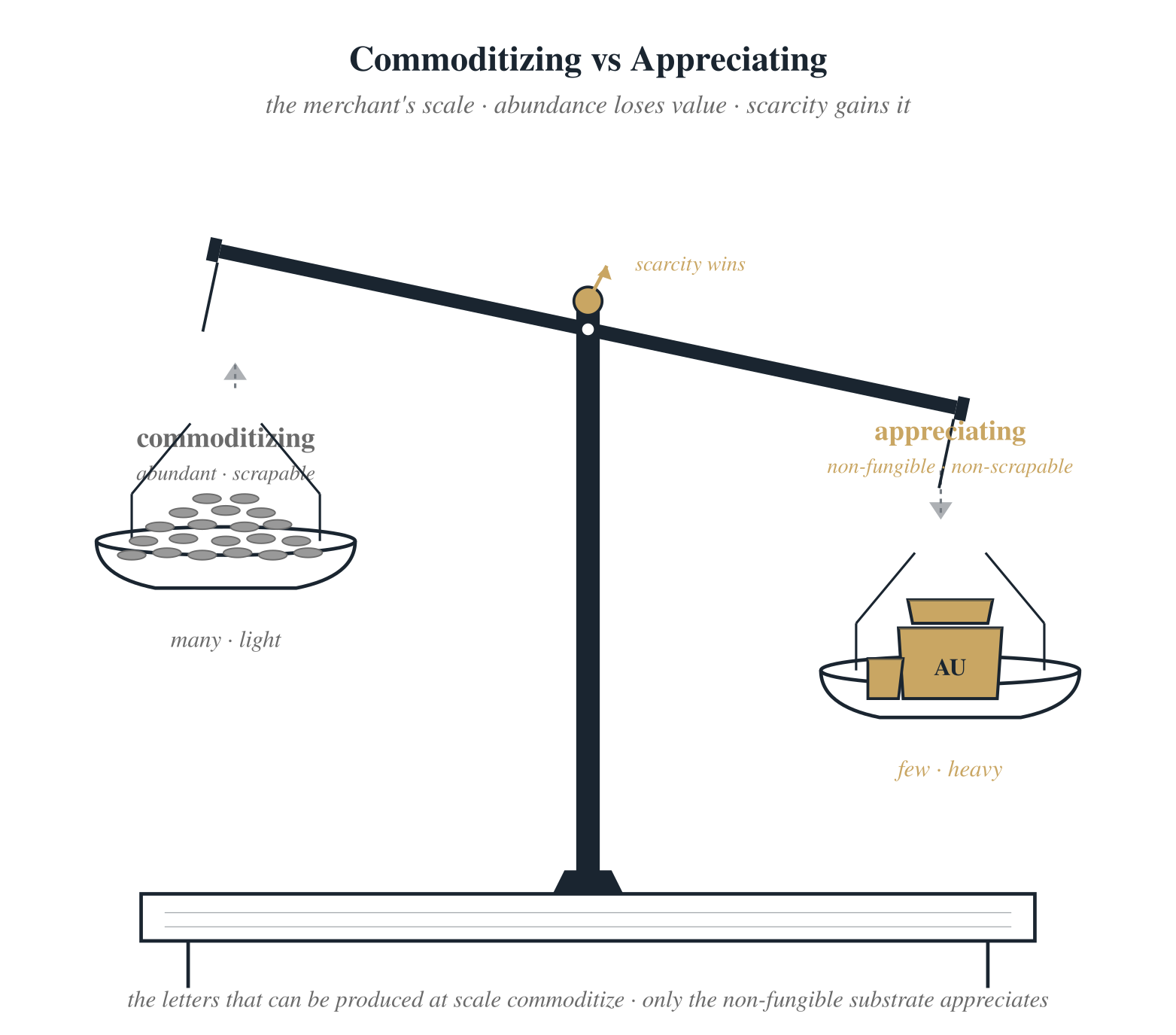
The commoditizing letters. Whatever letter enters mainstream production today will be table stakes within three years and worthless as a moat within five. This is what commoditization means under the infinite alphabet: the letter becomes so widely held that it stops being a differentiator and starts being a required input. Pre-training capability commoditized in 2024. Reasoning capability is commoditizing through 2026. Agentic capability will commoditize by 2028. Nothing that can be scaled and shared stays a moat.
The appreciating letters. Whatever letter cannot be scraped, scaled, or shared appreciates in value as the commoditizing letters lose theirs. Tacit knowledge in specific industries. Non-fungible expertise locked to specific firms. Regulatory positioning locked to specific jurisdictions. Distribution surfaces locked to specific user relationships. Physical-world capability that lives in the parts of the alphabet AI cannot yet read. These letters do not commoditize because they cannot be produced at scale. They can only be assembled slowly, one relationship at a time.
The strategic move that falls out of this is sharper in the alphabet framing than in any other frame I have seen: identify the specific letters your firm holds that are non-scrapable, non-scalable, and non-shareable. Everything else is rented substrate. Whatever you own that is scarce is your position. Whatever you rent that is abundant is your cost line.
The winners of the next decade of the AI Supercycle will not be the firms with the best models, the largest compute budgets, or the strongest brand recognition. They will be the firms that correctly identified which specific letters were becoming scarce, and assembled a defensible position around those letters before the rest of the market noticed.
The physics that closes the argument
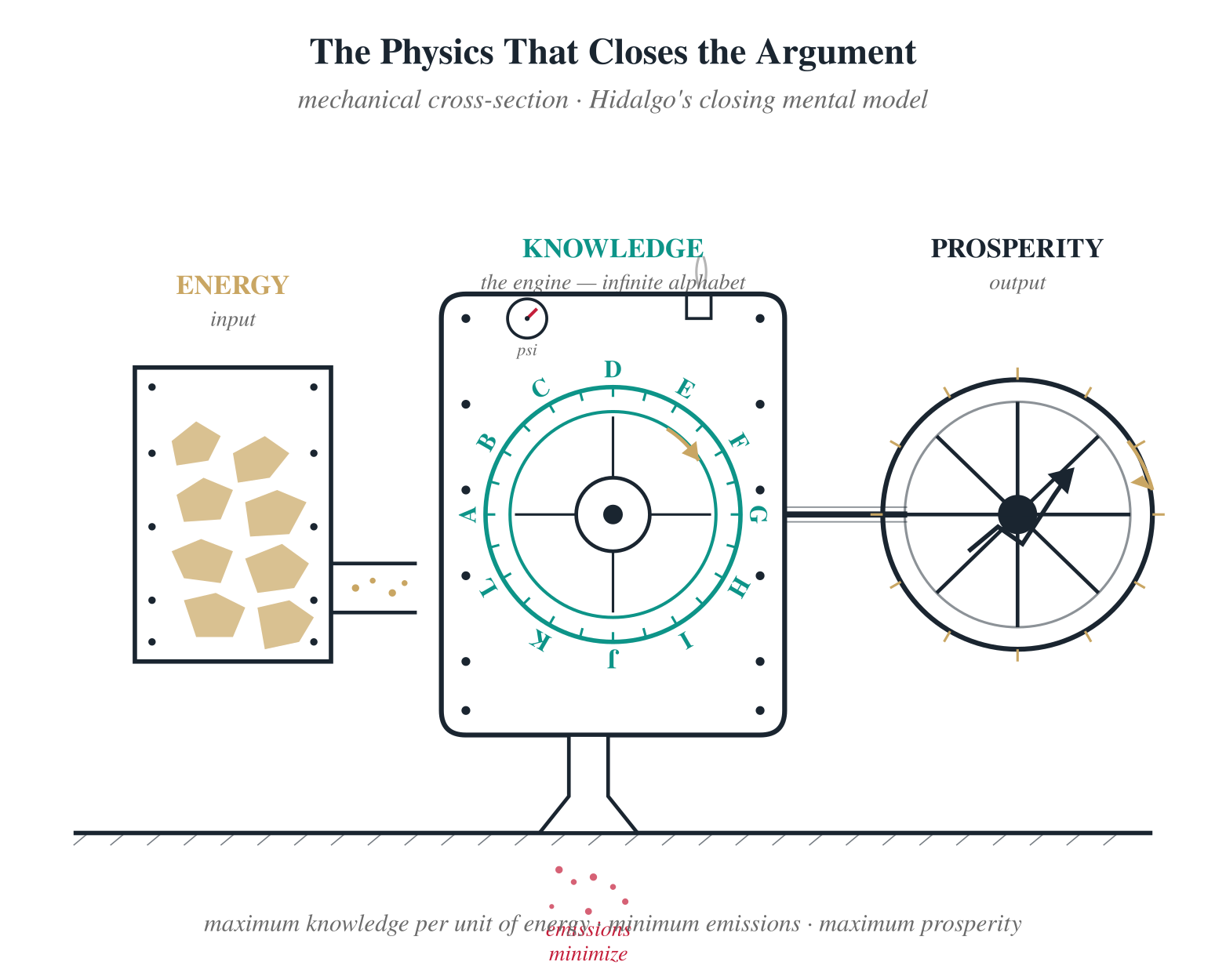
Hidalgo ended the conversation with the mental model he uses himself, and it is the correct synthesis to close on. He described a continuity between physics, biology, and economics — and offered a single operating frame for reading any economic system:
Energy is the input. Prosperity is the output. Knowledge is the engine in between.
The question worth asking of any economy is how much knowledge is produced per unit of energy, with what side effects (emissions being the critical one), and what that ratio implies for the prosperity the system can generate.
Apply this to the AI Supercycle and the whole framework snaps into focus. The supercycle is fundamentally an energy-to-knowledge conversion story. Data centers are the visible tip. Frontier labs are the workshops where new letters of the alphabet are being spelled. The unit economics of the cycle are the ratio of prosperity produced to energy consumed, and every strategic question at the technology layer is downstream of that ratio.
This is why the Map of AI has Energy & Physical at Layer 1. Not because energy is a factor, but because energy is the input. Everything above it — foundries, silicon, networking, compute, models, harness, distribution — is machinery for converting energy into knowledge. Governance is the fence around the machinery. And the output the whole apparatus is trying to produce is prosperity: measurable increases in what human societies can do.
The Infinite Alphabet is the vocabulary for the middle term — the knowledge that lives between energy input and prosperity output. It is why the middle term cannot be reduced to a single number, why more of it does not automatically mean more prosperity, why some combinations of letters produce breakthroughs and other combinations produce nothing. And it is why the strategic question every AI-era firm has to answer is not “how much intelligence can we produce” but “which letters can we spell that nobody else can.”
The commoditizing letters lose value as they are copied. The appreciating letters gain value as the surrounding market becomes able to see how rare they are. The firms and geographies that read the alphabet correctly capture the next generation of prosperity. The ones that treat AI as jello miss it.
Key Takeaways & Mental Models
The Infinite Alphabet is a change of representation. Knowledge is not a single homogeneous substance; it is a vast collection of complementary, non-substitutable letters. The economy is a Scrabble game played across geographies and centuries.
Complementarity and non-substitutability are the two load-bearing properties. Letters need each other to form words. Letters cannot be swapped. Together these produce a combinatorial economy where value lives at the joints.
A large fraction of the alphabet is physical. Robotics has not yet crossed into it. AI capability curves are being measured against the fraction of the alphabet the current stack can see.
The exponential is a stack of S-curves. Hidalgo confirmed the AI-industry version on record. Pre-training, test-time compute, agentic loops, continual learning — each a bounded curve, together a cascade. Winners are on the next curve, not the current one.
The bubble-vs-supercycle paradox is resolved through the alphabet. The bubble is the market treating non-fungible knowledge as fungible. The supercycle is the substrate compounding underneath. Both are true simultaneously.
The three nested cycles are three rates of alphabet change. New letters on the short cycle. Industries re-sort on the medium cycle. Civilizations absorb the alphabet on the long cycle.
The printing press is the Zero Industrial Revolution. AI 2016–2030 runs on the same clock as Reformation 1516–1530. The perceived slowness of past revolutions is a memory artifact.
Absorptive capacity is the enterprise bottleneck. Eight months to procure a Claude Max subscription is half a paradigm cycle. Enterprises without absorptive capacity are systematically one cycle behind.
The Map of AI is nine distinct alphabets, not nine categories of the same substance. No single player can master all nine.
Knowledge agglomerates, it does not diffuse. Silicon Valley, Shenzhen, Zhongguancun succeed because the letters were already there. Yachay and Neom fail because they cannot be summoned by real estate.
The forgetting rate is 3 to 6 percent per month. Knowledge is a muscle. Continuous production is the only preservation mechanism. The West’s memory-manufacturing bottleneck, nuclear-plant capability loss, and mega-project atrophy all follow the same law.
Governance is a fence, not a letter. It is a set of rules about which combinations are legal. Any moat built inside the fence is exposed when the fence moves.
The final synthesis is Hidalgo’s own mental model. Energy is input. Prosperity is output. Knowledge is the engine. Maximize knowledge per unit of energy, minimize emissions, and prosperity follows. The Infinite Alphabet is the vocabulary for the middle term.
The only durable strategic question is which letters you hold that nobody else can spell. Everything scrapable, scalable, or shareable commoditizes. Only the non-fungible substrate appreciates.


