


This episode was first published on The Business Engineer in November 2025. Looking back, it fits more naturally within the AI Supercycle series, as it examined one of the most important physical and geopolitical foundations of the AI era: Apple’s manufacturing dependency on China.
Apple’s China story is not just about supply chains. It is about how technology, manufacturing depth, geopolitical risk, and market access became fused into a single strategic system. That same system-level tension will define the next phase of AI infrastructure, where control over production capacity may matter as much as control over software, chips, or models.
Patrick McGee’s “Apple in China” isn’t just a business book—it’s a chronicle of how the world’s most valuable company became inextricably tied to America’s chief geopolitical rival, transforming both in the process.
The story begins not with strategy or vision, but with embarrassment. Patrick McGee, then the Apple reporter for the Financial Times, was interviewing the CEO of Qualcomm—a $200 billion chip designer that powers virtually every 3G, 4G, and 5G device on the planet. The CEO mentioned that during COVID, he had quarantined for 14 days just to visit factories in Taiwan. McGee was puzzled. Qualcomm is a fabless company—they don’t manufacture chips themselves. Why the visit?
“We follow the Apple model,” the CEO explained.
McGee realized he had no idea what that meant. He was covering Apple, and he didn’t understand the fundamental architecture of how the company actually operated. That moment of professional shame became the genesis of one of the most important business books of the past two decades—a work that traces not just Apple’s history, but the evolution of US-China relations, global supply chains, and the hollowing out of American manufacturing capacity.
The Foundation: Survival Through Outsourcing
The conventional narrative around Apple treats the company as a design genius that happened to manufacture in China. The reality is far more pragmatic and far more desperate.
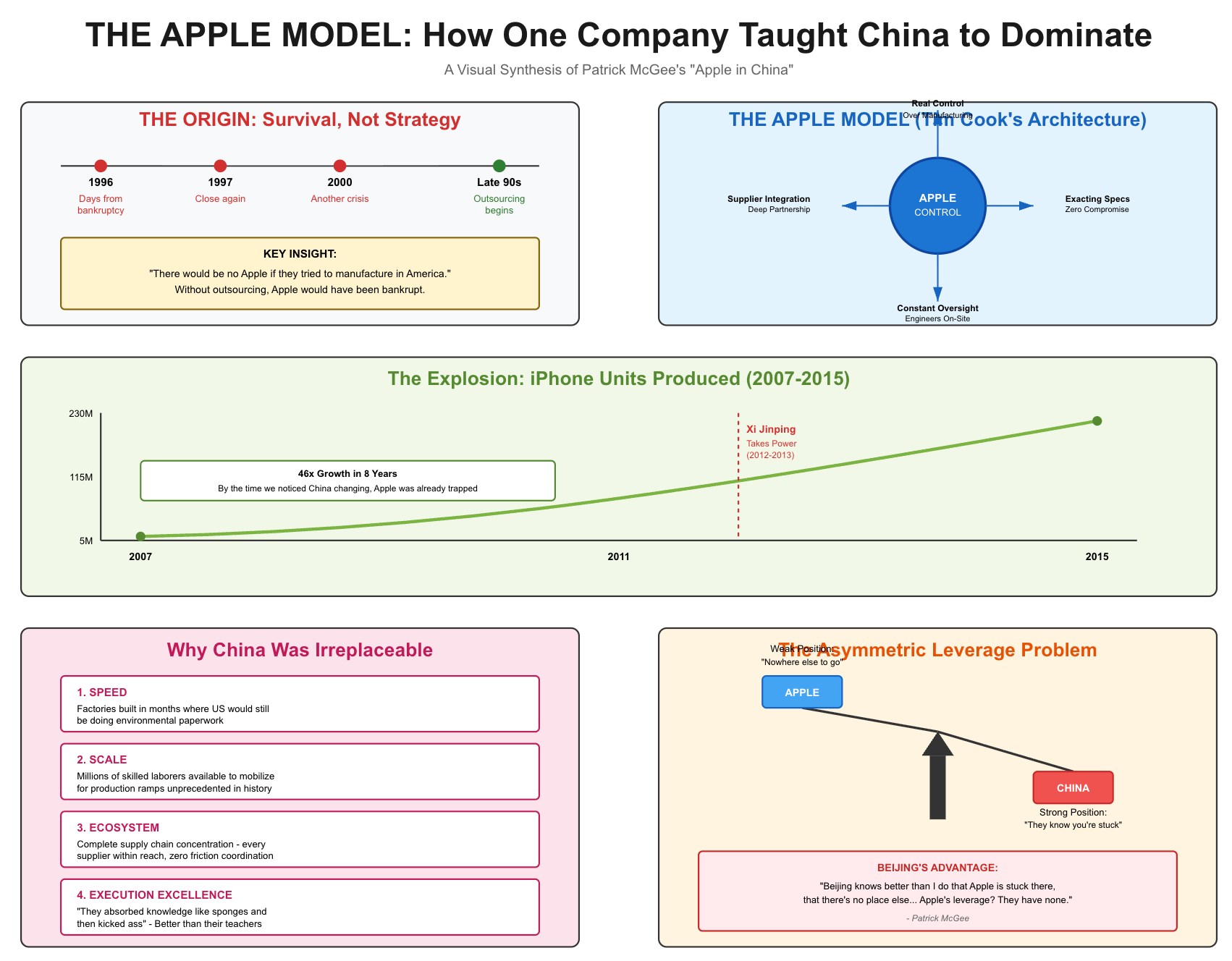
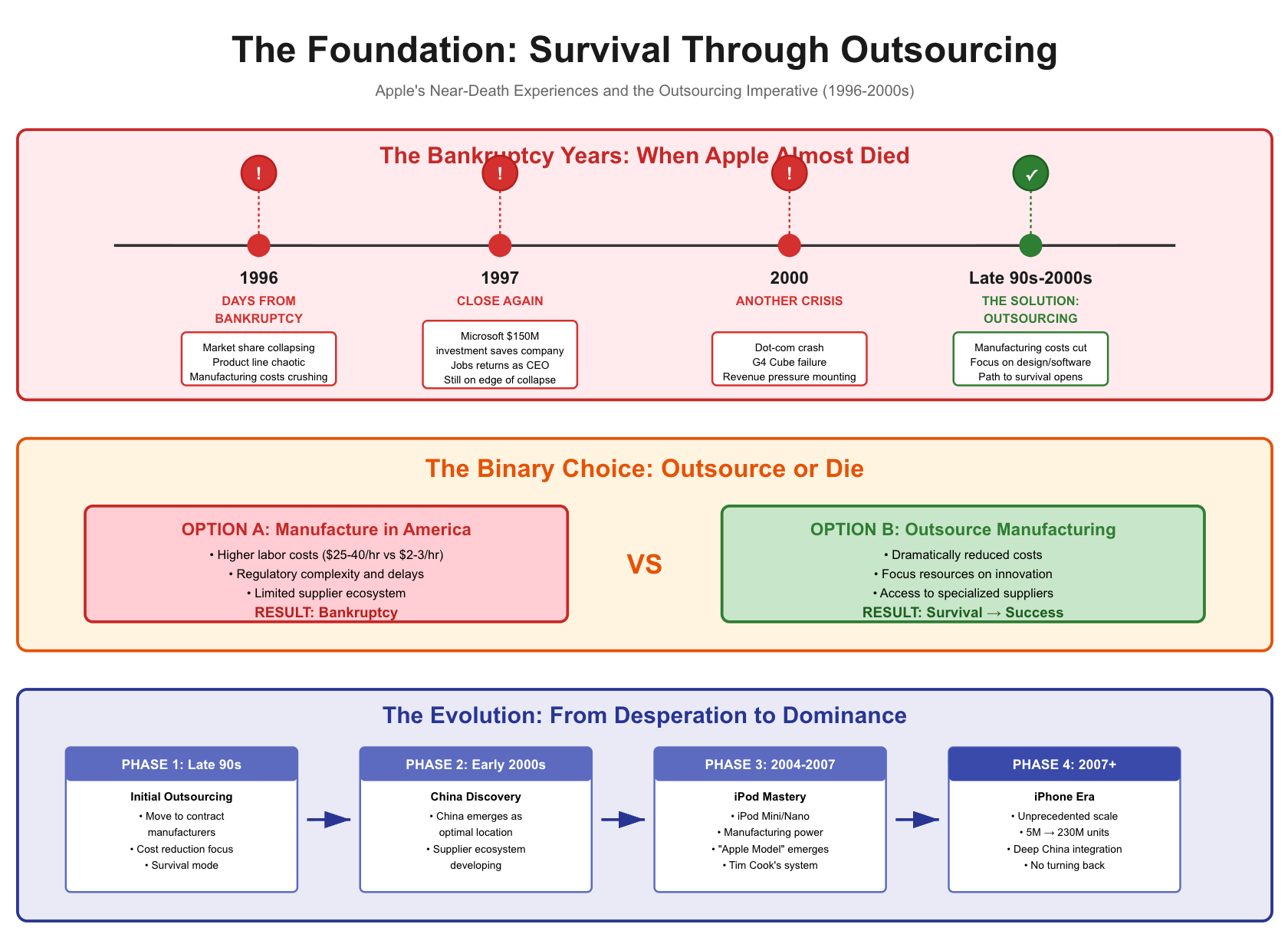
Apple wasn’t choosing between manufacturing philosophies in the 1990s. It was choosing between outsourcing and bankruptcy. The company came perilously close to collapse in 1996, again in 1997, and once more in 2000. Outsourcing and offshoring weren’t strategic luxuries—they were existential necessities.
McGee traces Apple’s journey through several distinct phases:
Late 1990s: Initial moves toward outsourcing as a survival strategy
Early 2000s: Discovery and deepening engagement with China
2004-2007: The iPod Mini and iPod Nano establish unprecedented manufacturing power
2007-2015: iPhone production explodes from 5 million units to 230 million units annually
These weren’t just product launches. They were the creation of an entirely new model for how complex electronics could be manufactured at scale—a model that would reshape global industry.
What Made China Different
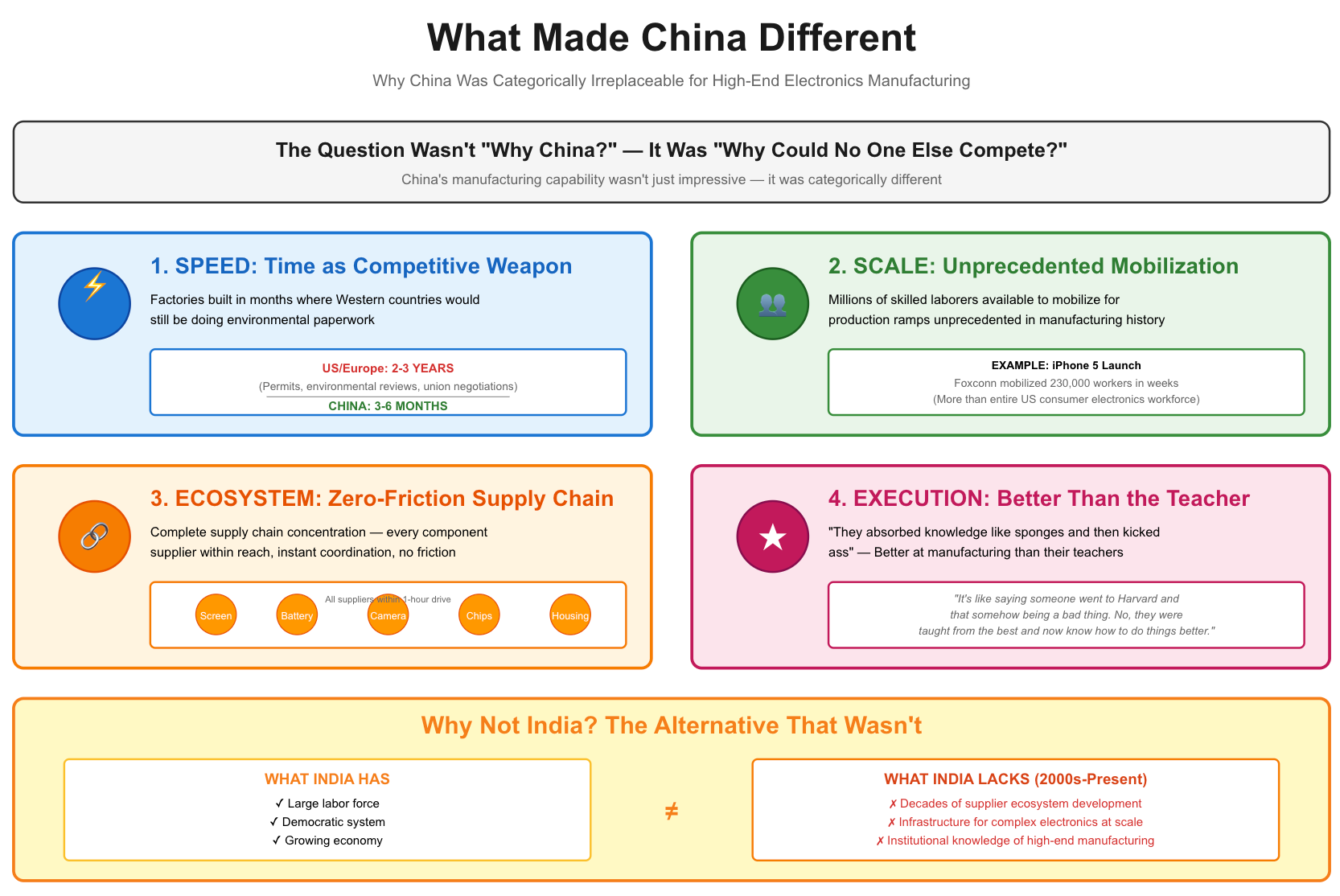
The question isn’t why Apple went to China. The question is why no one else could compete with what China offered.
The scale and speed of China’s manufacturing capability wasn’t just impressive—it was categorically different from anything available in the developed world. McGee emphasizes that this wasn’t about cheap labor or regulatory arbitrage, though those factors mattered. It was about something deeper: China’s ability to mobilize resources, coordinate complex supply chains, and execute at a pace that made Western manufacturing look practically medieval.
Consider what Apple required: factories built in months where Western countries would still be doing environmental paperwork, access to millions of skilled laborers, and suppliers willing to retool their entire operations on Apple’s demanding timeline. China didn’t just meet these requirements—it exceeded them, becoming better at high-end electronics manufacturing than anyone else on the planet.
The relationship worked because both parties brought something essential to the table. Apple brought world-class engineering, exacting standards, and an almost obsessive attention to detail. China brought execution capacity, supply chain coordination, and an industrial policy that prioritized manufacturing excellence.
As McGee puts it: “Apple was the teacher.” But China wasn’t just a passive student. They absorbed knowledge like sponges and then kicked ass. It’s like saying someone went to Harvard—that’s not a criticism, it’s recognition that they learned from the best and now know how to do things better than their teachers.
The Tim Cook Factor
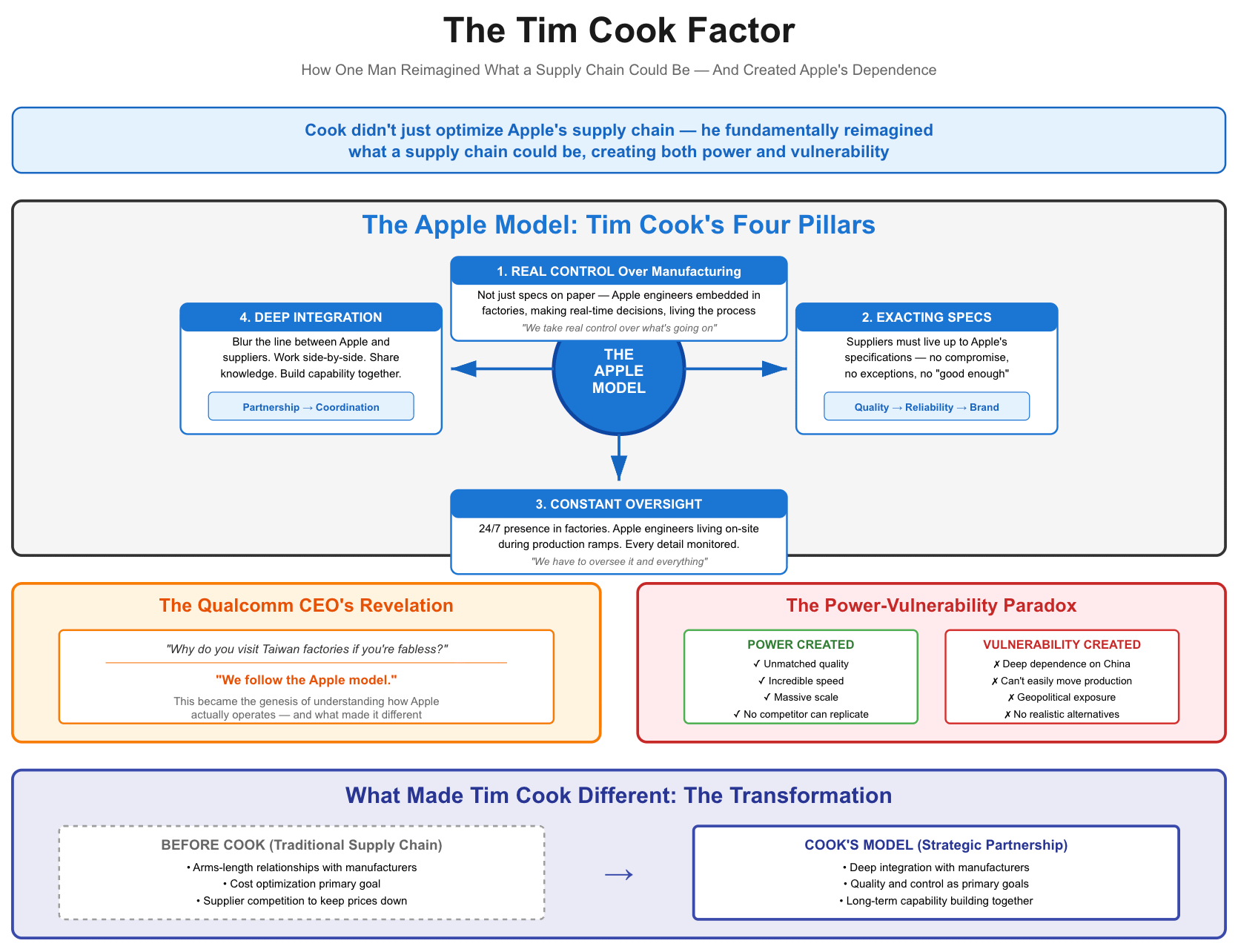
Before Tim Cook became CEO, he was the architect of Apple’s supply chain dominance. His role in this story cannot be overstated.
Cook didn’t just optimize Apple’s supply chain—he fundamentally reimagined what a supply chain could be. His innovations weren’t about cutting costs or finding cheaper suppliers. They were about achieving a level of control and coordination that no other company had demonstrated.
The “Apple model” that the Qualcomm CEO referenced essentially means: take real control over what’s happening in manufacturing, impose exacting specifications, maintain constant oversight, and never accept that “good enough” is actually good enough. Cook institutionalized this approach, creating systems where Apple engineers worked side-by-side with suppliers, where Apple’s standards became the industry’s standards, and where the line between Apple and its suppliers blurred in important ways.
This level of integration had a profound effect: it made Apple simultaneously powerful and vulnerable. Powerful because no competitor could replicate the quality, speed, and scale of Apple’s manufacturing. Vulnerable because Apple became deeply, perhaps irreversibly, dependent on a manufacturing ecosystem centered in China.
The Xi Jinping Inflection Point
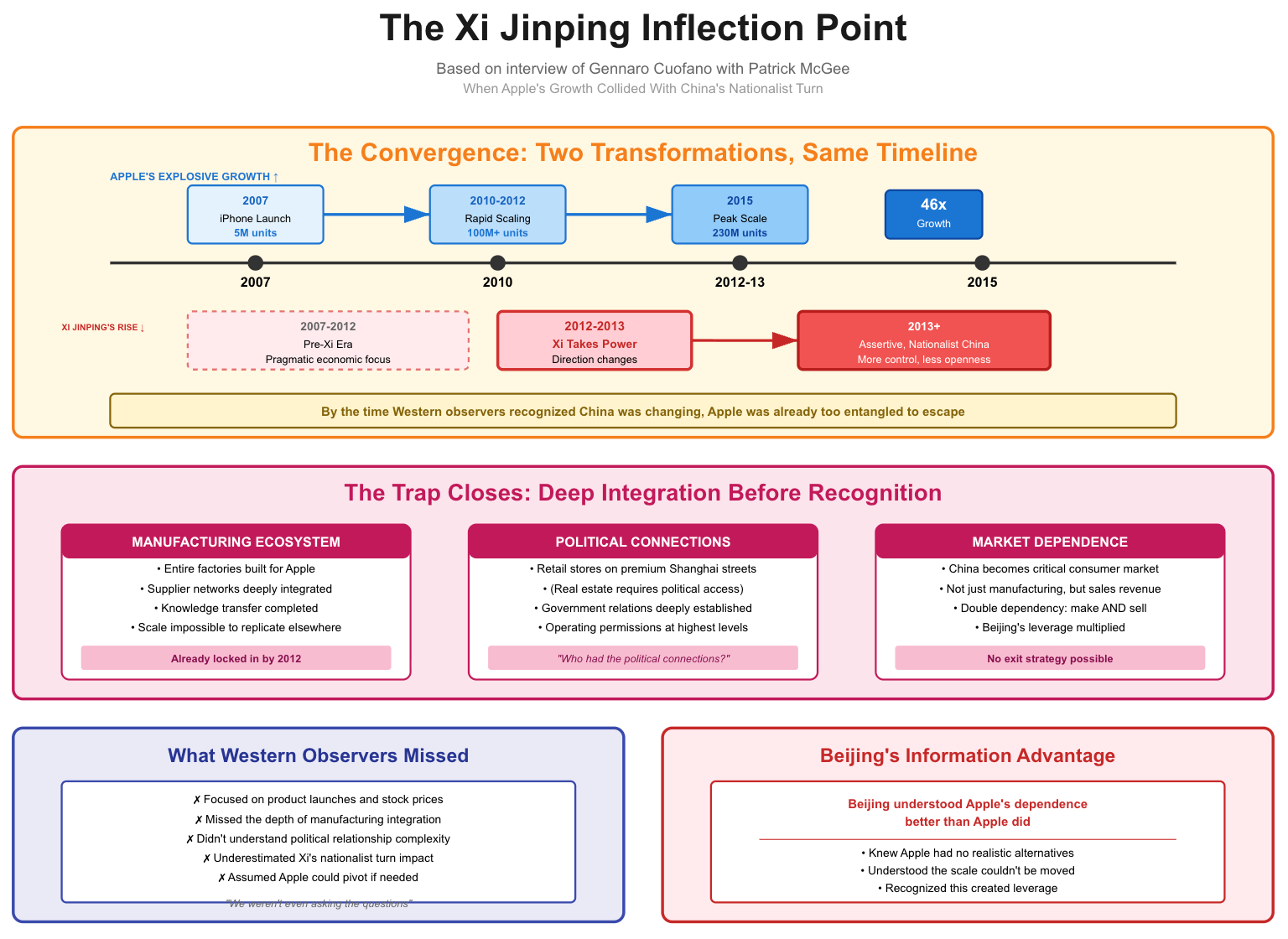
The period from 2007 to 2015 saw two parallel transformations: Apple’s explosive growth coincided almost exactly with Xi Jinping’s rise to power and his turn toward a more assertive, nationalist China.
By the time Western observers recognized that China was changing, Apple was already too entangled to easily extricate itself. The company had built not just factories, but entire ecosystems in China. They had negotiated retail locations on premium streets in Shanghai—something that requires significant political connections in China’s system. They had become embedded in China’s economy in ways that went far beyond manufacturing contracts.
McGee’s research reveals a question that few were asking: who actually had those political connections? How did Apple navigate China’s opaque political system? The answers involve a level of government relations and political engagement that most Western observers missed while focusing on product launches and stock prices.
The relationship also had profound asymmetries. Beijing understood Apple’s dependence better than Apple did. Chinese officials knew that Apple had no realistic alternative to China’s manufacturing capacity, at least not without years of investment and development. This knowledge became leverage in ways both subtle and explicit.
The Geopolitical Paradox
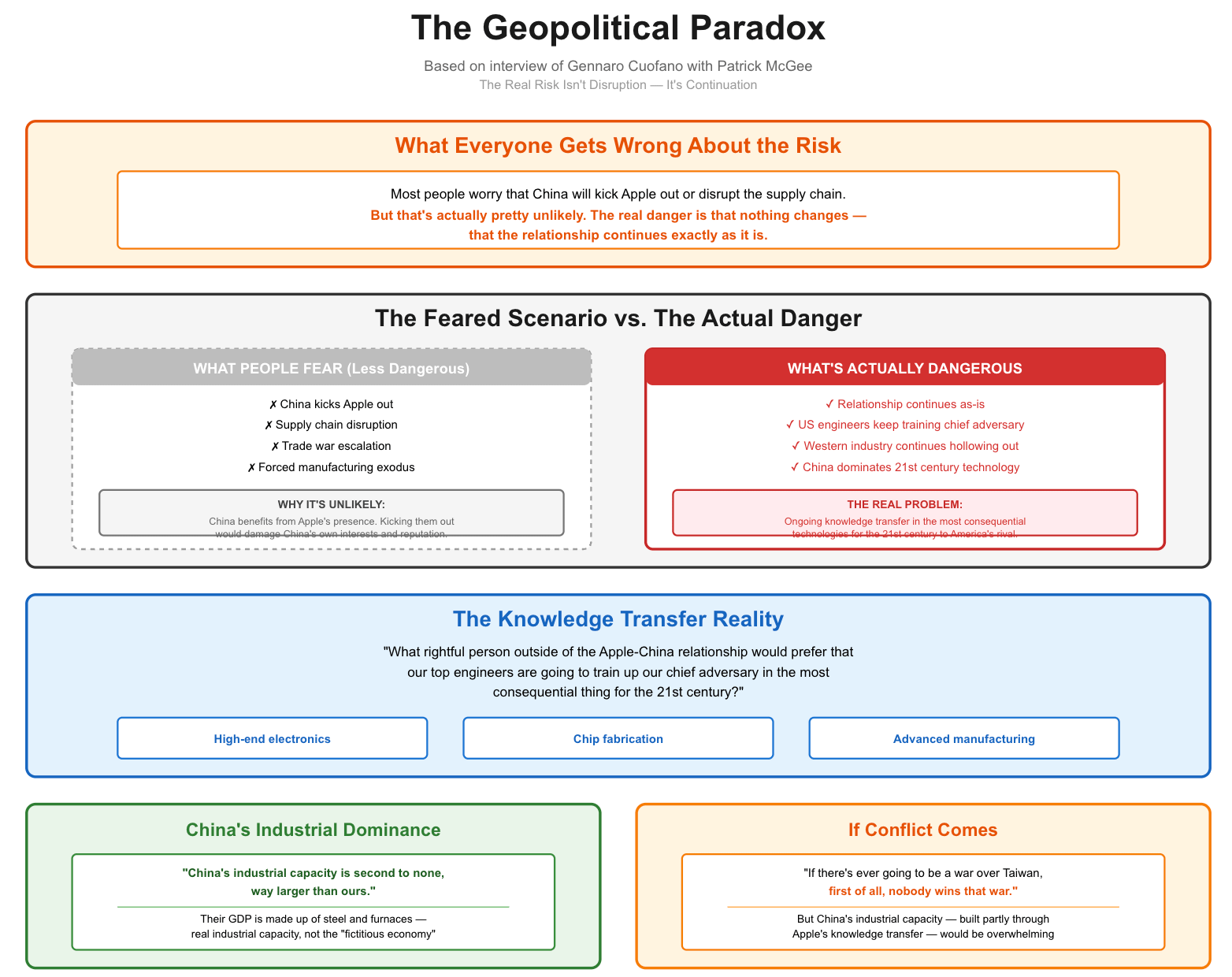
The most unsettling dimension of the Apple-China relationship isn’t what might happen—it’s what is happening.
The real risk isn’t that China will kick Apple out. The real risk is that the relationship will continue exactly as it is. McGee argues that the most dangerous scenario isn’t disruption, but continuity—a continued transfer of knowledge, capability, and manufacturing expertise from American engineers to America’s chief geopolitical rival.
Consider the implications: the United States is training its primary adversary in the most consequential technologies for the 21st century—high-end electronics, chip fabrication, advanced manufacturing. This isn’t happening through espionage or theft (though those exist). It’s happening through the ordinary operations of one of America’s most successful companies.
The question isn’t whether this makes business sense for Apple—clearly it does. The question is whether what makes sense for Apple makes sense for America. These interests aren’t necessarily aligned, and McGee’s book forces readers to confront that uncomfortable reality.
The Hollowing Out
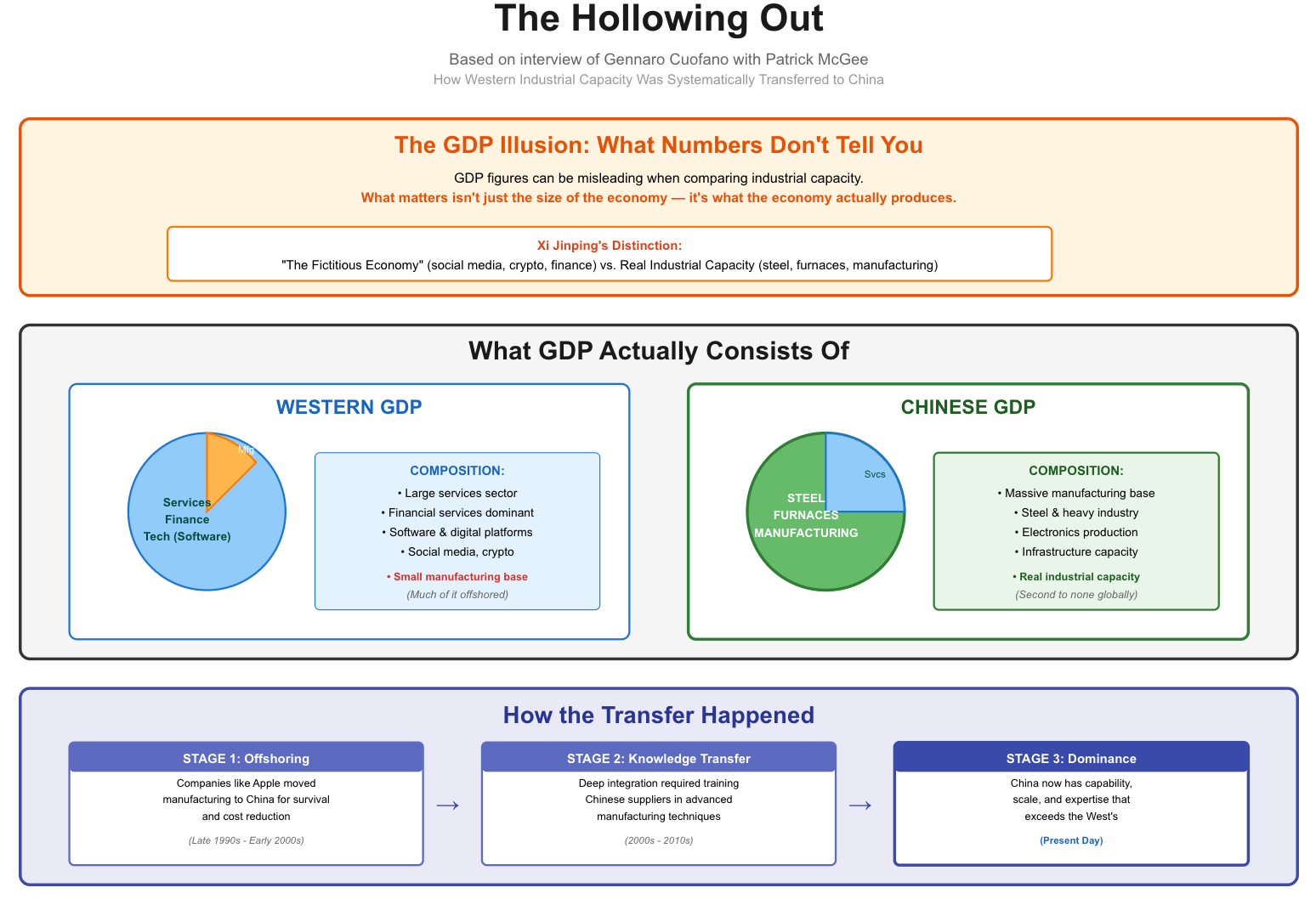
If war ever comes over Taiwan, McGee argues, “nobody wins that war.” But beyond the immediate catastrophe of military conflict lies a deeper concern: China’s industrial capacity is now second to none, far larger than America’s.
The GDP figures can be misleading. As Xi Jinping himself has noted, much of China’s GDP consists of “steel and furnaces”—real industrial capacity. By contrast, a significant portion of Western GDP comes from what Xi dismissively calls “the fictitious economy of social media and crypto.”
This isn’t just about manufacturing iPhones. It’s about the fundamental industrial base that any modern economy—and especially any military power—requires. The West’s industrial capacity has been systematically hollowed out, and China has systematically built up its own. Apple didn’t cause this trend alone, but it exemplified and accelerated it.
The Counterfactual Question
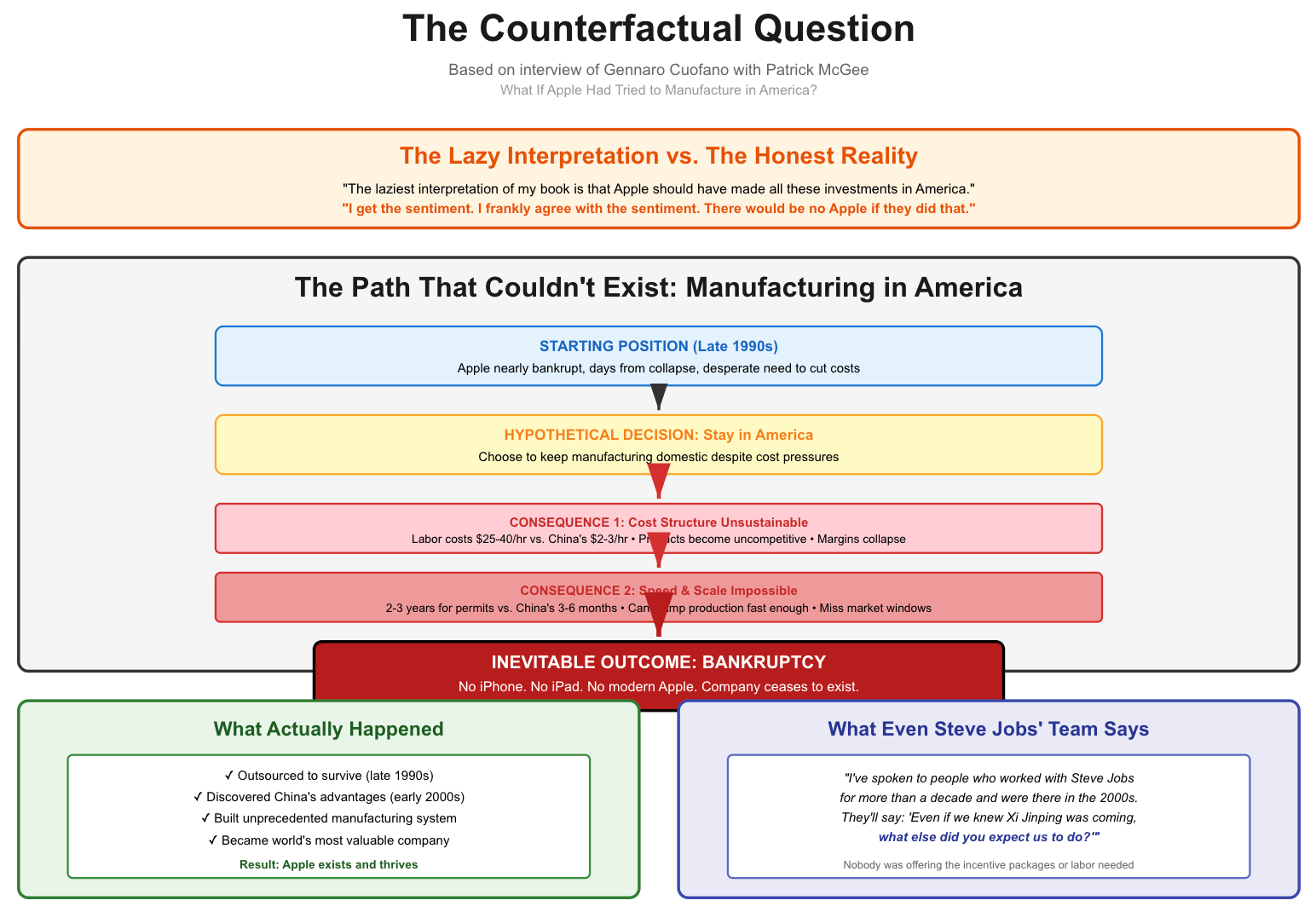
Could Apple have done things differently? McGee is blunt: “There would be no Apple” if the company had tried to maintain domestic manufacturing. The company was days away from bankruptcy in 1996, close again in 1997, and again in 2000. Without offshoring and outsourcing, Apple wouldn’t have survived to make the iPhone.
This creates an uncomfortable paradox for critics: the very success story they want to claim for America was only possible because of deep integration with China. The iPhone exists because of China’s manufacturing capability. The iPad, the MacBook, the entire Apple ecosystem—none of it would exist without the model McGee documents.
Even people who worked directly with Steve Jobs for more than a decade acknowledge this reality. When asked about the Xi Jinping era, they respond: “What else did you expect us to do?” Nobody else was offering the incentive packages, the millions of laborers, or the ability to build factories in months rather than years.
The lazy interpretation of McGee’s book is that Apple should have invested in America. The honest interpretation is that if Apple had done so, we wouldn’t have an Apple to argue about.
The India Question
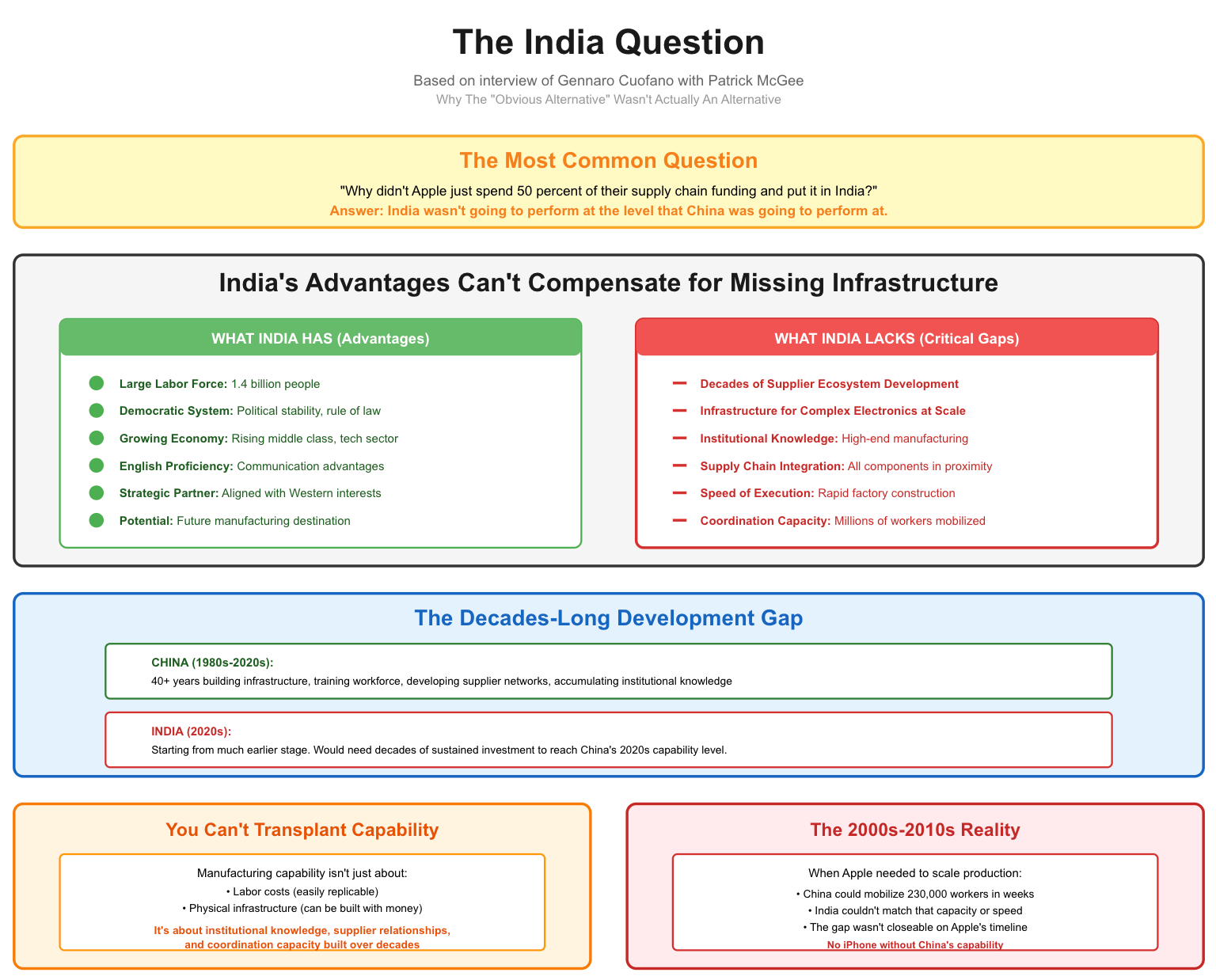
As tensions with China have increased, India has emerged as a popular alternative in policy discussions. The reality is more complicated.
India wasn’t going to perform at the level China performed at—not in the 2000s, and arguably not now. This isn’t about criticizing India’s potential. It’s about recognizing that China spent decades building the infrastructure, training the workforce, and developing the supplier ecosystems necessary to manufacture complex electronics at scale.
You can’t simply transplant this capability to another country, even one with significant advantages like India’s demographics and democratic system. The manufacturing ecosystem is as much about institutional knowledge, supplier relationships, and coordination capacity as it is about labor costs or physical infrastructure.
The Asymmetric Leverage Problem
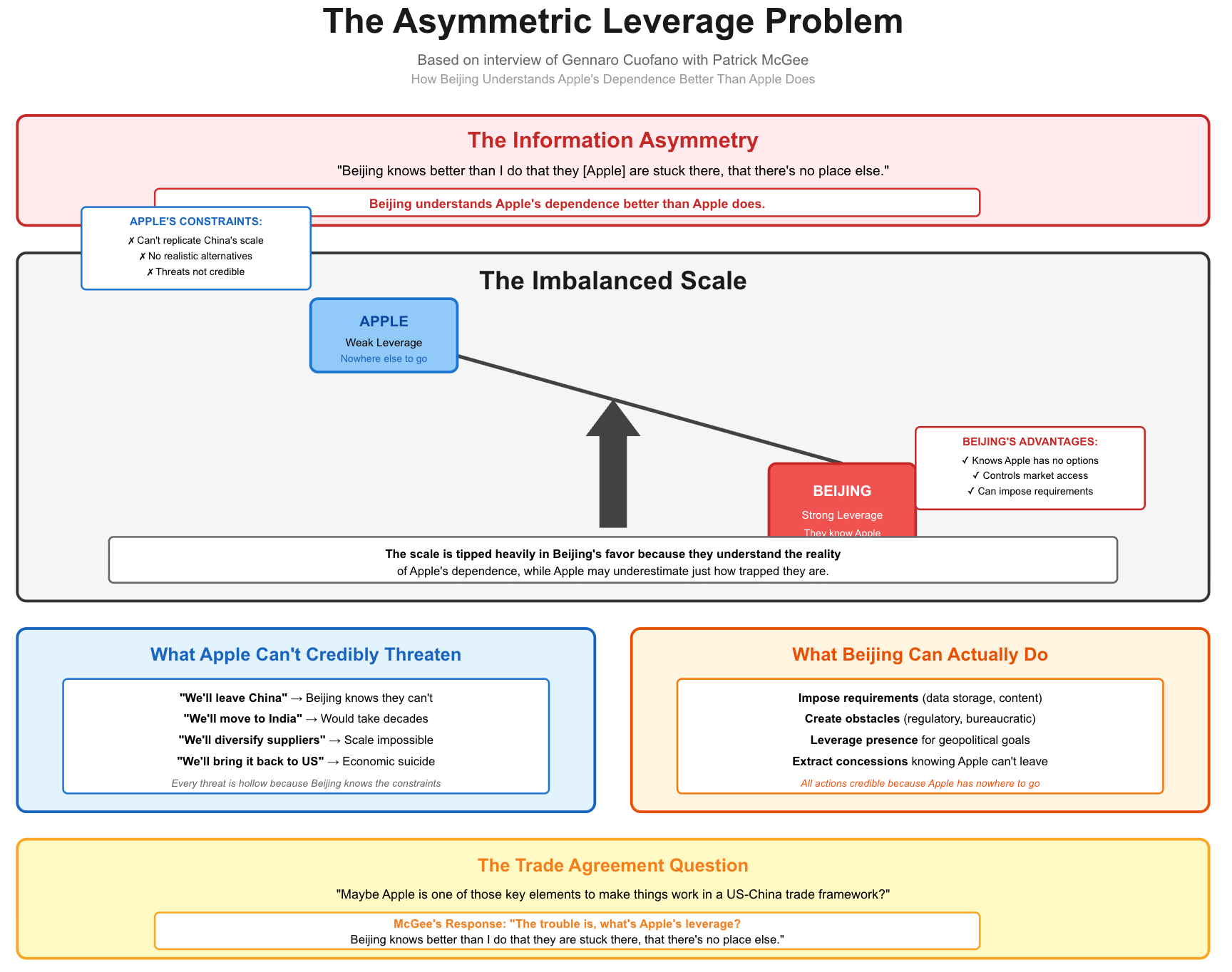
One of the most striking insights from McGee’s analysis: Apple’s leverage in China is far weaker than most observers assume. Beijing knows that Apple is stuck. They understand that there’s no realistic alternative manufacturing location that can deliver what China delivers.
This knowledge creates a profound asymmetry in bargaining power. Apple can threaten to leave, but the threat isn’t credible—at least not on any timeline that matters for current business decisions. China can impose requirements, create obstacles, or simply leverage Apple’s presence for broader geopolitical goals, knowing that Apple’s options are limited.
The situation might theoretically improve under some framework of US-China trade agreements, with Apple as a key element making things work. But McGee is skeptical: what exactly is Apple’s leverage in negotiating such arrangements when Beijing knows the company has nowhere else to go?
The Sourcing Achievement
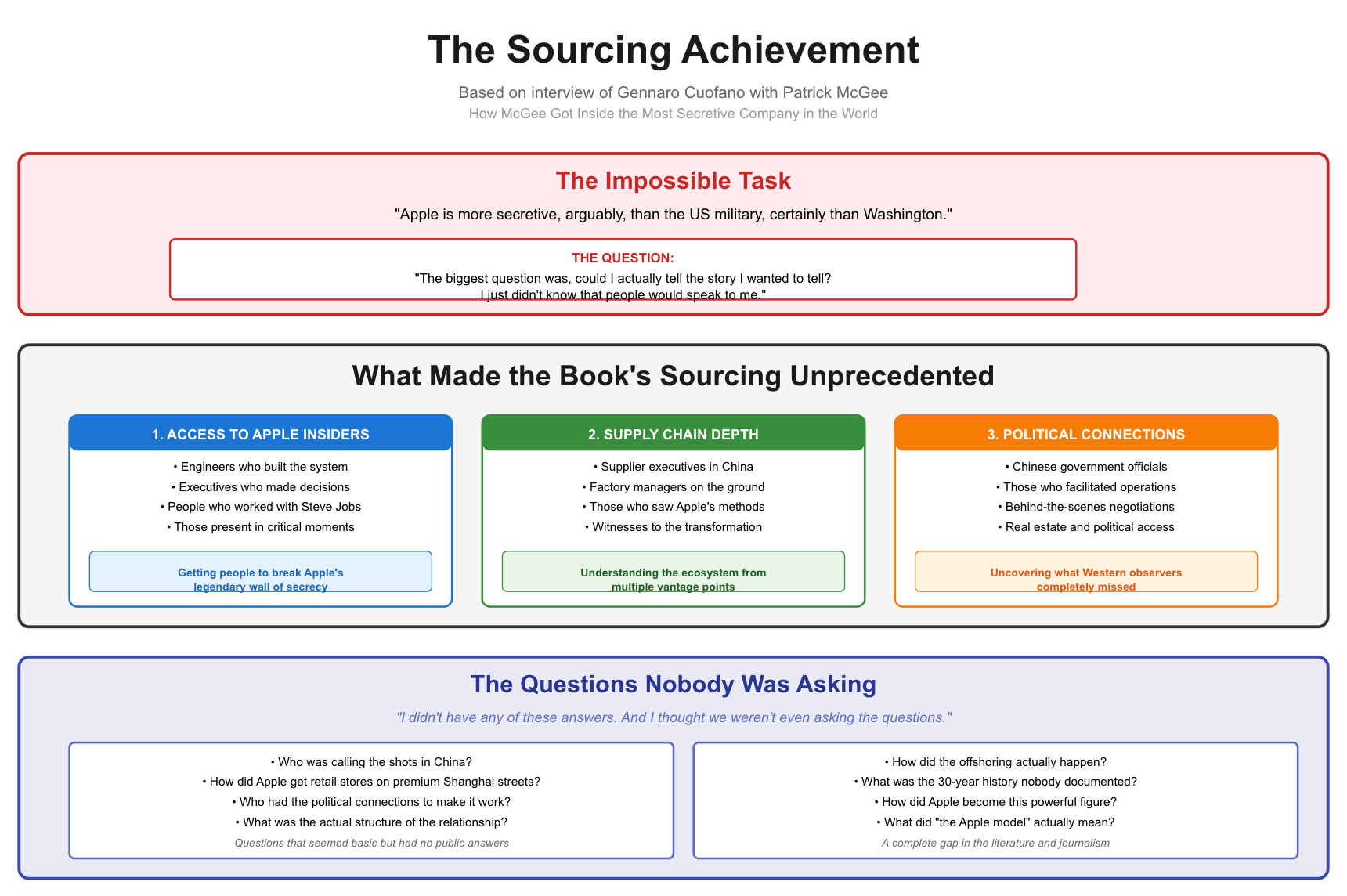
If there’s one thing McGee is proudest of, it’s the sourcing of “Apple in China.” Apple is arguably more secretive than the US military, certainly more secretive than most government agencies. Getting people to speak on the record, or even on background, about Apple’s operations is notoriously difficult.
The book succeeds because McGee managed to build trust with dozens of sources across Apple’s ecosystem—engineers, executives, suppliers, and government officials. The result is a level of detail and insight that simply doesn’t exist elsewhere in the literature on Apple or on global supply chains.
This sourcing wasn’t just about access. It was about understanding: McGee had to learn not just what happened, but why it happened, and what the alternatives actually were. Many business books fail because they impose retrospective logic on historical decisions. McGee’s book works because it reconstructs the actual constraints and options that decision-makers faced.
The Stakes Today
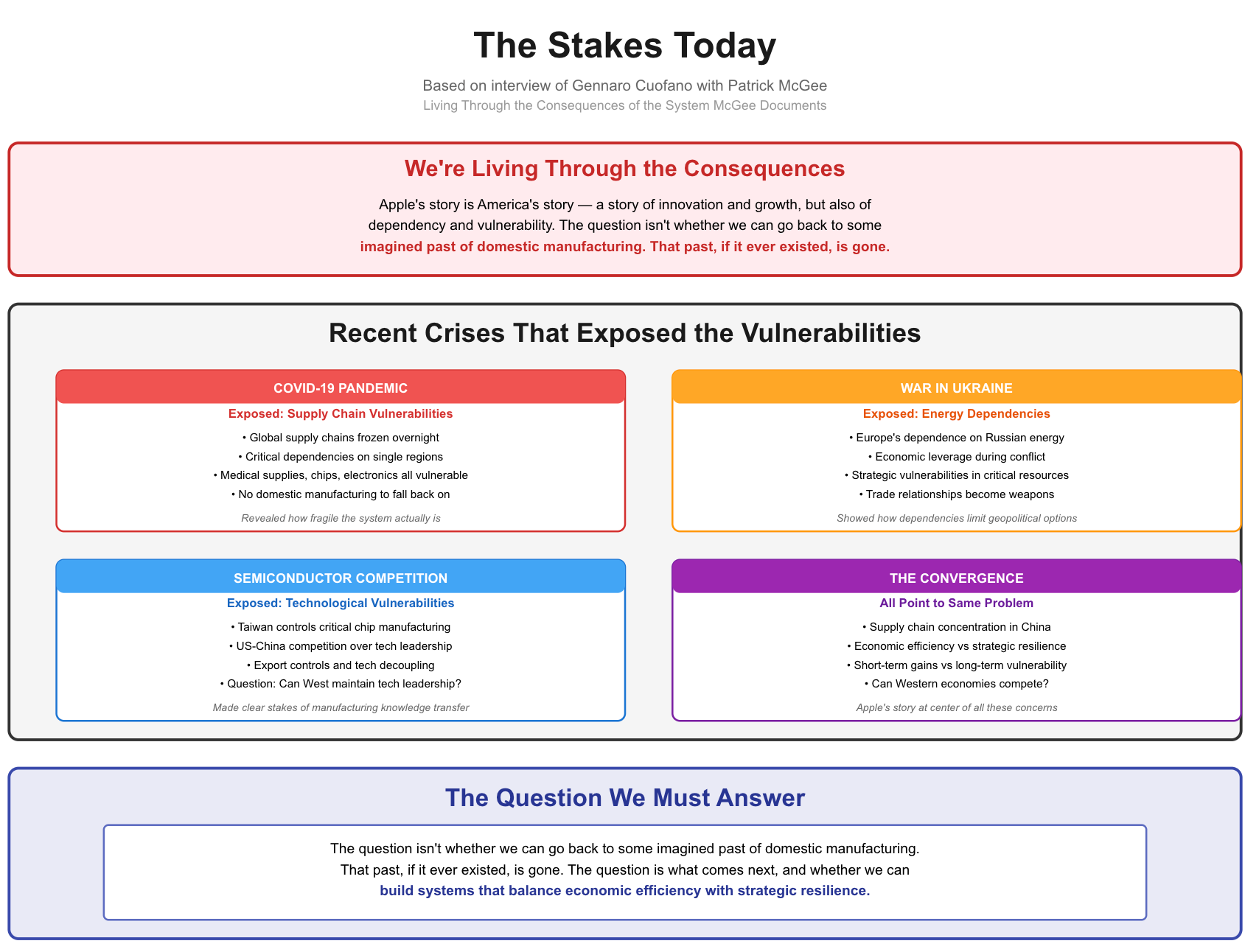
We’re living through the consequences of the system McGee documents. The COVID-19 pandemic exposed supply chain vulnerabilities. The war in Ukraine highlighted energy dependencies. The competition over semiconductor manufacturing revealed technological vulnerabilities. And at the center of all these concerns sits the question of whether Western economies can maintain technological and manufacturing leadership when so much capability has been offshored.
Apple’s story is America’s story—a story of innovation and growth, but also of dependency and vulnerability. The question isn’t whether we can go back to some imagined past of domestic manufacturing. That past, if it ever existed, is gone. The question is what comes next, and whether we can build systems that balance economic efficiency with strategic resilience.
McGee’s book doesn’t answer that question. But it does something more valuable: it provides the detailed understanding necessary to even ask the question properly. And in an era of simplistic takes and political posturing about China, manufacturing, and American competitiveness, that clarity is invaluable.
For anyone trying to understand how we got here—how the world’s most valuable company and the world’s most populous authoritarian state became partners in the most important manufacturing relationship of the modern era—”Apple in China” is essential reading. Not because it offers solutions, but because it documents with unusual precision and sourcing the system we actually have, rather than the one we imagine or wish we had.
Recap: In This Episode!
The Transformation: From Near-Bankruptcy to Global Dominance Through Offshoring
Apple’s engagement with China wasn’t strategic brilliance; it was survival. The company faced existential collapse multiple times in the 1990s and early 2000s. Outsourcing became the only viable option.
McGee maps four manufacturing phases:
Late 1990s – Outsourcing as triage.
Early 2000s – Deep integration with China.
2004–2007 – iPod manufacturing establishes China’s supremacy.
2007–2015 – iPhone era: scale jumps from 5M to 230M units a year.
This was not mere contract manufacturing. It was the birth of a new global manufacturing model: Apple-driven, China-executed, and world-changing.
Mechanisms: Why China Became Irreplaceable
McGee shows China outperformed not because of cheap labor but because of state-enabled coordination capacity. China could mobilize workers, suppliers, land, and capital faster than any Western system.
Key mechanisms:
Factories built in months, not years.
Millions of skilled laborers deployable on demand.
Suppliers retooled and synchronized at Apple’s cadence.
Industrial policy aligned to win high-end electronics.
China didn’t just execute Apple’s playbook; it mastered and extended it. Apple transferred knowledge; China built institutions to retain and scale it.
The Tim Cook Architecture: Precision, Control, Vulnerability
As COO, Cook built the “Apple model”:
Radical integration with suppliers.
Nonstop engineering oversight inside factories.
Zero tolerance for variance.
Supply chain as a strategic weapon, not a cost center.
This created unmatched product quality, speed, and scale. But the same system locked Apple into China’s ecosystem. The more Apple optimized, the more path dependent it became.
Xi Jinping’s Rise: When a Manufacturing Dependency Became a Political Dependency
Apple’s explosive growth overlapped almost perfectly with Xi’s ascent. What began as an economic integration became a political entanglement.
McGee examines:
Apple’s need for political access to secure stores and operations.
The opaque intermediaries who brokered these relationships.
Beijing’s sophisticated understanding of Apple’s dependence.
Apple needed China to scale; China used Apple to accelerate its own industrial ascent.
The Geopolitical Paradox: Continuity Is More Dangerous Than Disruption
McGee argues the core risk isn’t that China ejects Apple. It’s that the status quo continues.
Because the status quo means:
Continuous transfer of manufacturing know-how.
Strengthening of China’s industrial base.
Continued erosion of Western capacity.
Deepening asymmetry of leverage.
Apple’s success becomes America’s structural weakness.
The Hollowing Out of the West: Industrial Power vs the “Fictitious Economy”
A core thesis: China built real industrial capacity, while the West drifted toward digital ephemera. Xi’s critique of Western GDP as inflated by “social media and crypto” frames the contrast.
Apple exemplified the shift:
High-value Western design.
High-value Eastern manufacturing.
A widening gap between innovation and industrial capability.
This divergence now shapes everything from semiconductor policy to defense readiness.
Counterfactuals: Could Apple Have Done Anything Else?
McGee’s answer is blunt: no.
Domestic manufacturing would have killed Apple before the iPhone ever existed. No country offered what China offered in the 2000s. Even today, no alternative matches China’s depth.
This destroys the simplistic narrative that Apple “should have built in America.” The company had no viable domestic option. China made Apple possible.
The India Question: Attractive in Theory, Unrealistic in Practice
India is not the next China. Not because of a lack of talent or ambition, but because:
China built decades of infrastructure and supplier ecosystems.
Manufacturing scale depends on institutional knowledge and coordination, not just labor pools.
India cannot replicate China’s 2000s model on short timelines or with similar state capacity.
India may grow, but China’s system is not transplantable.
Asymmetric Leverage: Beijing Holds the Stronger Hand
Apple cannot credibly threaten to leave. Beijing knows it. Supply chain reallocation would take a decade and cost hundreds of billions.
This asymmetry shapes:
Regulatory concessions.
Political compromises.
Apple’s muted stance on sensitive issues.
China’s confidence in using Apple as leverage in broader US–China dynamics.
Sourcing as an Achievement: Cracking Apple’s Wall of Secrecy
McGee’s unique contribution is access. Apple’s internal operations are more secretive than most governments. The book succeeds because he secured rare, deep, cross-ecosystem sourcing from engineers, suppliers, and political actors. The result is a level of operational insight that doesn’t exist elsewhere.
Implications: The System We Built, Not the System We Wished For
The book forces recognition: the West offshored not just manufacturing but industrial capability, and Apple was both beneficiary and accelerant.
Today’s geopolitical landscape—semiconductor competition, supply chain fragility, technological rivalry—emerges from this architecture.
McGee doesn’t provide solutions, but he gives the analytical foundation needed to even formulate them. “Apple in China” is essential because it documents the world as it is: interdependent, asymmetric, and strategically unstable.
With massive ♥️ Gennaro Cuofano, The Business Engineer


