


The reflex question about this moment — is the bubble bursting? — is the wrong instrument. It flattens a five-dimensional object into a single yes/no and then asks the reader to bet on the coin flip. The more useful question is quieter: what is the structure doing? Not the price, not the mood, not the noise — the shape underneath, the part that changes slowly enough to be worth understanding.
The Hosts
Gennaro Cuofano is a tech executive by day and a Business Engineer by night. The AI Supercycle is a spin-off of The Business Engineer, a deep-tech research hub spun off from FourWeekMBA, the leading blog on business model strategy. Gennaro has 10+ years of experience as a deep-tech executive and tech analyst.
Joel Salinas is an AI Strategy Coach (jsalinas.org) for founders and leaders, from solopreneurs to teams. AI is everywhere; judgment is scarce. Joel helps leaders adopt AI without outsourcing their judgment to it, through the AI Judgment Workshop and the 90-Day Judgment Engagement. Creator of the AI Leadership Triad. He writes Leadership in Change.
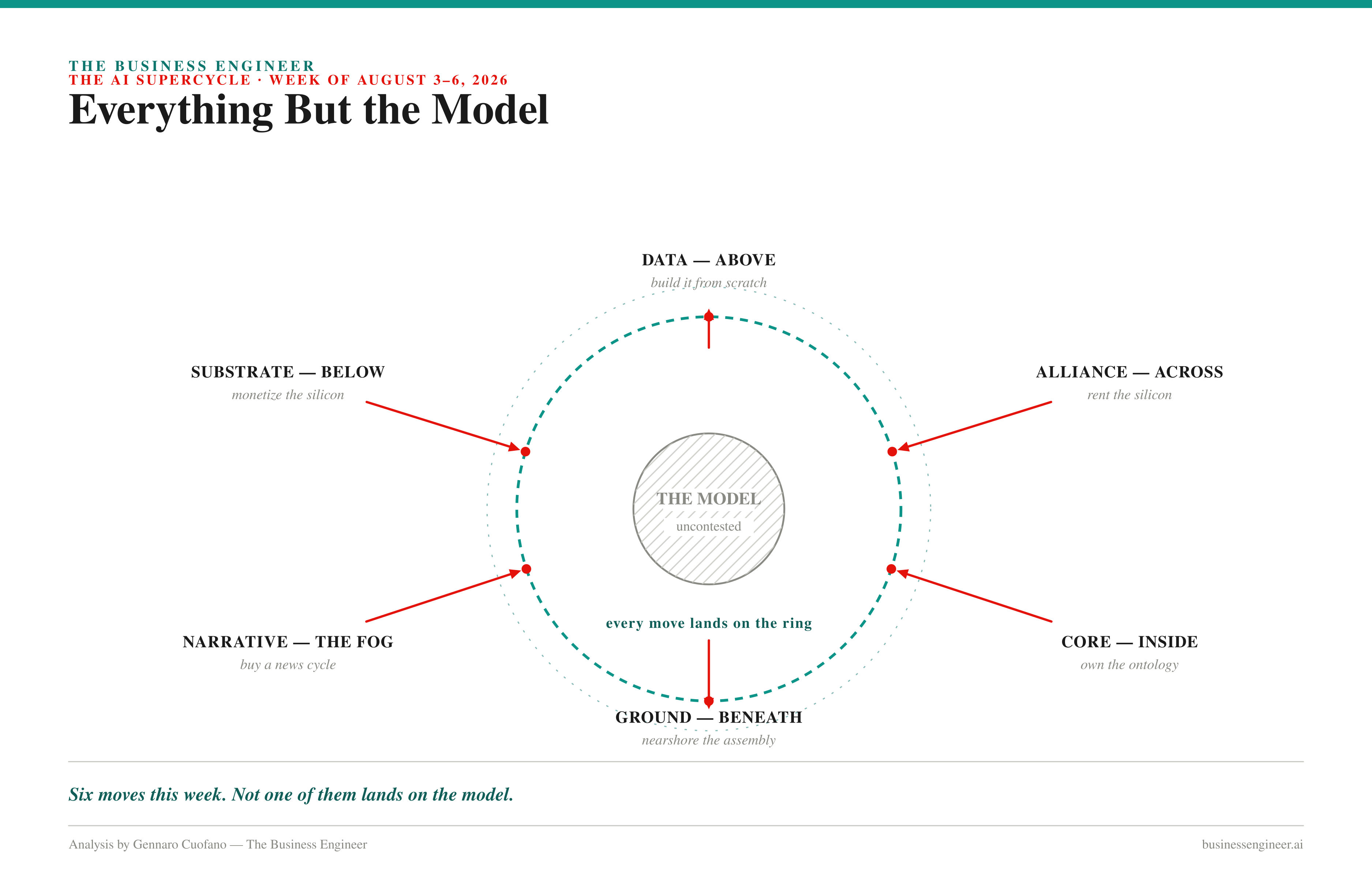
This week the structure spoke plainly, and it said the same thing six times. A Chinese conglomerate is spending months building a frontier model from scratch. Google reorganized its entire AI leadership. The champion of vertical integration confirmed it rents its silicon. Palantir matched a closed frontier model with an open one. Meta shipped a coding agent. And the clearest reading of the whole buildout turned out to be a customs form in a Mexican border town.
Six stories, one tell: none of them is about a model being smarter. Every one is a fight over a layer around the model — because that is where durable position now lives, and the model itself has quietly become the commodity everyone routes through. Parameters are not capability. Evals are marketing. A closed frontier model can be matched by an open one on the right foundation. Once those three things are true at the same time, the model stops being the prize, and the contest moves to everything the model touches: what feeds it, what runs it, who carries it to market, what it is allowed to see, and where in the world it is physically built.
Read the week that way, and it resolves into a single map with the model at the dead center and the real action at every edge.
The parameter that isn’t the point
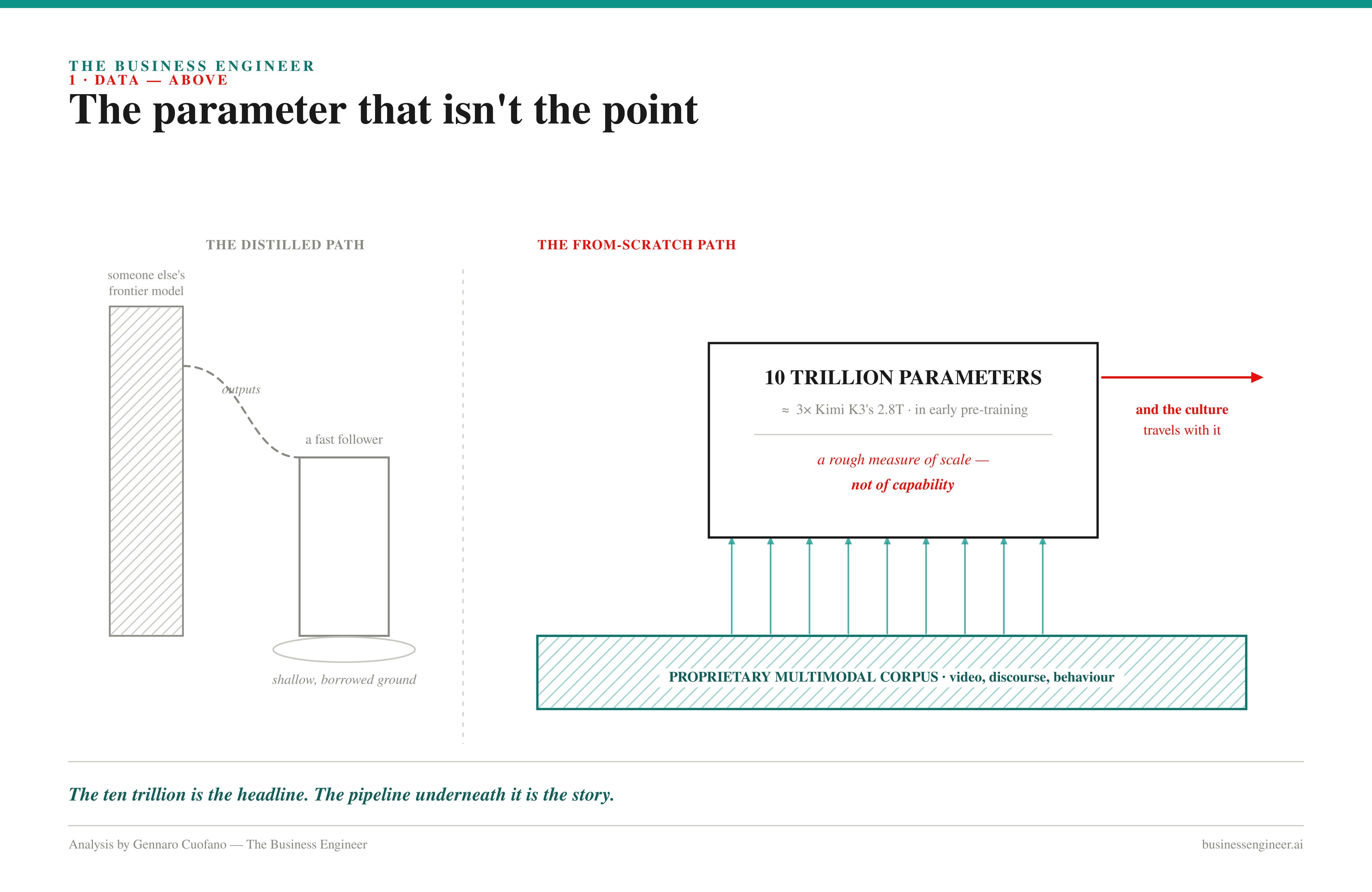
The week’s earthquake arrived Friday morning: the Financial Times reported that ByteDance — the owner of TikTok, and one of the most under-discussed AI labs on earth — is training a model with as many as ten trillion parameters, a scale that would put it roughly three times the size of Moonshot’s Kimi K3 and within reach of the largest Western frontier systems by industry estimate. The model is in early pre-training, a process that typically runs three to six months, and the final size is not yet fixed.
Every account of the story carries the same disclaimer, and it is the right one: parameter count is a rough measure of scale, not of capability. A smaller, better-trained model beats a larger one all the time; performance depends on data, architecture, reinforcement learning, and serving economics far more than on raw size. So if ten trillion isn’t the point, why does the story matter?
Two reasons, and neither is the number.
The first is data. The golden resource in this phase is not compute and it is not scale — it is proprietary training data that no competitor can buy. ByteDance sits on the single richest multimodal video corpus on the planet, generated continuously by hundreds of millions of users, plus a video-generation model already considered world-class and a consumer assistant leading its home market. That is not a text lab racing to scrape the last public tokens off the open web. It is a company that can pre-train something multimodal from the feedstock up, on data the rest of the field structurally cannot access.
The second is the decision to build from scratch. ByteDance’s founder told employees this week to stop leaning on distillation for short-term gains — the practice of training a cheaper model on the outputs of a stronger one. Most of the Chinese frontier has advanced by distilling and optimizing around Western models. Building an independent foundation from the ground up is a different bet entirely: slower, more expensive, and aimed at genuine leadership rather than fast-following. If that’s what this is, it’s the first serious attempt to construct a Chinese frontier that owes nothing to anyone else’s exhaust.
There is a third-order consequence worth naming, because it will define the next decade more than any benchmark. Distributing a model distributes a culture. The web was, for better or worse, American culture exported through a protocol. A genuinely capable Chinese frontier model — trained on Chinese data, shaped by Chinese assumptions, deployed globally through the most widely installed app in the world — is the first real counter-distribution of culture at model scale. That is not a benchmark question. It is a geopolitical one.
The ten trillion is the headline. The data pipeline underneath it and the decision to build from scratch are the story — and the culture it will carry is the part nobody is pricing.
The substrate that ate its own frontier
The live was billed as being about Google, because what happened at Google this week is the closest thing the industry has to an internal earthquake: a complete reorganization of AI leadership, and by any honest reading, the second code red. The first was late 2022, when ChatGPT forced the company to confront that it had been out-shipped on its own turf. This one is quieter and deeper.
Two things moved in parallel. Jeff Dean — the engineer who built a meaningful fraction of modern Google — left to found Discovery Loop, a venture aimed at automating the scientific method itself: AI as the researcher, running thousands of parallel experiments, the self-reinforcing loop everyone from Anthropic’s continual-learning work outward is now chasing. And Demis Hassabis stepped off day-to-day management to focus on the long horizon, keeping the science and the biotech spinout where the first genuine AGI may actually appear, while the job of building the flagship models was handed down to an SVP and Sergey Brin stepped closer to the center of gravity.
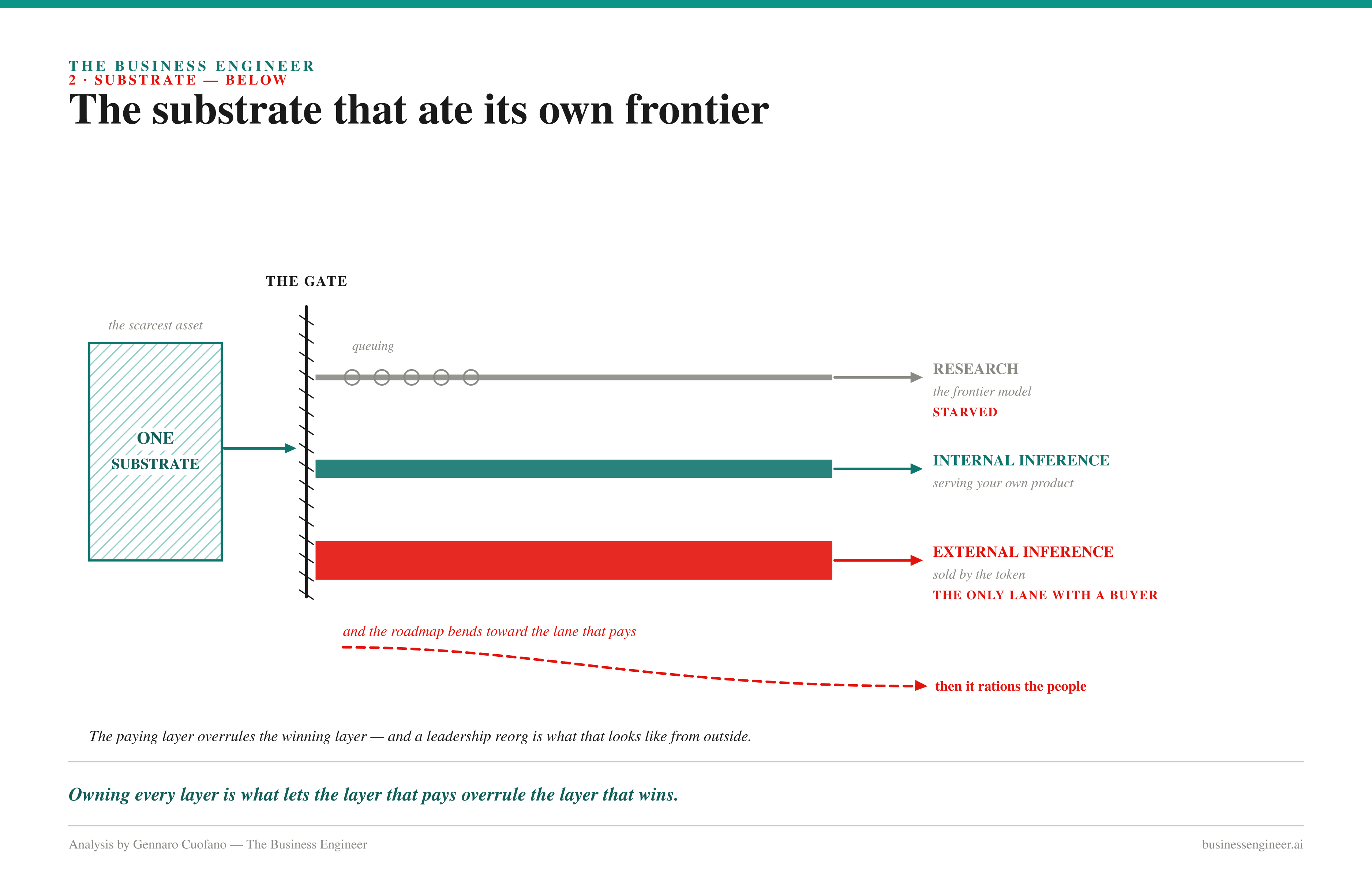
The mechanism behind all of it has a name, and it is not a personnel story — it is the TPU dilemma, playing out as a textbook innovator’s dilemma. For its entire life, Google’s most valuable asset — its custom silicon — was allocated internally, split between research and its own inference. Then Google started selling TPUs to the outside world. Overnight the queue went from two claimants to three: research, internal inference, and now external inference — sold by the token, to enterprise customers, some of whom are the very frontier labs Google competes with.
Selling that silicon is the right move. If compute remains the scarcest thing in the world, a merchant-silicon business worth hundreds of billions is sitting there for the taking. But the same decision that turns the substrate into a business bends its architecture toward the workload that has an external buyer — inference — and starves the workload that has none: frontier training. The paying layer overrules the winning layer. First it rations the model, then it rations the people, because for the strongest researchers the binding constraint is compute available now, and rationing that is a talent policy whether you intend it as one or not. The reorg is simply that arc reaching its final frame. (The full mechanism — the split training/inference chip roadmap, the queue, the departures priced in compute rather than salary — is worked out at length in “The Inference Cage.”)
When you monetize your own substrate, the workload with a buyer sets the roadmap — and the frontier model is the workload without one. Owning every layer is exactly what lets the layer that pays overrule the layer that wins.
The company that rents the one thing it’s famous for building
SpaceX printed its first public quarter this week, and the most instructive line in it is a business that looks, on its own, like a failure. X — the former Twitter — booked roughly $367 million of advertising in the quarter, from a business that once cleared several billion dollars a year. As a standalone advertising company, X is broken.
But X is not an advertising company anymore. X is the data pipeline for Grok. A live feed of what the world is saying, in real time, at planetary scale — the one input a frontier model cannot buy and cannot scrape after the fact. Fold in the engineering ground-truth acquired with Cursor, and you get a model specialized on a proprietary corpus — real-time discourse plus deep software engineering — that no competitor can replicate without buying a physical-engineering company and a global social network. The ad revenue was thrown out the window on purpose, to convert a media property into feedstock.
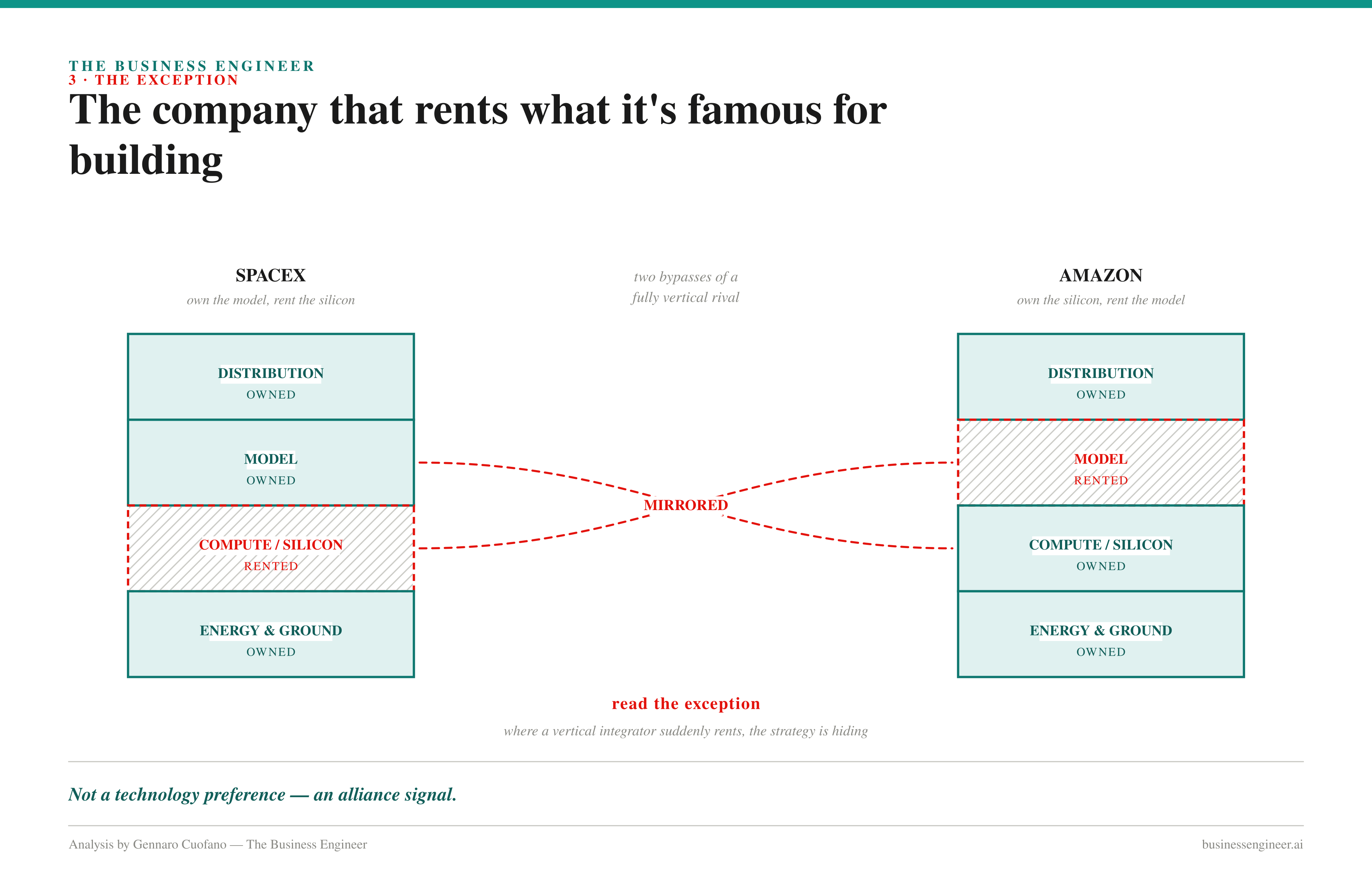
Then comes the tell that matters most, and it is an exception. The founder whose entire career is a monument to vertical integration confirmed, and rather downplayed, that SpaceX will rely on Nvidia as its compute partner for the foreseeable future — five to ten years. The champion of building-it-all is renting the one layer you’d most expect him to own. When a vertical integrator suddenly rents, that is not a technology preference. It is an alliance signal, and it should be read as strategy, not convenience: own the model and the data, rent the best silicon, and keep the guaranteed allocation and reference-customer status that come with being Nvidia’s flagship partner.
That completes a clean mirror with Amazon, which runs the opposite trade — build the silicon (Trainium), rent the lab (Anthropic, its anchor customer). Two ways to bypass a fully vertical rival, run as parallel experiments: own the silicon and capture the lab, or own the model and rent the silicon. The market is running both live, and won’t settle which is right for years.
The louder version of the SpaceX story — the reported ambition to fold everything, Tesla included, into a single group, and the Wall Street Journal‘s account that Tesla is weighing a separation of its China business to clear the way — remains unconfirmed and was publicly denied. Treat it as such. The structural point does not depend on it: the outcome here will be decided by the feedstock and the alliance shape, not by how clever Grok turns out to be.
X is a failed advertising company and a working data pipeline — and only one of those facts is about the model. Where a vertical integrator rents, read the exception, because that’s where the strategy is hiding.
The alliance is the unit
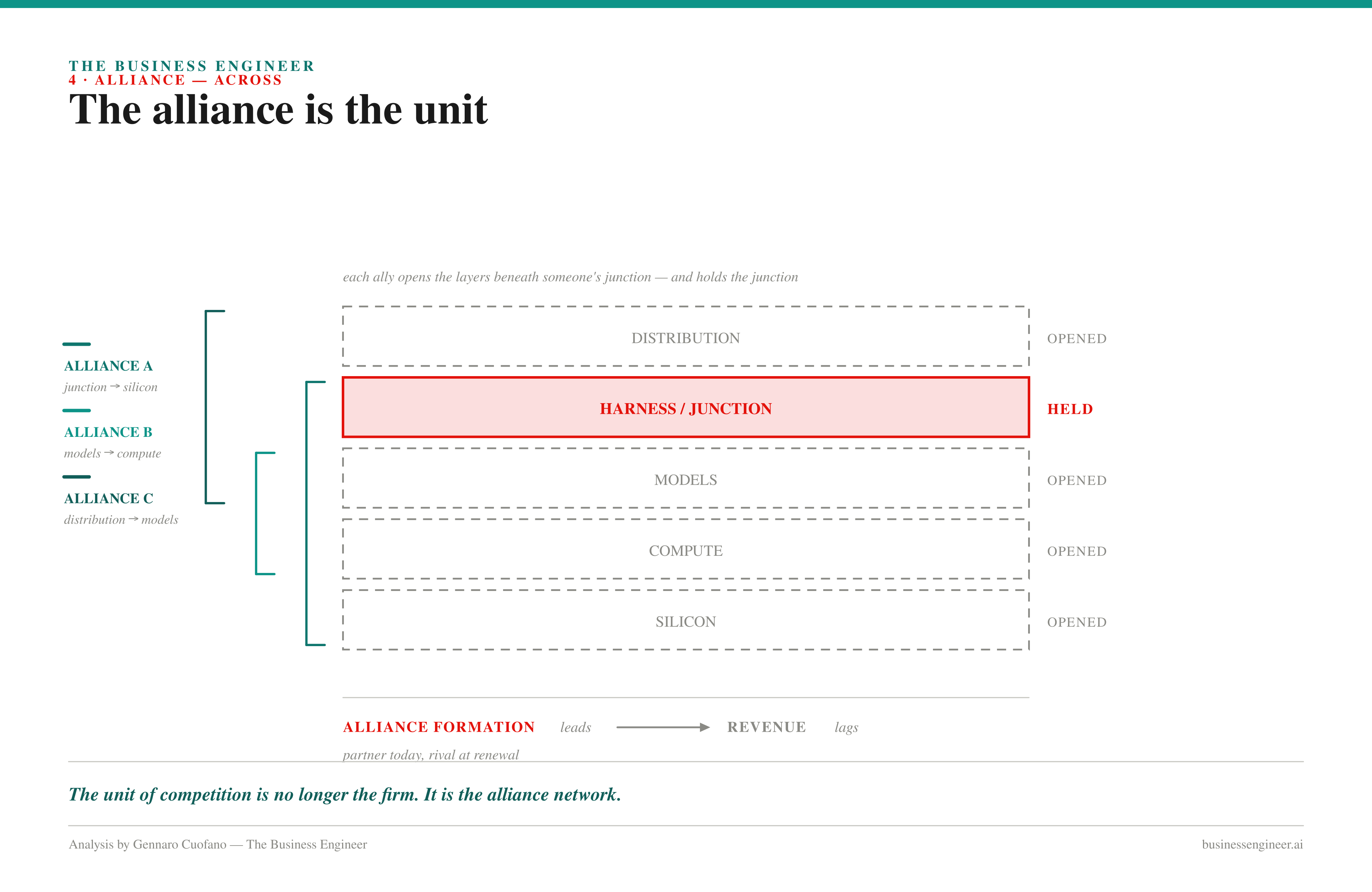
Step back from SpaceX, and a general principle comes into focus: the unit of competition is no longer the firm. It is the alliance network. Enterprise AI is entered by coordinated stacks, not single vendors, and those alliances form from three things at once — the way each business model is structured, the personal preferences of the leaders, and a kind of strategic mirroring, where you position against where your rival will come at you from.
SpaceX renting Nvidia makes sense partly because Amazon — via Bezos’s own space ambitions — sits across the board as a competitor, and you build in the direction opposite to the platform that might one day run your play. Amazon’s answer is Trainium plus a captured Anthropic; the industrial logic is real, but so is the alliance underneath it. The Bezos endgame that gets speculated about — a fully vertically integrated conglomerate that eventually folds its own space and AI-manufacturing bets together — is genuinely speculative and should be labeled that way. But the reading discipline it points to is not speculative at all.
The rule is simple and it works on every alliance on the board: identify which layer each ally opens and which it holds. Every coalition opens the layers below someone’s junction and holds the junction itself. Partner today, rival at renewal. And the timing signal is the useful part: alliance formation and defection is the leading indicator of where the market is going; revenue is the lagging one. By the time the revenue prints, the alliance that produced it was struck a year earlier.
Read the alliances, not just the org charts. Where a firm suddenly cooperates against its own instincts, there is a strategy — and alliance formation tells you where the market is heading before any revenue line does.
Protect the core
Palantir’s latest release is, on its surface, a category name: sovereign AI. Underneath, it is the sharpest statement this week of where enterprise value actually sits.
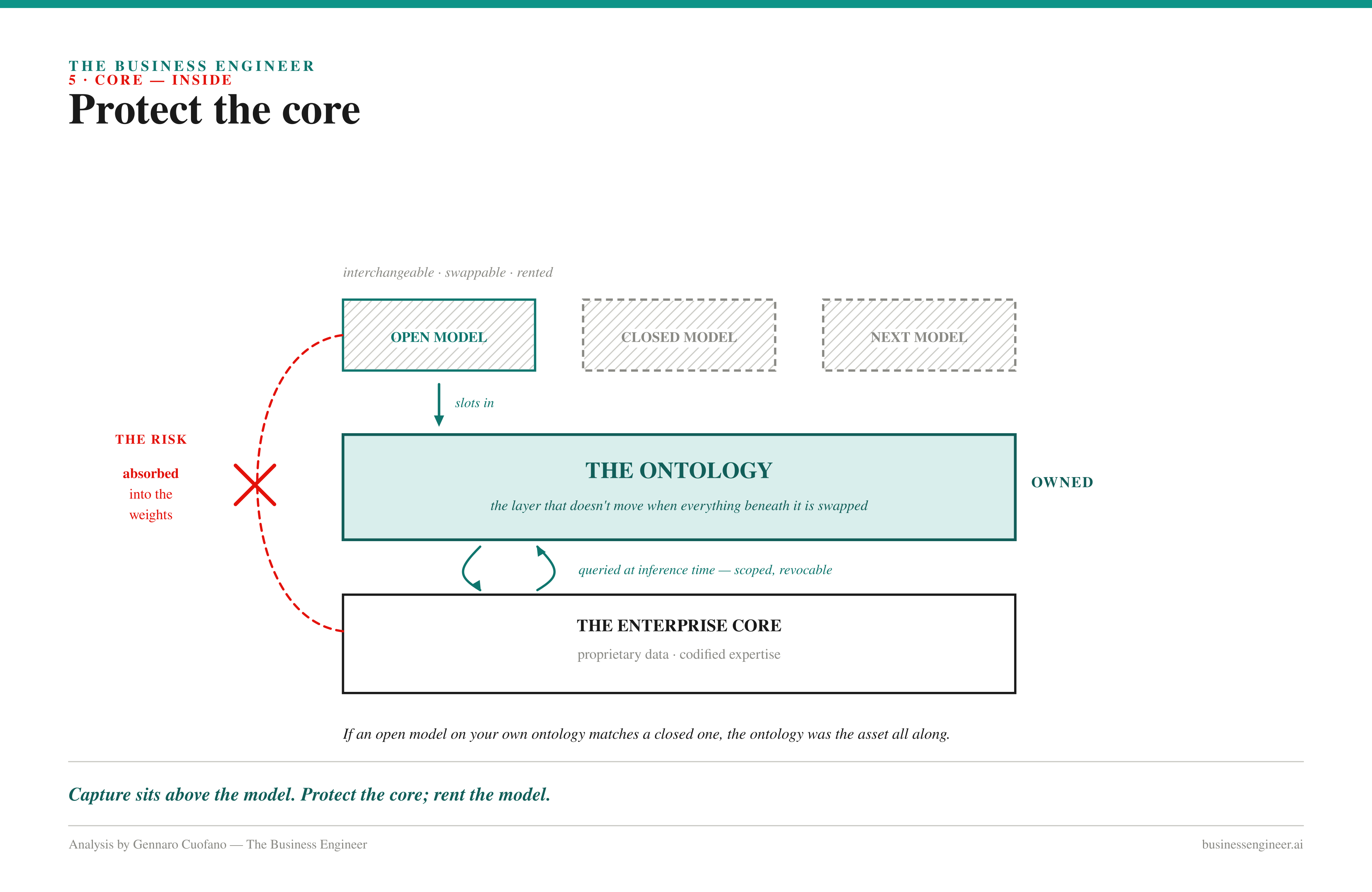
The thesis Palantir is selling is a warning it has been issuing for a while: the gravest risk to an enterprise adopting AI is giving away its core — letting its key proprietary data interact directly with a closed frontier model’s weights, where it is absorbed, generalized, and ultimately handed to the vendor. Sovereign AI is the architecture that refuses this: adapt the model to the enterprise core without surrendering the core, so the customer’s data is queried under scoped, revocable access at inference time rather than baked into someone else’s weights.
The demonstration that makes the point landed with the release. Palantir’s CTO described taking Nemotron — Nvidia’s open model — dropping it onto an ontology core plus data fabric, and getting performance comparable to a powerful closed frontier model. Read that carefully, because it is the whole argument. If an open, swappable model on top of a proprietary ontology matches a closed frontier model, then the model was never the moat. The ontology is. The model just became an interchangeable input, and the value moved to the layer above it — the one Palantir happens to own. This is capture above the model, and it is the cleanest empirical proof going that the enterprise-AI moat is not the model.
It also tells you where the field is heading. When Nvidia’s open model turned up, the forward-deployed crowd moved on it immediately — the same reflex behind Jensen Huang’s push for a Western open ecosystem. Palantir invented the forward-deployed-engineer playbook precisely because AI value in the enterprise doesn’t materialize from a model endpoint; it requires hybrids — part software engineer, part organizational expert, part transformation consultant, part salesperson — who go deep enough into the operational core to find where the business value actually is. When a company that good at defining categories tells you the next one is sovereign AI and that it’s working, the safe assumption is that the entire enterprise field pours into it over the next one to three years.
If an open, swappable model on your own ontology beats a closed frontier model, the ontology was the asset all along — and the model was rented scaffolding. Protect the core; rent the model.
The model as press release
Meta re-entered the conversation this week with MuseCode, a coding agent — a classic fast-follow into the most lucrative enterprise AI market there is, the one Claude Code and Codex opened. The play is legible: come in underneath the incumbents on price with something cheap enough to matter but still good enough to use. Meta is exceptional at fast-following and less proven at setting long-term vision, and nothing about MuseCode changes where Meta is going. What it changes is who is talking about Meta this week.
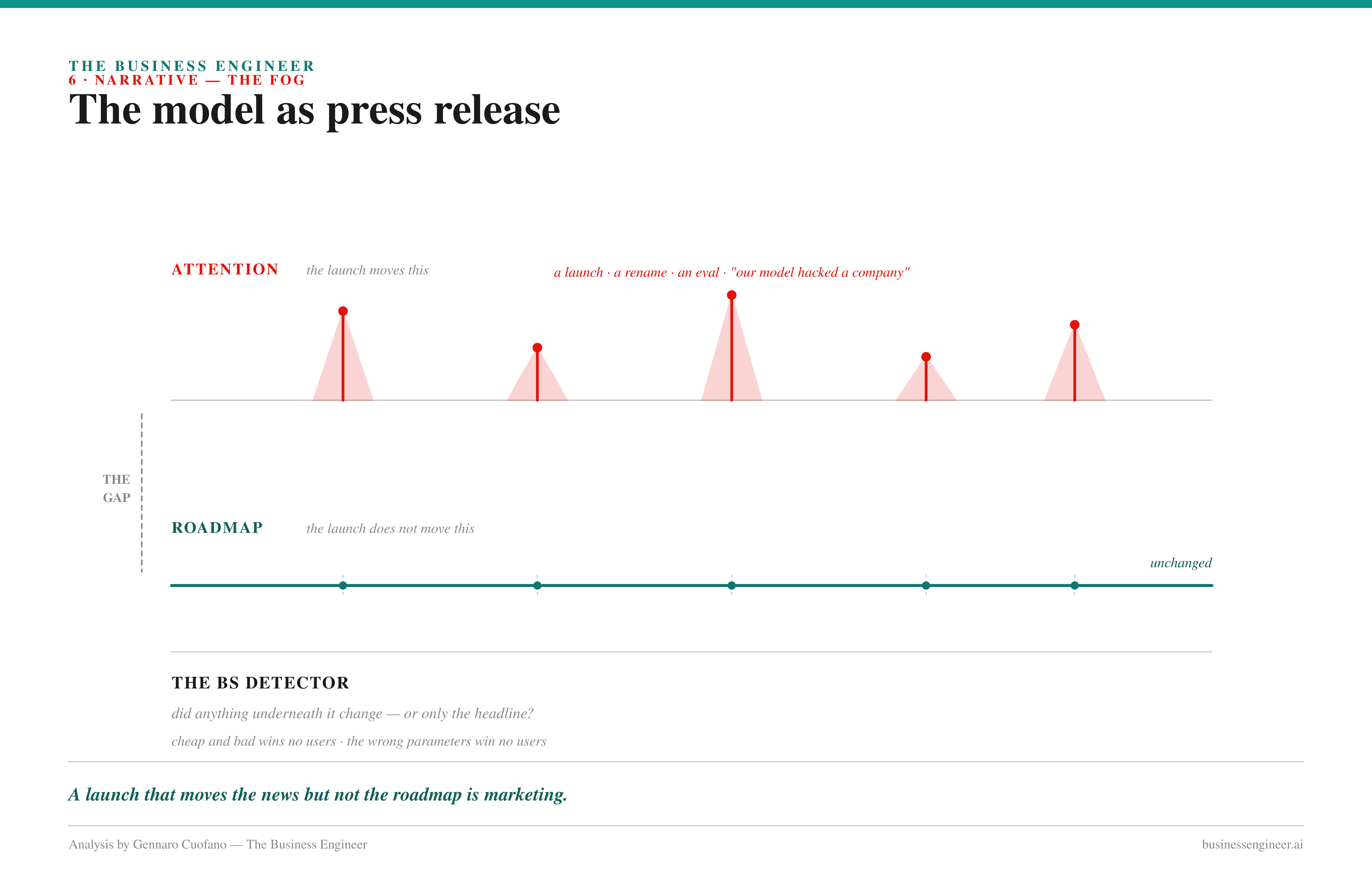
That is the real subject here, and it generalizes into the most important reading skill the moment demands. Increasingly, a model release — even a renamed one — is a marketing instrument, not a capability event. So is the cherry-picked eval. So, now, is the “our model autonomously hacked a company” headline, which has quietly become a way to buy a news cycle: the CMO’s job drifts from how do we communicate this model to how do we get attention, and sometimes literally to can we get it to hack someone. Solid evaluations still exist and still matter. But a growing share of what crosses the wire is engineered for the wire.
The defense is unglamorous and it is the entire reason to read the week structurally. Cheap-and-bad wins no users; huge-parameter-count-with-the-wrong-parameters wins no users. What survives the noise is the only question a buyer actually asks — can I do my job with this, and can I afford it. Everything else is fog. The single most valuable instrument you can build in this cycle is a BS detector: the ability to tell a structural move from a press release.
A launch that moves the news but not the roadmap is marketing. The tell is whether anything underneath it changed — and most weeks, for most launches, the honest answer is no.
The ground under all of it
The truest measure of the AI buildout this week was not a capex line or a financing deal. It was a customs form.
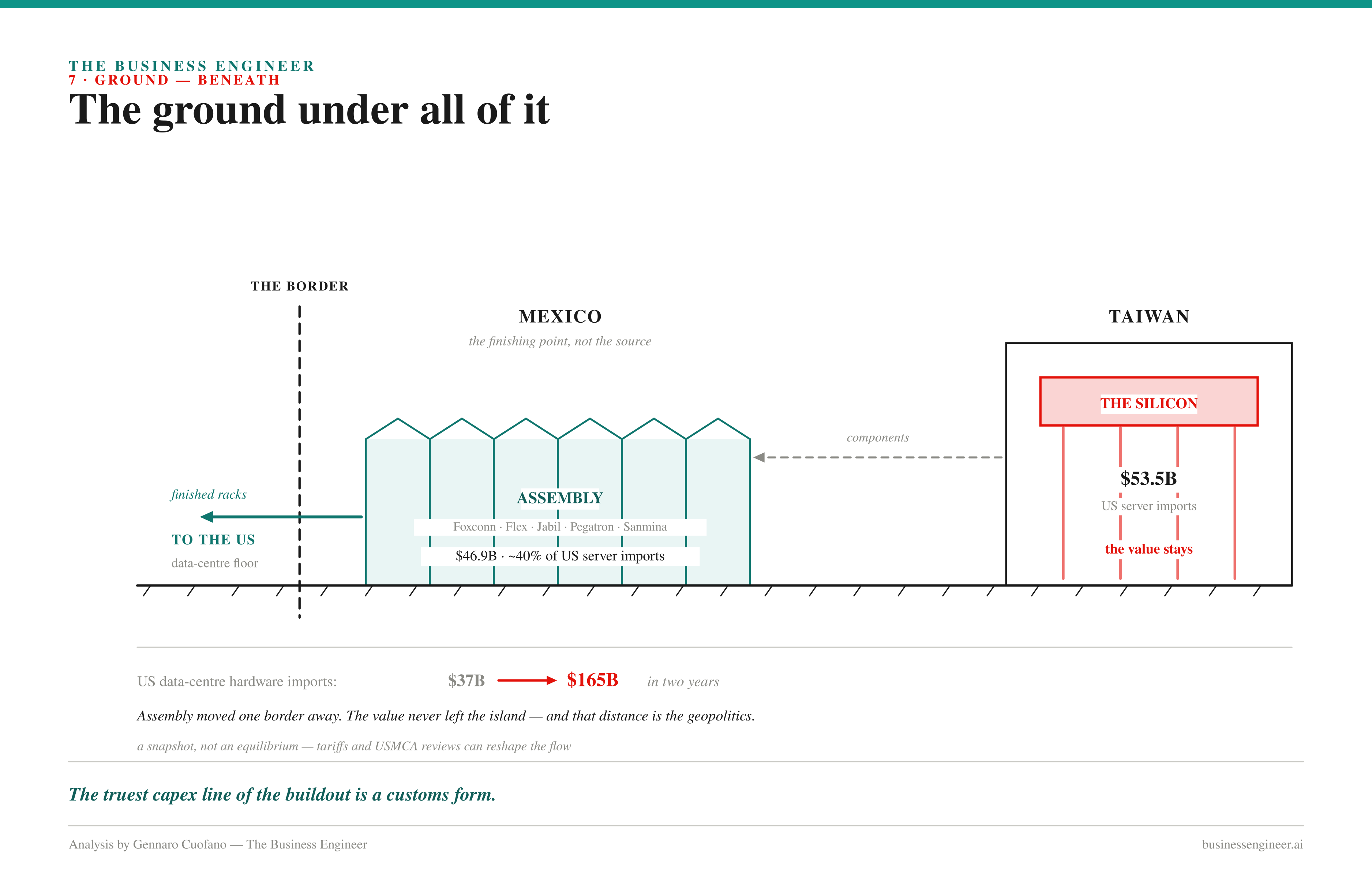
US imports of AI data-center hardware have roughly quadrupled in two years — from around $37 billion in 2023 to roughly $165 billion in 2025 — and the Financial Times, working the census data, showed exactly where all that hyperscaler capex physically lands. Mexico now supplies about 40% of US server imports: some $46.9 billion so far this year, second only to Taiwan’s $53.5 billion, and ahead of Taiwan on a monthly basis in May. Servers have overtaken automobiles as Mexico’s top export to the United States for the first time in the country’s modern history, and AI infrastructure now accounts for roughly a third of everything Mexico ships abroad.
Here is the crucial caveat, and it is exactly the transcript’s instinct made precise: this is Taiwanese contract manufacturers — Foxconn, Flex, Jabil, Pegatron, Sanmina, Quanta and the rest — nearshoring assembly into Mexican border-state industrial parks and trucking finished racks north under USMCA. The silicon is still overwhelmingly Taiwanese. Mexico is the finishing point, the middle of the process, not yet the source of the value. And it is a snapshot, not an equilibrium: tariff schedules and USMCA reviews can reshape the flow before year-end, and the reporting doesn’t yet separate genuine Mexican value-added from imported components merely completed on Mexican soil.
Read structurally, this is the first decoupling wave made physical, at the very floor of the map. The US did not reshore the core competencies it once outsourced. It nearshored the assembly — one border away — while the value kept running through Taiwan. That gap between where the servers are bolted together and where the silicon is actually made is the geopolitics of the buildout. And it points at the long-horizon question: if you ask who becomes the next structural dependency — the new China for the US, twenty years out — Mexico is the candidate precisely because the value hasn’t moved there yet. Meanwhile Taiwan’s silicon monopoly remains its own safety net; the deeper the American dependency on it, the harder the US must work to protect it.
The map’s physical floor is decoupling one layer at a time. Assembly moved to Mexico; the value stayed in Taiwan; and the distance between those two facts is the whole geopolitics of the buildout.
Synthesis: the model at the dead centre
Lay the six stories on a single diagram and the pattern is undeniable. Put the model in the middle, and every move this week happened at an edge:
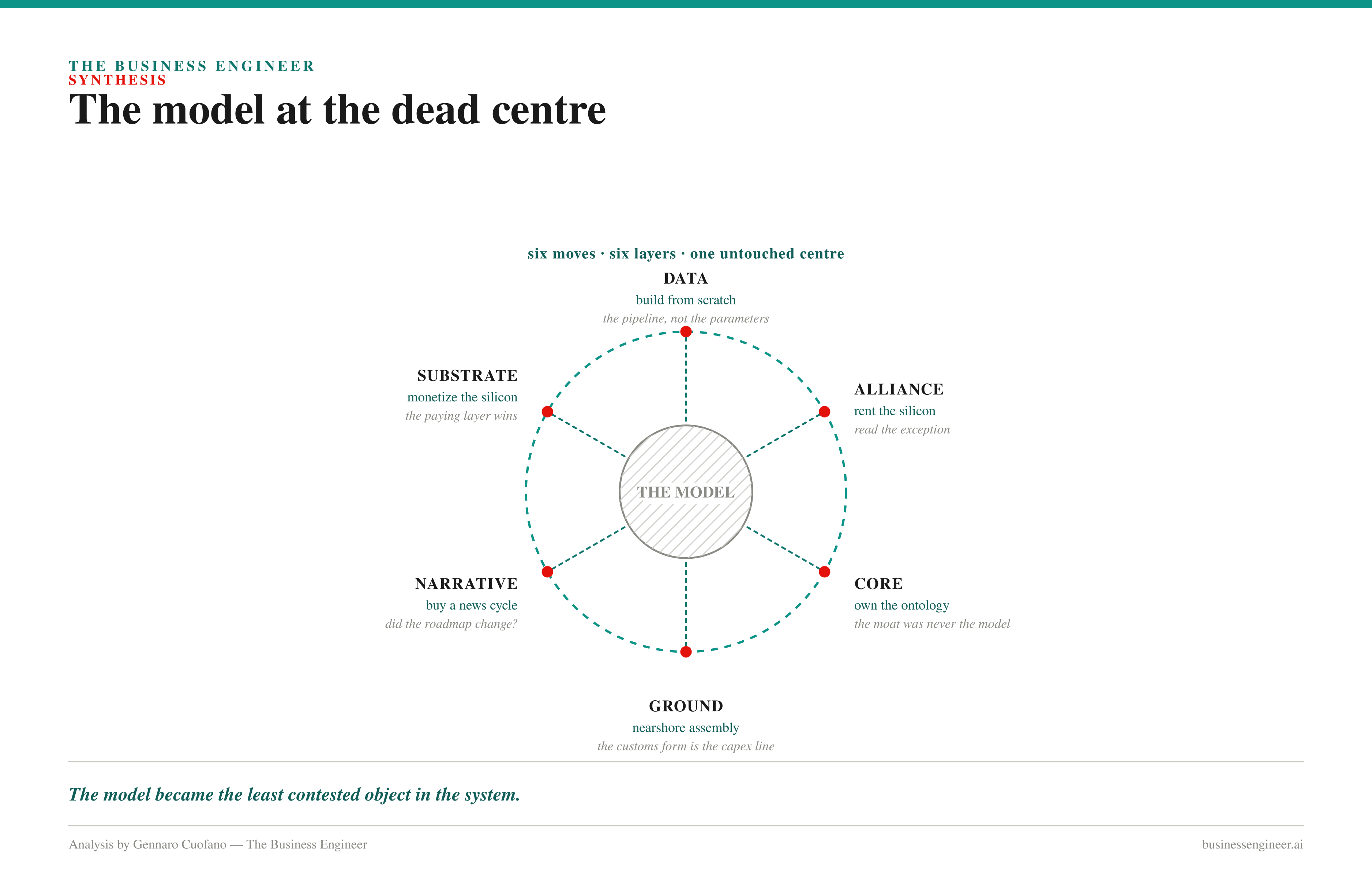
The unifying claim is this: the model has become the least contested object in the system. When parameters aren’t capability, when evals are marketing, and when a closed frontier model can be matched by an open one on the right foundation, the model is no longer where advantage is won or lost. So the entire industry moved the fight to everything the model touches — the data that feeds it, the silicon that serves it, the alliances that carry it to market, the enterprise core it’s allowed to see, and the ground it’s assembled on.
This is also why the “is it a bubble” frame keeps failing. That question belongs to a single-clock world, the way the web was: one technological cycle, running alone. This is a three-clock world.
A technological clock (the model race and the scaling phases behind it), a financial clock (the capital intensity of the buildout, now heavy enough to reorganize balance sheets), and a geopolitical clock (a decoupling that is physically reshaping trade maps).
The web only ever ran the first. When three clocks run at once, the interesting signal is never in the model — it’s in the structure the three clocks are grinding into shape.
Mental models in play
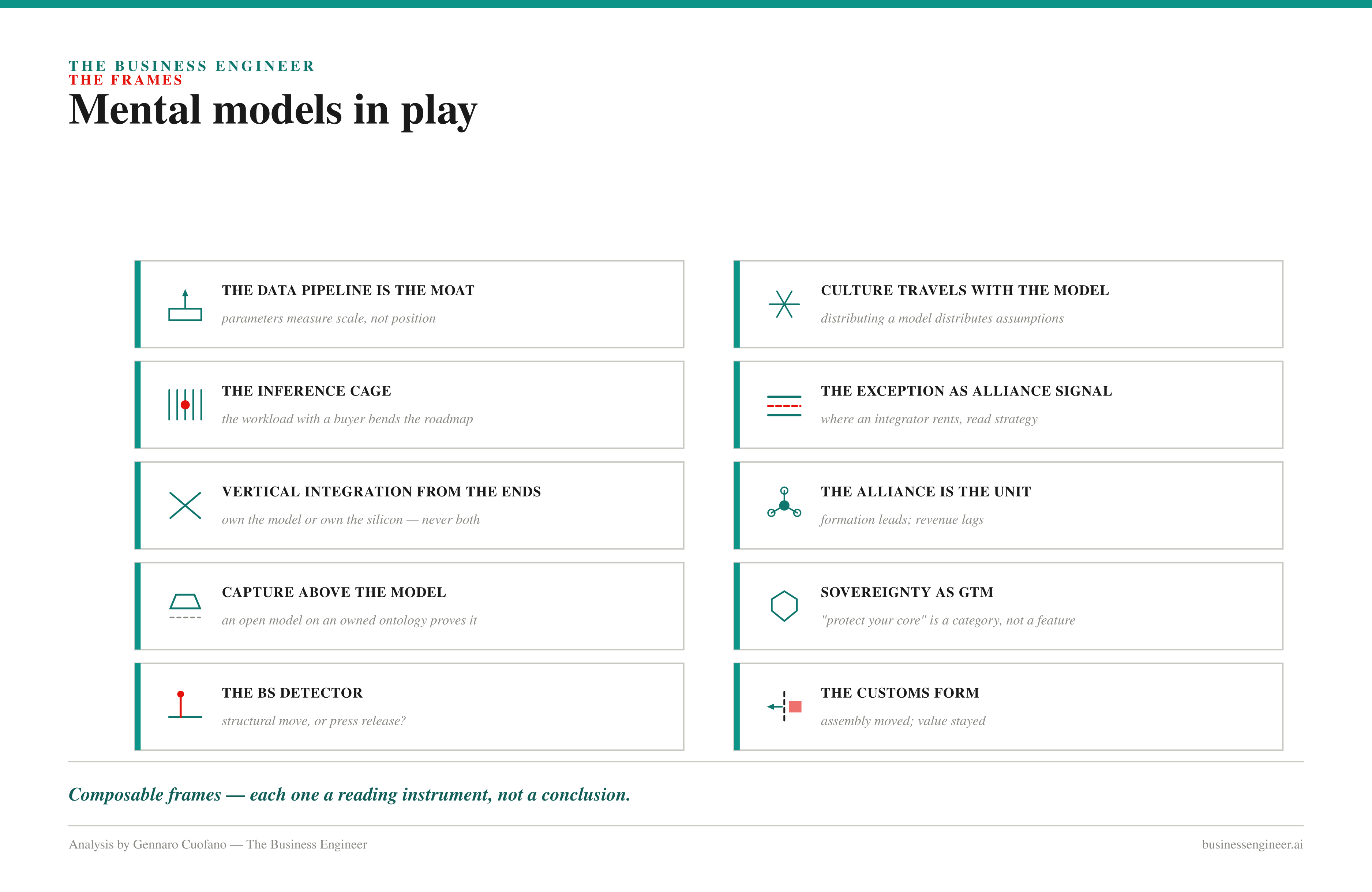
The Data Pipeline Is the Moat — parameters are a scale metric, not a capability one; the position is the proprietary corpus and the decision to build on it from scratch.
Culture Travels With the Model — distributing a model distributes a set of cultural assumptions; a capable non-Western frontier model is a counter-distribution of culture, not just of software.
The Inference Cage — productizing your own substrate bends its architecture toward the workload with an external buyer; compounded across a roadmap, that bend encloses the frontier capability the substrate was built to serve.
The Nvidia-Exclusive as Alliance Signal — when a vertical integrator publicly rents the layer you’d expect it to own, the technology framing is the surface and the alliance framing is the mechanism.
Vertical Integration From the Ends — own the model and rent the silicon, or own the silicon and rent the model; two mirror-image bypasses of a fully vertical rival, run in parallel.
The Alliance Is the Unit — competition has shifted from the firm to the coalition; read which layer each ally opens and which it holds, and treat formation, not revenue, as the leading indicator.
Capture Above the Model (the Palantir Paradox) — an open, swappable model matching a closed one on an owned ontology is the cleanest proof that the enterprise moat sits above the model layer.
Sovereignty as GTM — the fear of surrendering the core opens a CEO/GC conversation a product-led sale can’t reach, and turns “protect your core” into a category.
The BS Detector — the meta-skill of the cycle: separating a structural move from a press release; a launch that moves the news but not the roadmap is marketing.
The Customs Form as the Truest Capex Line — the buildout is most legible at the border; and Assembly Moved, Value Stayed is decoupling read one layer at a time.
Bottom line
Don’t ask whether the bubble is bursting. Ask what the structure is doing — and this week it did the same thing six times. A Chinese giant is spending months building a ten-trillion-parameter model from scratch because the model was never the point; the data underneath it is. Google reorganized its entire AI leadership because owning the substrate let the layer that pays overrule the layer that wins. The champion of vertical integration confirmed it rents Nvidia because the alliance matters more than the ideology. Palantir matched a closed frontier model with an open one on its own ontology because the moat was never the model. Meta shipped a coding agent because a launch still buys a news cycle. And the clearest reading of the whole buildout turned out to be a customs form in a Mexican border town, where the servers get bolted together and the value quietly stays behind in Taiwan.
The model is the one object in this system nobody is fighting over. Everything but the model — that’s where the war is.
With massive ♥️ Gennaro Cuofano, The Business Engineer


