For my entire personal life, I’ve been a student and lover of history. For my entire professional life, I’ve been obsessed with analysis.
The AI Supercycle is where those two worlds converge.
It began as a spin-off from The Business Engineer, which has always been centered on business analysis. But The AI Supercycle has become something broader: the most complete and unconstrained expression of how I think.
It starts with historical analogy, perhaps one of the hardest disciplines to practice rigorously, and uses it to build mental models across the intersection of geopolitics, finance, macroeconomics, and technology.
Because we are living through strange times. Or perhaps, more accurately, we are rediscovering how the world has always worked.
Geopolitics, finance, and technology are not separate domains. They are interconnected systems, linked by feedback loops that continuously reinforce, constrain, and reshape one another.
My goal has been to approach this with rigorous research, first-principles thinking, and intellectual independence.
That requires holding two opposing perspectives at the same time.
On one hand, I need a tight grip on the dominant AI narrative emerging from the technology community: what people are building, believing, funding, and forecasting.
On the other, I need to operate almost like a “thinking hermit,” deliberately removing myself from the noise of tech circles, going back into history, zooming out across decades and centuries, and only then zooming back in on the present.
That tension between immersion and distance is central to my work.
To me, this is as much a public service as it is a private enterprise.
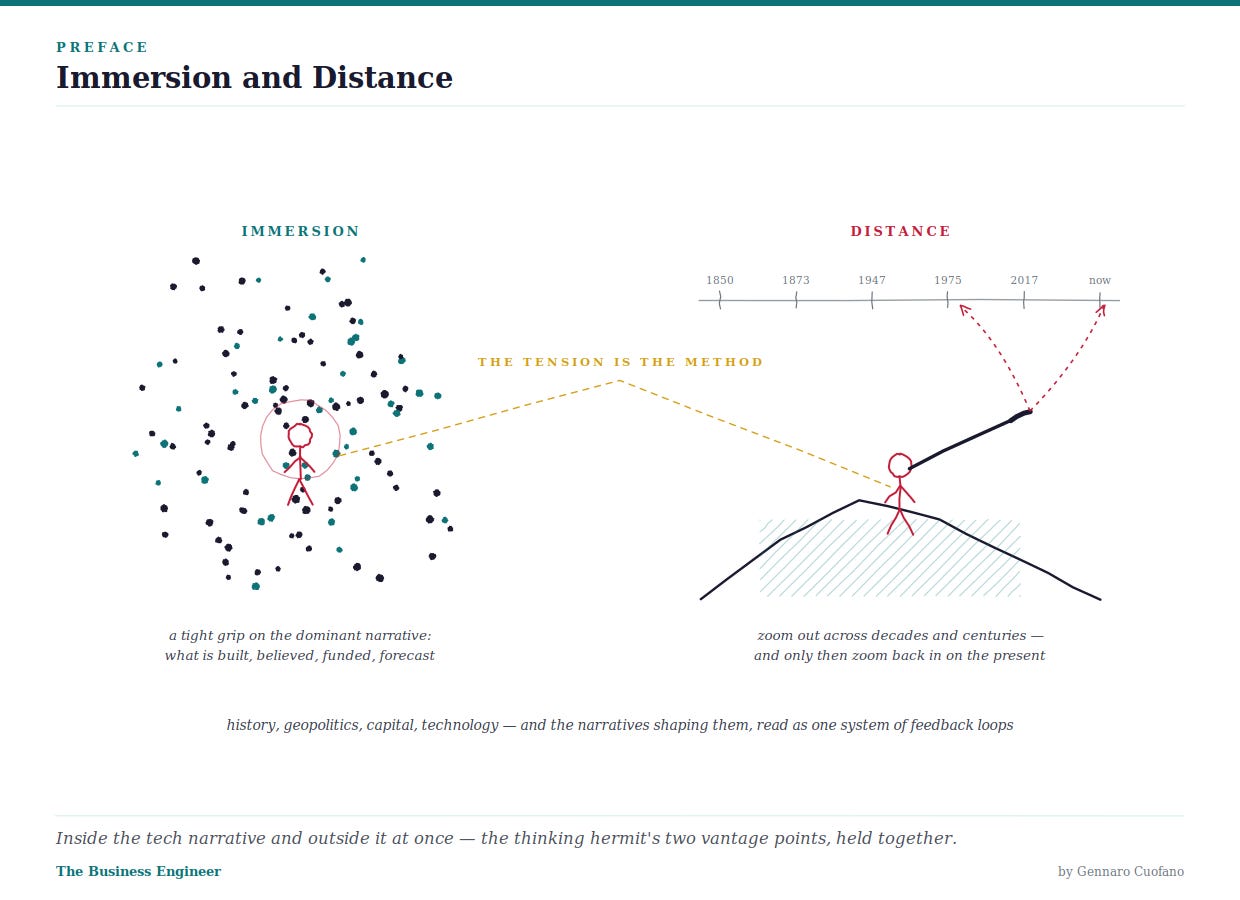
The AI Supercycle is my attempt to connect those layers: history, geopolitics, capital, technology, and the narratives shaping them.
That is the value I hope to bring to the table.