
We’re entering another inning of one of the most extraordinary technological races ever seen.
I came to the tech world more than a decade ago, and I’ve seen plenty of crazy things happen since. Over the years, I’ve had to develop my own way of separating the signal from the noise. That is the whole point of The Business Engineer and The AI Supercycle: building a framework that helps me understand what is happening beneath an increasingly overwhelming news cycle.
For me, that means going back to first principles. What does a technology actually make possible? What needs to exist for it to scale? Who finances it, who controls its bottlenecks, and what happens when its consequences reach far beyond the companies developing it?
Those are the questions from which my definition of the AI Supercycle emerged.
The AI Supercycle, as I define it, is the process through which AI reorganises technology, capital, infrastructure, and economic activity—and, in doing so, reshapes the political and geopolitical conditions that govern its own development.
The feedback between those forces is central to my thesis. AI changes the economy. Those economic changes influence politics and the balance of power. Politics and geopolitics then feed back into where AI can develop, who can access it, how it is financed, and how quickly its infrastructure can be built.
That is the original idea I have been developing through The Business Engineer and The AI Supercycle.
The beginnings of this way of thinking became much clearer to me around 2020. The pandemic exposed vulnerabilities in the technological globalisation we had largely taken for granted. Suddenly, access to manufacturing capacity, critical components, and international supply chains looked much more dependent on geography and political relationships.
I started seeing technology spilling over into everything else. The ChatGPT moment subsequently crystallised that realisation and gave it a much greater sense of urgency.
This is why I have never been satisfied with describing AI as another version of the web, cloud, or mobile cycle.
Even when people describe it as those three cycles combined, I think the comparison can still understate what is happening. It keeps us anchored to the recent history of the technology industry, when the consequences I am trying to understand extend into the organisation of the economy itself.
My reasoning starts with a simple chain of dependencies. If AI can perform an expanding range of economically useful work, its development requires computing capacity. That capacity requires chips, energy, land, equipment, and capital. As those requirements grow, they begin to affect industrial investment, public infrastructure, and the allocation of resources. Once they reach that scale, they become political.
The comparisons I find more useful are therefore railways, electrification, and the early semiconductor era: periods in which technological development became inseparable from physical infrastructure, industrial capacity, and state power.
That is the scale of change I am examining when I talk about the AI Supercycle.
I also see the relatively open, US-centred globalisation of the last three decades as an unusual historical setting. It encouraged us to assume that powerful technologies would spread through increasingly integrated markets and supply chains. I think carrying that assumption into the AI era is a mistake.
The current wave of frontier AI has been driven heavily by private laboratories and private capital, but it is developing within an increasingly contested strategic environment. Governments recognised AI’s importance well before ChatGPT—the United States had a national AI research strategy in 2016, and China published its major development plan in 2017. What has changed is how immediate, expensive, and publicly visible the consequences have become.
To navigate this, I follow a few signals closely.
SoftBank, for example, has become one of my compasses for the financial side of the industry. Its role in Stargate helped make OpenAI’s expansion beyond a Microsoft-centred infrastructure arrangement concrete. In January 2025, SoftBank took responsibility for financing the initiative while Microsoft relaxed its exclusivity over new OpenAI computing capacity. That was less than two years ago, although it already feels like another lifetime.
To me, that development captured something important: the ambitions of the frontier laboratories were drawing in a much wider coalition of capital and infrastructure providers. The next stage of AI would depend increasingly on their ability to coordinate that coalition.
But the biggest mistake we can make today is to assume that the politics of this cycle will consolidate around a single ideology.
One of the implications of my definition of the AI Supercycle is that AI inevitably becomes an issue across political parties, because its consequences reach across society.
This week’s midterms brought that into focus. Ballotpedia reports that voters favoured limits on data-centre development in 40 of the 41 local ballot measures decided on 3 November. Those votes covered different kinds of restrictions and conditions, but together they show how contentious the physical footprint of AI has become in the communities being asked to accommodate it.
The concern was already crossing party lines. In September, the House passed the Ratepayer Protection Act by 417 votes to three. The bill would require state utility commissions to consider standards making large data centres cover the additional infrastructure costs they create.
A politician is, among other things, a barometer of the pressures felt by their community. When those pressures show up through electricity bills, water supplies, construction projects, or concerns about employment, politicians across the spectrum have an incentive to respond.
Anthropic is another reason I resist reading this through a simple left-versus-right lens.
Its disagreements with the Trump administration over safeguards have coexisted with a hard line on Chinese access to advanced AI. In March 2025, it explicitly advocated tighter semiconductor export controls while calling for an additional 50 gigawatts of dedicated US power by 2027 and faster permitting. Those positions sit together within the same company’s policy agenda.
My reading is that stronger demands for safeguards can coexist with a more determined effort to preserve American AI leadership. Democratic electoral gains could bring tougher conditions for individual projects while leaving the strategic case for domestic capacity intact—or strengthening it.
The eventual pace of construction depends on how those competing pressures are resolved.
The Trump administration has given the buildout political backing through major investment announcements and an explicit AI strategy. Its July 2025 AI Action Plan called for faster permitting, expanded domestic infrastructure, and the export of American AI systems. The next test is how that ambition translates into arrangements that communities, utilities, and state governments are willing to accept.
We also need to pay attention to timing.
SemiAnalysis estimates that roughly three-quarters of the capacity scheduled for 2027 across the top 20 states in its model is already under construction. Most of its projected US additions for 2028 have yet to start. That makes the later pipeline more exposed to changing approvals and development conditions, although projects already underway can still depend on outstanding permits for power or subsequent phases.
This is why I keep returning to the underlying dependencies. Announcing a project, securing financing, starting construction, and delivering usable capacity are different achievements. Each requires a different set of conditions to hold.
Meanwhile, enterprise demand—the economic foundation of the cycle—has continued to expand.
Menlo Ventures estimates that enterprise AI deployment spending reached an annualised rate of approximately $177 billion by September 2026, 5.4 times its comparable estimate a year earlier. Anthropic’s latest filing offers another concrete indicator: approximately $17 billion in third-quarter revenue, compared with $1.4 billion in the same quarter last year.
That supports my view that the industry is still responding to substantial growth in demand. It also requires us to keep asking what kind of demand is growing, how much customers will pay for it, and whether the resulting revenue can support the infrastructure commitments being made.
Ramp’s latest token data illustrates the distinction: among the customers it tracks, usage grew much faster than expenditure. Falling prices and improving efficiency can expand adoption while changing the economics of the capacity built to serve it.
For me, this is the AI Supercycle unfolding in practice. The technology is becoming entangled with debt, financing, energy, national strategy, and local permission. Each of those forces now feeds back into the industry’s ability to keep expanding.
That is precisely why I developed the framework around the interaction between technology, macroeconomics, and geopolitics. As AI becomes more consequential, understanding the technology alone explains a smaller part of what determines its trajectory.
My compass still points towards execution as the central immediate risk: the ability to finance, permit, power, and build the capacity that expanding adoption requires.
Demand is growing. The question I am watching is whether the industry can translate that demand into infrastructure that can actually be delivered—and generate the durable revenue needed to sustain it.
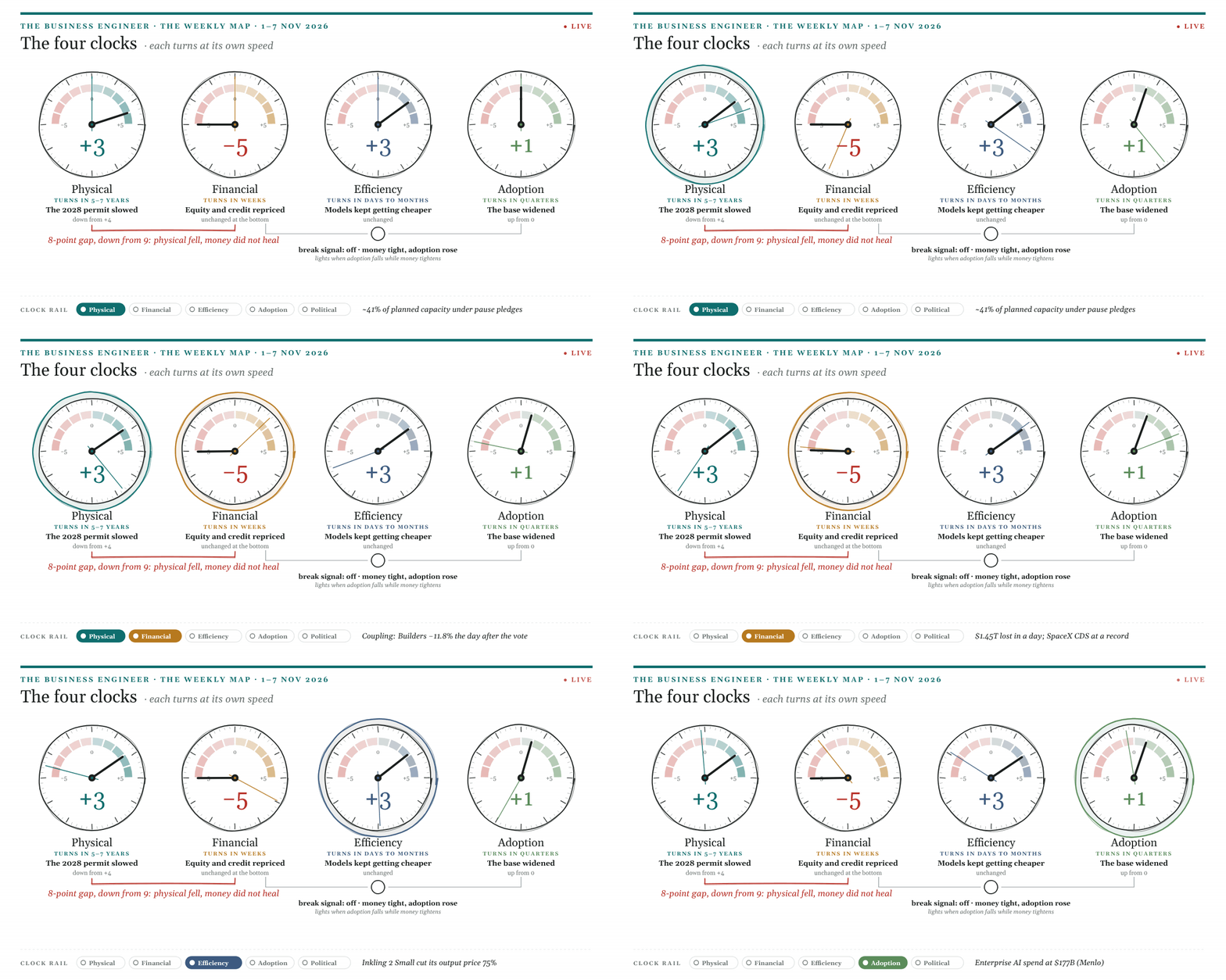
Last week I argued that the build-out had been handed a credit rating. The builders had run past their own cash, and lenders had started to price the difference. I still think that is true. But this week changed my mind about which constraint binds first.
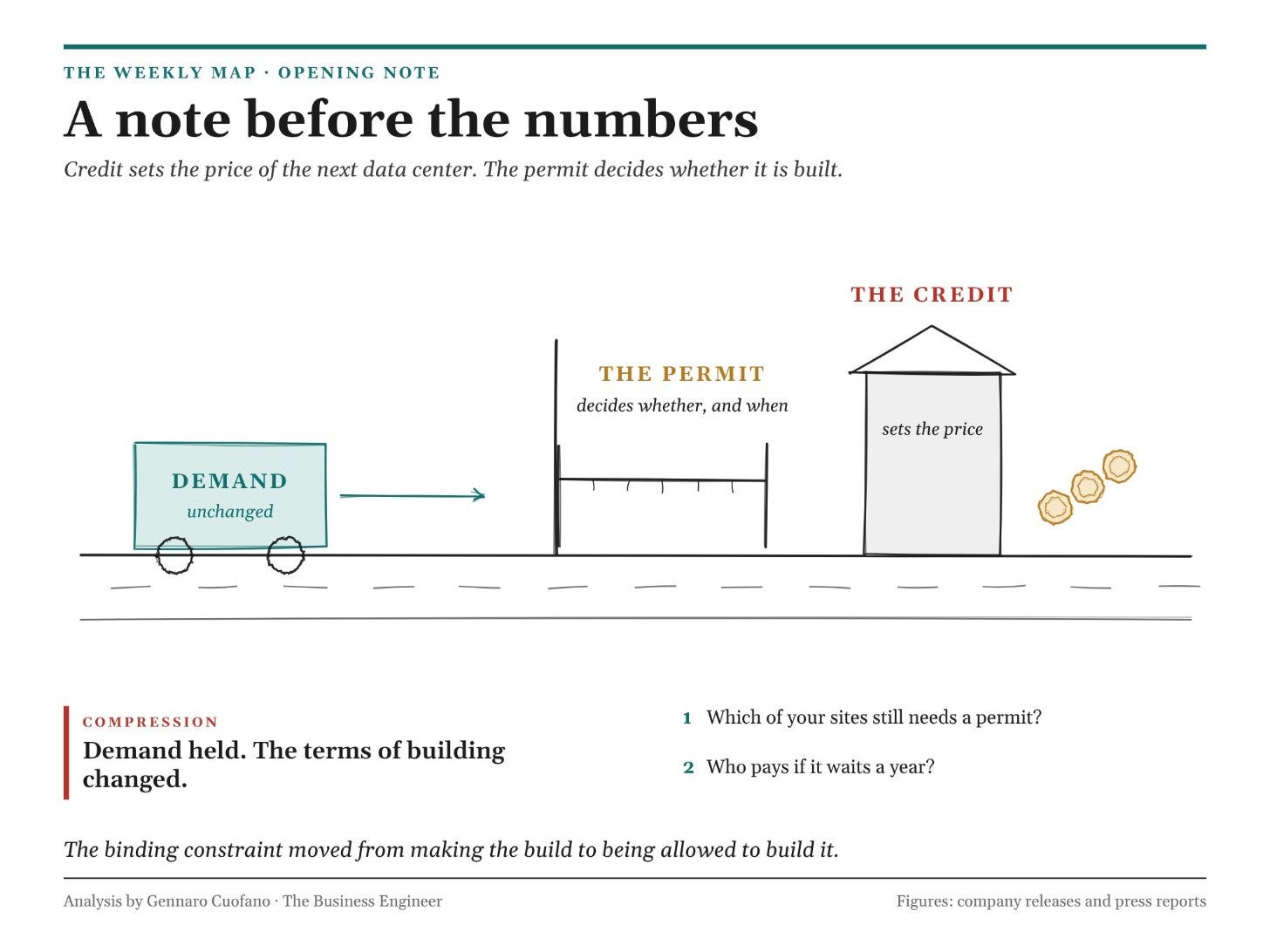
Credit sets the price of the next data center. A permit decides whether it gets built at all, and when. On Tuesday, voters in ten states made that second question real for the first time. On Thursday and Friday, the credit market priced the first one hard, from Seoul to New York.
What did not move is just as important. Nobody cut an order. The memory makers kept their prices. The labs kept their revenue. The companies that reported mostly beat their numbers. The demand for compute held. The terms on which it gets built changed.
So the issue opens with one argument. The build now needs permission, permission has a price, and that price lands on the companies that borrow to build. After it come the people who moved the week in their own words, the world around the stack, and then each layer in turn. Every story appears once, in the place where it does the most work.