

Over the last three years, I’ve tried to explain from multiple angles why this AI Supercycle is structurally different from previous technology cycles. In several of those pieces, I compared the Transformer to the microprocessor and described what is happening now as a second computing revolution.
That comparison is not just about the importance of the underlying technology. It is about the infrastructure that has to be rebuilt around it.
The computing stack we spent the last eighty years constructing was designed for a very different machine. From the 1940s and 1950s onward, the modern computing system evolved around deterministic computation: software expressed explicit instructions, processors executed them, storage preserved state, networks moved information, and datacenters were optimized to run those workloads as efficiently and predictably as possible.
AI changes the nature of the computer sitting at the center of that system.
The new machine is not simply faster. It is probabilistic, generative, increasingly agentic, and capable of producing useful behavior rather than merely executing predefined instructions. It can reason imperfectly, generate software, use tools, interact with other models, and perform work whose exact path cannot always be specified in advance.
That is precisely what makes it so powerful. It is also what makes its infrastructure requirements so different.
Seen from the outside, the current capex race can look like the railway booms of the late nineteenth century: enormous sums of capital chasing a technology whose eventual demand is still difficult to measure. There is some truth in that analogy. Infrastructure cycles often overshoot, financing structures become aggressive, and not every asset earns its original return.
But that framing misses the deeper point.
What is being built is not simply more datacenter capacity. We are rebuilding the physical foundation of computing for a different kind of computer.
The old stack was built around CPUs, deterministic software, relatively predictable power densities, and workloads whose marginal cost could approach zero once the software had been written. The emerging stack is being reorganized around accelerators, high-bandwidth memory, advanced networking, enormous electrical loads, liquid cooling, continuous inference, and models whose intelligence is produced by consuming compute at runtime.
That last difference is fundamental.
With traditional software, the expensive part was largely creating the program. Once written, executing another instruction was extraordinarily cheap. With AI, the intelligence itself has a marginal cost. Every token, reasoning step, tool call, agent interaction, and generated artifact consumes compute. As AI becomes more capable, we do not simply install the software and move on. We continuously feed the machine electricity, chips, memory bandwidth, and increasingly sophisticated infrastructure.
This is why the capex numbers have become so extreme.
We are trying to retrofit an infrastructure designed for the deterministic computer into one designed for a probabilistic computer whose capabilities scale with the amount and quality of compute we can continuously supply to it.
And we are still learning the consequences.
A deterministic computer either executes the instruction or it does not. An AI system operates through probabilities. It can be extraordinarily capable and still fail unpredictably. It can substitute for cognitive labor while simultaneously requiring new layers of evaluation, orchestration, verification, and control. It can reduce the cost of an individual unit of intelligence while causing aggregate demand for intelligence to explode.
That creates dynamics the previous computing revolution did not have.
The cheaper the token becomes, the more tokens we find reasons to consume. The more capable the models become, the larger the set of work we attempt to hand them. And the more work we hand them, the more infrastructure has to sit underneath them.
This is the structural logic behind the datacenter buildout.
The gigawatts, the gas turbines, the nuclear restarts, the HBM factories, the networking equipment, the cooling systems, and the extraordinary capital commitments are not peripheral to the AI story. They are the physical expression of a computing architecture being rewritten underneath us.
The railway analogy therefore works only up to a point.
Railways were infrastructure for a new transportation network. The current buildout is infrastructure for a new computational substrate. Some projects will undoubtedly be delayed. Some will be overbuilt. Some financing structures will break. Some companies will discover that they bought capacity at precisely the wrong moment.
But none of that would mean that the underlying buildout was unnecessary.
It would mean that, as in every major infrastructure transition, the market had to discover how much of the new foundation it actually needed, where it needed it, and who could earn an adequate return from owning it.
That is why the gigawatt has become such an important unit.
It is not merely a measure of electricity.
It is becoming a measure of how much of the new computing economy can physically exist.
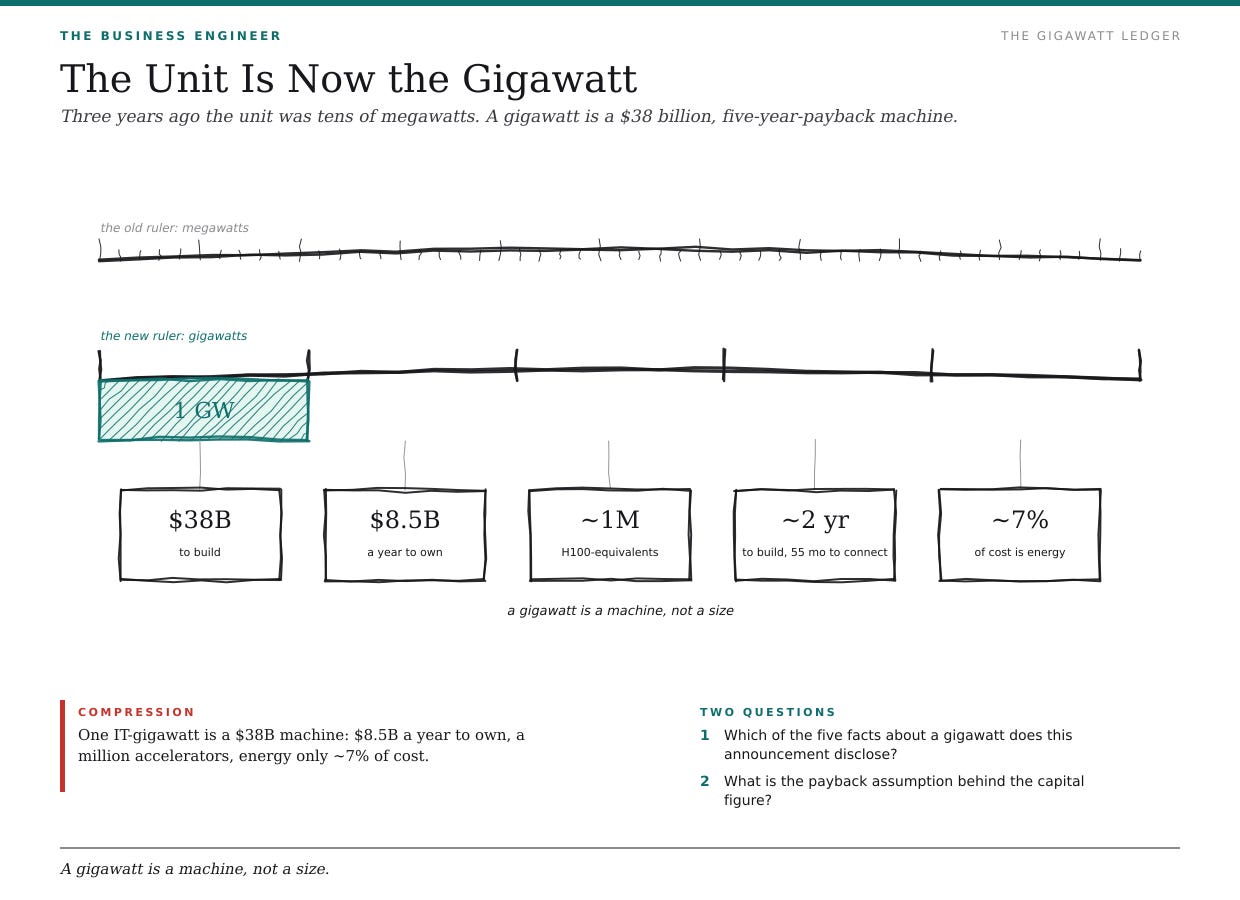
Three years ago, a large AI cluster was measured in tens of megawatts. Today the announcements are written in gigawatts. That is not simply a larger number. A gigawatt is a different kind of economic object.
On Epoch AI’s model, one gigawatt of IT capacity built around NVIDIA GB200 NVL72 racks costs roughly $38 billion. About $26 billion of that sits in servers. Once the hardware is depreciated over five years and the buildings over fourteen, ownership costs approach $8.5 billion a year. Even electricity, despite the scale involved, represents only about $600 million annually, roughly 7% of the total. Bernstein arrives at a broadly similar construction estimate around $35 billion, while NVIDIA has suggested that future generations could push the cost of a gigawatt toward $50–60 billion.
One gigawatt also corresponds to roughly one million H100-equivalents of compute. SpaceXAI’s Colossus 2 in Memphis, currently tracked at around a gigawatt, sits near 1.1 million H100-equivalents. Once electricity is available, a facility of this scale can take around two years to build. If the power is not available, the project enters a US interconnection process whose average wait has stretched to roughly 55 months.
That gives us the basic unit of the AI infrastructure cycle:
A gigawatt is a roughly $38 billion machine, consuming the electricity of a small city, running close to a million accelerators, and carrying hardware that has to earn its cost back on a five-year clock.
The entire US AI buildout can be understood by asking three questions: How many of these machines are actually being built? When will they arrive? And what has to be true economically for them to pay for themselves?
For full access, subscribe below. If you’re already a paid member of The Business Engineer, just ping me and I’ll enable access for you.
What One Gigawatt Actually Means
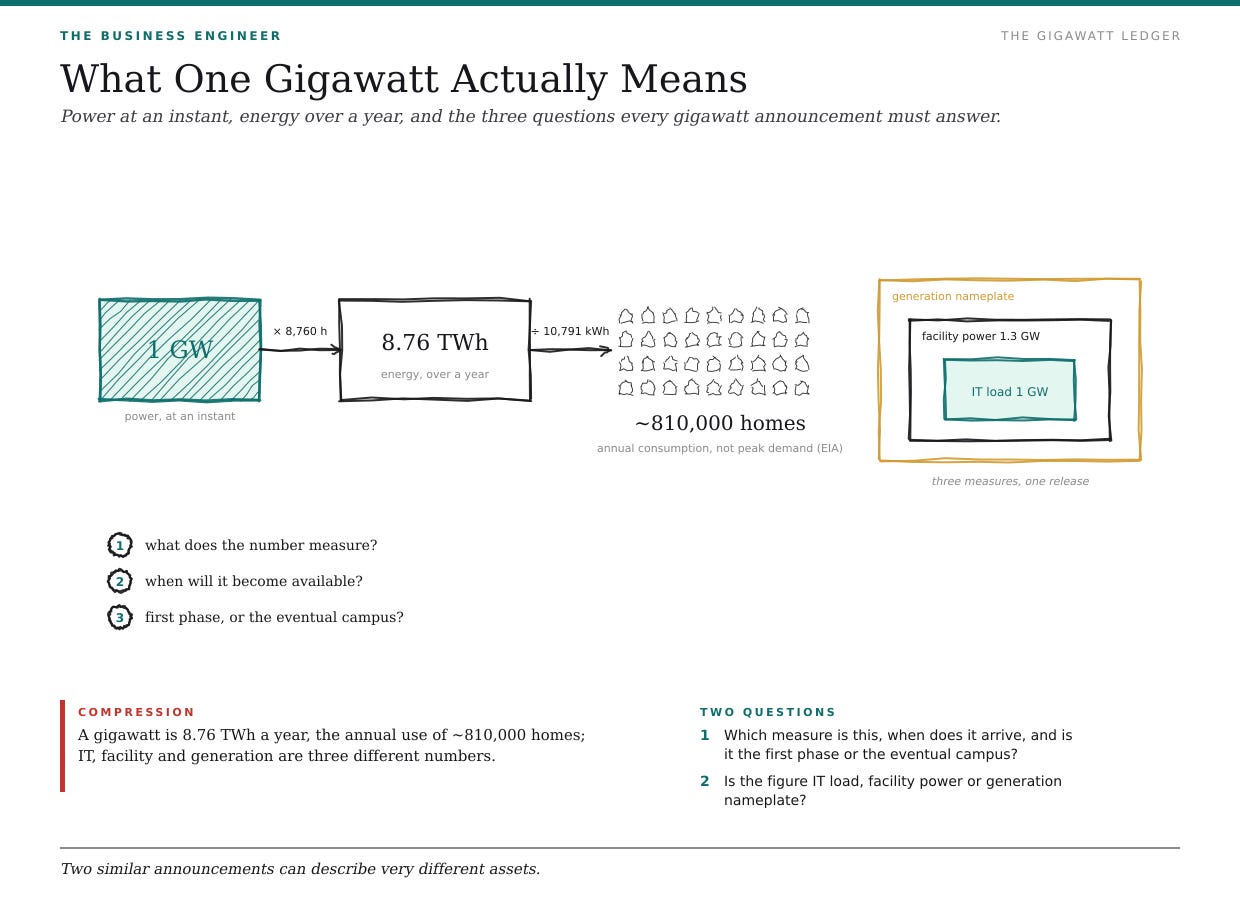
One gigawatt equals 1,000 megawatts, or one billion watts. It measures power: the rate at which electricity is being generated or consumed at a particular moment. Energy measures the accumulated consumption over time. That distinction separates the capacity of a facility from its electricity bill over a year. (U.S. Energy Information Administration)
Imagine a facility drawing one gigawatt continuously, every hour of every day. Over a normal year, it would consume 8.76 terawatt-hours, or 8.76 billion kilowatt-hours.
For perspective, the US Energy Information Administration, the federal agency responsible for energy statistics, reports that the average residential electricity customer purchased 10,791 kilowatt-hours in 2022. Using that historical benchmark, a continuous one-gigawatt load would consume as much electricity annually as approximately 810,000 residential customers purchased over an entire year. This compares annual energy consumption, not identical peak demand. (U.S. Energy Information Administration)
Now scale the thought experiment. A five-gigawatt load running continuously would consume 43.8 terawatt-hours a year. These are not ordinary commercial buildings with unusually large electricity bills. They are industrial concentrations of demand that require substantial power infrastructure.
There is another distinction: the electricity used by the computers is not the same as the electricity used by the entire campus.
IT power refers to the computing equipment. Facility power includes cooling and other supporting systems. A hypothetical campus requiring 30% additional electricity for those systems would need 1.3 GW of facility power to support 1 GW of IT load. Epoch AI’s infrastructure estimates similarly distinguish computing power from the larger total required at the facility level. (Epoch AI)
Generation capacity is a third measurement. A power plant’s rated capacity is not automatically the same as the continuous power available to the computers after operating constraints and facility overheads.
So every gigawatt announcement needs three questions: What does the number measure? When will it become available? And does it describe the first operating phase or the eventual campus?
Without those answers, two apparently similar announcements can describe very different assets.
The Financial Anatomy of a Gigawatt
Epoch AI, a nonprofit research organization that measures AI progress, hardware, and computing infrastructure, provides a useful starting point for understanding the capital involved. (Epoch AI)
In May 2026, its researchers built a financial model of a hypothetical US AI datacenter with one gigawatt of capacity for IT equipment. Their question was straightforward: what would it cost to construct, equip, and operate a facility of that size using NVIDIA’s GB200 NVL72 systems? This is a representative cost estimate, not the construction budget of a particular campus. (Epoch AI)
The GB200 NVL72 is a liquid-cooled computing rack connecting 72 GPUs, the specialized processors used for AI workloads, into an integrated system. A gigawatt-scale facility combines many such systems with networking, electrical infrastructure, and cooling. (NVIDIA)
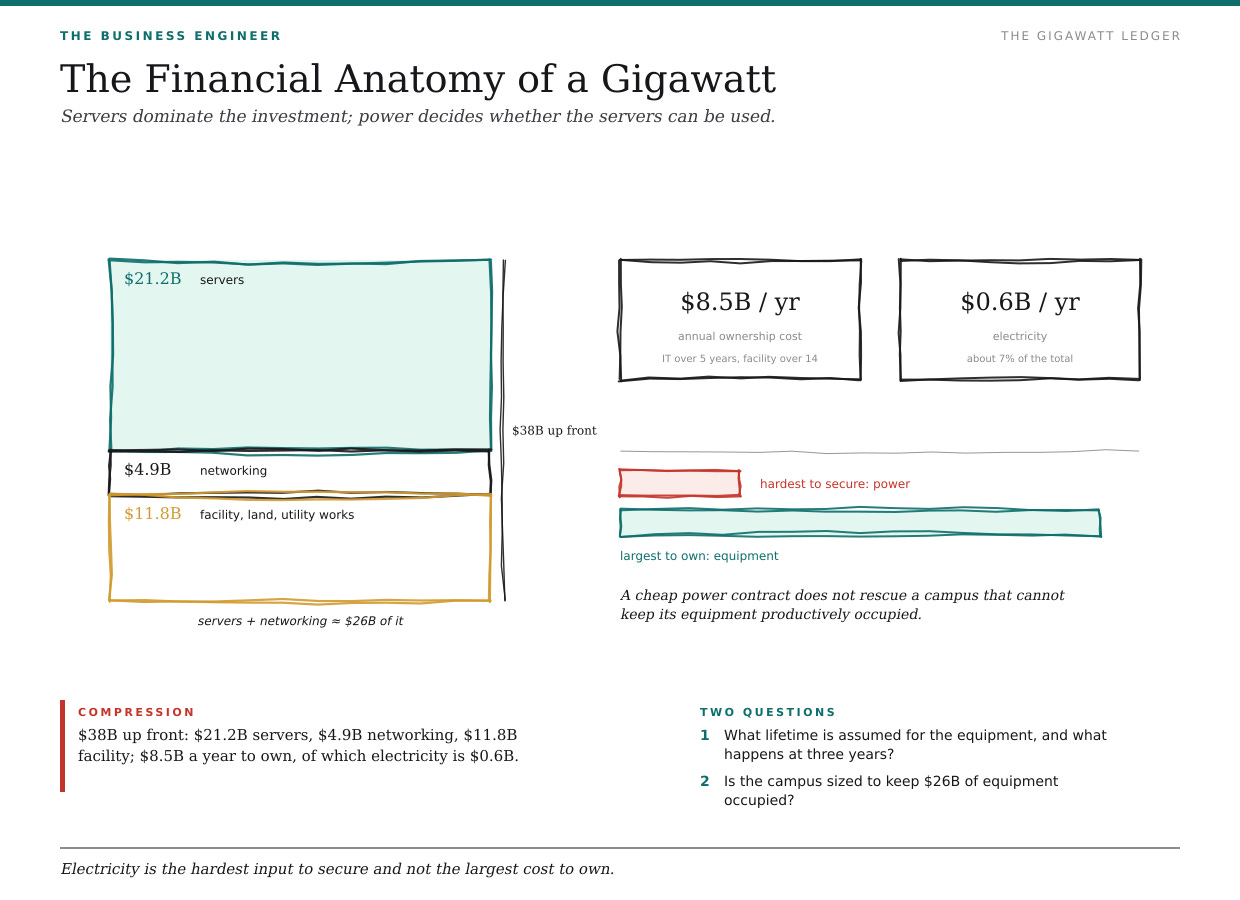
Epoch estimates approximately $38 billion in upfront investment, comprising:
$21.2 billion for servers.
$4.9 billion for networking.
Approximately $11.8 billion for the facility, land, and utility works.
Servers and networking together therefore account for roughly $26 billion. Annualizing capital over assumed asset lifetimes, including the cost of capital and operating expenses, produces approximately $8.5 billion in annual ownership costs. Electricity contributes roughly $600 million. The calculation assumes five years for IT equipment and fourteen for the facility; actual costs depend on design, location, financing, and equipment choices. (Epoch AI)
The implication is counterintuitive: electricity can be the hardest input to secure without being the largest cost of ownership.
The equipment dominates the investment. Power determines whether that equipment can be used. A cheap electricity contract does not rescue a campus that cannot keep its expensive systems productively occupied.
This is why the gigawatt is more than an engineering unit. It connects an enormous electrical requirement with a large stock of capital that must be converted into valuable work.
The Fleet That Exists Is Not the Pipeline Being Announced
The next challenge is separating what is operating from what is being built and what is merely planned.
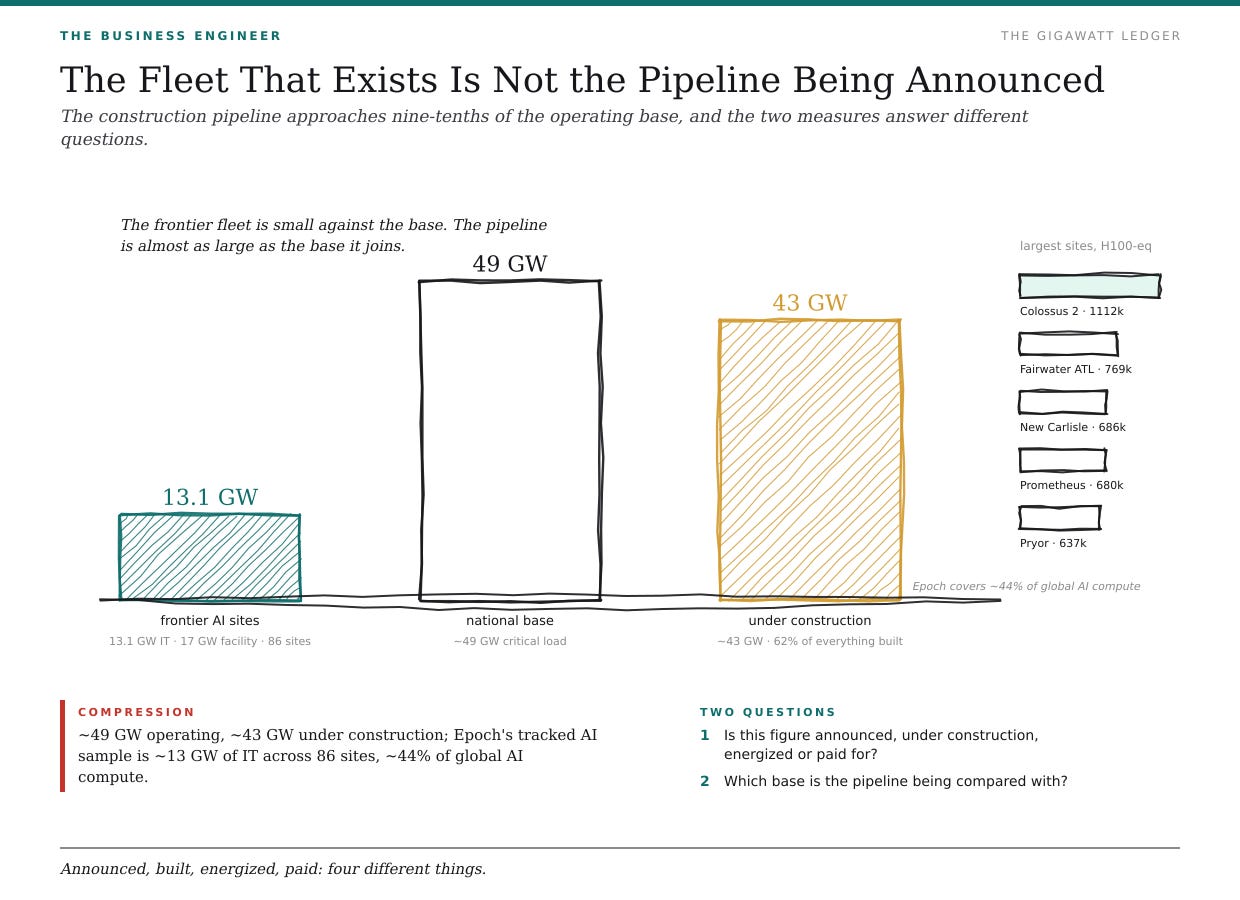
The broad US capacity estimates assembled for this analysis put the operating datacenter base at approximately 49 GW of critical load, with another 43 GW under construction. These totals cover more than frontier AI: they include infrastructure supporting conventional cloud and enterprise workloads. On those figures, the construction pipeline approaches nine-tenths of the operating base.
That is the scale of the transition. The country is attempting to add a volume of capacity approaching the size of the base it already operates.
But a construction pipeline is not a functioning fleet. A site can be under construction without having its full power supply, computing equipment, or customer workloads available. Nor should every megawatt of general-purpose datacenter capacity be priced as though it contained the most expensive frontier AI configuration.
Epoch AI provides a narrower view of AI infrastructure. Its September 2026 coverage spans 86 sites worldwide, representing roughly 13 GW of IT capacity. Importantly, this is a tracked global sample, not a complete inventory of all AI computing capacity. Epoch estimates that its coverage captures approximately 44% of global AI compute, with visibility varying substantially by company and geography. (Epoch AI)
These measurements answer different questions. The broad US total describes a national datacenter market. Epoch’s inventory provides detailed evidence about a selection of AI facilities. Dividing one by the other would not produce a valid estimate of AI’s share of US datacenter capacity.
The distinctions that matter are operational:
Announced capacity represents intention. Construction represents progress. Energized and equipped capacity represents delivery. Paid utilization begins to establish the business case.
Treating all four as the same thing makes the buildout look further advanced, and more commercially secure, than it necessarily is.
For full access, subscribe below. If you’re already a paid member of The Business Engineer, just ping me and I’ll enable access for you.
The Arrival Schedule: Three Waves of Construction
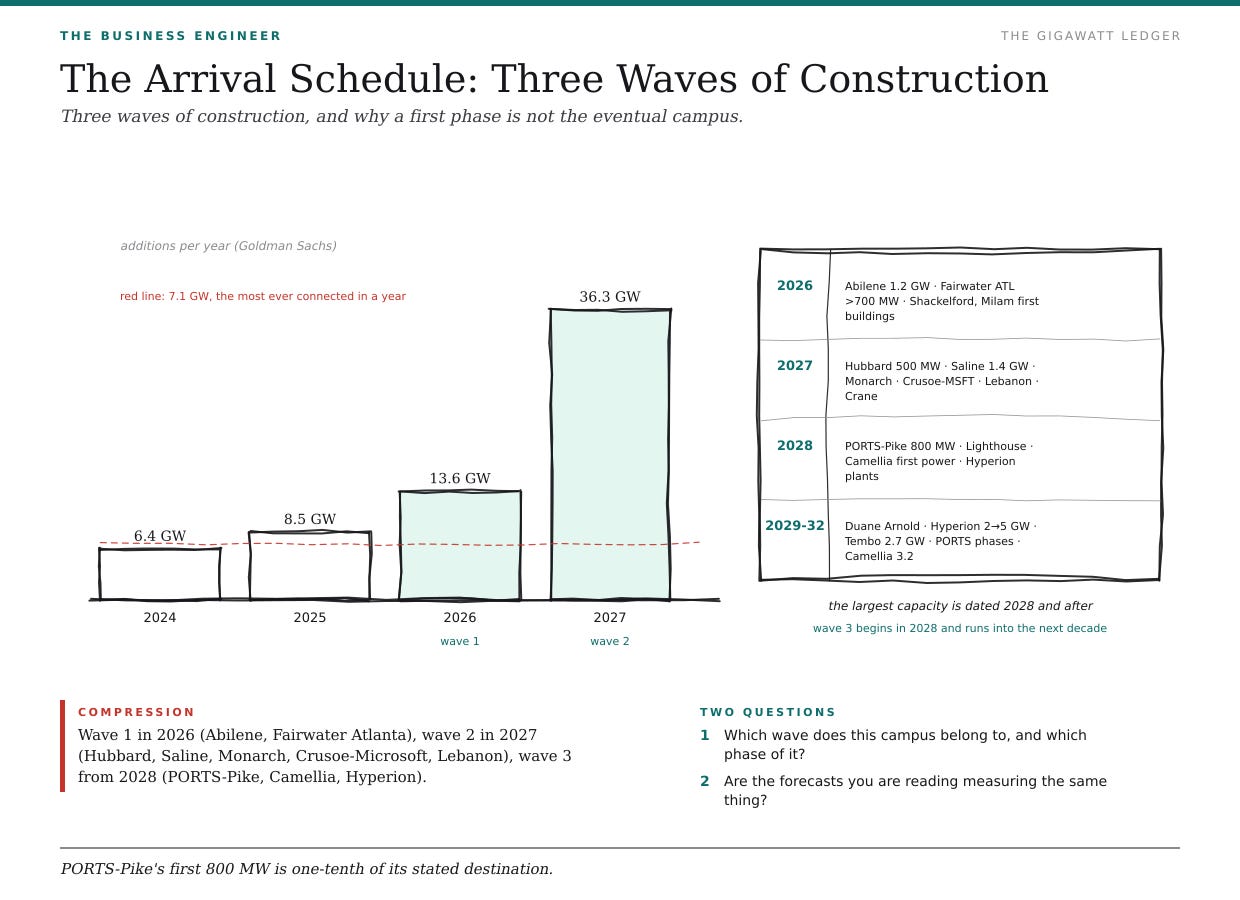
The expansion is easier to understand as a sequence of waves than as a single national opening date.
BloombergNEF, Bloomberg’s research service covering energy, commodities, and industrial transitions, projects 118 GW of installed US datacenter capacity by 2030 and 194 GW by 2035 in its July 2026 outlook. These are forecasts of future capacity, not measurements of electricity already being consumed. (BloombergNEF)
A more front-loaded forecast attributed to Goldman Sachs envisages 13.6 GW of additions in 2026 and 36.3 GW in 2027, taking capacity toward 95 GW by the end of that year. The forecasts should be read separately rather than combined into one continuous curve. Their timing and underlying definitions matter.
The first wave centers on 2026 delivery schedules. It includes the original Abilene campus moving toward 1.2 GW, Microsoft’s Fairwater Atlanta moving beyond 700 MW, and construction advancing at Shackelford County and Milam County. These are already large developments, but they represent the earlier portion of a much larger expansion.
The second wave is scheduled around 2027. It includes Nexus Hubbard’s first 500 MW, the 1.4 GW Saline Township campus, Nscale’s Monarch development in West Virginia, Crusoe’s 900 MW Microsoft campus, and Meta’s Lebanon site. The planned Crane nuclear restart is another important milestone, supplying electricity rather than computing capacity itself.
The third wave begins in 2028 and extends into the following decade. PORTS-Pike, an Ohio AI development with an eventual ambition of 8 GW of IT capacity, starts with an 800 MW phase. Camellia, OpenAI’s planned development in Georgia, is intended to expand toward 3.2 GW. Meta’s Hyperion is scheduled to grow toward approximately 2 GW in 2030 before a larger 5 GW ambition.
The difference between a first phase and an eventual campus is enormous. PORTS-Pike’s initial 800 MW would represent only one-tenth of its stated 8 GW destination.
Opening the first building does not mean the entire announced gigawatt total has arrived. Every subsequent phase remains another delivery challenge and another investment decision.
That is also where the financial risk begins: capital can be committed years before the full commercial opportunity becomes visible.
Three Gates Between an Announcement and a Working Gigawatt
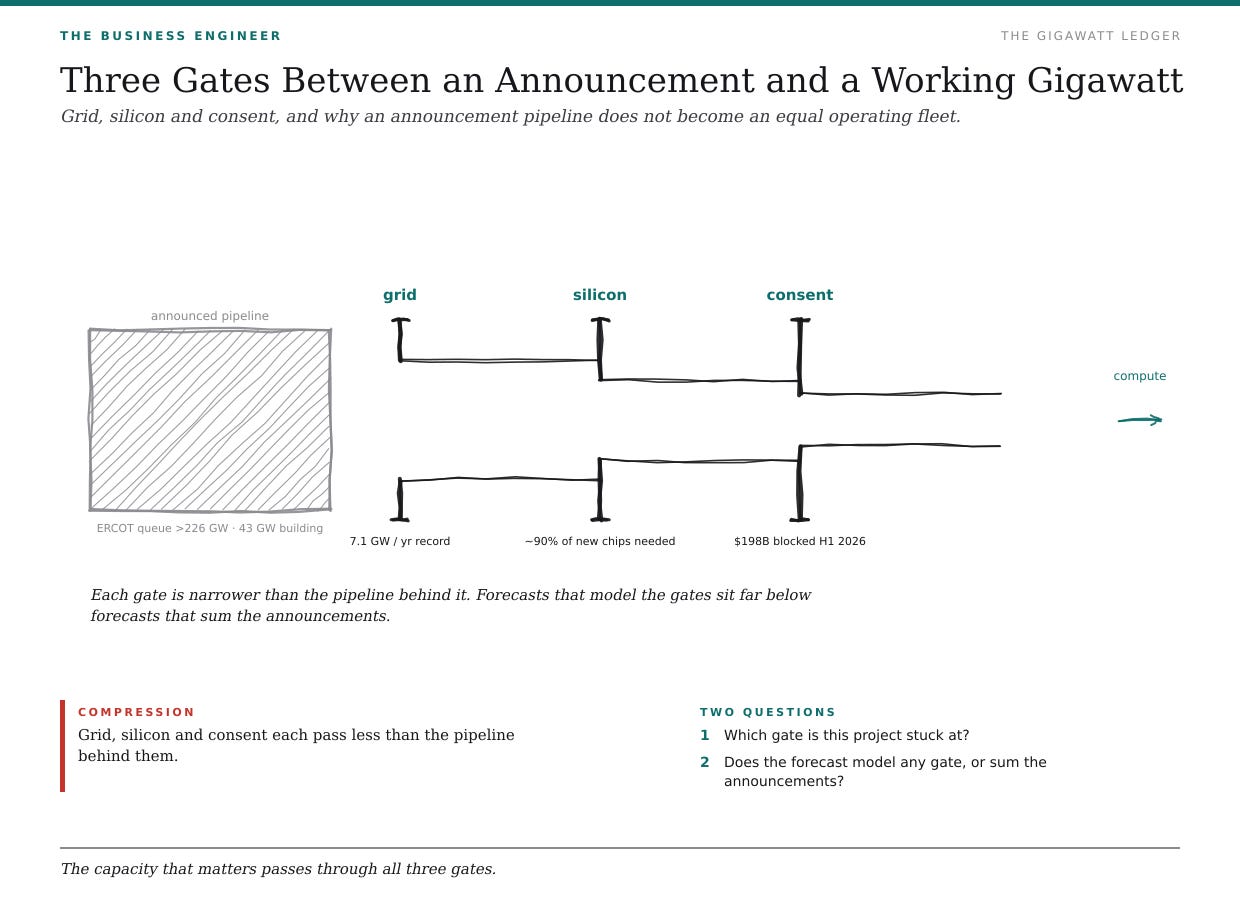
Every project must pass through three broad constraints before it becomes usable computing capacity: grid, silicon, and consent. These gates explain why a large announcement pipeline does not automatically become an equally large operating fleet.
The first gate is electricity. A developer can secure land, sign a customer, and order equipment without having a practical route to energizing the completed site on schedule. Generation must exist, but so must the infrastructure that delivers electricity to the campus.
The scale of requested demand illustrates the difficulty. ERCOT, the operator of the main Texas electricity grid, had a large-load queue exceeding 226 GW in late 2025, with almost 90% associated with datacenters, according to the estimates used here. A connection queue is not operating demand: projects may overlap, change, or fail to proceed.
The relevant question is not how much power developers have requested. It is how much can actually be delivered to the right locations, on the required schedules.
The second gate is silicon. London Economics International estimated that fulfilling every announced US datacenter project for 2025–2030 would require approximately 90% of the world’s incremental chip supply under its assumptions. “Incremental” means additional supply, not all chips already being produced.
The collective problem is that many individually plausible developments can make overlapping claims on the same manufacturing capacity. A powered building still needs servers, memory, networking, and the work required to integrate them.
The third gate is consent. Data Center Watch, which tracks local opposition and its effects on development, counted at least 75 projects worth approximately $130 billion blocked or delayed in the first quarter of 2026, followed by at least 45 projects worth nearly $68 billion in the second quarter. Those are reported project values affected by disruption, not equivalent amounts of capital permanently lost. (Data Center Watch)
These are distinct constraints. Additional equipment does not resolve an unavailable connection. Available electricity does not remove a permitting dispute. Financing does not guarantee that all the dependencies can be completed simultaneously.
The capacity that matters is the capacity that passes through all three gates.
Why the Datacenter Is Becoming a Power Project
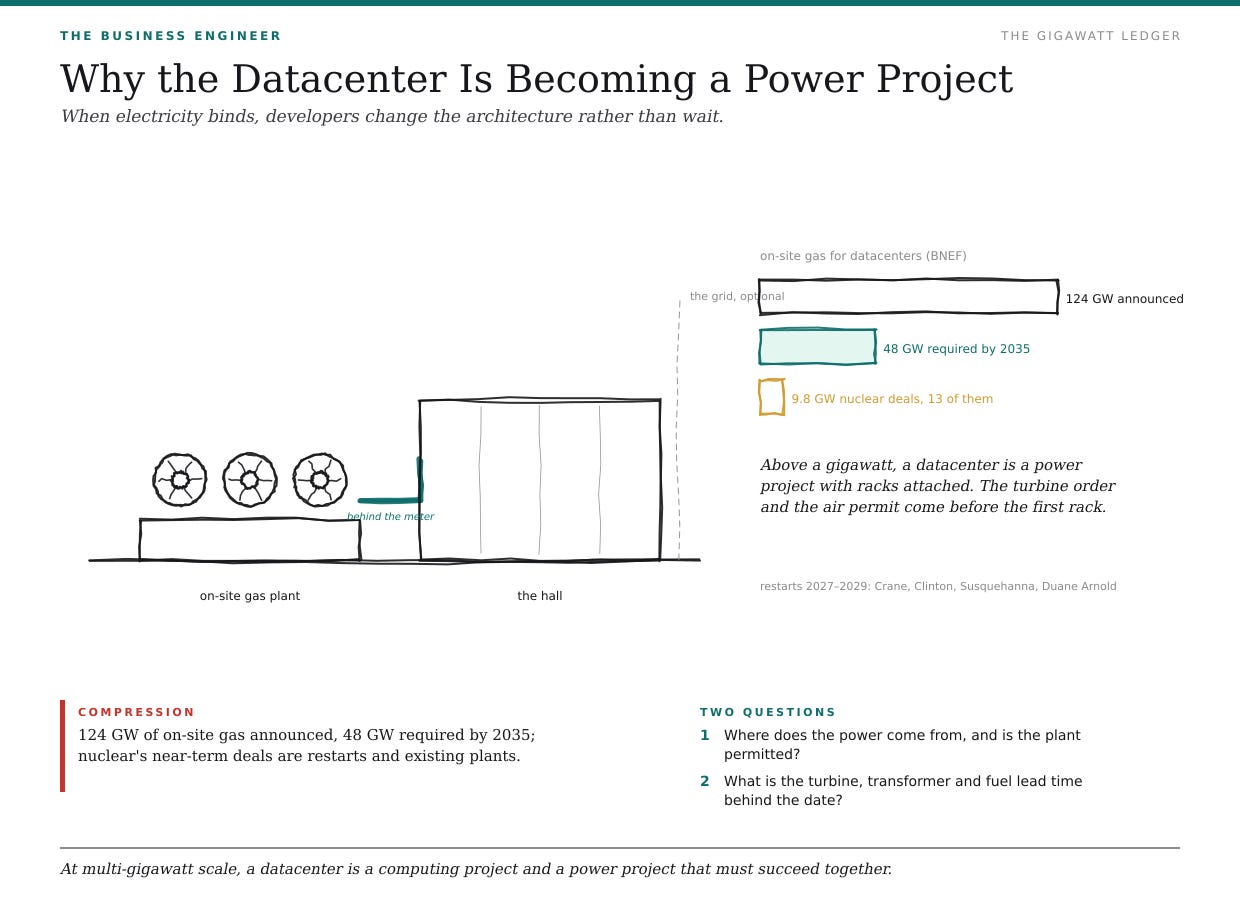
When electricity becomes a binding constraint, developers have an incentive to change the architecture of the project rather than simply wait.
Some campuses increasingly combine computing infrastructure with the generation needed to supply it. BloombergNEF identifies approximately 124 GW of announced on-site gas generation associated with datacenters. Its July outlook estimates that 48 GW would need to be built by 2035 if grid connections do not accelerate sufficiently to support its base-case capacity forecast. These are generation figures, not additional IT capacity. (BloombergNEF)
The approaches vary. PORTS-Pike’s eventual plan pairs 8 GW of IT load with at least 10 GW of proposed generation. Hyperion relies on new utility generation, with ten gas plants identified as supporting the development. Other projects include behind-the-meter generation, meaning electricity production on the customer’s side of the conventional utility delivery arrangement.
The development task now extends beyond buildings and servers into turbines, substations, transformers, fuel supply, pipelines, and approvals. Power is no longer merely something purchased after the campus is designed. Securing it becomes part of the design itself.
Nuclear offers another route, but its timing and structure matter. The near-term arrangements identified across Crane, Clinton, Susquehanna, and Duane Arnold largely involve existing plants and restarts, rather than newly constructed reactors. Much of the greenfield nuclear opportunity sits in the 2030s. A contract for output from an existing plant is not equivalent to an equal addition of new national generation capacity.
The industry is therefore changing shape. At multi-gigawatt scale, a datacenter development increasingly becomes a computing project and a power project that must succeed together.
Gigawatts Measure the Input. Customers Pay for the Output.
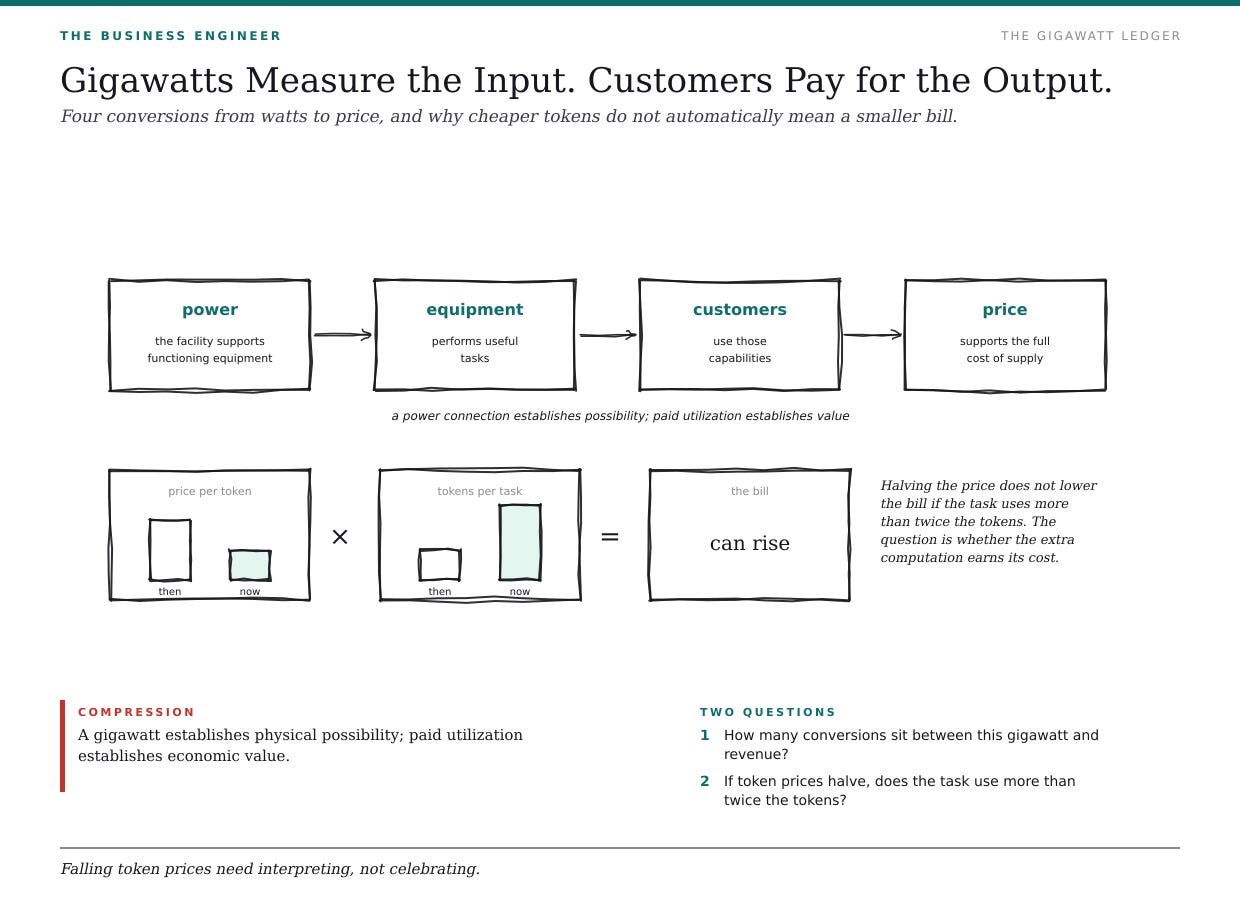
Electricity makes the computing possible. It does not tell us how much useful work the equipment performs.
AI infrastructure is sometimes compared using H100-equivalents, a way of expressing computing capacity relative to NVIDIA’s H100 accelerator. This allows different systems to be discussed in a common unit. It is not a count of physical H100 chips, and it does not create a fixed conversion between electrical power and useful output. (Epoch AI)
Hardware generation, software, workload, and utilization all affect what a campus can produce. Two facilities with similar electrical capacity need not deliver the same volume of commercially valuable work.
There are several conversions between a gigawatt and revenue: the facility must support functioning equipment; the equipment must perform useful tasks; customers must use those capabilities; and the realized price must support the full cost of supplying them.
A power connection establishes physical possibility. Productive utilization establishes economic value.
This is why falling token prices need to be interpreted carefully. A token is a unit of model input or output, not a completed business outcome. Lower token prices can reduce the cost of a given task, but more elaborate reasoning or agent activity can increase the number of tokens used.
As a simple illustration, halving the price per token does not lower the total bill if an application begins consuming more than twice as many tokens. The relevant business question is whether the additional computation produces enough additional value.
The potential expansion mechanism is powerful: lower costs make new applications economical, better capabilities make new tasks feasible, and usage expands. The cost of a unit of intelligence can fall while the total market for intelligence grows. But that expansion is a commercial outcome to be demonstrated, not an automatic consequence of installing more equipment.
The Spread That Must Finance the Next Campus
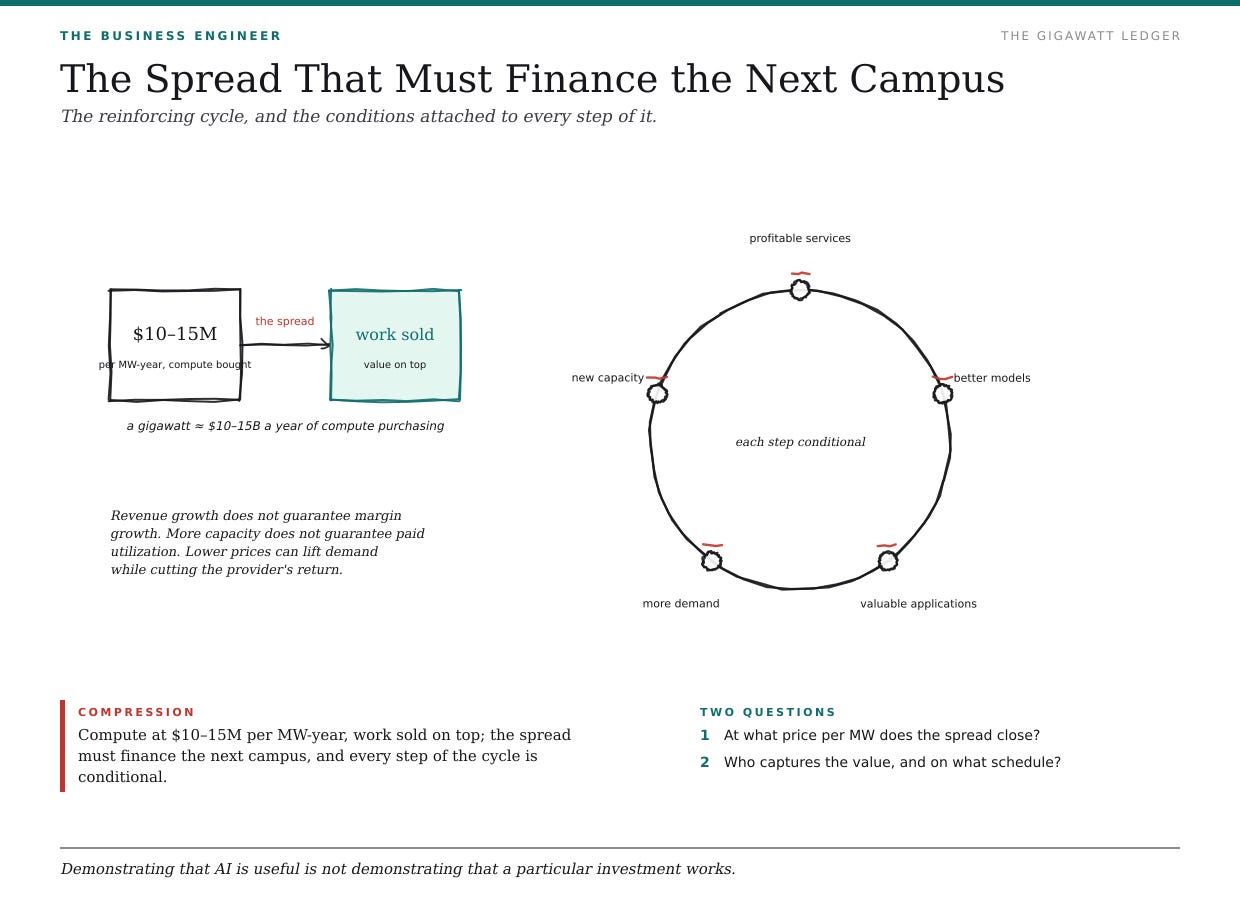
The infrastructure ultimately depends on a spread between the full cost of producing computing services and the value of the work sold on top.
The estimates used here put leading labs’ compute acquisition costs at approximately $10–15 million per megawatt-year. At that illustrative rate, a gigawatt would correspond to $10–15 billion of annual compute purchasing. This is a service-purchasing measure, not an electricity bill or a construction budget, and it depends on what the contract includes.
The proposed reinforcing cycle works like this: profitable deployed services help finance better models; better models create more valuable applications; greater demand supports new capacity; and additional capacity makes more work economical.
But each step is conditional. Revenue growth does not guarantee margin growth. More capacity does not guarantee paid utilization. Lower prices can stimulate demand while simultaneously reducing the returns available to the infrastructure provider.
This is the difference between demonstrating that AI is useful and demonstrating that a particular investment works.
The demand question is how much valuable work AI can perform. The investment question is how much of that value the owners of the infrastructure can capture, and on what schedule.
Who Owns the Infrastructure, and Who Commits to Using It?
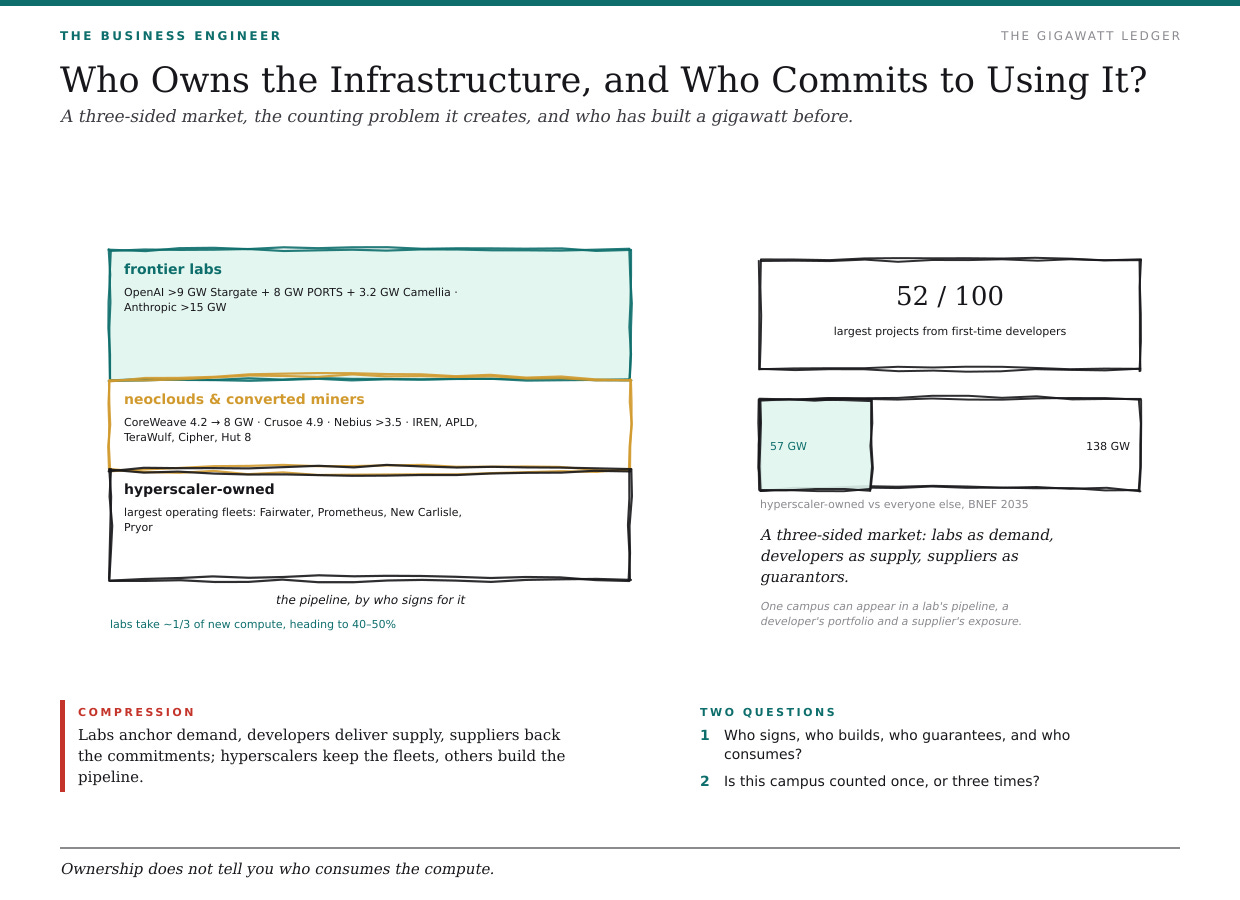
The industry’s division of labor is changing.
The large technology companies commonly described as hyperscalers, including Amazon, Microsoft, Alphabet, and Meta, remain central to the operating fleet. But frontier AI developers are increasingly becoming anchor customers for capacity built by others. An anchor customer provides a substantial initial demand commitment that can help make a development financeable.
OpenAI’s original seven Stargate locations are described as having more than 9 GW planned, against roughly 0.4 GW operating in the September snapshot. Separately, PORTS-Pike involves an eventual 8 GW commitment structure, with NVIDIA providing credit support on the initial 4.25 GW. Anthropic’s pipeline exceeds 15 GW across approximately fifteen campuses, without the company owning the underlying sites. These describe different contractual positions and development stages, not equivalent operating fleets.
Specialist infrastructure companies occupy the space between the labs and traditional hyperscalers. These include neoclouds, providers focused on supplying AI computing capacity, and former cryptocurrency-mining operators adapting sites with existing power access.
The capacity figures associated with this group include approximately 4.2 GW contracted by CoreWeave, alongside an 8 GW target for 2030, approximately 4.9 GW with Crusoe, and more than 3.5 GW with Nebius. IREN, Applied Digital, TeraWulf, Cipher, Hut 8, and Galaxy are also identified among operators adapting powered sites for AI.
BloombergNEF expects the ownership shift to continue: its 2035 forecast assigns approximately 57 GW to hyperscalers and 138 GW to other owners. Ownership, however, does not tell us who ultimately consumes the computing services. A lab or hyperscaler can be a major customer of infrastructure it does not own. (BloombergNEF)
The structure is increasingly three-sided: labs create demand, developers deliver physical capacity, and suppliers or financial partners support the commitments connecting them.
That also creates a counting problem. The same campus can appear in a lab’s contracted pipeline, a developer’s project portfolio, and a supplier’s financing exposure. Those may be three descriptions of one asset, not three additions to national capacity.
Every Gigawatt Creates Dependencies Across the Supply Chain
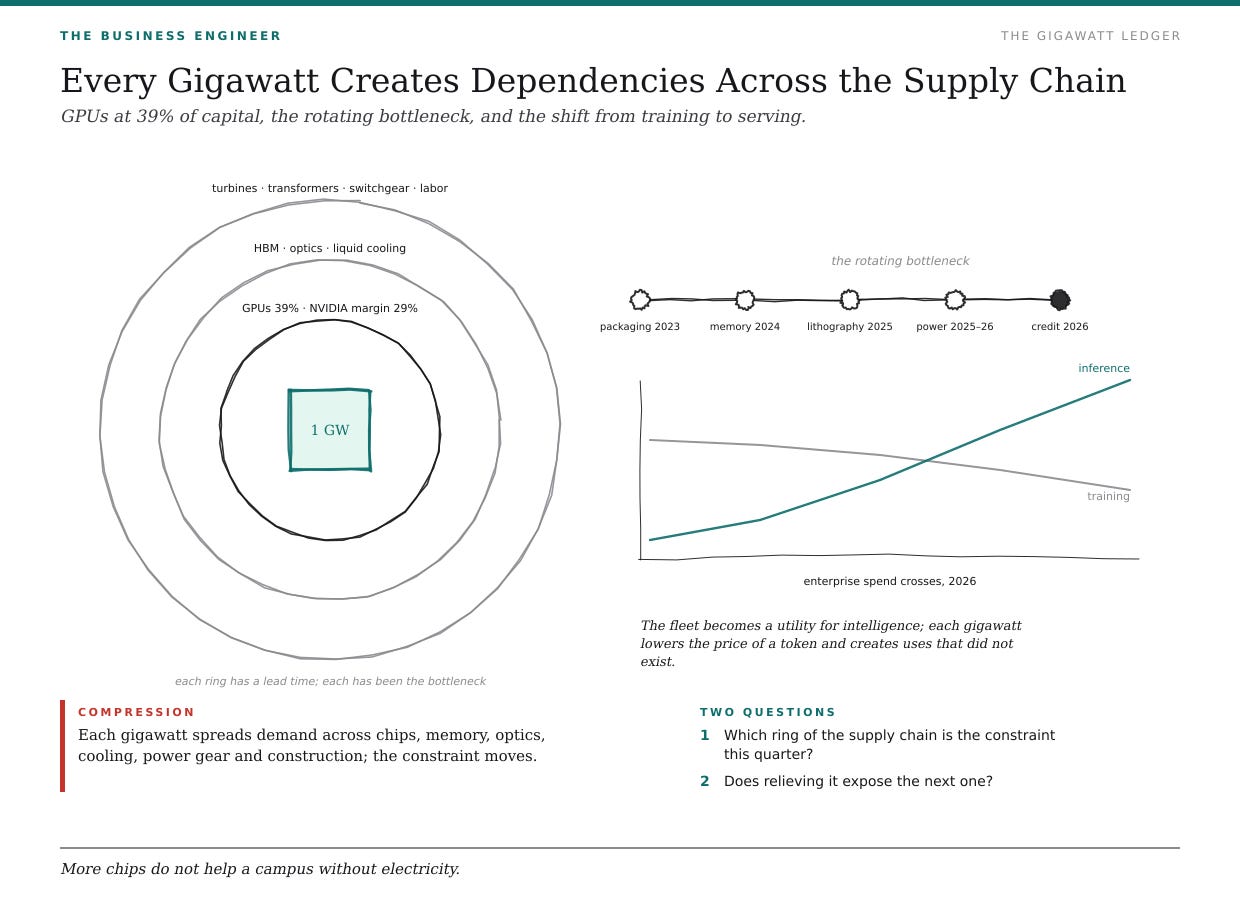
The buildout distributes demand across accelerators, memory, semiconductor manufacturing, networking, cooling, electrical equipment, and construction.
Bernstein’s analysts estimate that GPUs account for approximately 39% of the capital in a GB200-class gigawatt, while NVIDIA’s gross profit represents roughly 29% of the entire project value in their breakdown. That profit is embedded within the spending, not an additional cost to be added on top.
The broader lesson is that the location of the constraint can change. My framework for the AI Supercycle follows the pressure moving through advanced packaging, high-bandwidth memory, lithography, power, and increasingly credit. That is a way of interpreting the changing constraints, not a claim that earlier bottlenecks have disappeared.
Relieving one constraint can expose another. More chips do not help a campus without electricity. More energized buildings do not help without customers. More customers do not make every financing structure sustainable.
The distinction between training and inference matters here. Training builds or updates the model; inference runs it to produce outputs. The commercial case for the expanding fleet increasingly depends on the recurring work of serving users and businesses, not only on developing the next frontier model.
That is the path toward an infrastructure utility for intelligence. It is also where the financing becomes inseparable from the technology.
The Money Behind the Megawatts
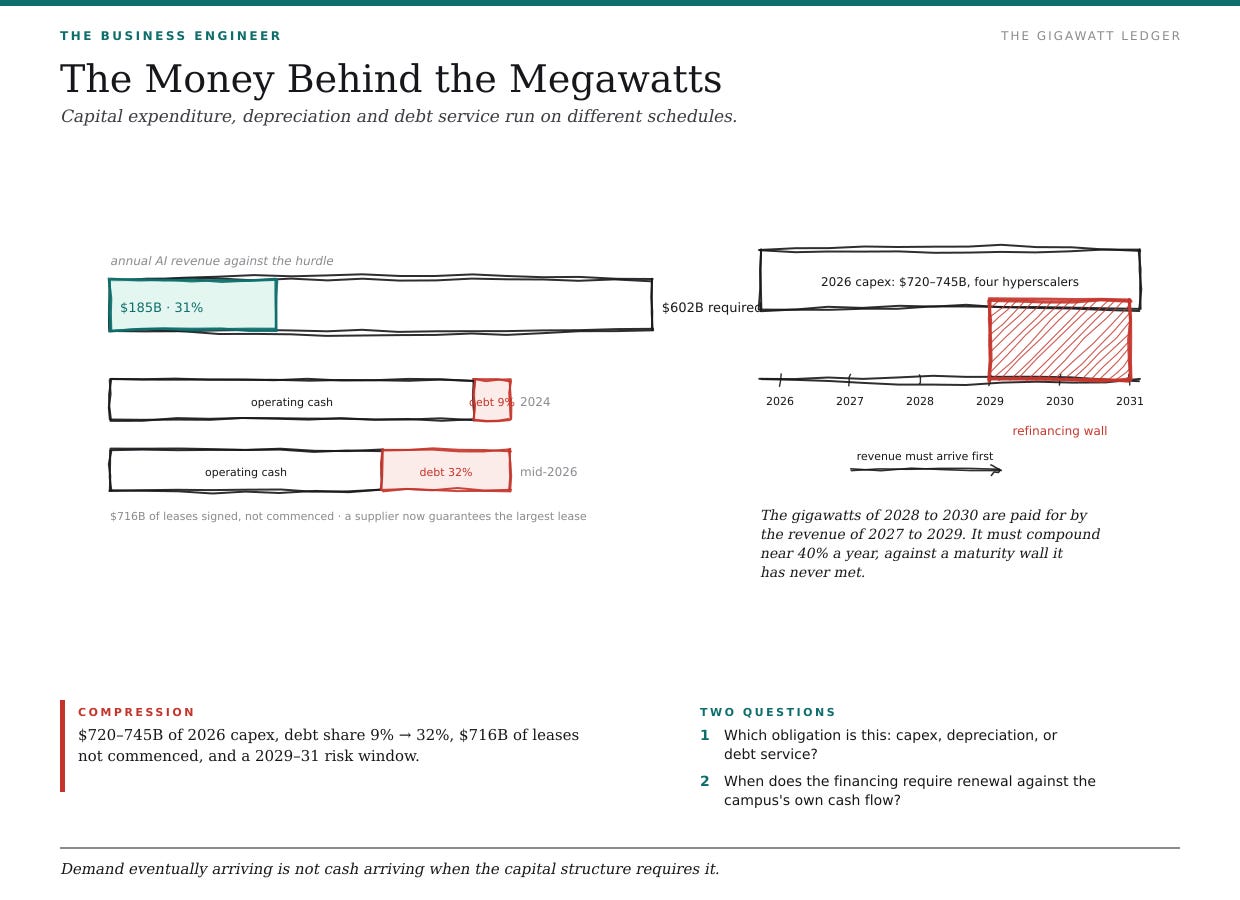
Combined 2026 capital-expenditure guidance for the four largest hyperscalers is estimated at approximately $720–745 billion. This is broad company spending, not a clean measure of AI-only investment. A valid return calculation must match the assets being financed with the revenue attributed to them.
The financing structure is also becoming more complex. New debt issuance amounted to roughly 9% of hyperscaler capital expenditure in 2024, rising to approximately 32% by mid-2026 in the financial comparison used here. Across four companies, leases signed but not yet commenced total approximately $716 billion. These measures describe different obligations and should not simply be added together: a multiyear lease commitment is not equivalent to a year of cash spending.
Three concepts need to remain separate.
Capital expenditure is the investment in the asset. Depreciation allocates its cost across an assumed useful life. Debt service and refinancing concern the obligations used to fund it. They interact, but they do not occur on identical schedules.
This creates the central timing risk. A campus may enter operation later than expected. Its utilization may develop gradually. Its equipment can still accumulate costs, while its financing obligations come due.
The 2029–2031 period is therefore an important risk window in the investment thesis: major campus phases are expected to arrive around the same period in which some financing raised earlier in the cycle may need renewal. That is a scenario to assess project by project, not a universal maturity date for the industry.
Demand eventually arriving is not the same as cash arriving when the capital structure requires it.
Why 2027 Matters
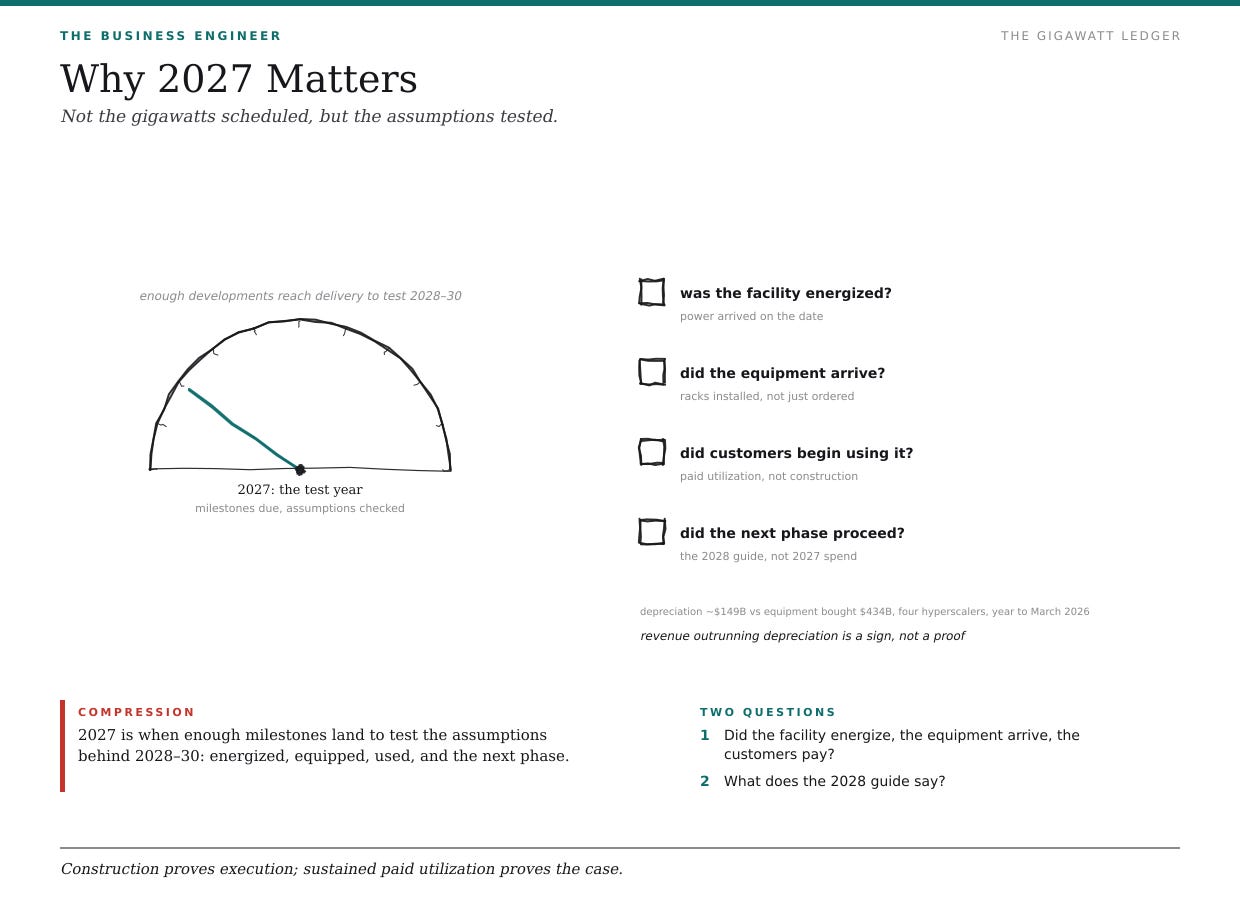
The significance of 2027 is not simply the number of gigawatts scheduled to arrive. It is that enough major developments are expected to reach delivery milestones to test the assumptions supporting the larger 2028–2030 expansion.
The questions become concrete: Was the facility energized? Did the equipment arrive? Did customers begin using it? Did the next phase proceed?
Construction progress demonstrates execution. Sustained paid utilization begins to demonstrate the investment case.
Current spending can be misleading because it often reflects decisions made earlier. Equipment has been ordered, leases signed, and construction contracts committed. Spending can remain high even while expectations for subsequent expansion change.
That makes next-year capital guidance particularly useful. The 2028 investment outlook may reveal changes in demand expectations more clearly than fluctuations inside an already committed 2027 construction program.
Revenue must also be evaluated against the growing cost of the installed assets. The financial snapshot places depreciation across the four largest hyperscalers at approximately $149 billion in the year to March 2026, against $434 billion of equipment purchases. These are company-level figures, so they require scope alignment before comparison with AI revenue.
Revenue growth outrunning depreciation growth can be a useful sign. It is not, by itself, proof of an adequate return. The starting levels, operating margins, financing costs, and cash flows still matter.
From 2028 Onward, Follow the Phases
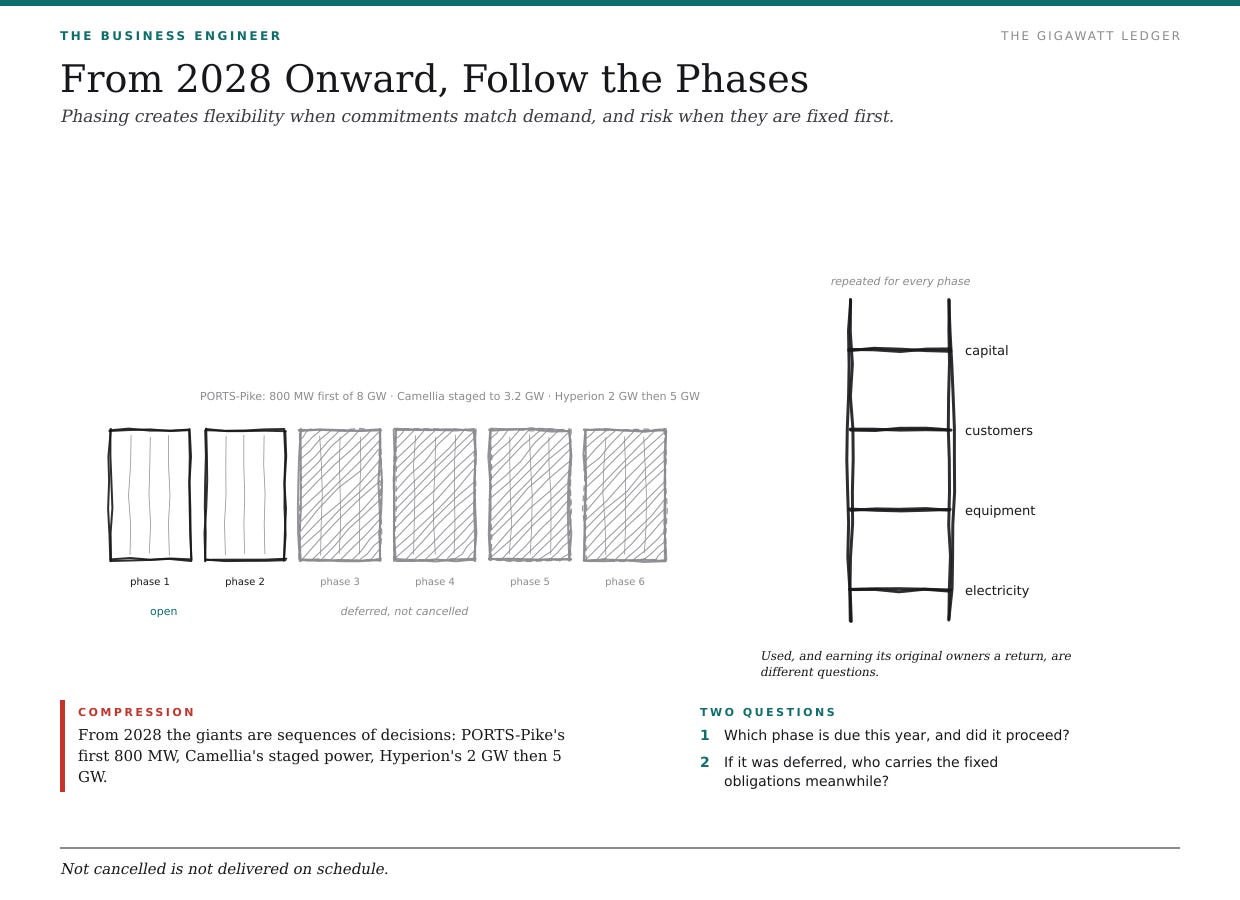
The largest developments should not be analyzed as binary events.
PORTS-Pike’s initial phase, Camellia’s staged power delivery, and Hyperion’s expansion all illustrate a structure in which the eventual campus depends on repeated decisions about electricity, equipment, customers, and capital.
A project can open its first buildings while delaying later ones. It can postpone equipment installation, defer leases, or slow expansion. The campus survives, but the economics change.
“Not cancelled” does not mean “delivered on the original schedule.” Neither guarantees the original return.
Phasing creates flexibility when commitments can be matched to demonstrated demand. It creates risk when substantial obligations are fixed before utilization develops. The headline size of a campus tells us less than the sequence of decisions required to reach it.
This also separates the usefulness of the infrastructure from the success of its original financing. A campus can eventually support valuable work under new ownership, at a different acquisition price, after its first investors have absorbed losses.
“Will the asset be used?” and “Will its original owners earn an adequate return?” are different questions. That distinction may become increasingly important as the largest projects reach operation.
Five Signals That Make the Buildout Easier to Read
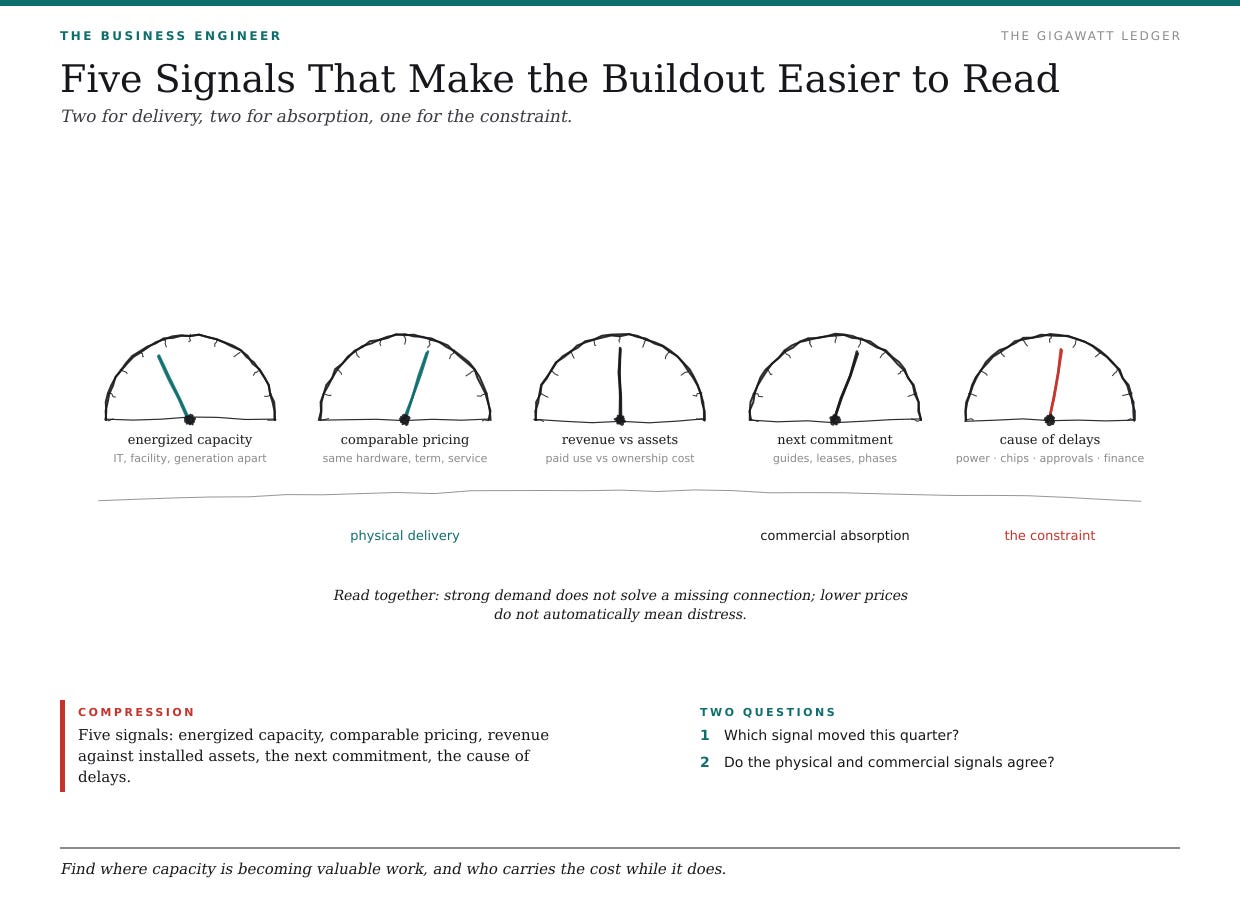
The most useful indicators connect physical delivery with commercial absorption. Together, they reveal more than any single spending announcement.
Capacity actually energized. Follow commissioned infrastructure, keeping IT load, facility demand, and generation separate. Applications in a queue are not delivered capability.
Comparable compute pricing. Compare equivalent hardware, contract periods, and service commitments. Falling prices can reflect better technology, greater supply, weaker demand, or a combination.
Revenue relative to the installed assets. Track whether paid usage supports the operating and ownership costs of the equipment. Match the revenue being counted to the assets producing it.
The next investment commitment. New capital guidance, leases, and expansion phases reveal whether companies still expect additional capacity to earn a return.
The cause of project delays. Distinguish power, equipment, approvals, financing, and customer-related problems. Each implies a different constraint on the pipeline.
These indicators should be read together. Strong demand does not solve an unavailable grid connection. Successful construction does not guarantee profitable utilization. Lower compute prices do not automatically indicate distress.
The task is to identify where capacity is becoming valuable work, where that conversion is slowing, and who carries the cost while it does.
Two Futures, With Demand for AI in Both
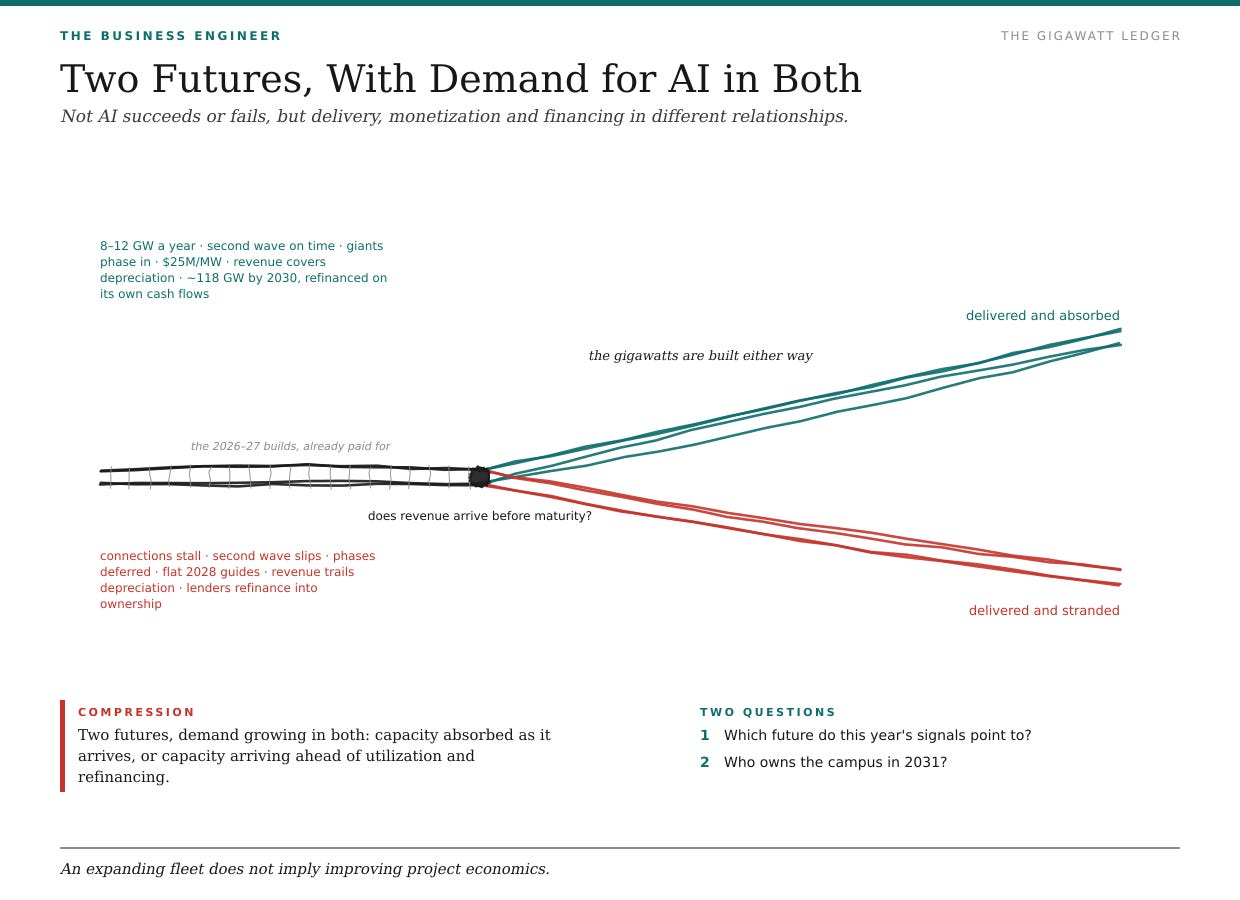
The two most useful scenarios are not “AI succeeds” and “AI fails.” They describe different relationships between delivery, monetization, and financing. Demand can expand in both.
In the first, power arrives quickly enough to support the construction waves. Campuses enter service in manageable phases. Better technology lowers the cost of useful work, and paid usage expands fast enough to absorb the new capacity. Some projects disappoint, but the system increasingly supports itself through the revenue it produces.
In the second, demand also grows, but the timing is less forgiving. Connections slip. Some campuses arrive late. Others carry equipment and financing commitments ahead of sufficient utilization. Prices weaken before operators recover enough of their investment, while refinancing becomes difficult before cash flows are strong enough.
Capacity can continue expanding for a time in the second scenario because earlier commitments are still moving through construction. This is why capital expenditure alone is an incomplete signal.
An expanding fleet does not automatically imply improving project economics. Rising demand does not automatically make every capital structure sustainable.
Three Clocks Determine the Outcome
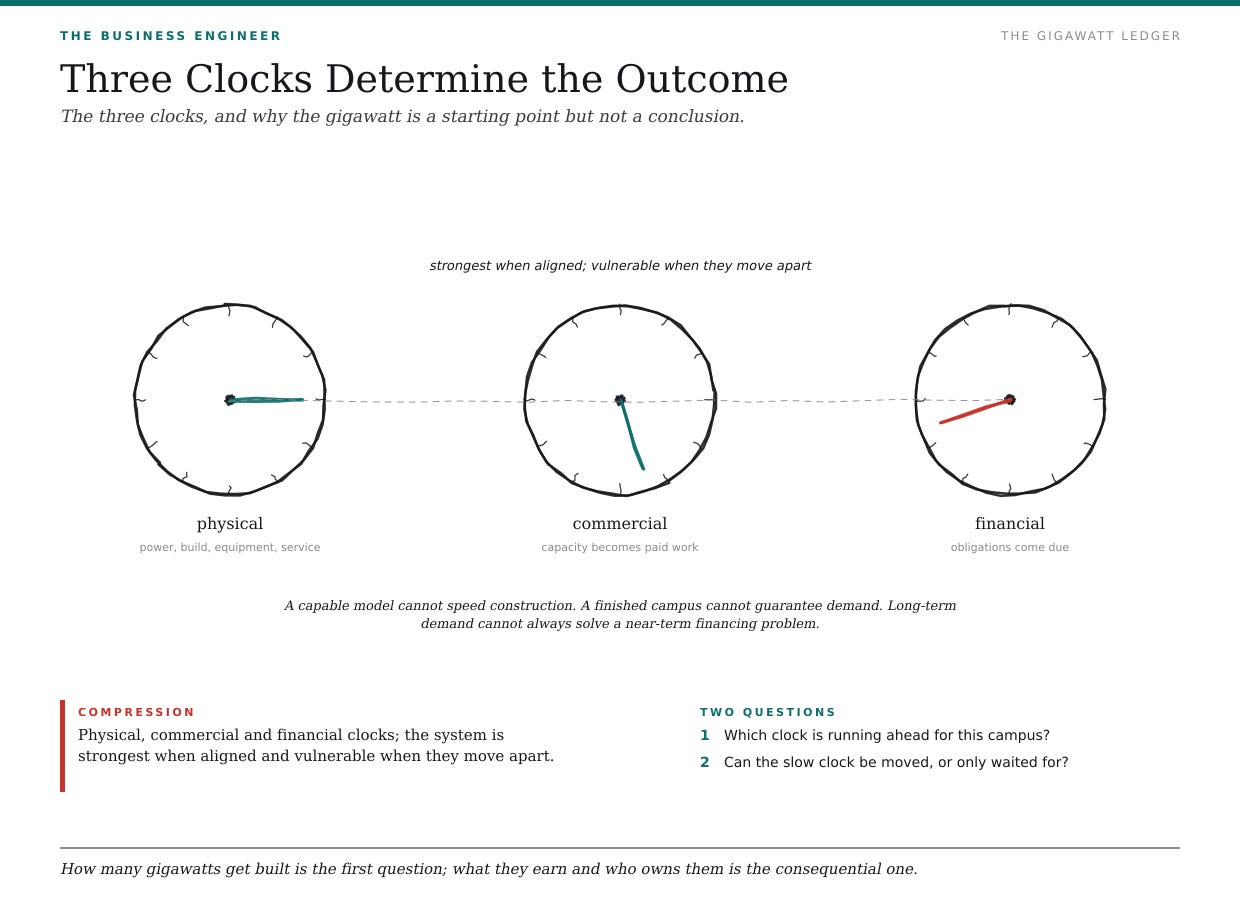
The whole buildout becomes easier to understand by following three clocks.
The physical clock measures the time required to secure power, construct the facilities, deliver the equipment, and put it into service. The commercial clock measures how quickly that capacity becomes work customers will pay for. The financial clock measures when the obligations supporting the assets require payment, renewal, or refinancing.
The system is strongest when these clocks remain aligned: infrastructure arrives as demand develops, and cash generation strengthens before the financing becomes restrictive. It becomes vulnerable when they move apart.
A capable model cannot accelerate every construction dependency. A completed campus cannot guarantee enough demand at the required price. Long-term demand cannot always solve a near-term financing problem.
That is why the gigawatt is a useful starting point but an insufficient conclusion. It makes the physical scale visible. It does not tell us whether the equipment is productive, whether the work is profitable, or whether the owners have enough time for the economics to mature.
The structural case for rebuilding computing infrastructure and the investment case for a particular campus must therefore remain separate. A technological transition can be real while some of the capital committed to it earns poor returns.
The US AI datacenter buildout is a race to turn electricity into computing capacity, computing capacity into valuable work, and valuable work into cash before the financing catches up.
The first question is how many gigawatts get built. The more consequential question is what those gigawatts earn, and who ultimately owns them.
With massive ♥️ Gennaro Cuofano, The Business Engineer
For full access, subscribe below. If you’re already a paid member of The Business Engineer, just ping me and I’ll enable access for you.