

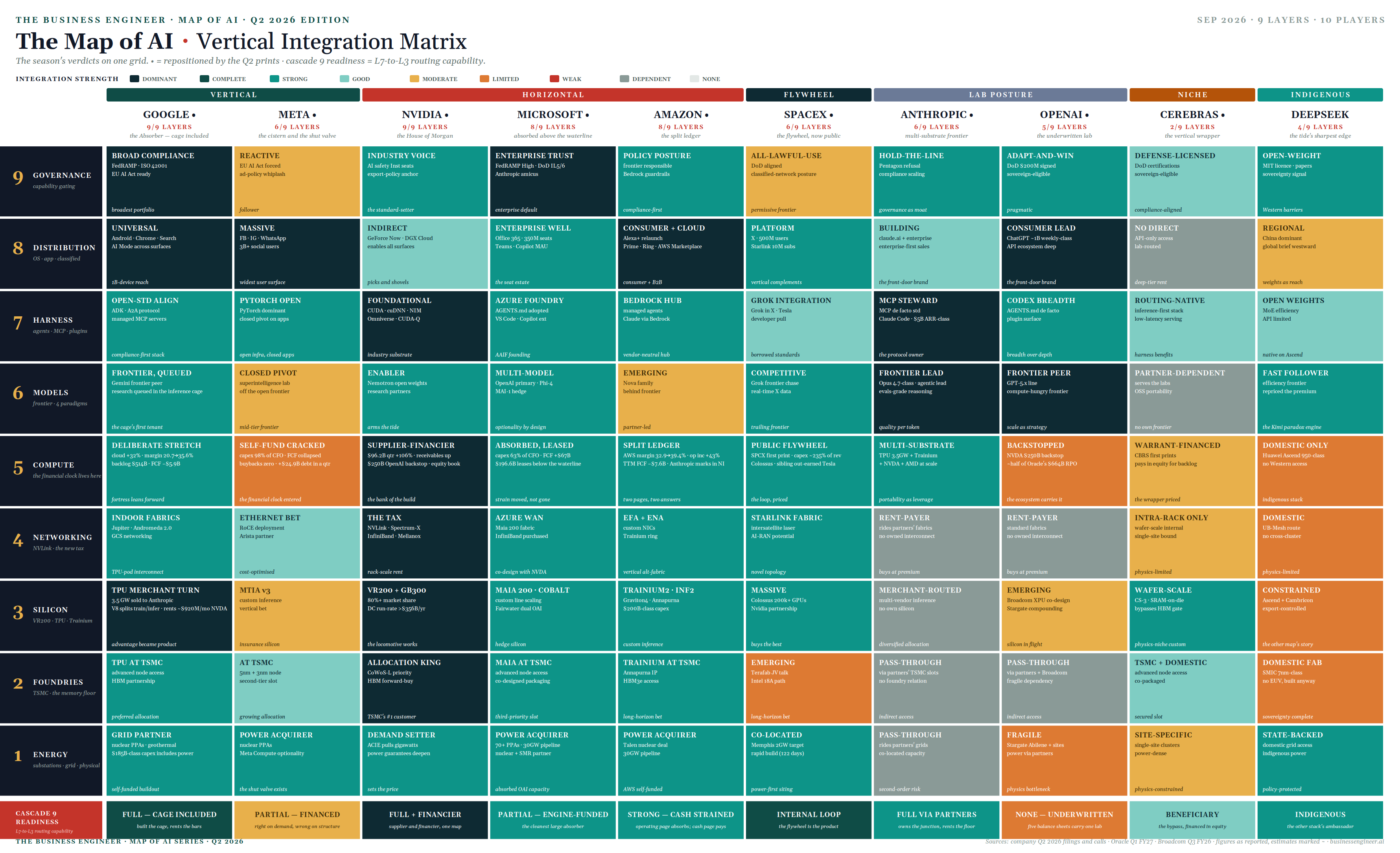
A version of the AI story can be told entirely through league tables. Who has the largest model? Who bought the most GPUs? Who owns the biggest cloud? Who spent the most capital? Who has the strongest benchmark? Who shipped the fastest accelerator? Those rankings are easy to produce and increasingly misleading because they compare companies that are not trying to win the same game.
Google does not need to become NVIDIA. NVIDIA does not need to own Google’s distribution. Anthropic can be strategically strong while depending on almost everyone underneath it. Cerebras can matter while occupying only a fraction of the stack. SpaceX can look incomplete as a column and extraordinarily complete as a circuit. DeepSeek cannot be understood properly if you grade it against the same industrial assumptions as an American frontier lab.
A better instrument is a grid. Put the nine layers of the AI stack down one axis: Energy → Foundries & Memory → Silicon → Networking → Compute → Models → Harness → Distribution → Governance. Then place the major players across the other axis: Google, Meta, NVIDIA, Microsoft, Amazon, SpaceX, Anthropic, OpenAI, Cerebras, DeepSeek. Now stop asking who is biggest and ask a more useful question in every cell: What does this company actually control here, how strong is that position, and why does it own that layer at all?
What emerges is not a ranking. It is a set of geometries. And the geometry is the strategy.
That’s why I’ve been working for months on the Atlas of AI.

If you are an existing paid member of The Business Engineer, please reply to this email to gain access to the AI Atlas.
The Nine Layers
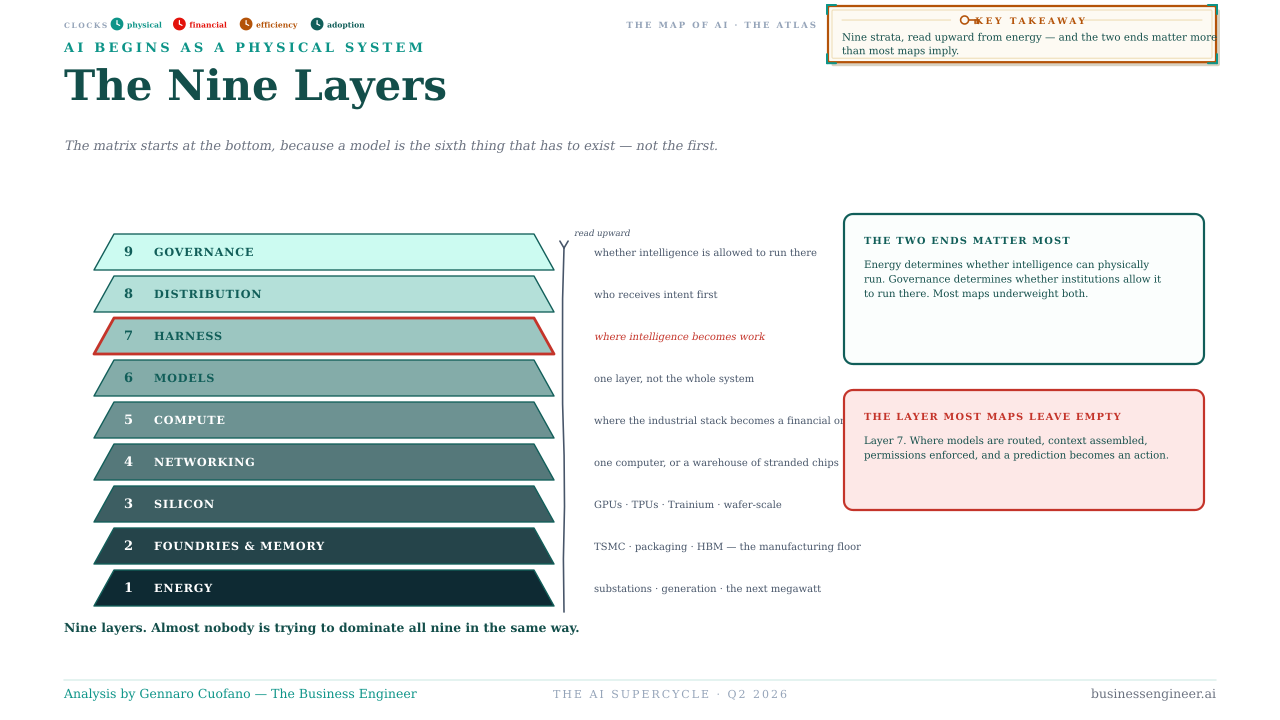

The matrix starts at the bottom because AI begins as a physical system long before it becomes a model. Energy is the floor. Data centers do not run on abstractions. They run on substations, generation contracts, grids, gas, nuclear, renewables, batteries, and increasingly strategic power agreements. The question is not simply who consumes the most electricity, but who can secure the next megawatt when everybody wants the same one.
Above energy sit foundries and memory. TSMC capacity, advanced packaging, HBM, domestic fabs, export controls, and memory supply determine how much silicon can actually be produced. A company can design a magnificent accelerator and still discover that somebody else owns the manufacturing floor. Then comes silicon: GPUs, TPUs, Trainium, Maia, custom inference chips, wafer-scale architectures, and the proliferating attempts to reduce dependence on a single merchant supplier. Silicon gets most of the attention because it is visible, expensive, and benchmarkable, but it only becomes useful at scale because networking turns thousands of accelerators into one system. Interconnect, Ethernet, InfiniBand, optical systems, and data-center topology determine whether a warehouse of chips behaves like one computer or like a warehouse of stranded chips.
Above networking sits compute, where the industrial stack becomes a financial one. Compute is not merely how many accelerators exist. It is who owns them, who financed them, whether the capacity is internal or rented, whether the data center is leased or owned, whether power is contracted separately, and whether the customer paid in advance. Then comes models, the layer public narratives often confuse with AI itself. Frontier models remain enormously important, but the matrix makes clear that they are one layer in a much larger system. Some companies treat the model as the center. Others increasingly treat it as a component that can be routed, replaced, or rented.
The next layer is the one I increasingly think matters most: the harness. This is where models are routed, enterprise context is assembled, tools are connected, permissions are enforced, memory persists, evaluations run, agents interact with systems, and intelligence becomes actual work. Then comes distribution: browsers, operating systems, enterprise seats, clouds, social graphs, search, messaging, marketplaces, APIs, and devices. Distribution determines who receives the user’s intent before anybody else. At the top sits governance: policy posture, compliance, enterprise trust, sovereignty, safety boundaries, procurement eligibility, and ultimately whether intelligence is allowed to operate in the markets and institutions that control real budgets.
Nine layers. But almost nobody is trying to dominate all nine in the same way.
Six Shapes of AI
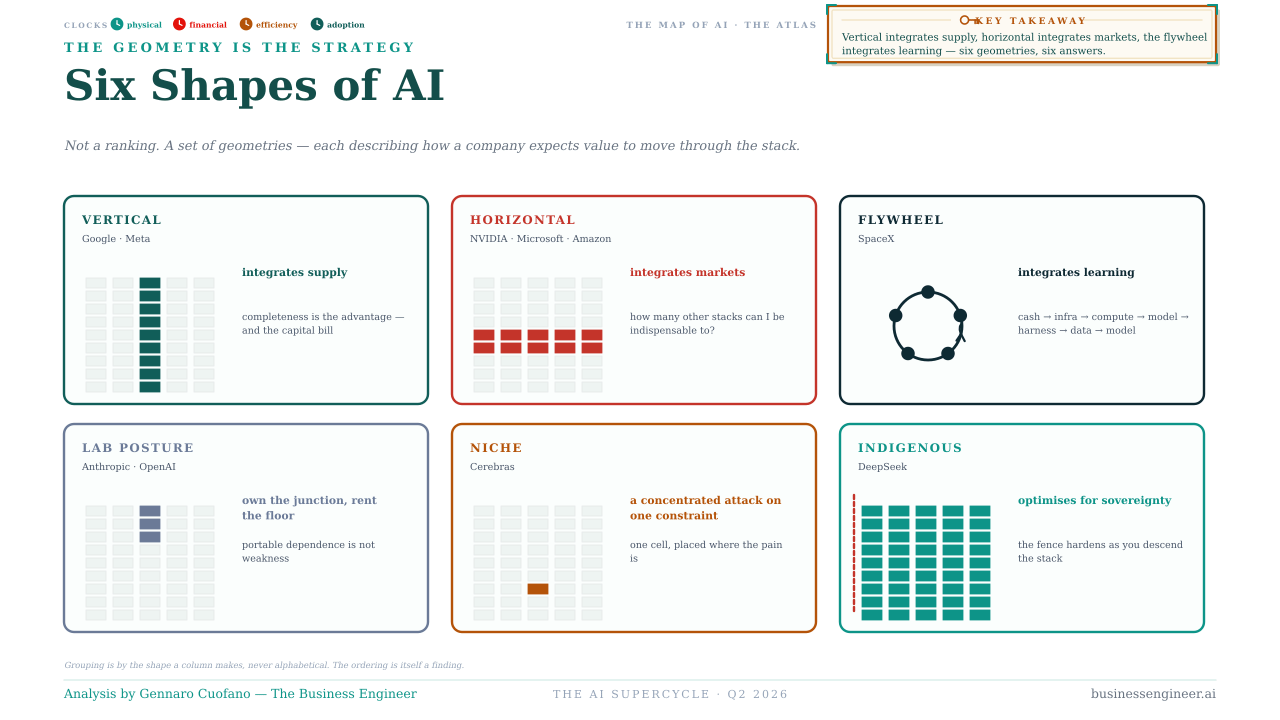
The matrix resolves into six broad geometries: the vertical, horizontal, flywheel, lab posture, niche, and indigenous stack. These shapes matter because they describe not only technological position but how each company expects value to move through the stack.
The vertical. Google is the purest expression. It occupies all nine layers: power procurement and infrastructure at the bottom; deep foundry relationships; TPUs at silicon; proprietary networking; massive compute; Gemini at the model layer; agent and developer infrastructure in the harness; Search, Android, Chrome, Workspace, YouTube, Cloud, and billions of devices at distribution; and a broad policy and compliance machine at governance. The cells do not need to be equally strong. Completeness itself creates an advantage. When silicon becomes constrained, the vertical has its own architecture. When merchant GPUs become expensive, it can route toward TPUs. When model economics compress, it still owns infrastructure and intent. When power becomes the bottleneck, it can sign directly against generation.
Meta represents another form of the vertical. It increasingly owns more of the column, from custom silicon and networking through massive compute, open models, and consumer distribution. But Meta exposes the other side of the strategy: the more of the column you internalize, the more of the column you must finance. Vertical integration replaces supplier dependence with capital intensity.
The horizontal. NVIDIA also touches almost every layer, but its strategic logic is nearly the inverse. NVIDIA does not primarily want to internalize the stack for its own applications. It wants everybody else’s stack to run through NVIDIA. Silicon remains the center, but the position stretches into networking, systems, software, model tooling, cloud relationships, enterprise distribution, and increasingly the financing surrounding the infrastructure that consumes its products. The vertical asks, How much of my own stack can I control? The horizontal asks, How many other stacks can I become indispensable to?
Microsoft and Amazon belong to the horizontal family for another reason. Both have enormous strength in compute and distribution while deliberately maintaining optionality across models and silicon. Azure can distribute OpenAI while developing its own models and accelerators. AWS can host Anthropic while building Trainium, offering many other models, and using Bedrock as the abstraction layer. These are not incomplete verticals. They are portfolios of dependencies designed to stop any one dependency from capturing the whole stack.
The flywheel. SpaceX looks incomplete if read as a conventional column. Read as a circuit, it becomes much more interesting. An operating business produces cash and proprietary data. Cash funds infrastructure. Infrastructure supports compute. Compute supports the model. The model runs inside a harness connected to distribution controlled by the same industrial family. Usage then generates data and operating feedback that flow back toward the system. The important word is not integration but co-adaptation. The model changes the product, the product changes how the model is used, usage generates new data, and the data changes the next model. The vertical integrates supply. The horizontal integrates markets. The flywheel integrates learning.
The lab posture. Anthropic and OpenAI look structurally strange by the standards of the old technology industry: extraordinarily strong near the model and harness, highly dependent underneath. Neither owns a foundry. Neither owns a general-purpose networking estate comparable with the hyperscalers. Both depend heavily on external compute and power supplied through somebody else’s balance sheet. Two years ago that might have looked like obvious fragility. Today it can also be read as deliberate capital allocation. Why own foundries, networks, and power generation if those layers can be rented while differentiation remains higher near intelligence, orchestration, and the customer relationship?
Anthropic makes the logic particularly visible because portability across several silicon substrates can itself become leverage. If the workload can move, infrastructure providers compete for it. Dependence becomes less dangerous when it is portable dependence. The doctrine is simple: own the junction, rent the floor. Whether that remains rational depends on where durable value ultimately settles.
The niche. Cerebras represents almost the opposite strategy. Do not occupy nine cells. Put almost everything into one architectural bet located directly against an incumbent bottleneck. Wafer-scale computing attempts to alter the relationship between compute, memory, and interconnect by changing the physical unit itself. Its value does not come from breadth but from whether the chosen cell sits exactly where the constraint becomes economically painful. A niche is therefore not a weak vertical. It is a concentrated attack on one constraint.
The indigenous stack. DeepSeek belongs partly to another map. Its stack operates under different industrial constraints: export controls, domestic silicon, Chinese foundries, local energy systems, policy support, and a strategic requirement to reduce exposure to Western bottlenecks. Seen purely through American infrastructure economics, some cells appear weaker. Seen through sovereignty, those same cells can be strong. Technical efficiency is not always the optimization target. Strategic autonomy can be. Weights cross borders relatively easily. Advanced lithography does not. Ideas diffuse. Foundry capacity, HBM supply, packaging, power infrastructure, and export permissions remain physical. The geopolitical fence becomes harder as you descend the stack.
The Paradox of Integration
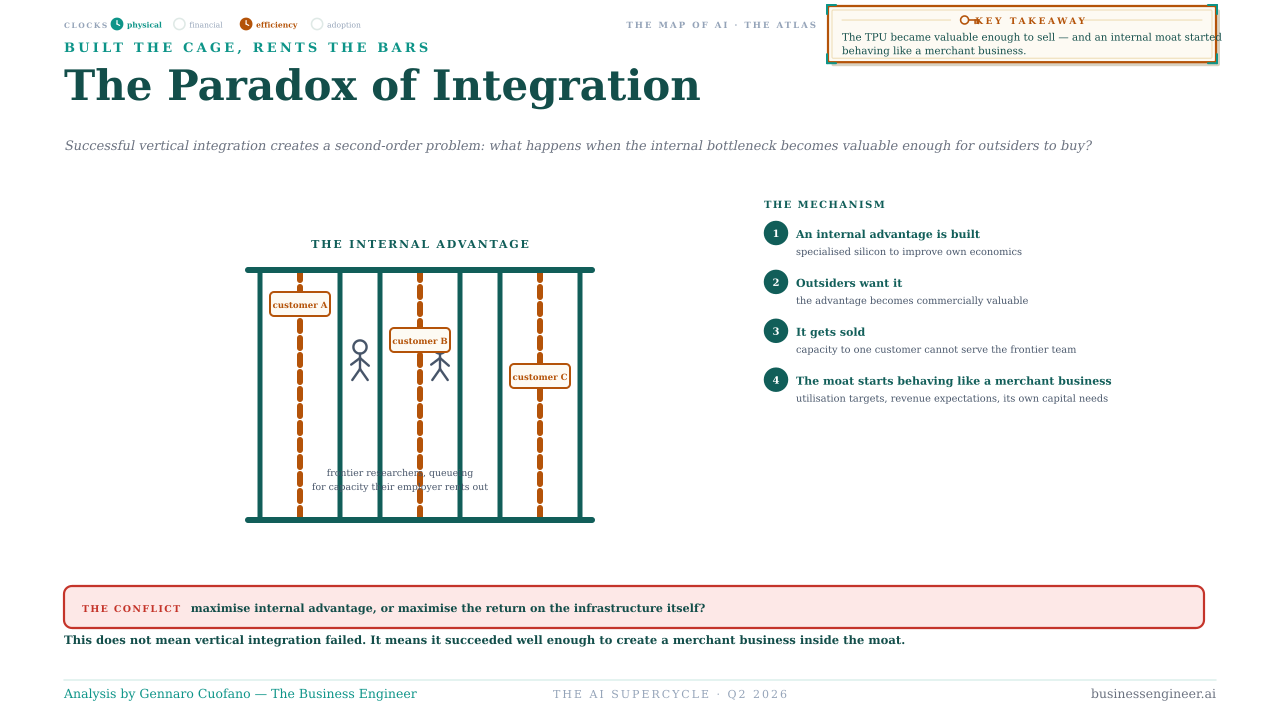
Google exposes an important paradox. The TPU began as an internal advantage: specialized silicon designed to improve Google’s economics and reduce dependence on merchant accelerators. Then the TPU became commercially valuable. Once customers want the internal advantage, the company has another option: monetize it externally.
That creates a conflict. Capacity sold to an outside customer cannot simultaneously serve internal frontier researchers. The better the merchant business becomes, the more the infrastructure organization has to decide whether it exists to maximize Google’s internal technological advantage or maximize the economic return on the infrastructure itself. Once a proprietary system develops external customers, revenue expectations, utilization targets, and its own capital requirements, an internal moat begins behaving like a merchant business.
This does not mean vertical integration failed. It means successful vertical integration creates a second-order problem: what happens when the internal bottleneck becomes valuable enough for outsiders to buy? Google built the cage. Then the market wanted to rent the bars.
What Q2 Changed
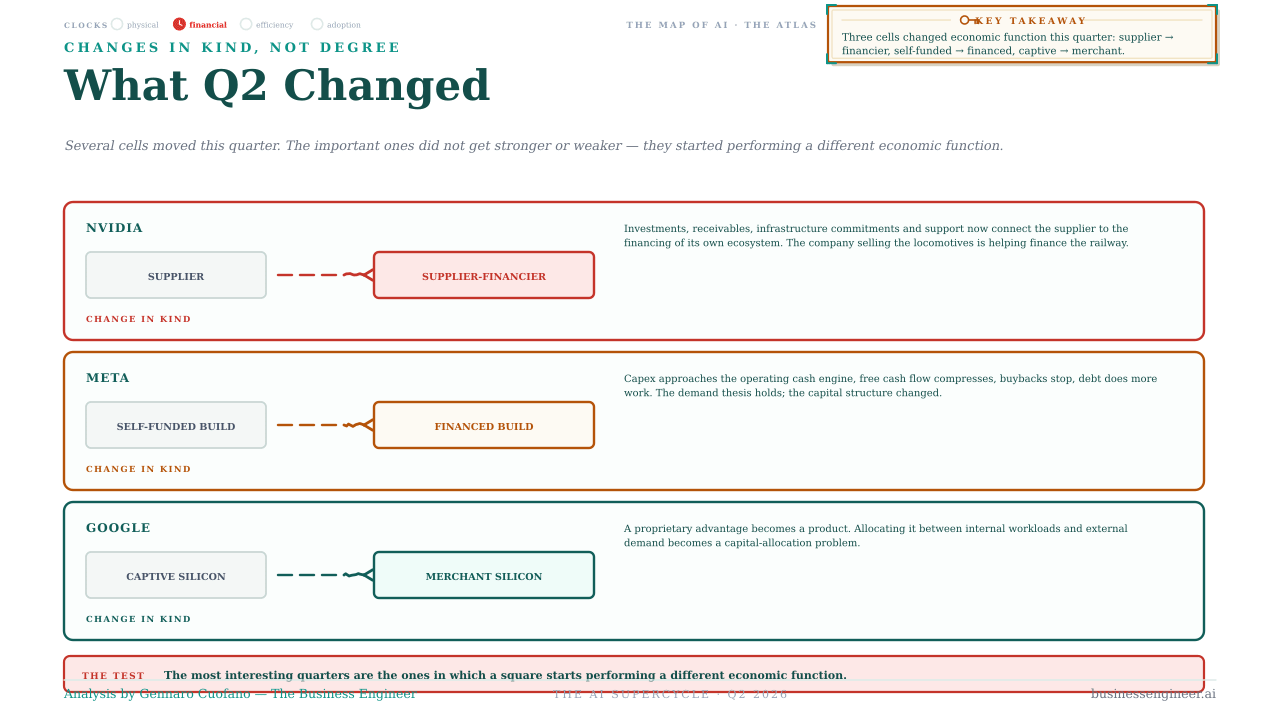
A useful map has to move. This quarter several cells did, but the most important shifts were not weak-to-moderate or strong-to-dominant. They were changes in kind.
NVIDIA moved from supplier toward supplier-financier. NVIDIA remains the critical equipment supplier at the center of the AI infrastructure buildout. What changed is its relationship with the capital structure around its customers. Investments, partnerships, receivables, infrastructure commitments, and other forms of support increasingly connect NVIDIA to companies whose expansion ultimately drives demand back toward NVIDIA equipment. The exact instruments vary. The structural change is what matters: the supplier becomes more entangled with the financing of its own ecosystem.
The railway analogy is difficult to avoid. Infrastructure can have enormous long-term economic value while securities financing the build still perform terribly. Railways transformed economies; individual projects failed, ownership changed, credit was restructured, and assets survived. The AI version contains a stranger twist: the company selling the locomotives is increasingly helping finance the railway. That does not prove demand is fictional. It means supplier strength and financing risk can coexist.
Meta’s compute cell cracked, but demand did not. The important distinction is not demand versus no demand. It is self-funded build versus financed build. When capital expenditure approaches the operating cash engine, free cash flow compresses, buybacks disappear, and debt begins playing a larger role, the technological thesis can remain intact while the financing architecture changes. A company can be right about AI demand and still discover that its previous capital structure cannot support the rate at which it wants to build.
Meta retains an important valve because the assets are real. Capacity can be slowed, redirected, monetized, leased, or eventually offered externally. Physical infrastructure contains optionality in a way operating expense does not. The better interpretation is therefore not that Meta’s demand thesis failed, but that its prior self-funding model became insufficient for the scale of the build it wanted to undertake.
Google’s silicon became merchant silicon. Again, the significant movement is not that the cell became stronger. It changed economic function. A captive advantage increasingly becomes a product. Once that happens, allocation of proprietary infrastructure between internal workloads and external demand becomes a capital allocation problem.
That distinction, changes in kind rather than degree, is precisely what a matrix like this is designed to reveal.
Compute Is the Row That Explains the Quarter
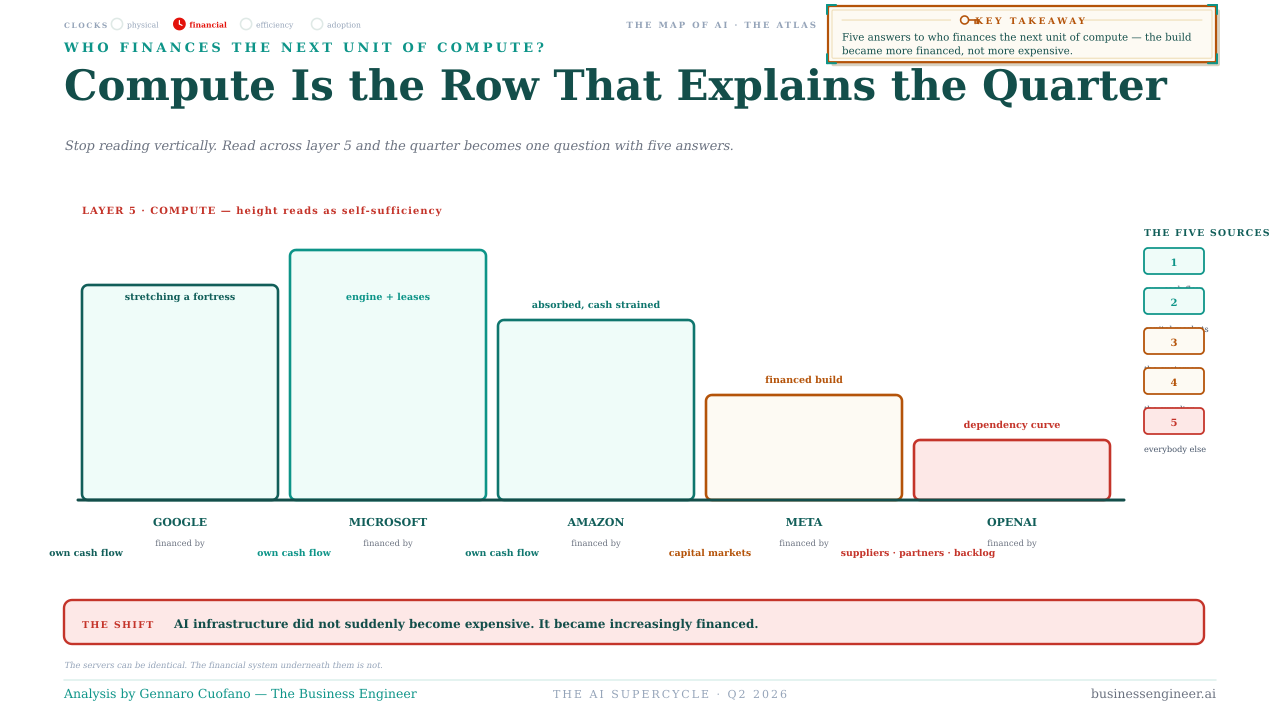
Now stop reading vertically and read across compute. The quarter becomes much more interesting.
Google is deliberately stretching a fortress balance sheet to expand capacity. Microsoft retains an extraordinary operating engine, but part of the infrastructure burden increasingly sits in signed leases and future obligations rather than only conventional owned capex. Amazon continues absorbing a vast build through operations while its cash profile becomes more demanding. Meta crosses from predominantly internal self-funding toward a structure where external capital matters more. OpenAI sits farther along the dependency curve, relying heavily on suppliers, infrastructure partners, contracted capacity, and balance sheets outside its own.
Different companies, one underlying question:
Who finances the next unit of compute?
There are only a few answers. The first is own cash flow, the cleanest structure. Existing businesses generate enough cash to fund capacity directly. The second is capital markets, with debt or equity bridging current cash flow and future infrastructure demand. The third is the customer, through prepayments, minimum commitments, long-term contracts, and backlog. The fourth is the supplier, through equity, extended payment terms, receivables, guarantees, infrastructure support, or strategic investment. The fifth is everybody else, as scarcity migrates through memory prices, electricity, leases, component costs, and downstream margins.
The farther the system moves down that list, the more interesting the financial architecture becomes. This is the most important shift of the quarter: AI infrastructure did not suddenly become expensive. It became increasingly financed.
That difference is enormous. An expensive build financed from operating cash behaves very differently from the same physical infrastructure financed through debt, prepayments, supplier support, long leases, equity issuance, and interdependent backlog. The servers can be identical. The financial system underneath them is not.
The Stack Becomes a Network of Balance Sheets
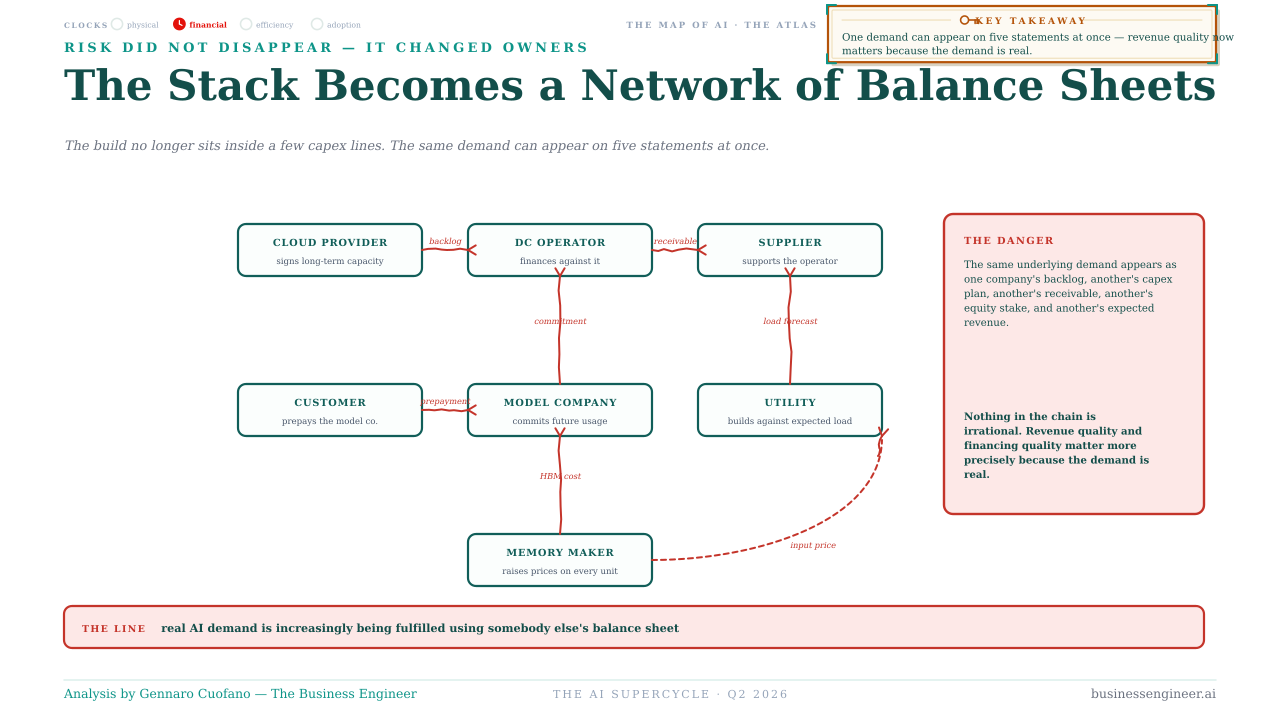
The matrix therefore becomes more than a technology map. It becomes a capital map. The AI build no longer sits neatly inside the capital-expenditure line of a handful of hyperscalers. Risk travels between participants.
A cloud provider signs a long-term capacity agreement. A data-center operator finances against that agreement. A supplier supports the operator. A model company commits future usage. A customer prepays the model company. A utility builds against expected data-center load. Memory suppliers raise prices as each accelerator consumes more constrained HBM. The cost ultimately appears across several companies and several financial statements.
Nothing in that chain is necessarily irrational. The danger is that the same underlying demand can appear multiple times: as one company’s backlog, another company’s capex plan, another’s receivable, another’s strategic equity investment, and another’s expected future revenue. As the cycle matures, revenue quality and financing quality matter more precisely because the technological demand is real.
Risk did not disappear. It changed owners.
The prints after the quarter sharpened the same point. One major infrastructure provider can carry contracted backlog equivalent to years of current revenue while producing strongly negative free cash flow and financing part of the expansion with substantial equity issuance. The backlog headline establishes demand. The financing tells you how that demand reaches production. Another custom-silicon provider can report extraordinary AI growth and commitments from the largest model builders while simultaneously seeing margins pressured by increasing memory content and customer deployments supported by financing vehicles.
Neither result invalidates the demand thesis.
Both say something more interesting:
real AI demand is increasingly being fulfilled using somebody else’s balance sheet.
Bottlenecks Cascade Down the Stack
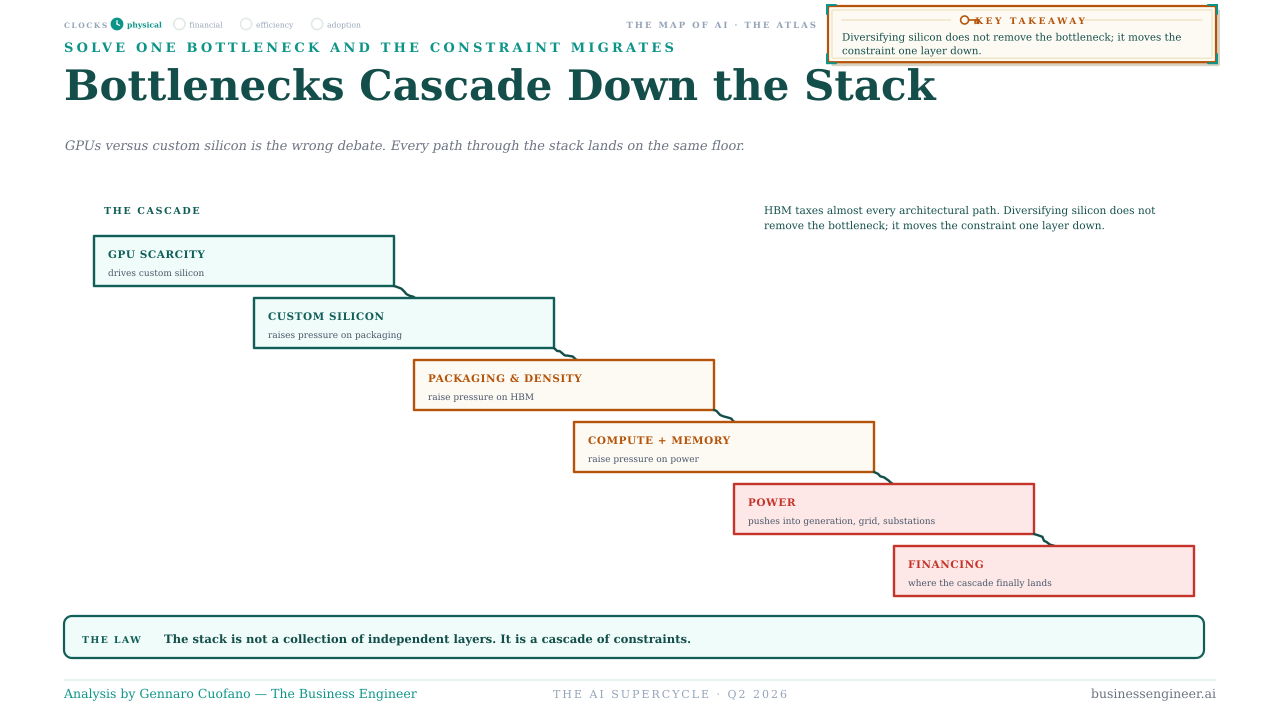
The map also explains why debates framed simply as NVIDIA GPUs versus custom silicon miss the deeper mechanism. Silicon sits on top of foundry capacity, advanced packaging, and memory. HBM in particular can tax almost every architectural path through the stack. NVIDIA can design better GPUs. Google can design TPUs. Amazon can build Trainium. Microsoft can develop Maia. Broadcom can participate in custom accelerators. Cerebras can redesign the physical architecture entirely. But if all of these systems increase demand for constrained memory, diversification in silicon does not eliminate the bottleneck. It moves the constraint one layer downward.
This is one of the recurring laws of the AI Supercycle: solve one bottleneck and the constraint migrates. GPU scarcity drives custom silicon. Custom silicon increases pressure on advanced packaging. Packaging and accelerator density increase pressure on HBM. Compute and memory increase pressure on power. Power pushes the constraint into generation, substations, grid access, and ultimately financing. The stack is not a collection of independent layers. It is a cascade of constraints.
This is also why energy belongs inside the AI map rather than beside it. At the scale implied by frontier training, inference, persistent agents, and data-center construction, power becomes product strategy. An infrastructure company can have chips, networking, funding, and customers and still fail to deploy because the relevant substation will not be available for years. The deepest vertical is therefore not merely the company that owns a model and a cloud. It is the company capable of converting electrons into accepted AI work with the fewest external veto points.
Governance plays a strangely symmetrical role at the opposite end. For consumer AI it can look like friction; for regulated enterprise deployment it can become distribution. A technically superior model that cannot satisfy procurement, sovereignty, data residency, auditability, safety, or sector-specific requirements may be commercially irrelevant for entire classes of workloads. Energy determines whether intelligence can physically run. Governance determines whether institutions allow it to run there.
The two ends of the stack matter more than most conventional AI maps imply.
Distribution Owns Intent
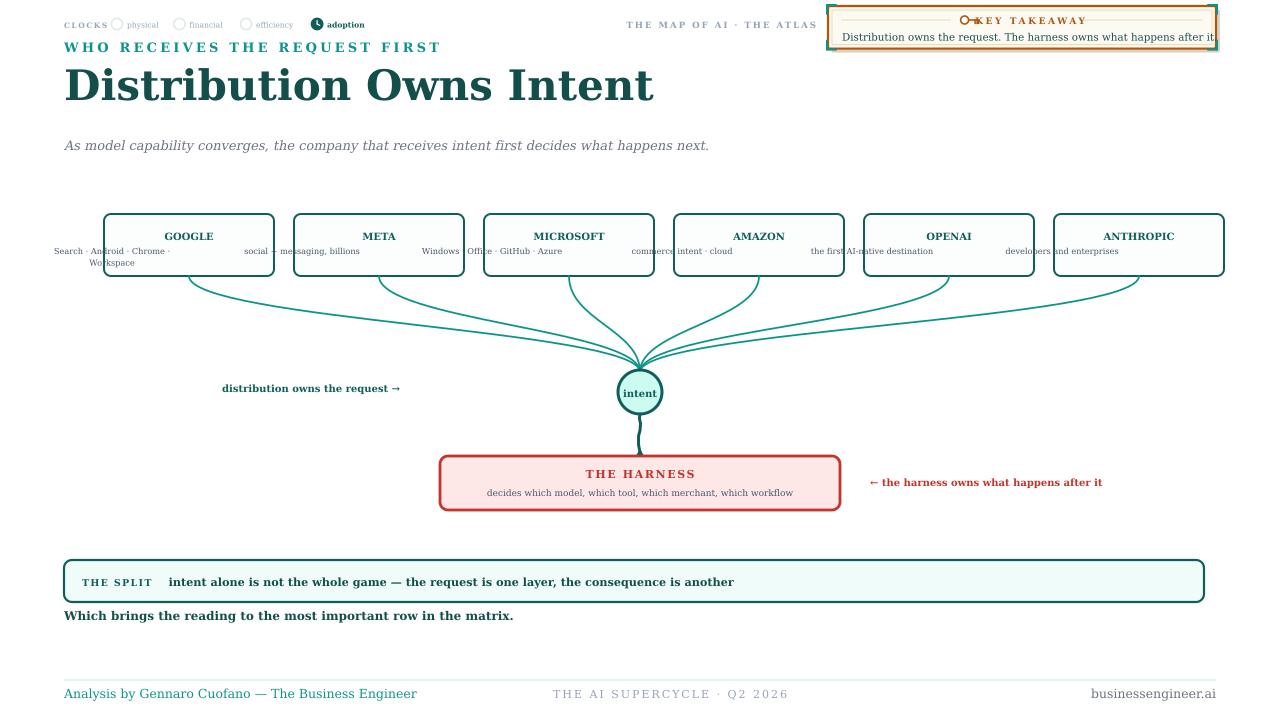
Distribution becomes increasingly important as model capability converges. Google owns Search, Android, Chrome, Workspace, YouTube, and Cloud. Meta owns consumer social and messaging surfaces measured in billions of users. Microsoft owns Windows, Office, GitHub, Azure, and much of the enterprise seat estate. Amazon owns enormous commerce intent and cloud distribution. OpenAI owns one of the first truly AI-native consumer destinations. Anthropic is building a different kind of distribution through developers and enterprises.
Distribution matters because it owns the request. The company that receives intent first can influence which model answers, which tool is called, which merchant receives the transaction, which source is retrieved, and which workflow executes.
But intent alone is not the whole game.
Distribution owns the request.
The harness owns what happens after it.
And that brings us to the most important row in the matrix.
The Missing Layer
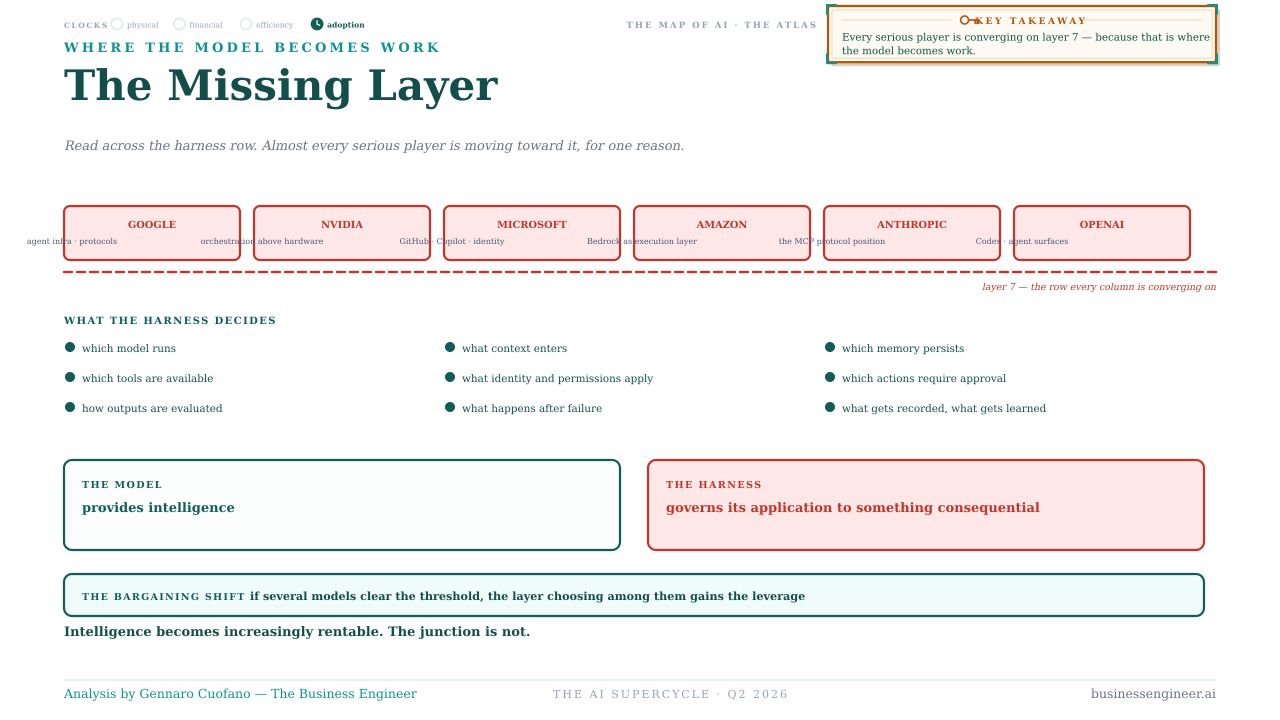
Read across the harness row. Almost every serious player is moving toward it. Google has agent infrastructure and increasingly rich developer and protocol surfaces. NVIDIA extends software and orchestration above its hardware. Microsoft combines Azure, GitHub, Copilot, enterprise context, identity, and an enormous installed base. Amazon uses Bedrock as a model abstraction and enterprise execution layer. Anthropic increasingly holds an important protocol position through MCP. OpenAI has Codex, agent surfaces, developer tooling, and a rapidly expanding action layer. Even companies whose original differentiation sits elsewhere keep moving toward the same layer.
The reason is simple.
This is where the model becomes work.
The harness decides which model runs, what context enters, which memory persists, which tools are available, what identity and permissions apply, which actions require approval, how outputs are evaluated, what happens after failure, what gets recorded, and what gets learned.
The model provides intelligence.
The harness governs the application of that intelligence to something economically consequential.
That distinction may define the next phase of the stack.
Models remain immensely valuable, but intelligence is becoming increasingly purchasable. Several frontier models can be routed behind the same application. Open weights improve. Smaller models become more capable. Inference costs decline. Models specialize. Enterprises increasingly adopt multi-model architectures.
None of this makes frontier models irrelevant. It changes the bargaining structure around them.
If several models can perform a routine task above the required threshold, the layer choosing among them gains leverage. If the enterprise owns its context, process state, permissions, evaluation standard, decision history, and tool connections, replacing the underlying model becomes possible.
Replacing the entire operating layer above it is much harder.
Intelligence becomes increasingly rentable. The junction is not.
Where Intelligence Becomes Work
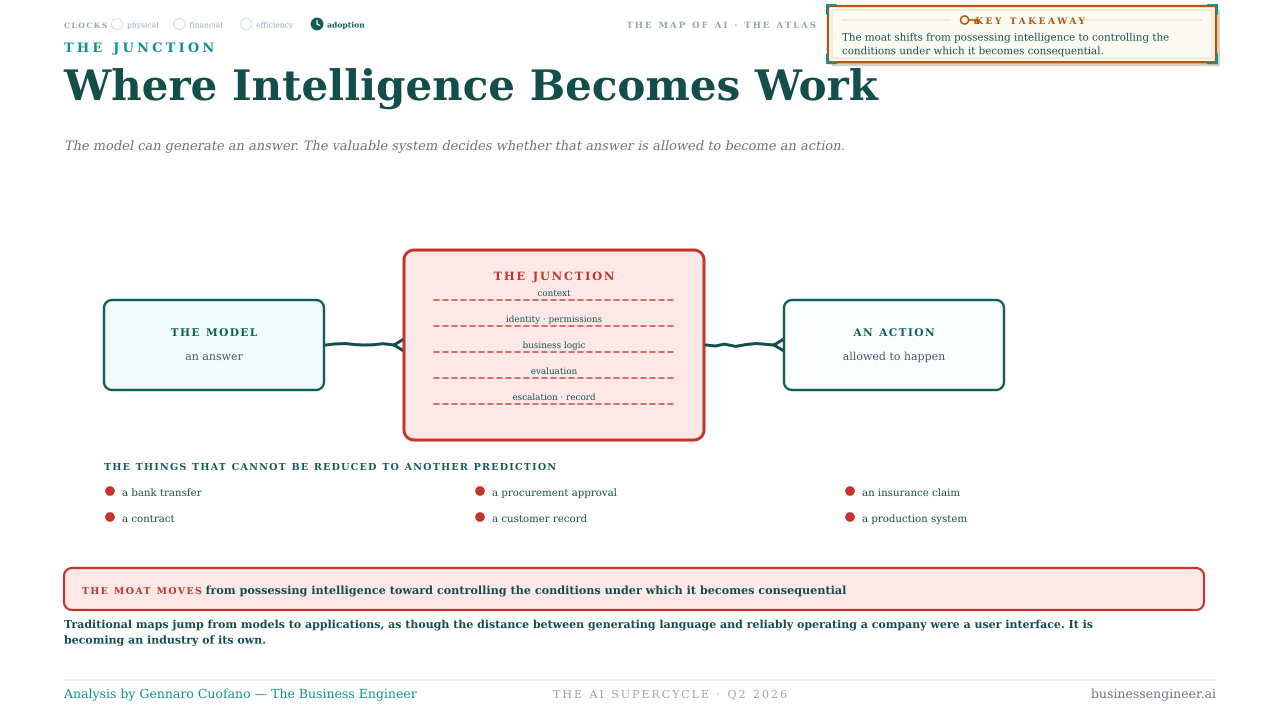
The harness matters most at the junction, the place where intelligence meets something that cannot be reduced to another prediction: a bank transfer, a procurement approval, an insurance claim, a medical decision, a contract, a customer record, a supply-chain action, a production system, or a regulatory boundary.
The model can generate an answer.
The valuable system decides whether that answer is allowed to become an action.
That requires context, identity, permissions, business logic, evaluation, governance, human escalation, and a record of what actually happened. The moat therefore shifts from merely possessing intelligence toward controlling the conditions under which intelligence becomes consequential.
This is the layer many traditional AI maps leave almost empty. They jump from models directly to applications, as though the distance between generating language and reliably operating a company were simply another user interface.
It is not.
It is becoming an industry of its own.
The harness is the deployment layer becoming a product.
This also makes the frontier labs easier to interpret. Anthropic does not necessarily need to own a substation if its durable position is the protocol through which enterprise agents reach context and tools. OpenAI does not necessarily need to own a foundry if it controls an agent surface through which users initiate valuable work. Those physical dependencies still affect cost, margin, resilience, and bargaining power, but dependency itself is not automatically strategic weakness.
Every company chooses which layers deserve ownership.
The question is whether the labs have chosen correctly.
If frontier models remain scarce, their position is obvious. If models commoditize while labs control harness and distribution, they may remain extraordinarily powerful. If models commoditize and the harness standardizes elsewhere, they become much more vulnerable.
That is the strategic test.
The Matrix Is Also a Capital Map
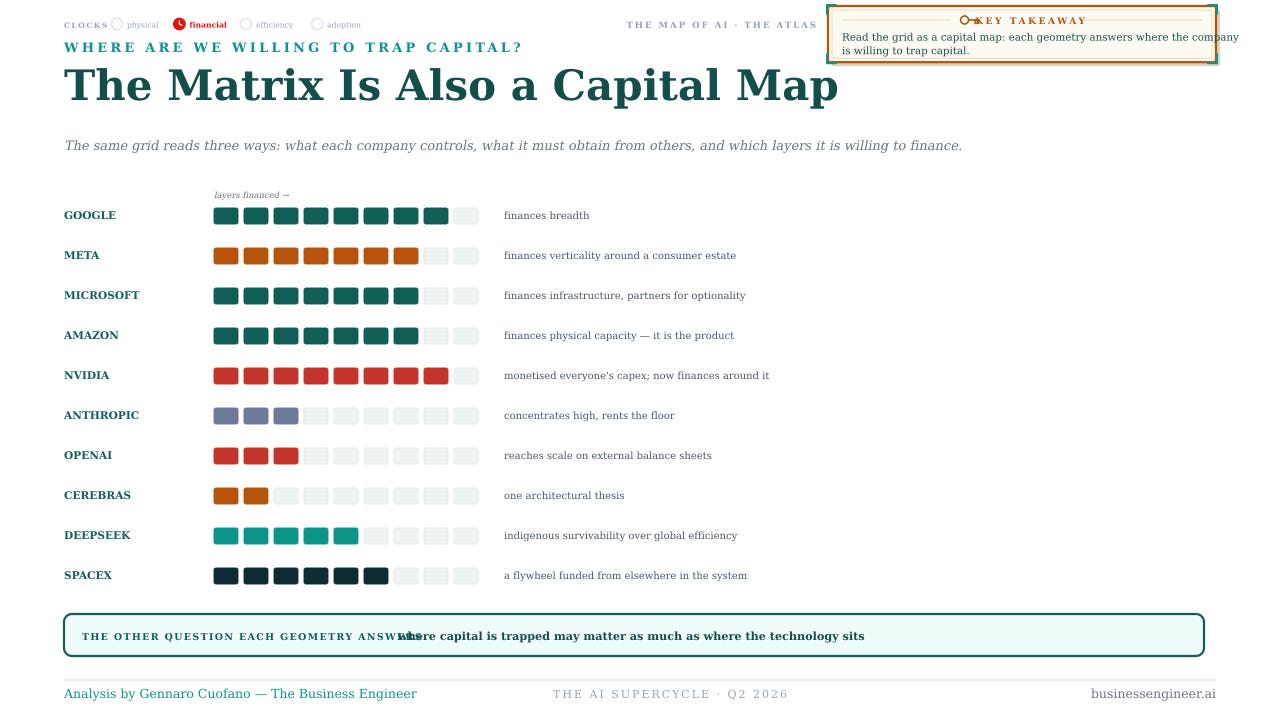
The same matrix can therefore be read in three ways. As a technology map, it shows what each company controls. As a dependency map, it shows what each company must obtain from somebody else. As a capital map, it shows which layers each company is willing to finance.
Google finances breadth. Meta finances verticality around a massive consumer estate. Microsoft finances infrastructure while using partnerships to preserve optionality. Amazon finances physical capacity because infrastructure itself is one of its core products. NVIDIA historically monetized everybody else’s capex and now increasingly participates in the financial structure surrounding that capex. Anthropic concentrates resources high in the stack and rents much of the industrial floor. OpenAI uses partnerships and external balance sheets to reach a scale its own operating cash flows could not independently finance. Cerebras concentrates capital around one architectural thesis. DeepSeek optimizes partly for indigenous survivability rather than pure global efficiency. SpaceX can fund a flywheel from cash generated elsewhere inside the same industrial system.
Each geometry therefore answers another question:
Where are we willing to trap capital?
That question may ultimately matter as much as where the technology sits.
From Seats to Tokens to Outcomes
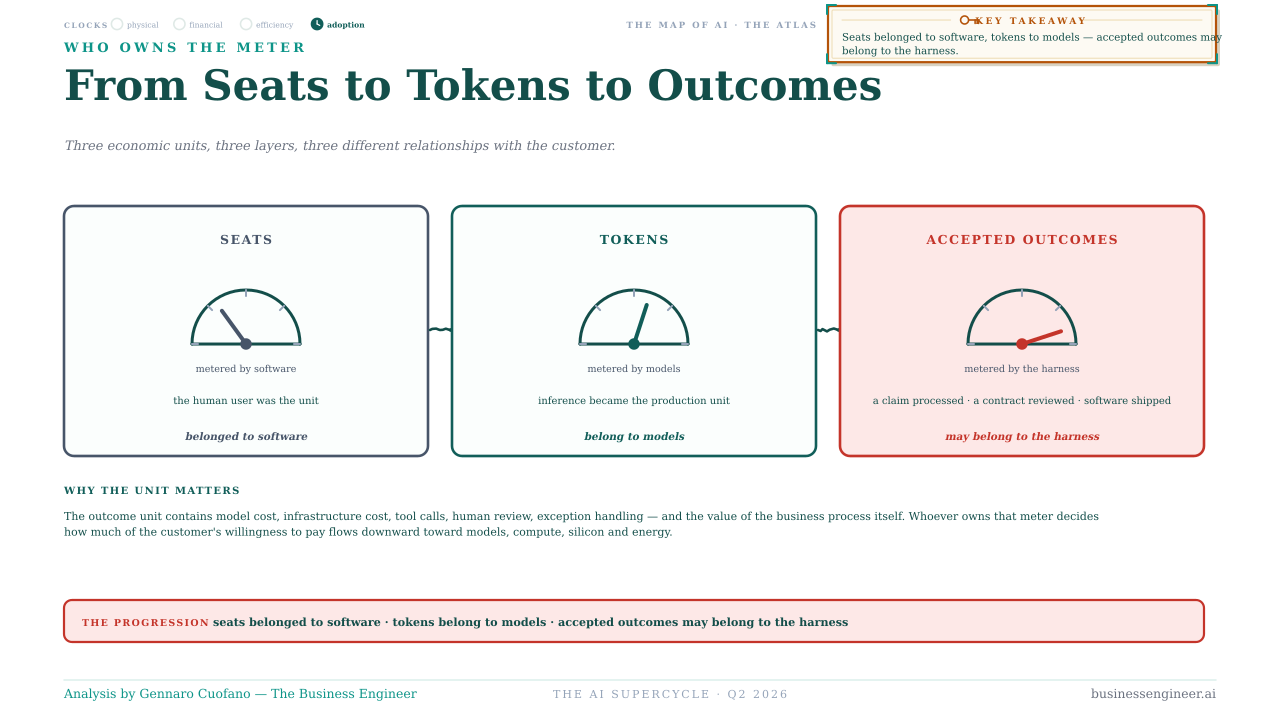
There is also an economic progression hidden inside the stack. Software was monetized through seats because the human user was the unit. Models introduced tokens because inference became the production unit. The harness increasingly introduces another possibility: the accepted outcome.
A claim processed.
A document reviewed.
A piece of software shipped.
A support request resolved.
A procurement decision completed.
A reconciliation performed.
A workflow executed.
This matters because it changes who can meter value.
The model provider meters intelligence consumption.
The application provider can increasingly meter work completed.
That unit has different economics. It contains model cost, infrastructure cost, tool calls, human review, exception handling, and the value of the business process itself. Whoever owns that meter gains a very different relationship with the customer.
Seats belonged to software.
Tokens belong to models.
Accepted outcomes may belong to the harness.
If that happens, the harness does more than orchestrate the technical stack. It becomes the economic layer that decides how much of the customer’s willingness to pay flows downward toward models, compute, silicon, and energy.
How to Read the Atlas
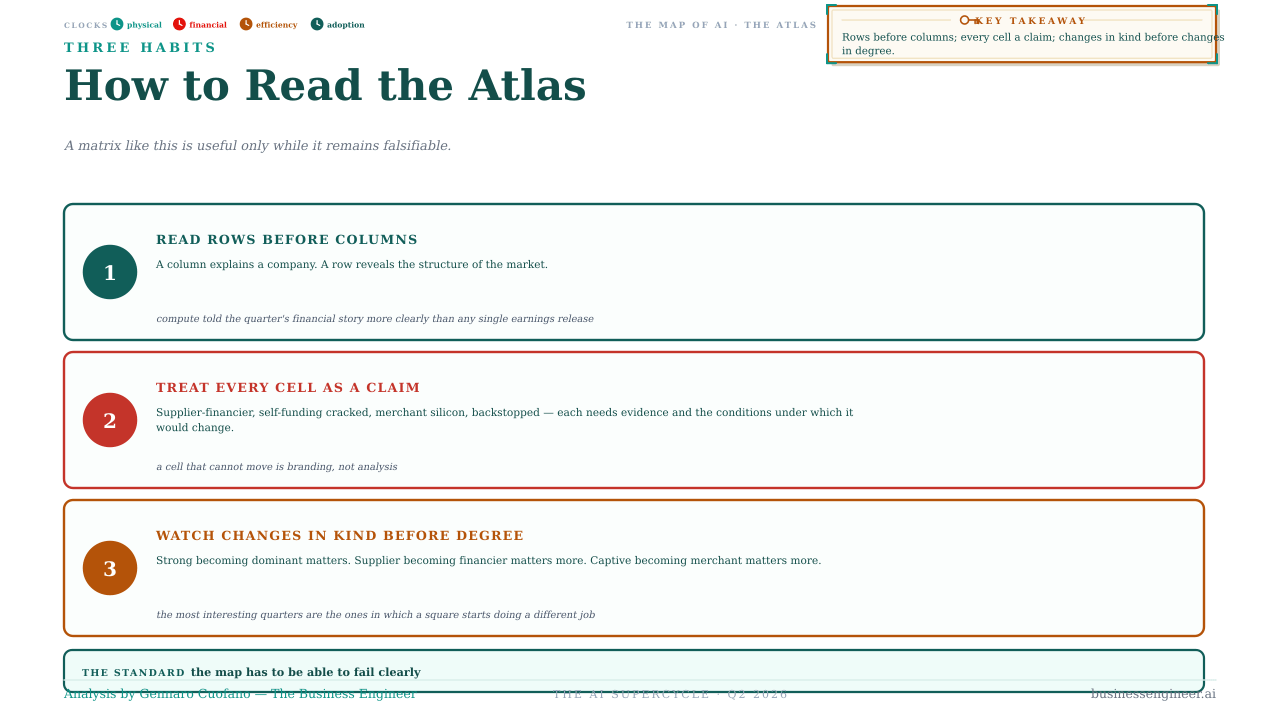
A matrix like this becomes useful only if it remains falsifiable. Three habits matter.
Read rows before columns. A column explains the strategy of a company. A row reveals the structure of the market. Compute told the financial story of this quarter more clearly than any individual earnings release. Memory shows where the next hardware tax may sit. Distribution shows who owns intent. The harness shows where software control may be migrating.
Treat every cell as a claim. “Supplier-financier,” “self-funding cracked,” “merchant silicon,” “multi-substrate,” “backstopped,” “rent-payer”: these are not aesthetic labels. Each should have evidence behind it and conditions under which the judgment would change next quarter. A cell that cannot move is branding, not analysis.
Watch changes in kind before changes in degree. Strong becoming dominant matters. Supplier becoming financier matters more. Captive becoming merchant matters more. Dependent becoming portable matters more. A business becoming an infrastructure provider when its internal capacity turns commercial matters more than another percentage point of share.
The most interesting quarters are the ones in which a square starts performing a different economic function.
What the Atlas Says About the AI Supercycle
The technology is real. Infrastructure demand is real. Monetization is increasingly real. Financial excess can also be real. Those statements are not contradictory. Infrastructure cycles almost always contain both a technological truth and a financial overreaction to that truth.
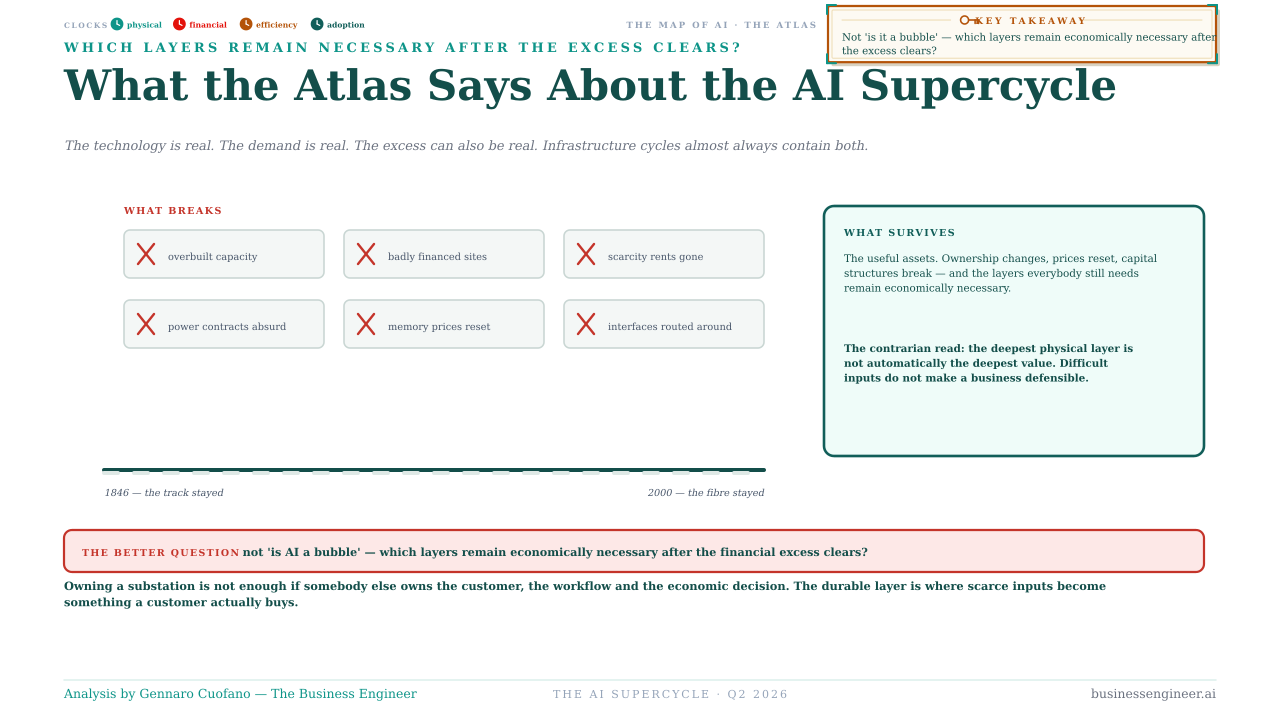
Britain needed railways. It still financed too many of them in the wrong structures and at the wrong prices. The Internet transformed the economy. Investors still lost extraordinary amounts of capital financing telecom infrastructure and dot-com companies. Fiber remained. Networks remained. Data centers remained. Ownership changed. Prices reset. Capital structures broke. The useful assets survived.
The AI Supercycle can follow the same pattern. Some capacity will be overbuilt. Some data centers will be badly financed. Some scarcity rents will disappear. Some power contracts will look absurd in hindsight. Some memory pricing will collapse when capacity catches up. Some model economics will compress. Some interfaces will lose value as agents route around them. Some companies will discover that a technically excellent asset sits on the wrong side of the value migration.
None of this means the infrastructure was unnecessary.
That is why asking whether AI is a bubble is usually the wrong question.
The better question is:
Which layers remain economically necessary after the financial excess clears?
And here the matrix becomes contrarian. It is tempting to assume the deepest physical layer must capture the deepest value because it is hardest to build. Not necessarily. Foundries are incredibly difficult. Memory is constrained. Power is critical. Networking is sophisticated. Compute consumes enormous capital. All can generate significant rents. But a business does not become strategically defensible merely because its inputs are difficult.
Owning a substation is not enough if somebody else owns the customer, the workflow, and the economic decision.
The durable layer may ultimately be the place where all those scarce inputs are transformed into something a customer actually buys.
For enterprise AI, that may increasingly be the harness.
The place where models become claims processed, invoices reconciled, contracts reviewed, software shipped, customer interactions resolved, procurement decisions completed, and workflows operated.
The layer where intelligence becomes work.
The Missing Layer Was the Point
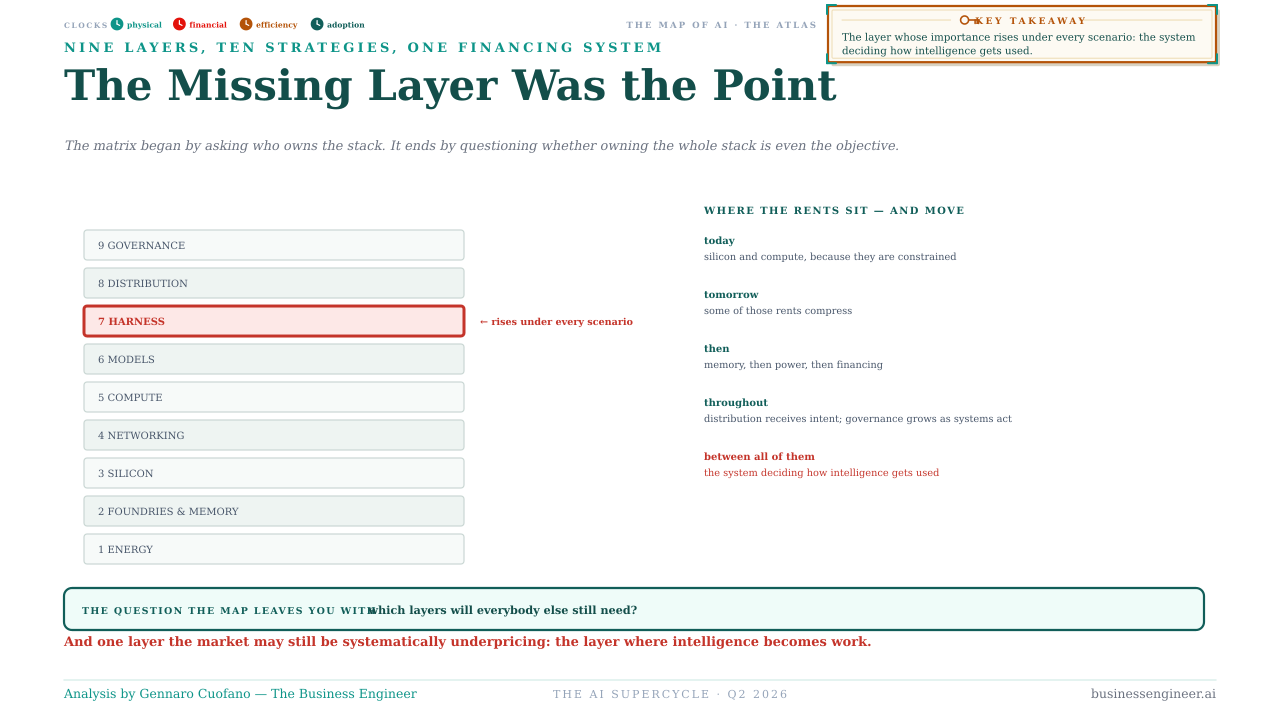
The Vertical Integration Matrix began as an attempt to understand who owned the AI stack. It ends by questioning whether owning the entire stack is even the right objective.
Google’s completeness is extraordinarily powerful. NVIDIA’s horizontality is extraordinarily powerful. SpaceX’s flywheel can be extraordinarily powerful. Anthropic’s selective dependence may prove entirely rational. Cerebras may be right that one architectural cell is enough. DeepSeek demonstrates that sovereignty creates another definition of completeness altogether.
There is no universally correct geometry. There is only a geometry appropriate to where scarcity currently sits and where the company expects value eventually to settle.
That is why the map has to remain dynamic. Today enormous rents sit in silicon and compute because those layers are constrained. Tomorrow some of those rents may compress. Memory can become the bottleneck, then power, then financing. Models can remain highly concentrated at the frontier while becoming interchangeable for much ordinary work. Distribution remains powerful because somebody has to receive intent. Governance grows in importance as systems move from answering to acting.
And between all of them sits the layer whose strategic importance can rise under almost every scenario:
the system deciding how intelligence gets used.
The harness.
The layer holding context, routing, permissions, tools, evaluation, workflow state, identity, memory, and the junction between prediction and action. The layer where intelligence stops being a model output and becomes an economic outcome.
The atlas therefore does not tell us who wins AI. It gives us a more useful question.
When the next bottleneck moves, when compute gets repriced, when capital becomes scarcer, when models converge, and when agents begin doing meaningful work across the enterprise:
Which layers will everybody else still need?
That is the purpose of the map. Not to count how many squares each company owns, but to identify the squares that will still matter after the colors change.
Nine layers. Ten radically different strategies. One financing system becoming increasingly intertwined underneath them.
And one layer the market may still be systematically underpricing:
the layer where intelligence becomes work.
With massive ♥️ Gennaro Cuofano, The Business Engineer