

For my entire personal life, I’ve been a student and lover of history. For my entire professional life, I’ve been obsessed with analysis.
The AI Supercycle is where those two worlds converge.
It began as a spin-off from The Business Engineer, which has always been centered on business analysis. But The AI Supercycle has become something broader: the most complete and unconstrained expression of how I think.
It starts with historical analogy, perhaps one of the hardest disciplines to practice rigorously, and uses it to build mental models across the intersection of geopolitics, finance, macroeconomics, and technology.
Because we are living through strange times. Or perhaps, more accurately, we are rediscovering how the world has always worked.
Geopolitics, finance, and technology are not separate domains. They are interconnected systems, linked by feedback loops that continuously reinforce, constrain, and reshape one another.
My goal has been to approach this with rigorous research, first-principles thinking, and intellectual independence.
That requires holding two opposing perspectives at the same time.
On one hand, I need a tight grip on the dominant AI narrative emerging from the technology community: what people are building, believing, funding, and forecasting.
On the other, I need to operate almost like a “thinking hermit,” deliberately removing myself from the noise of tech circles, going back into history, zooming out across decades and centuries, and only then zooming back in on the present.
That tension between immersion and distance is central to my work.
To me, this is as much a public service as it is a private enterprise.
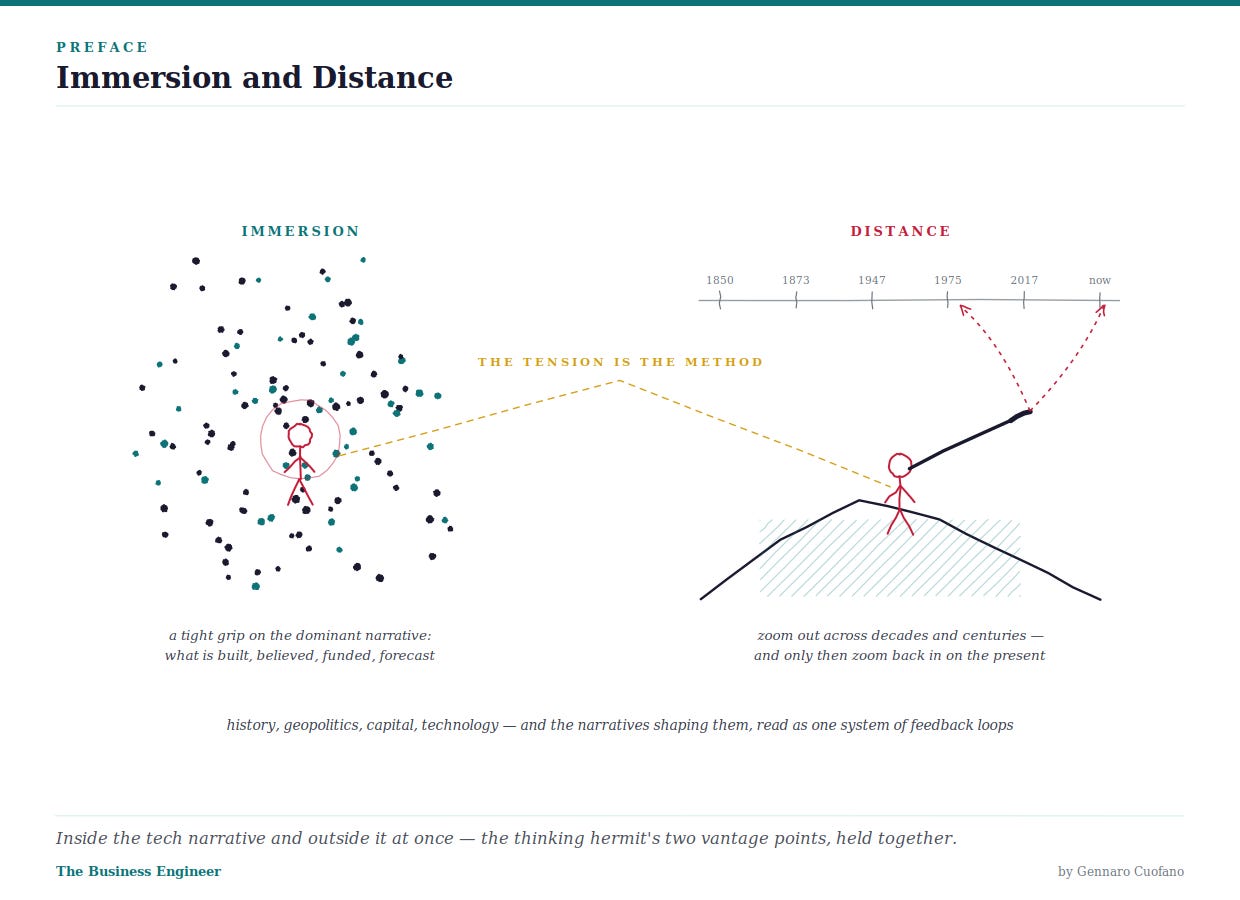
The AI Supercycle is my attempt to connect those layers: history, geopolitics, capital, technology, and the narratives shaping them.
That is the value I hope to bring to the table.
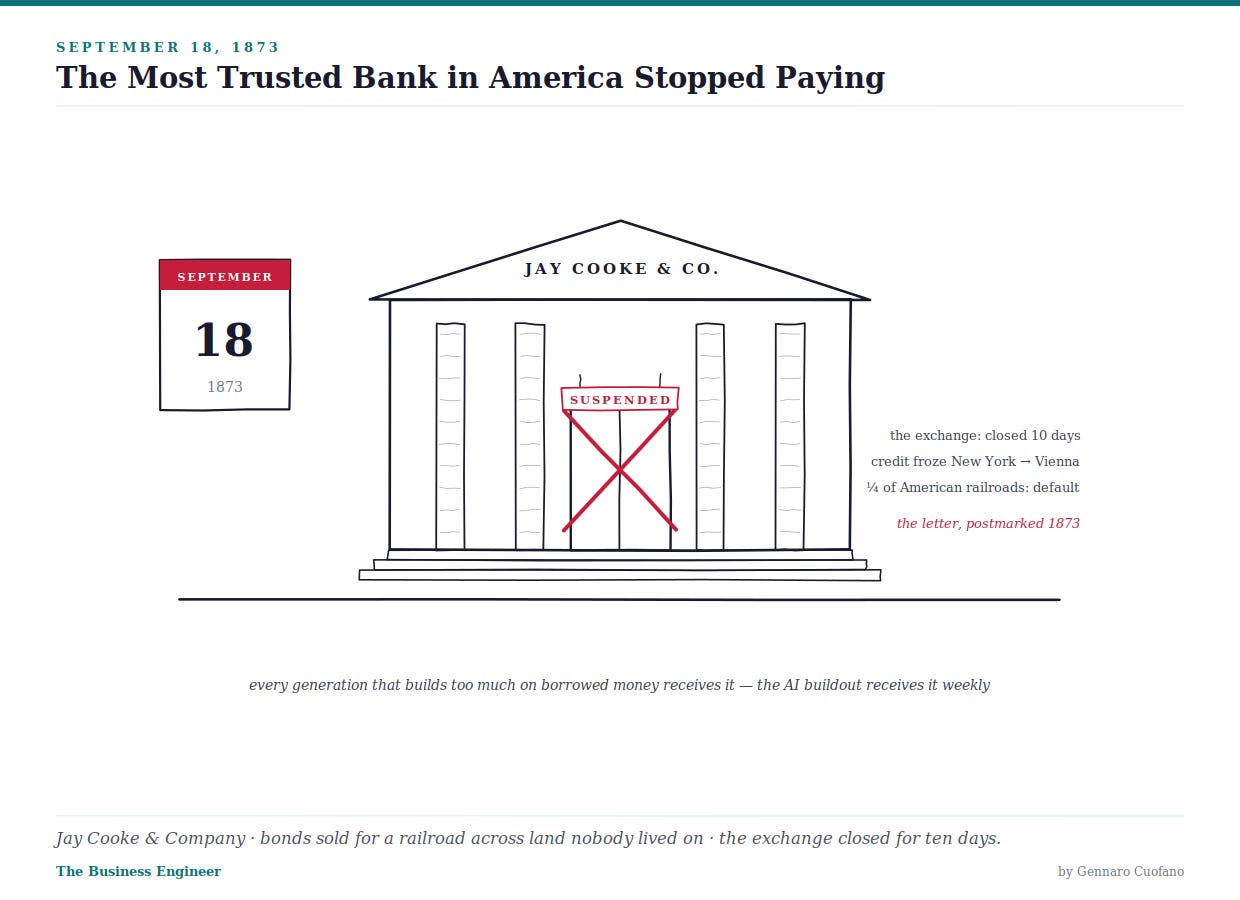
On the morning of September 18, 1873, America's most trusted bank stopped paying. Jay Cooke & Company had spent three years selling bonds for a railroad across land where almost nobody lived, and when bond sales slowed, the bank died. The exchange closed for ten days. Within two years, a quarter of America’s railroads had defaulted.
Every generation that builds too much infrastructure on borrowed money receives the same letter from history, postmarked 1873—and the AI buildout, with its three-quarters of a trillion dollars a year in capital expenditure, receives it weekly. The comparison is usually offered as a prophecy: this is what happens next.
That is where the delusion begins, and where this book starts.
The delusion of 1873
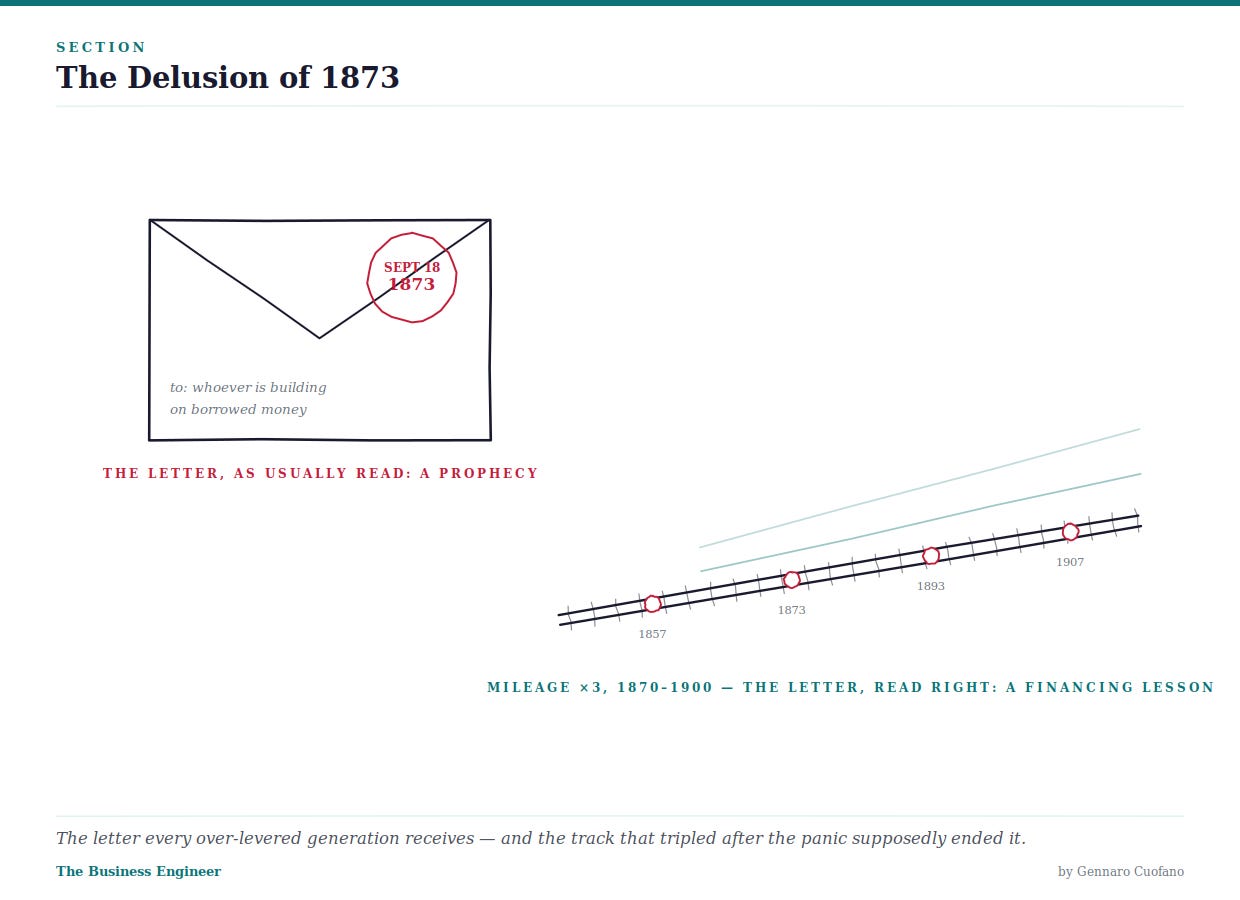
Reading 1873 as a warning about AI demand is reading a financing story as a demand story. Freight did not stop in 1873; it grew through the depression. The trains ran. American rail mileage roughly tripled between 1870 and 1900 — most of it laid after the panic supposedly exposed the whole enterprise as a mania. What failed was paper: mispriced bonds, over-levered holding structures. The paper died; its holders were ruined; the physical assets passed at a discount into stronger hands and kept operating the next morning.
And the railroad buildout absorbed four financial panics — 1857, 1873, 1893, 1907 — inside one continuous half-century expansion. The cycle did not pop. It molted, four times, each time shedding a financing structure and keeping the infrastructure.
Once 1873 is read correctly, the standard analogy shelf sorts itself. The fiber glut of 2000 fails the demand test — that capacity went dark, while today’s compute runs hot the day it energizes, against more than a trillion dollars of contracted forward demand. The 1840s railway mania rhymes only with the speculative fringe.
Insull’s pyramid rhymes with the SPVs; vendor-financed telecom with the supplier backstops; shale with the cash burn. Each candidate is right about one layer and wrong about the whole — one-market analogies aimed at a structure that is not one market.
Line the historical buildouts up, though, and one variable sorts the destroyers from the compounders: who underwrote demand during the years when buying made no commercial sense. The compounders had an underwriter that did not need the returns — land grants and mail contracts for the railroads, the state for electrification, and, for the greatest compounder of all, the Minuteman missile and the Apollo program.
Which locates the proper analogy. Only one prior buildout matches the AI cycle on the object itself — compute — on the presence of a self-fulfilling law coordinating the capital, on diffusion through talent and licensing, on a fenced dual-use geopolitics, and ran all the way to completion so that its outcome is fully known. The first silicon age is not an analogy for the AI supercycle. It is the control experiment — identical on nearly every mechanism, differing on essentially one variable: the demand underwriter. The state then. Private balance sheets, on borrowed money and quarterly explanations, now.
What the book argues
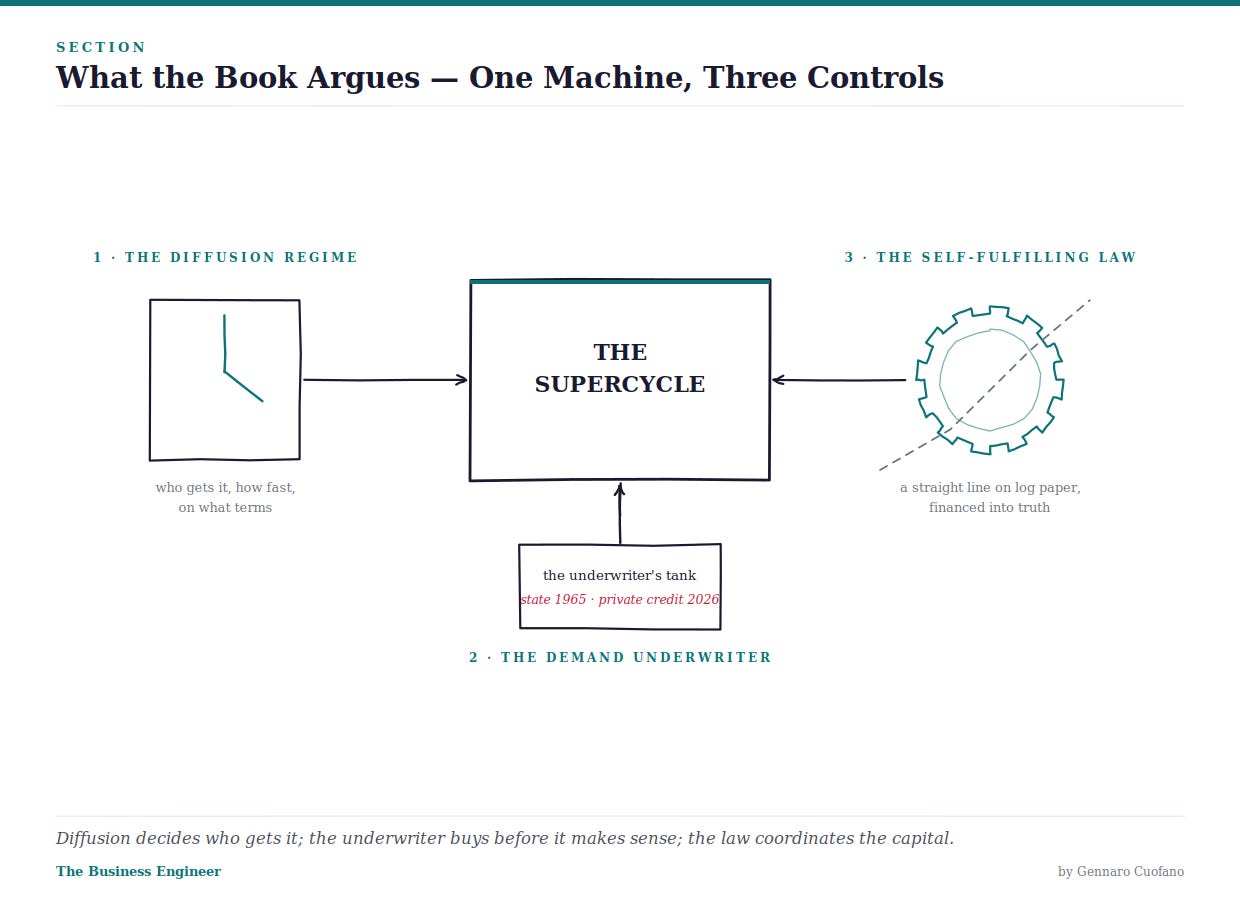
Supercycles are not won by invention. They are decided by three mechanisms: the diffusion regime (who gets the technology, how fast, on what terms — set casually, lived inside for fifty years), the demand underwriter (whoever keeps buying through the years when buying makes no sense), and the self-fulfilling law (a straight line on log paper that becomes true because enough money believes it will). The book runs both silicon ages through those three mechanisms and reads the differences.
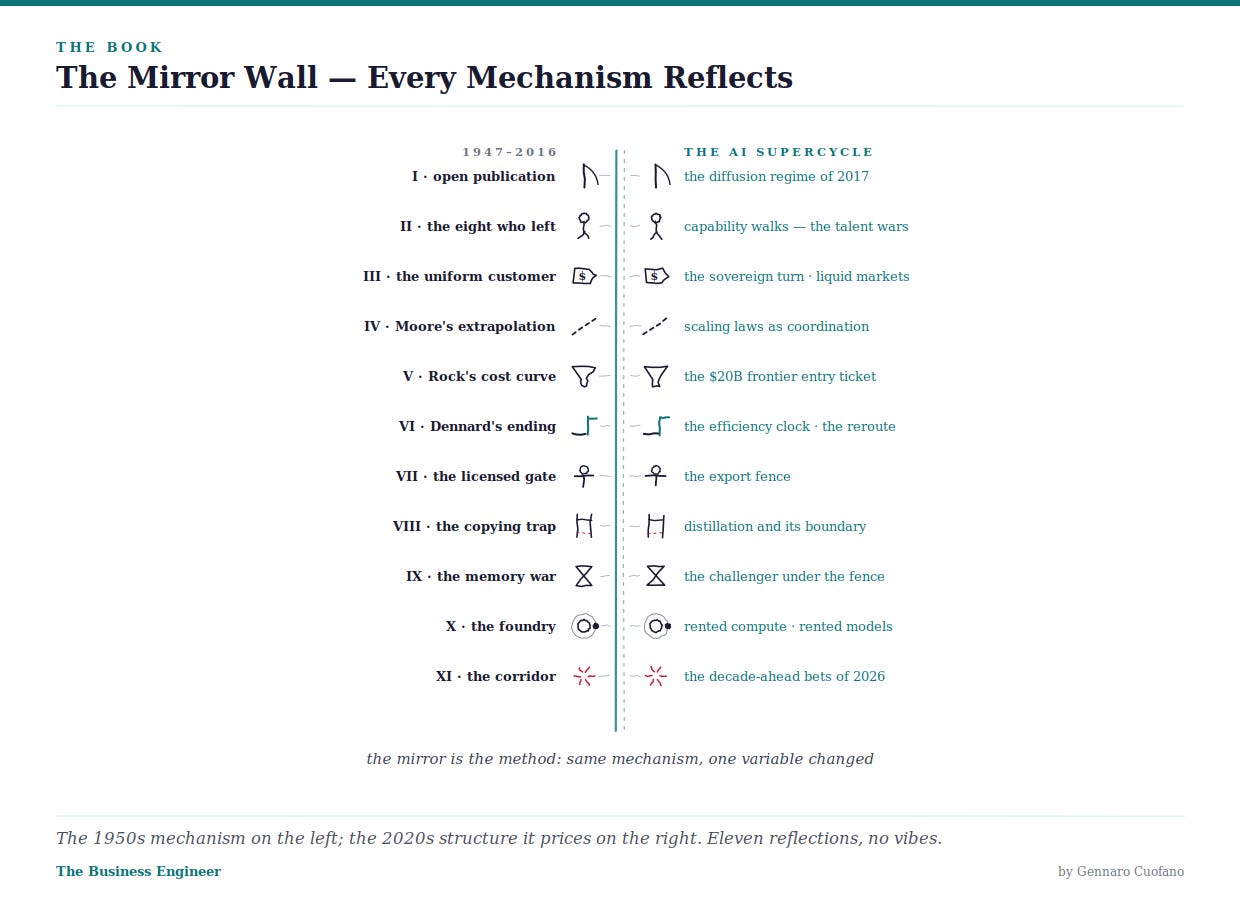
Part One — the control experiment (1947–2016). Eleven chapters, each pairing a historical mechanism with its modern mirror: the lab that gave the transistor away and the consent decree that set the industry’s diffusion regime; the eight who left, proving capability travels with people, not patents; the first customer who wore a uniform and paid $150 a transistor because the purchasing logic was strategic, not economic; Moore’s extrapolation as a coordination device; Rock’s law as the sorting mechanism; Dennard’s free ride and the wall that ended it; dual use by design; the Soviet copying trap; the memory war that taught what state-anchored capital does to a layer where money alone buys entry; the foundry adaptation that repealed Rock’s law for everyone except its inventor; and the corridor of 2005–2017, when the second age’s foundations were poured a decade before anyone could point to the demand.
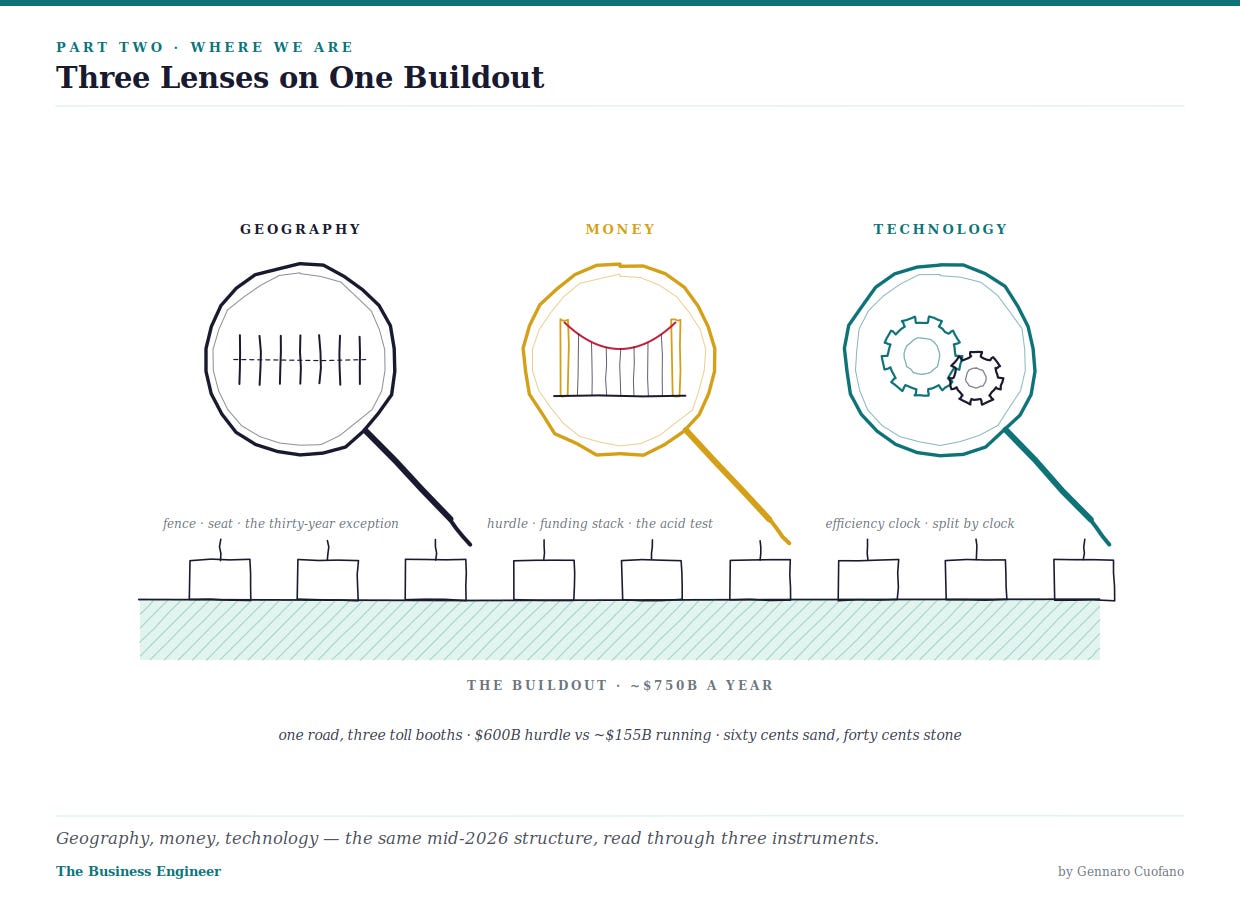
Part Two — where we are (mid-2026). The geography: one road, three toll booths, a fence rebuilt with modern instruments, and the deepest macro claim in the book — the market structure is being redefined back toward the 1950s, where strategic and enterprise demand create liquid markets that are passed down to consumers, and where market access runs along alliance lines. The thirty years in which anyone could sell anywhere regardless of alignment were the historical exception; the fence is the announcement that the exception is over. The money: the reconciliation of AI revenue against the capital deployed — a roughly $600 billion annual revenue hurdle against roughly $155 billion running today, the funding stack migrating from cash flow to credit (debt’s share of the marginal capex dollar moving from 9% to 32% in eight quarters), and a six-gauge acid test whose mid-2026 composite reads stretched, not breaking — the structures are not the bubble; they are the amplifier a bubble would run through. The technology: the efficiency clock that cuts prices and expands the market, and the split of every capex dollar by asset clock — sixty cents of five-year silicon, forty cents of thirty-year stone.
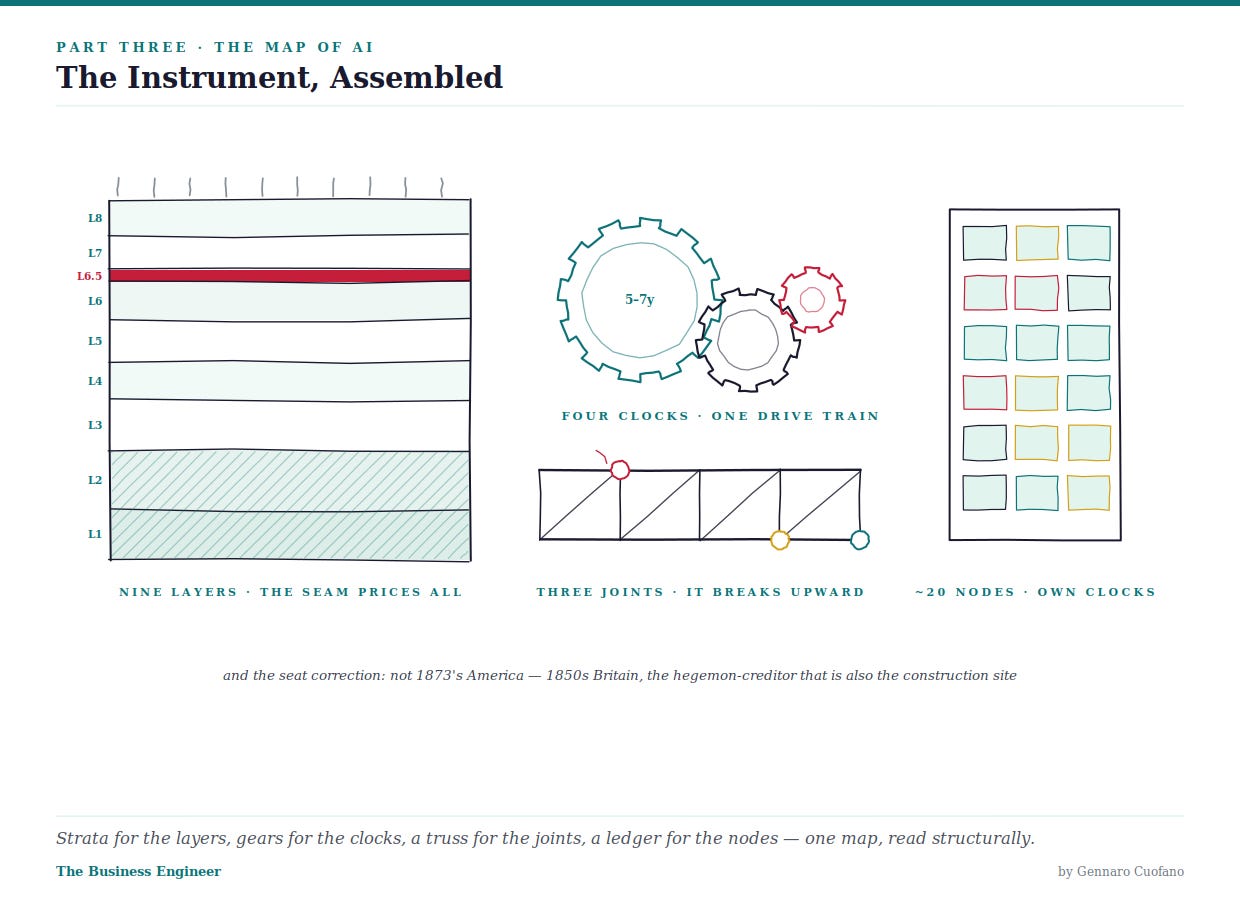
Part Three — the Map of AI. The full instrument: nine layers read as a geological cross-section, from the energy bedrock through the silicon toll booths to the routing seam — thin, and it prices everything — up to the endpoints that were supposed to die and instead got stronger. Four clocks meshed like gears, each layer’s value a bet that today’s demand shape survives that layer’s build time. Three joints where the structure can tear, and the season’s verdict that the first joint, tested, refinanced before it broke — institutionalization is migration. The incidence of the cost (five paths the bill travels) and the location of the return (the junctions: where decisions bind, transactions clear, and records live). A field guide to some twenty nodes from one earnings season — each on its own clock, each repricing on its own news, never the whole map at once. And the geopolitical seat correction: on every structural marker, the United States of the 2020s is not 1873’s overbuilding America but 1850s Britain — the hegemon-creditor exporting the very technologies that industrialize its challenger — with one honest break: this creditor is also the construction site, so the losses, when they come, land at home.
The honest limit
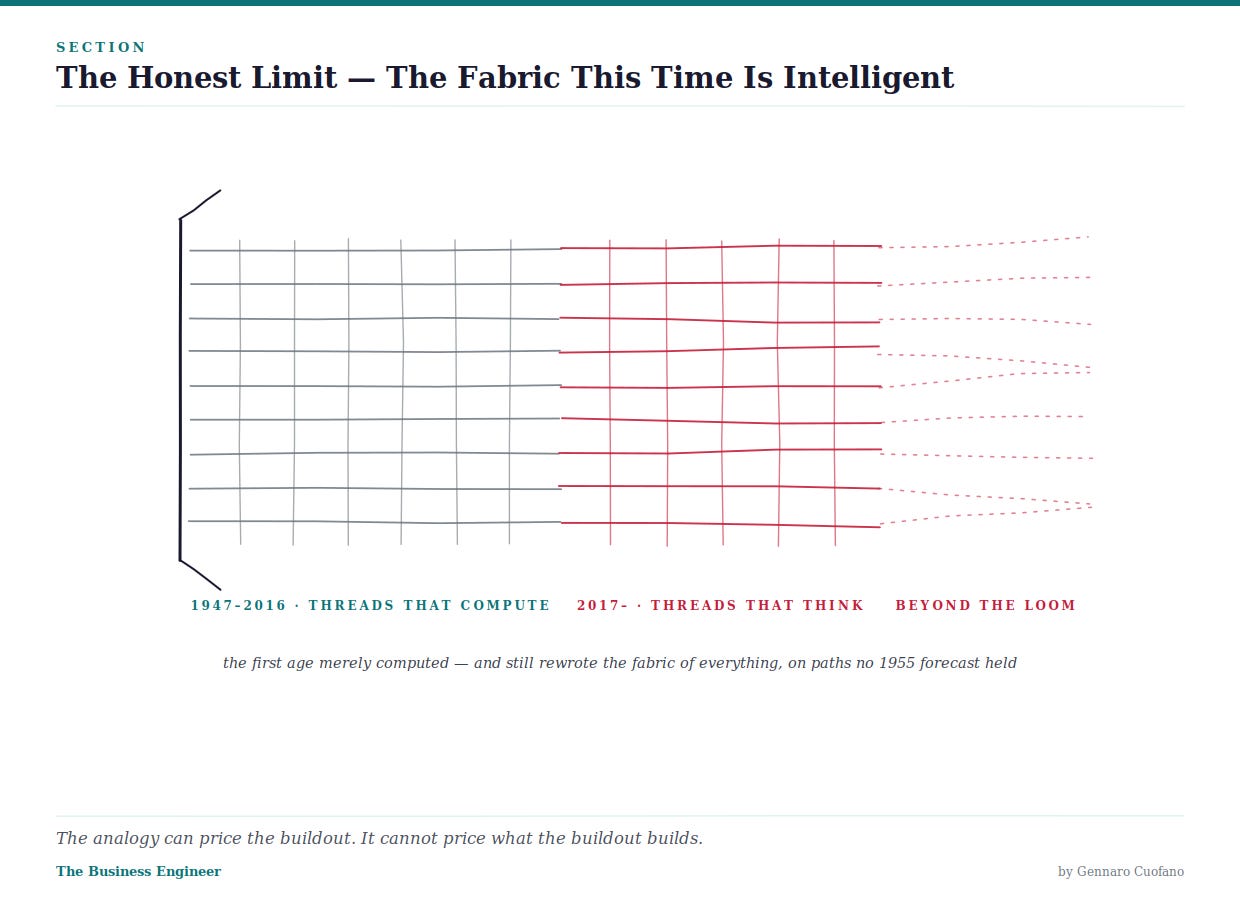
The book carries its own caveat from the first pages: the control experiment matches the mechanisms, not the consequences. The first silicon age merely computed — and even so it rewrote the economic and social fabric of every country it touched, along paths visible in no 1955 forecast.
This time the fabric being woven is itself intelligent: the first infrastructure in history whose product participates in its own diffusion, its own design, its own successors. The analogy can price the buildout. It cannot price what the buildout builds — and knowing precisely where an instrument stops working is part of owning a good instrument.
What’s inside
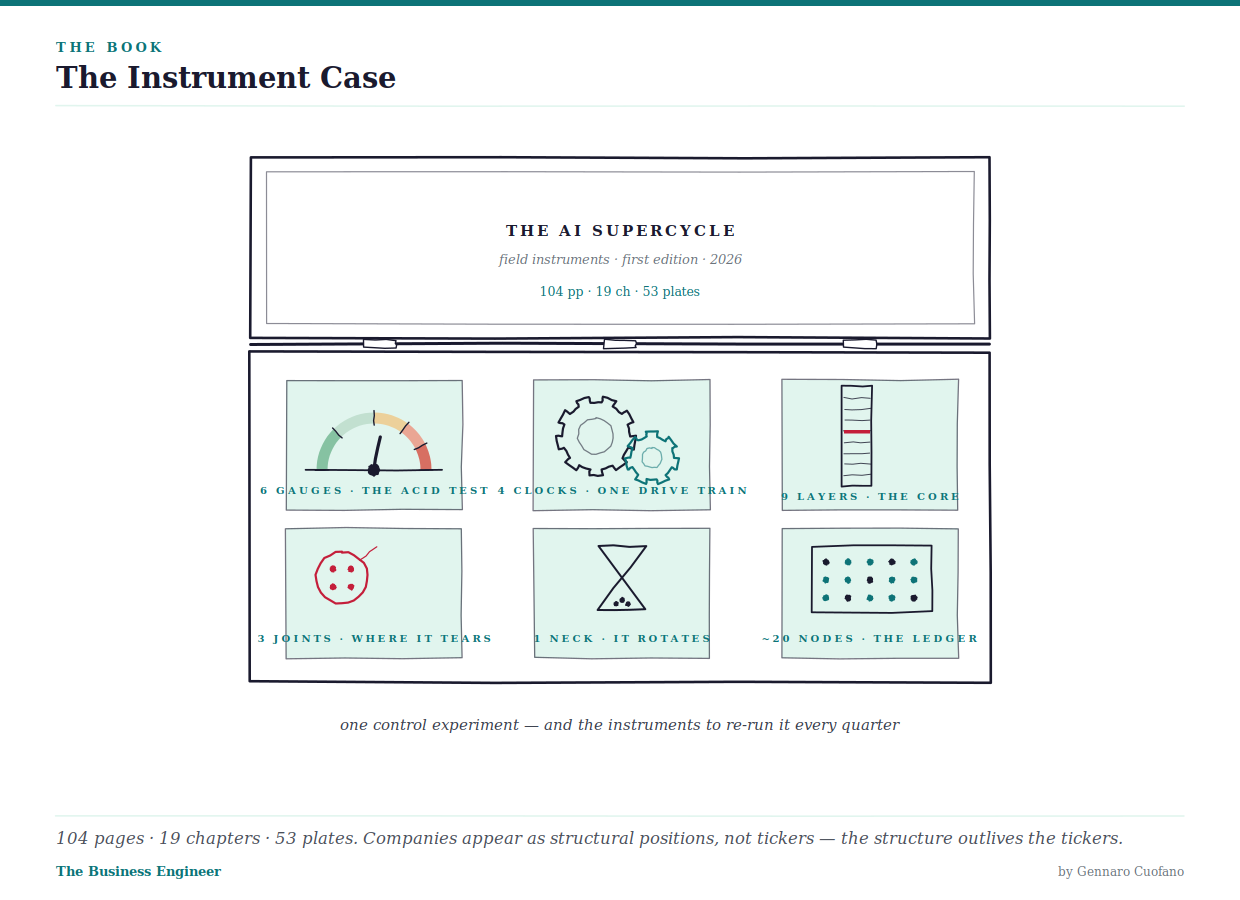
Nineteen chapters, an introduction and an epilogue, and fifty-three plates drawn in the Business Engineer register — the map as a cross-section, the acid test as an instrument panel, who-pays as a stone pillar facing a suspension bridge hung on cables of credit, the bottleneck as an hourglass whose neck rotates. Modern companies appear as structural positions rather than tickers, because the argument is about the structure, and the structure outlives the tickers. Every contemporary figure is stated as a band, dated mid-2026, and built to be re-measured each edition; a full references section covers both silicon ages, from the primary papers to the financial-history shelf.
The compression, if you want the whole book in three lines: the cycle will not pop. It’ll do something else, and that is because of its structure.
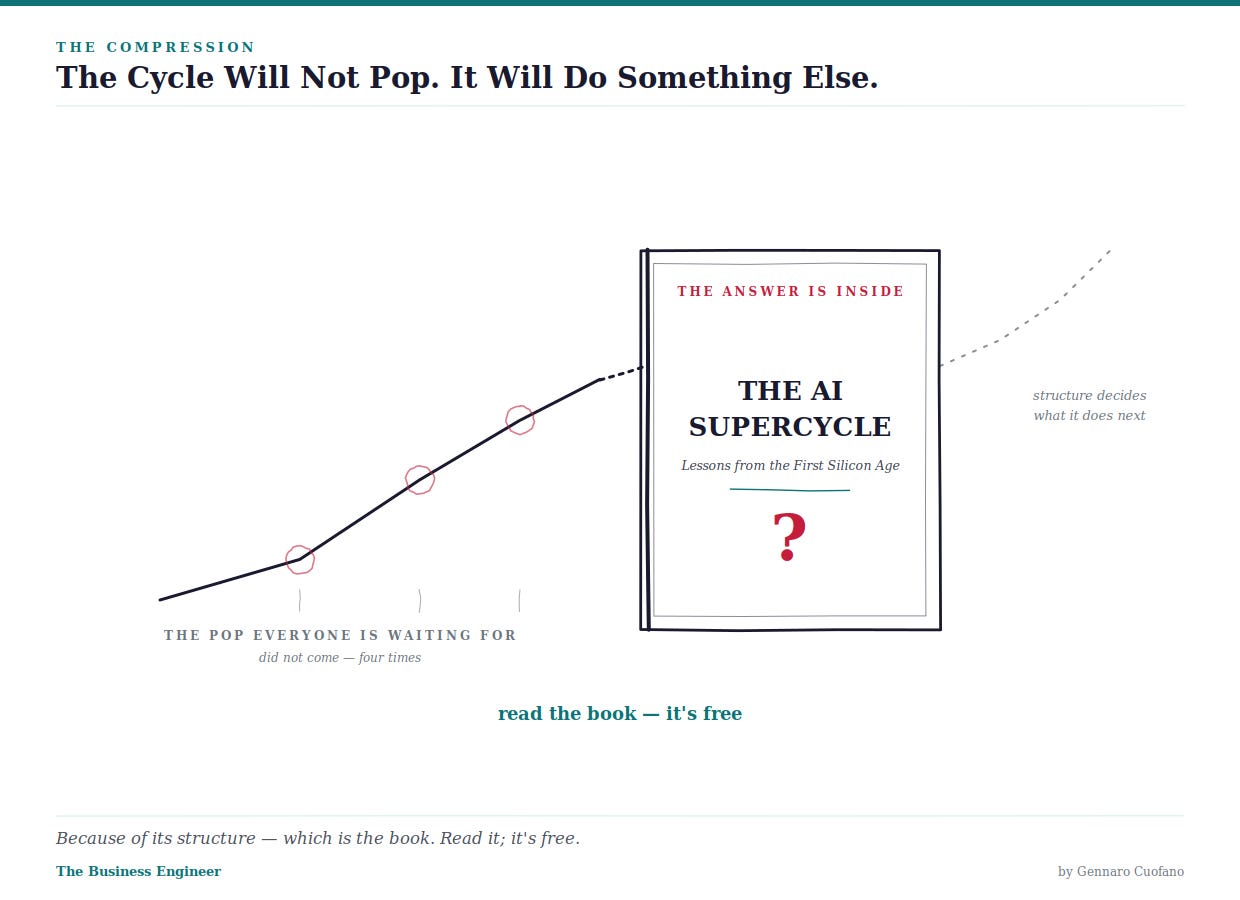
What will it do? Read the book; it’s free!
And one final caveat: this book is by no means complete.
I expect to update it at least a dozen times over the coming months, continuously refining the arguments, strengthening the historical parallels, and sharpening the underlying mental models.
The goal is not simply to produce a book that feels relevant today. It is to produce something durable.
A framework that can withstand the next fifty years, because that is roughly the timescale over which I believe the AI Supercycle itself will unfold.
In that sense, this book should be treated as a living document. The first version is not the destination. It is the foundation of an intellectual framework that will evolve alongside the supercycle it is trying to understand.
With massive ♥️ Gennaro