

Most maps of open AI start with companies. This one starts with the actual things those companies release: models, repositories, services, licences, protocols, and institutions. That matters because a company can be open in one part of its stack and completely closed in another.
To gain Full Access, subscribe below.
The basic rule of the atlas is simple: the unit is the release, not the company. Meta is therefore not one “open” node. Llama 4 Scout and Muse Glimmer 30B are separate nodes because they ship under different terms. The same is true for Alibaba: Qwen3.8 27B and Qwen3.8 Max are classified separately because their licences differ. A company can release one model permissively, another under custom terms, and still sell proprietary services around both. Calling the whole company “open” would hide that distinction.
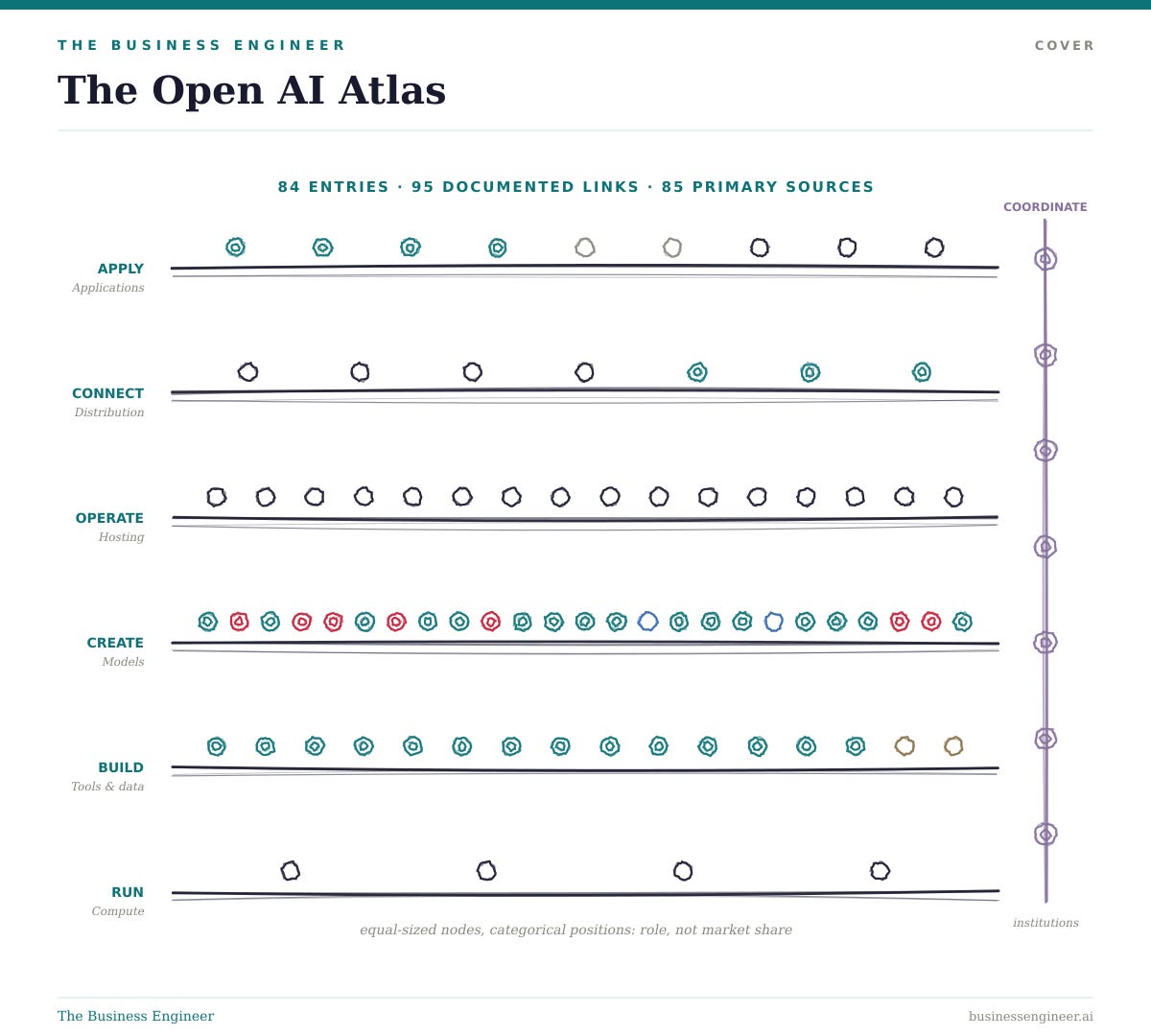
The map is organized by role in the stack. Compute sits at the bottom.
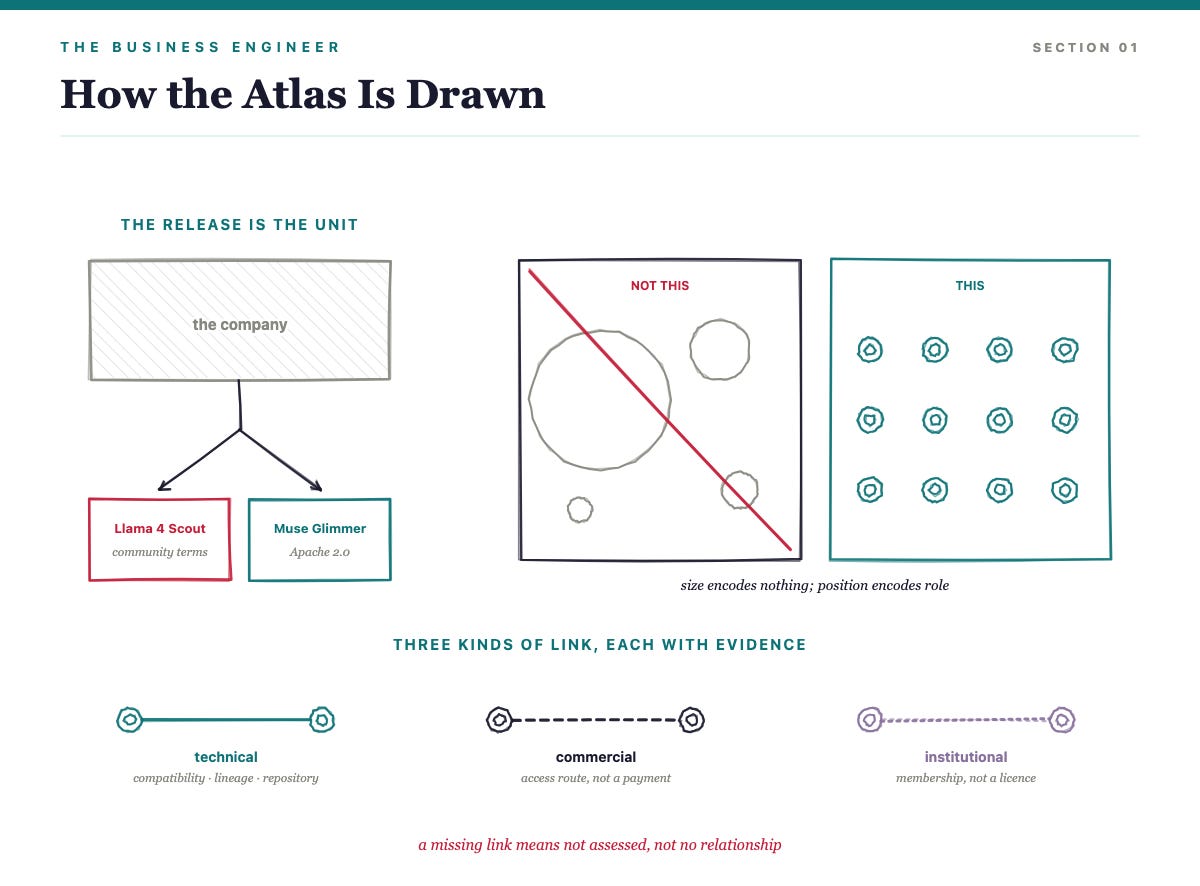
Applications sit at the top. In between are the tools that train, adapt, run, host, and route models. Institutions and protocols cut across the whole system. What the map deliberately does not show is size. A large company and a small project can appear as nodes of the same size because revenue, valuation, parameter count, downloads, and token traffic measure different things. A Hugging Face download is not the same thing as a request through Vercel. Neither is the same thing as enterprise adoption. Mixing them into one scale would make the picture look precise while comparing unlike things.
The same discipline applies to the connections. A line between two nodes means only that a specific relationship was verified: perhaps a model is supported by a serving engine, perhaps a host offers access to it, or perhaps a company belongs to a coalition. A line does not automatically mean market share, revenue, exclusivity, or strategic dependence.
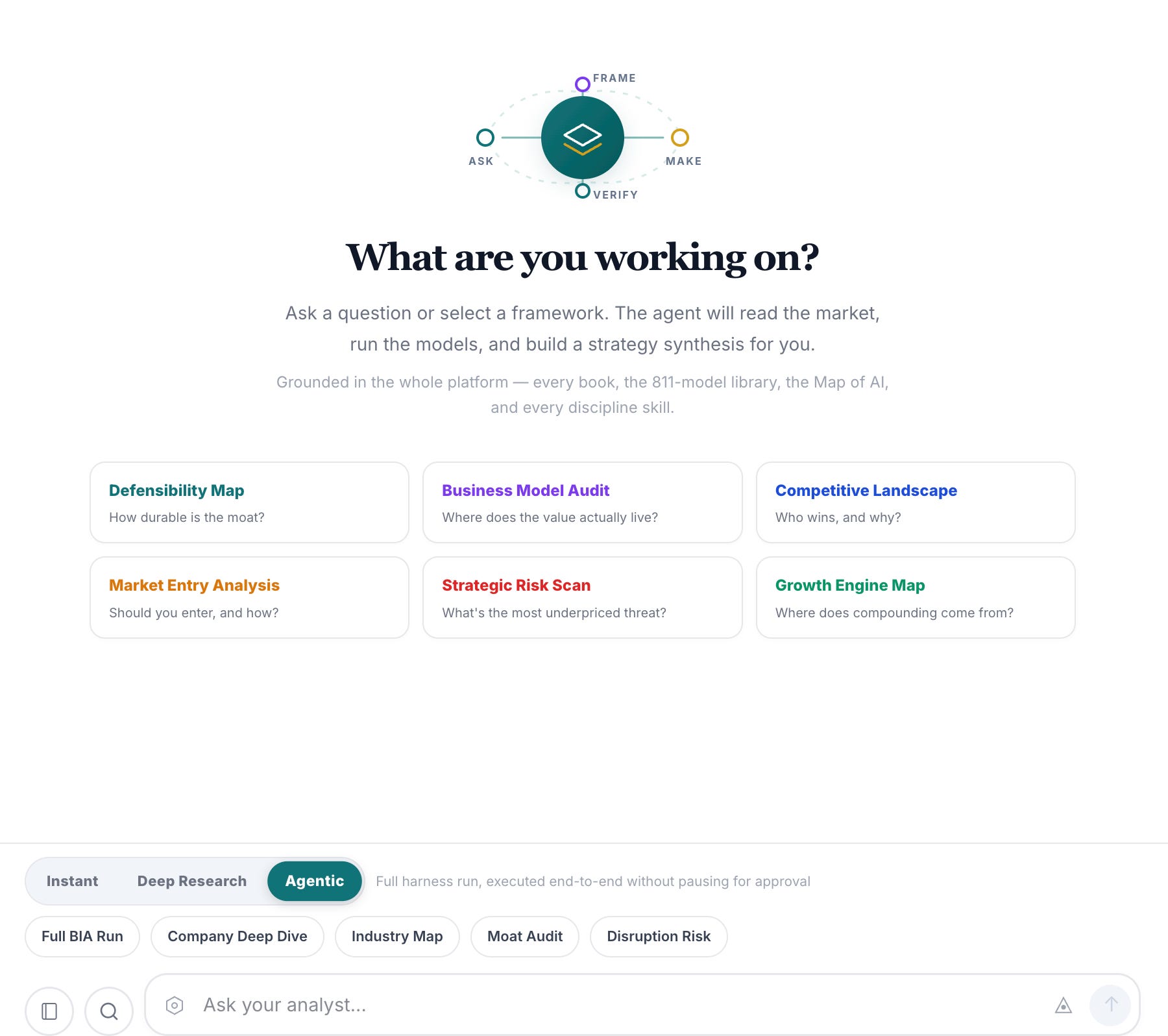
The Business Engineer’s Agenting platform is now available to Executive members. You can start exploring it here: businessengineering.ai/agent
You can preview the platform at Business Engineering AI.
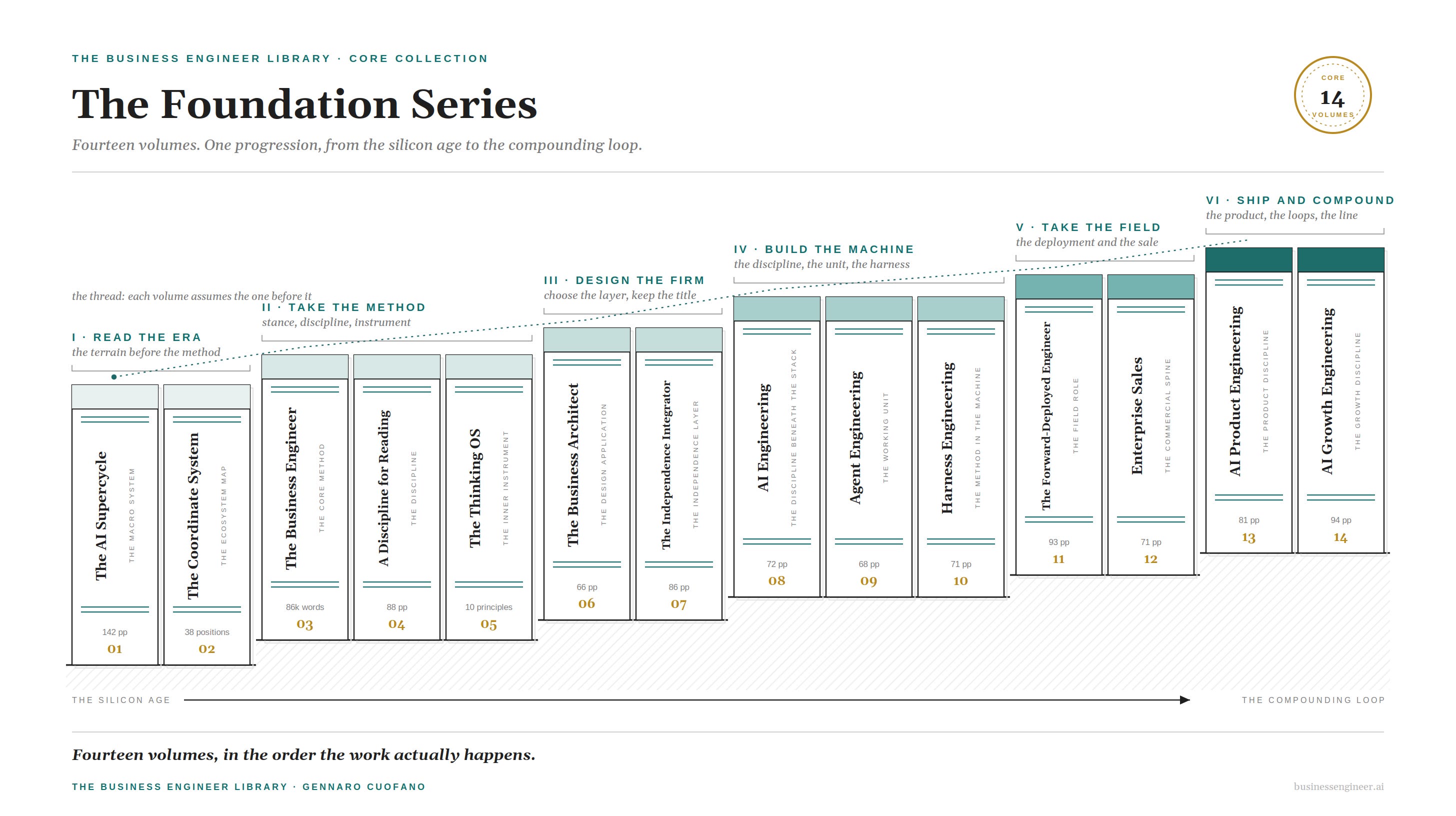
For the last three years, I’ve been rebuilding the Business Engineer’s curriculum from the ground up. That curriculum has now become the foundation of a new discipline, with the entire series taking shape around it.
What “Open” Means Here
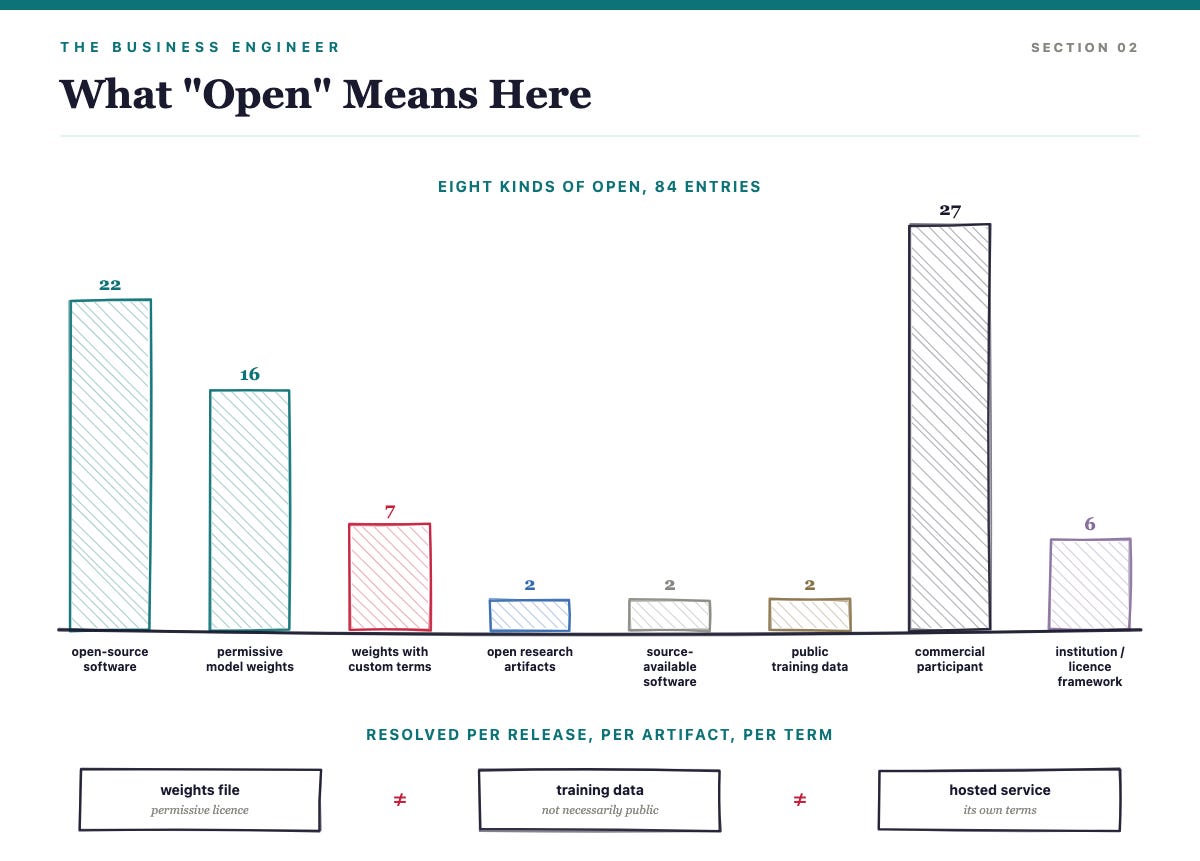
The word open is too broad to be useful on its own. The atlas separates eight different things:
Open-source software: the code is released under an open-source licence.
Permissive model weights: the model weights can be downloaded under relatively permissive terms such as Apache, MIT, or OpenMDW.
Weights with custom terms: the weights are downloadable, but the publisher adds restrictions or special commercial conditions.
Open research artifacts: the release includes more than weights, such as training data, recipes, or evaluation material.
Source-available software: the source can be inspected or self-hosted, but use is still restricted.
Public training data: datasets are released publicly under their own terms.
Commercial ecosystem participants: companies that host, route, run, or apply open models without themselves being open.
Institutions and licence frameworks: organizations and legal structures that coordinate the ecosystem.
The most important point is that these categories do not automatically travel together. A model can have permissive weights without public training data. A repository can be open while the hosted service built around it is proprietary. A model can be downloadable while its commercial use is restricted.
So when we say a model is “open,” the next question should always be: open in what sense, and under which terms?
That is why the atlas works at the level of the individual artifact rather than the company.
Run: Compute and Accelerators
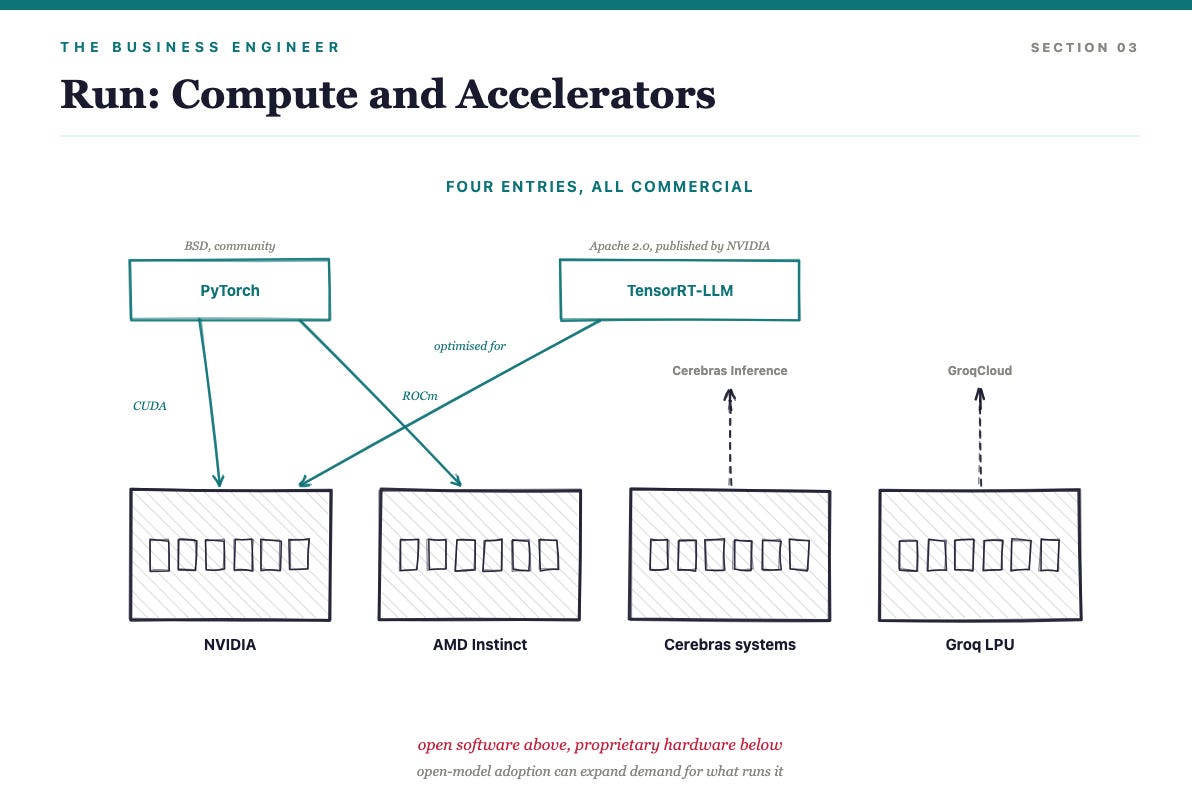
The compute layer is small and highly concentrated. The atlas includes NVIDIA, AMD, Cerebras, and Groq. All four are commercial infrastructure companies. None needs to make its hardware open in order to benefit from open AI.
The important relationship is between open software and proprietary hardware. PyTorch can run on CUDA and ROCm. TensorRT-LLM is open-source software optimized for NVIDIA hardware. This creates a simple economic logic: if open models and open software make it easier for more people to run AI, the companies selling the hardware can benefit from the additional demand.
A chip company does not need to open its chip to benefit from open models. It only needs more workloads to run on the chip.
This is one of the recurring patterns across the atlas: openness in one layer can strengthen proprietary businesses in another.
Build: Development and Runtimes
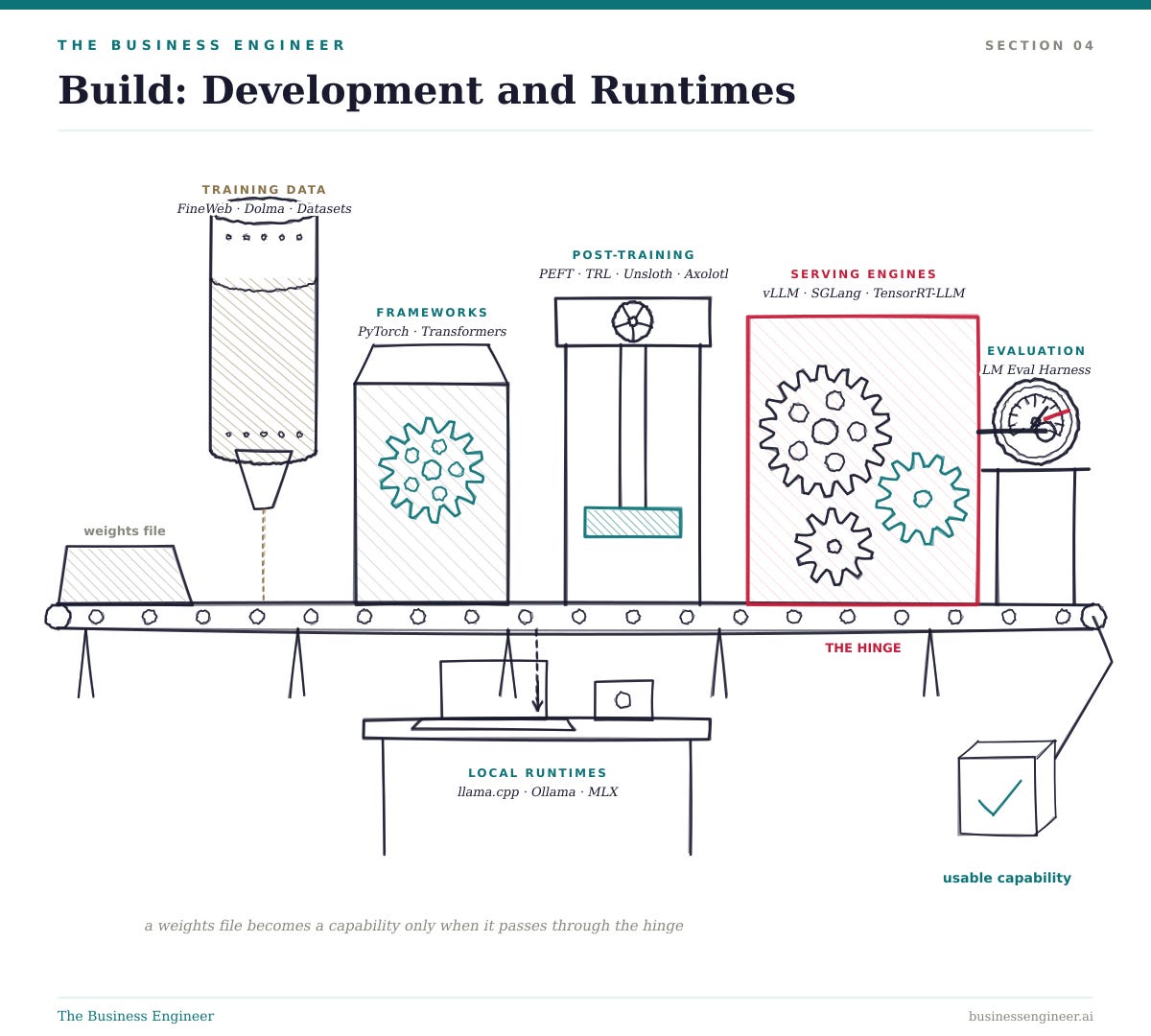
A model file is not yet a usable system. It needs software around it. That is what the development layer does.
This layer includes:
Training frameworks: PyTorch and Transformers.
Data tooling and datasets: Datasets, FineWeb, Dolma.
Post-training tools: PEFT, TRL, Unsloth, Axolotl.
Serving engines: vLLM, SGLang, TensorRT-LLM.
Local runtimes: llama.cpp, Ollama, MLX.
Evaluation tooling: EleutherAI’s LM Evaluation Harness.
This layer is easy to underestimate because it sits between the model and the application. But it is what turns weights into something developers can actually use.
A model sitting on Hugging Face is basically an artifact. It becomes a working capability when software can load it, serve it efficiently, evaluate it, fine-tune it, and connect it to an application.
That is why serving engines are one of the hinges of the entire open ecosystem. If a new model works with vLLM, SGLang, llama.cpp, Transformers, and other established tools, developers do not need to rebuild the operating stack from scratch.
This is also where open ecosystems start compounding. The more common infrastructure exists, the lower the cost of adopting the next model. The value shifts from merely having access to the weights toward being able to run and adapt them well.
Create: Models and Open Research
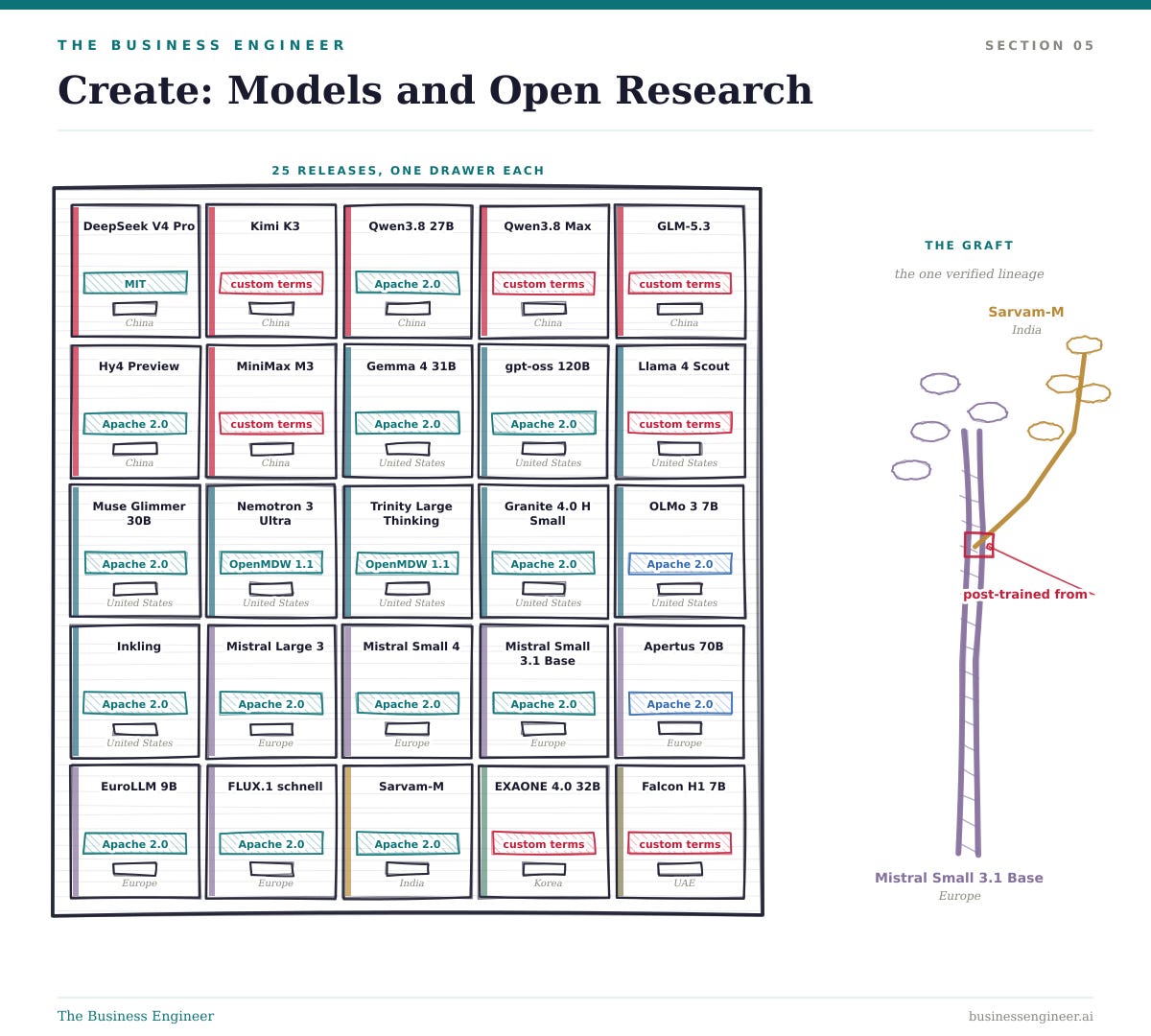
The atlas contains twenty-five model releases from the United States, China, Europe, India, Korea, and the UAE. But the important point is not the country count. It is that different releases from the same lab can have very different licences.
For example, one Qwen release can use Apache 2.0 while another release from the same publisher uses its own family-specific licence. Other Chinese models expose downloadable weights under custom commercial terms. The same pattern exists in the United States: companies whose flagship services are closed can still publish individual models under Apache or other permissive licences.
So it is a mistake to say:
“Alibaba is open.”
or:
“Google is closed.”
The correct question is:
“What are the terms of this specific release?”
The same logic applies to model lineage. A regional model can be developed and controlled locally while still depending on a base model trained somewhere else. The atlas records Sarvam-M as being built on Mistral Small 3.1 Base, for example. That means the regional team owns its specialization, but the original training run still comes from another organization.
Fine-tuning a model locally does not necessarily mean you independently control the whole model stack.
Operate: Hosting and Deployment
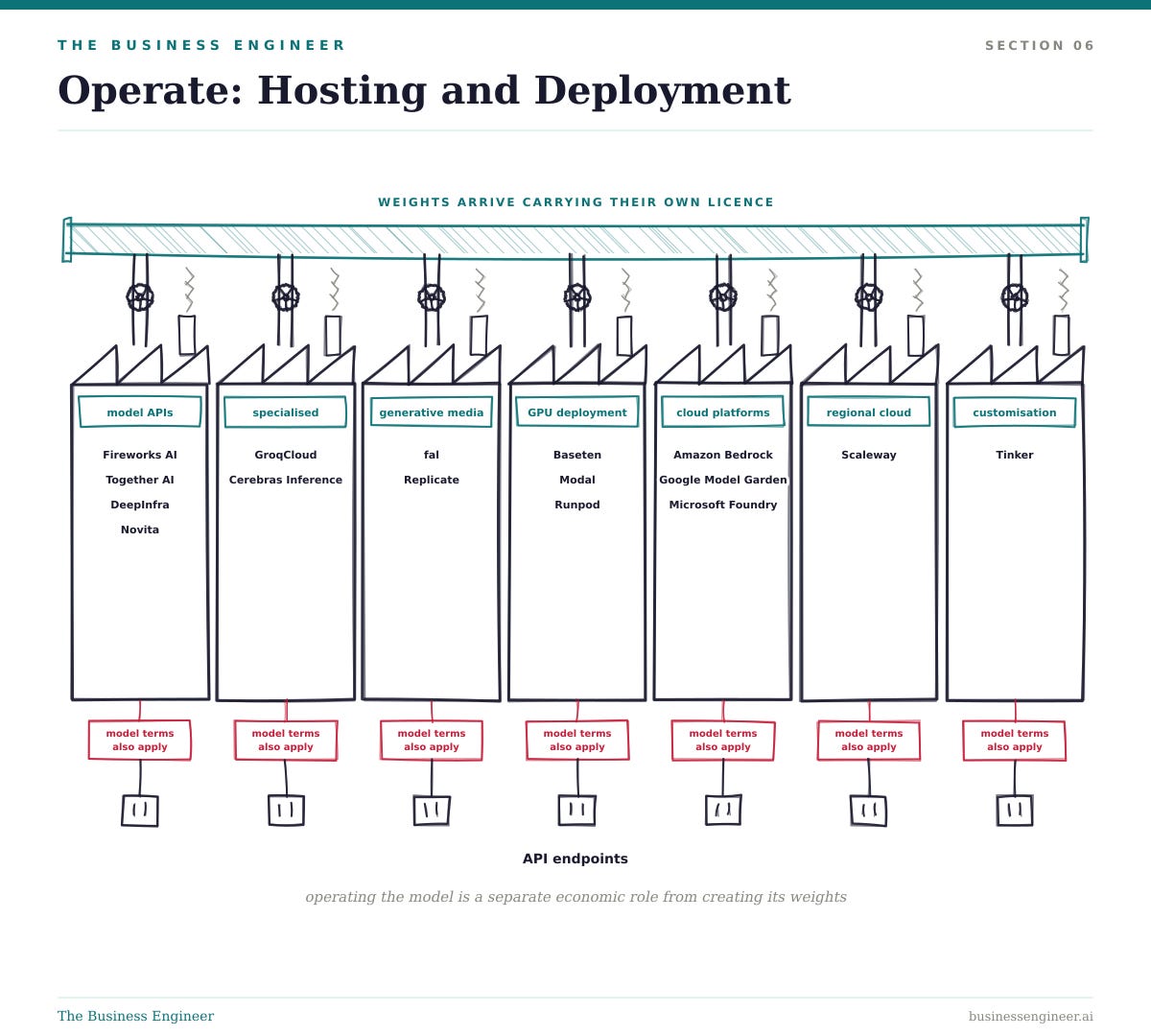
Once a model exists, someone still has to run it.
That is a separate business.
The atlas includes sixteen hosting and deployment services:
General model APIs: Fireworks, Together AI, DeepInfra, Novita.
Specialized inference: GroqCloud, Cerebras Inference.
Generative media: fal, Replicate.
Custom deployment: Baseten, Modal, Runpod.
Cloud platforms: Amazon Bedrock, Google Model Garden, Microsoft Foundry.
Regional cloud: Scaleway.
Customization: Tinker.
This layer makes the economics of open AI much easier to understand.
Suppose you use an open model through Fireworks. The model weights may be permissively licensed, but Fireworks is still providing a commercial service. You are paying for compute, memory, availability, scheduling, networking, and support.
The model can be open while the service running it is commercial.
That means the company that trained the model, the company that serves it, and the company that owns the customer relationship can all be different.
Open models therefore do not remove commercialization. They separate model creation from model operation.
Connect: Distribution and Routing
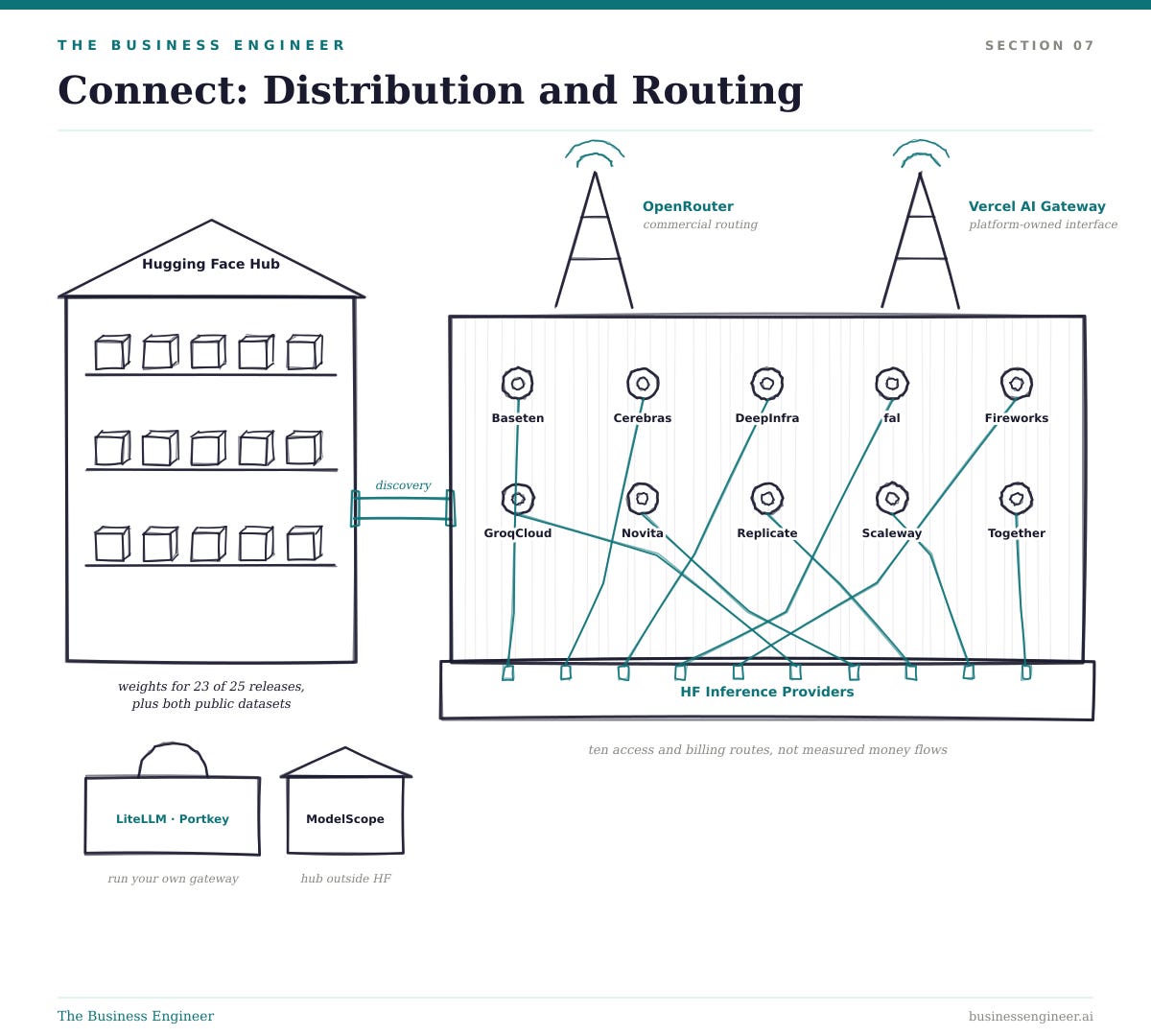
The routing layer sits above the hosts and gives developers a simpler way to reach many models and providers.
Hugging Face is a useful example because it plays two different roles. The Hub is primarily a repository where models and datasets are published. Hugging Face Inference Providers is a commercial routing layer that connects those models to hosting companies. Those are different functions.
OpenRouter and Vercel AI Gateway perform related commercial routing functions. LiteLLM and Portkey provide open-source ways to build or operate a similar routing layer yourself.
This creates an important separation:
the interface the developer calls no longer has to be the same company that actually runs the model.
You might call OpenRouter, choose a model from one lab, and have the request executed by an entirely different inference provider.
That turns routing into a new distribution layer above the host.
It also explains why gateway statistics must be interpreted carefully. Vercel or OpenRouter may see a huge volume of traffic, but that is still only the traffic that passed through their own distribution layer. They do not see every direct API call, private deployment, local model, or enterprise contract.
Apply: Applications and Agents
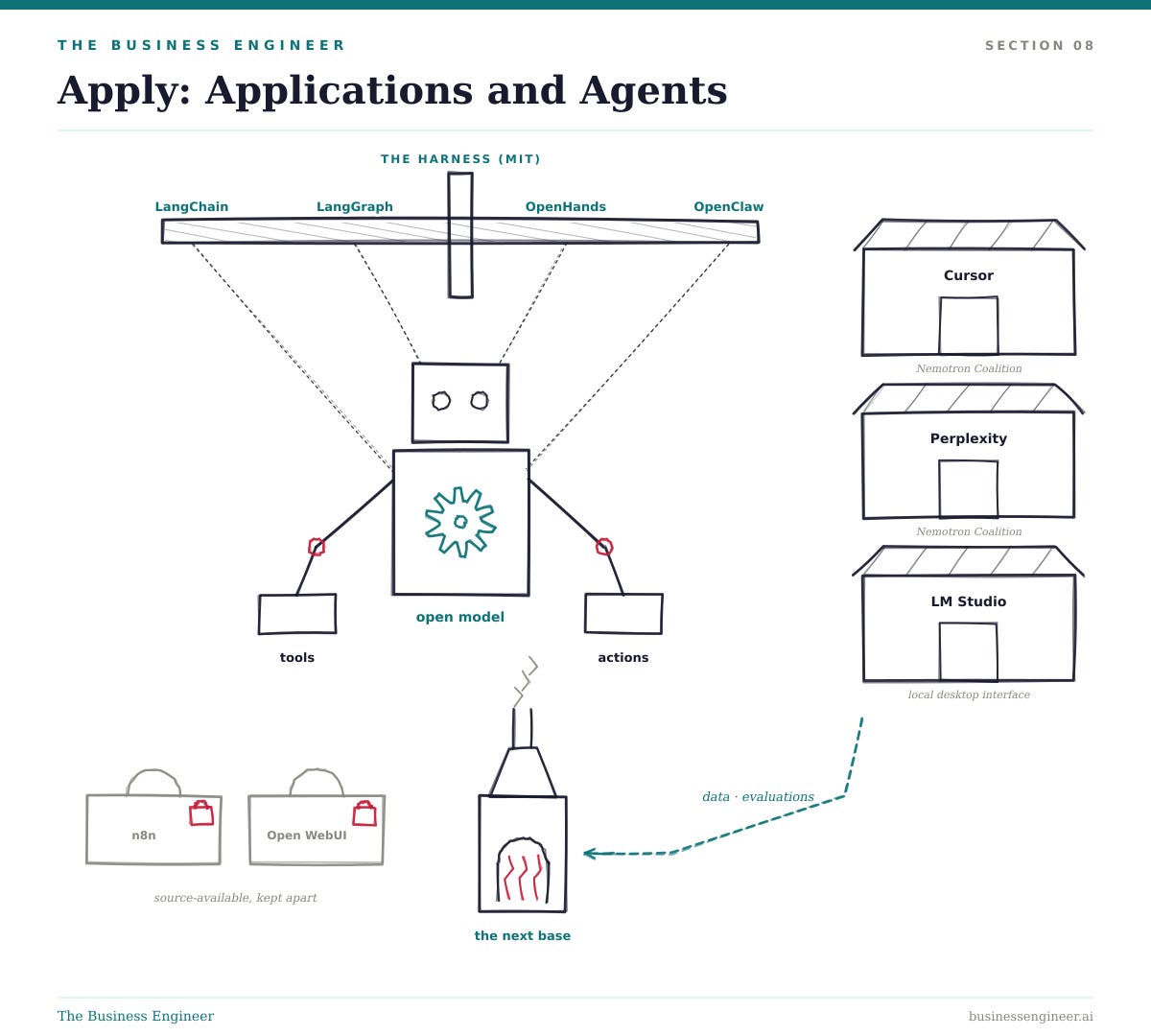
At the top of the stack are the products that actually turn models into work.
The atlas includes open frameworks such as LangChain and LangGraph, self-hosted agent software such as OpenHands, and systems such as OpenClaw that connect models to tools. It also includes source-available products such as n8n and Open WebUI, which are kept separate from fully open-source software because their licences impose additional restrictions.
On the commercial side are products such as Cursor and Perplexity.
The interesting change is that the relationship between models and applications is becoming two-way.
Traditionally, the model company built the model and the application company consumed it.
Now application companies can also contribute:
usage patterns,
evaluation data,
failure cases,
user requirements,
and domain-specific feedback.
That means the application layer can influence how future models are trained and improved.
The application is no longer only a customer of the model. It can become part of the model-development loop.
This is strategically important because some of the most valuable learning may sit with whoever owns the workflow and the users, not with whoever originally trained the base model.
Coordinate: Institutions and Protocols
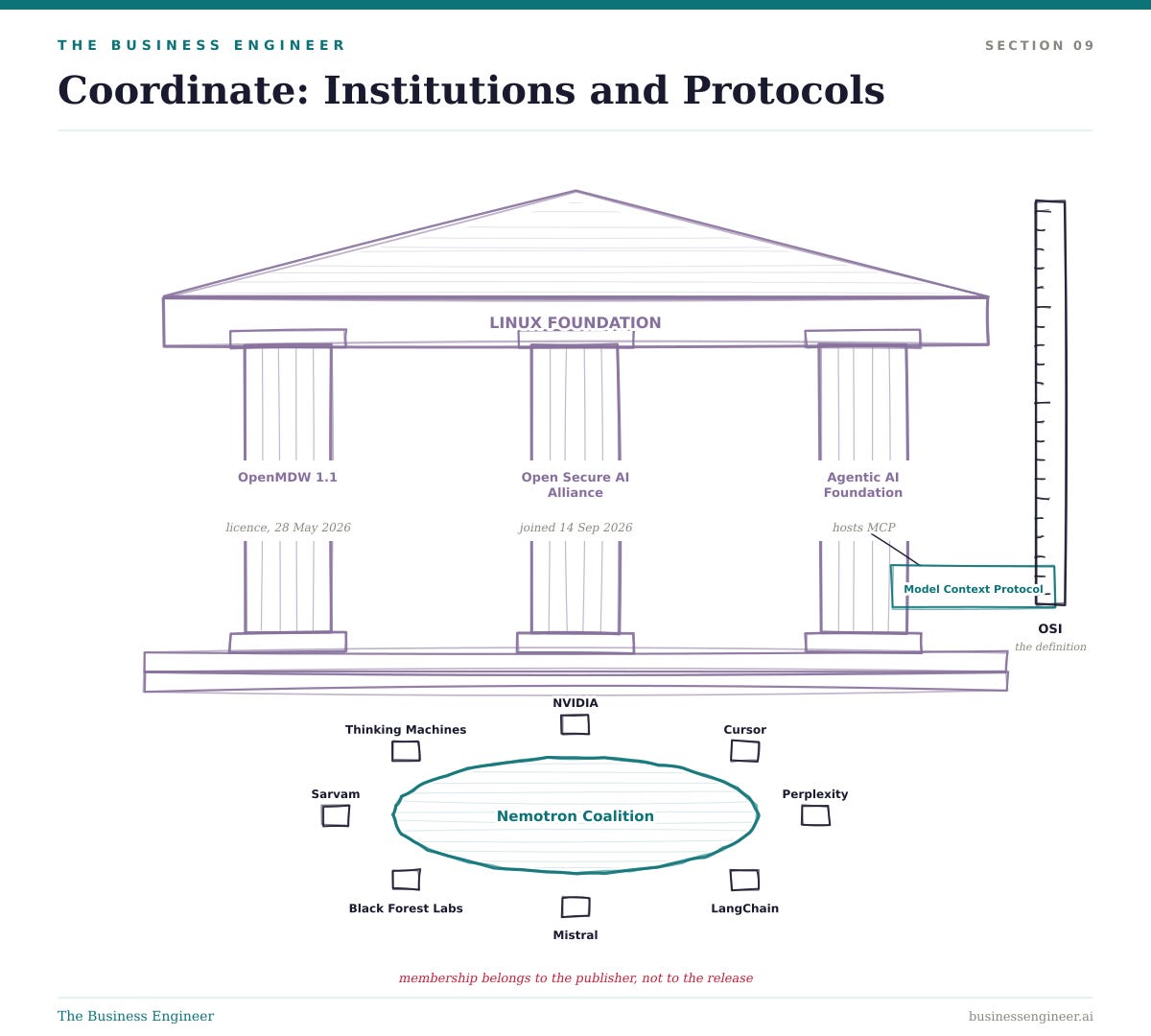
The final layer is not really above the others. It runs across them.
These are the institutions, licences, and protocols that make the ecosystem easier to coordinate over time.
The atlas includes the Open Source Initiative, the Linux Foundation, OpenMDW, the Open Secure AI Alliance, the Agentic AI Foundation, the Model Context Protocol, and the Nemotron Coalition.
Three different ideas need to stay separate here:
Licensing defines what you are allowed to do with an artifact.
Interoperability defines whether different systems can work together.
Governance defines how an ecosystem or project is maintained over time.
A model can have open weights while using no open protocol. A protocol can be open while many products using it are closed. A company can join a coalition without changing the licence of any model it releases.
That is why membership is not a licence.
Mistral joining a coalition tells us something about Mistral as an organization. It does not automatically change the rights attached to Mistral Large 3.
The Ninety-Five Links
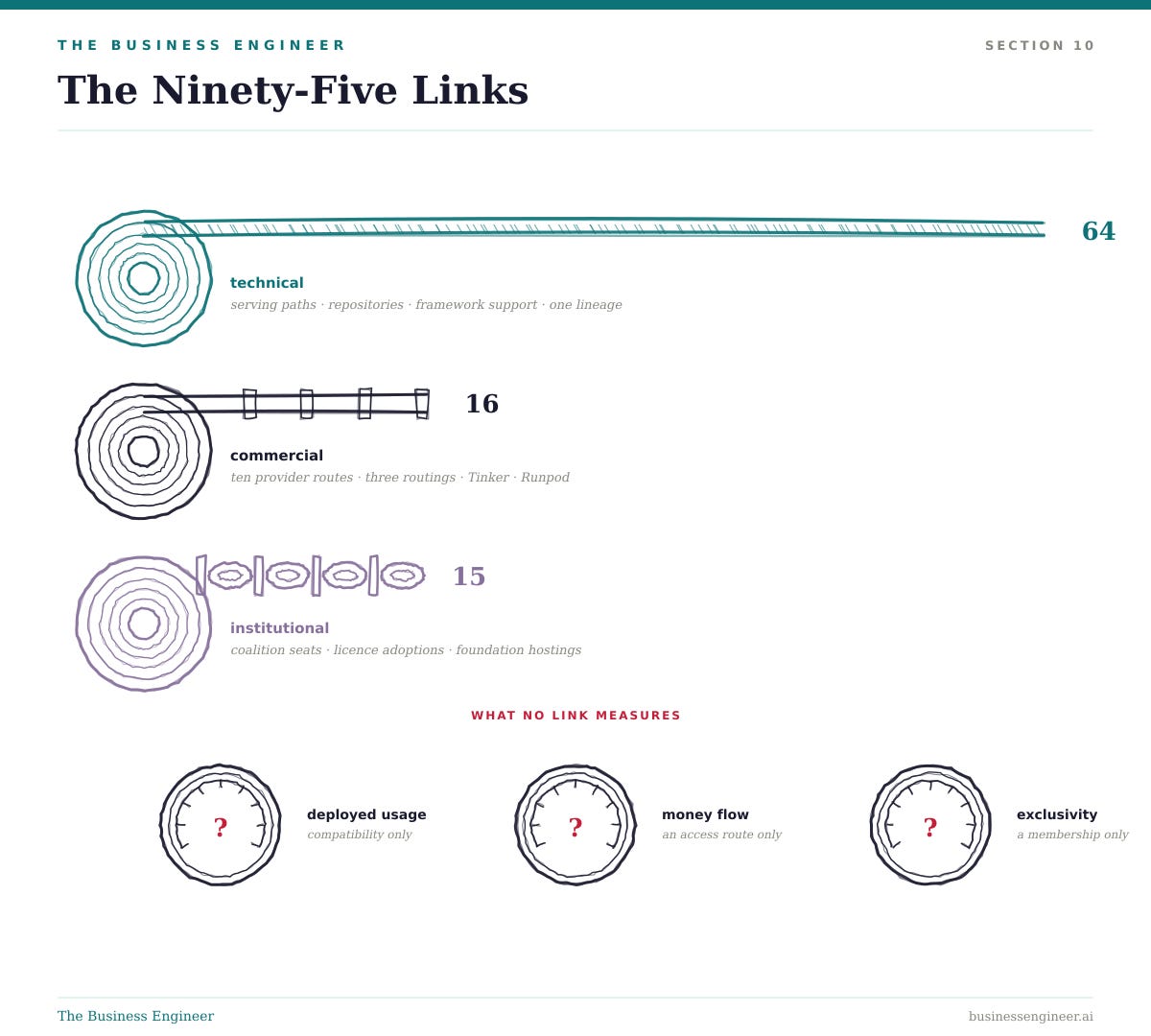
The atlas includes ninety-five verified relationships:
64 technical links: compatibility, framework support, repository availability, and model lineage.
16 commercial links: routes through which models can be accessed, hosted, or customized.
15 institutional links: coalition memberships, foundation relationships, and licence adoption.
The important point is that each type of link means only one thing.
If a model is linked to vLLM, it means there is documented compatibility. It does not mean vLLM is the most popular way to serve it.
If OpenRouter is linked to an inference host, it means a routing path exists. It does not tell us how much revenue passes through it.
If a company is linked to the Nemotron Coalition, it means the company is a member. It does not mean every model that company releases belongs to NVIDIA’s ecosystem.
The atlas deliberately refuses to turn one kind of evidence into another.
Compatibility is not usage. Access is not revenue. Membership is not control.
What the Atlas Refuses to Claim
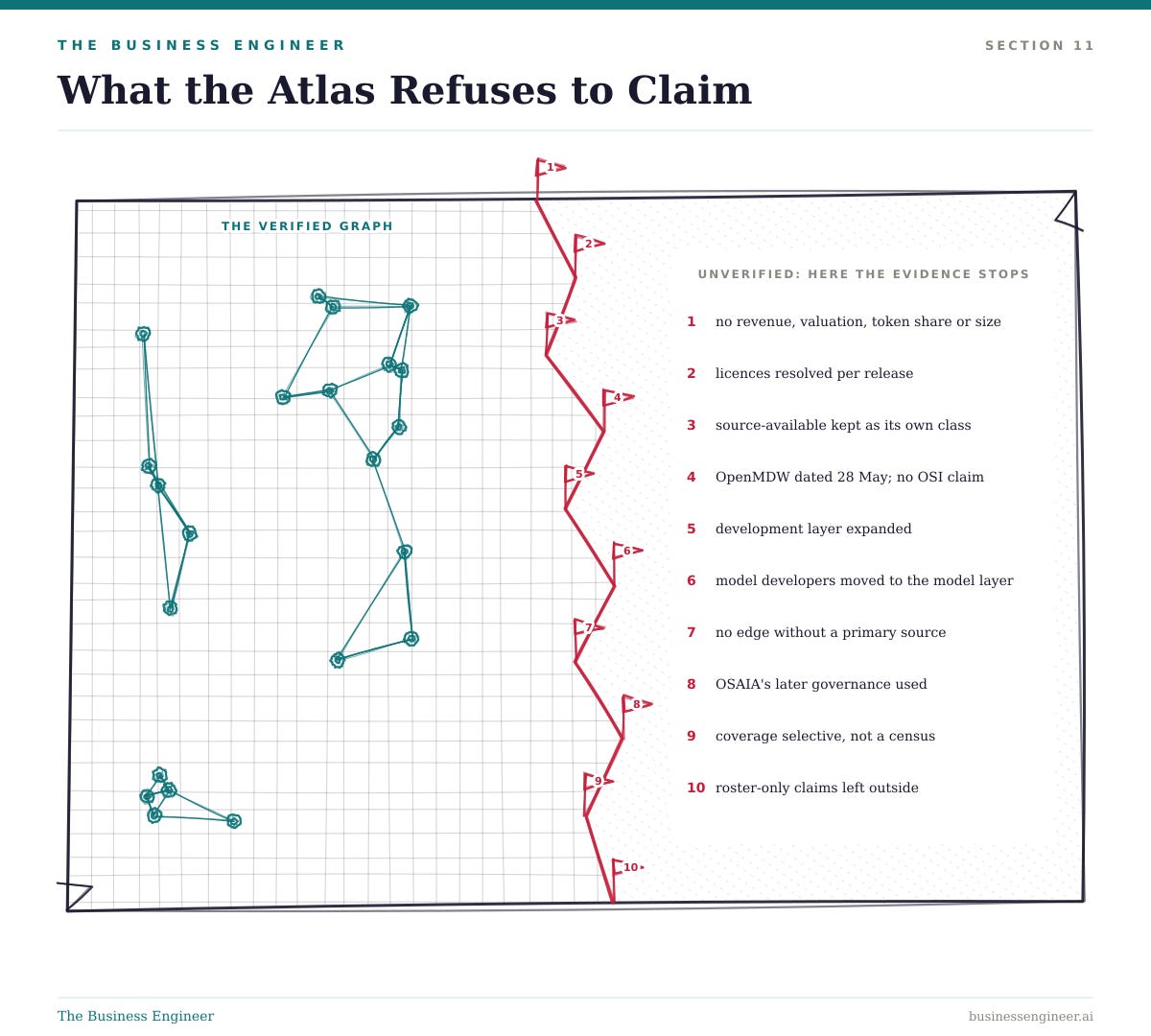
The things left out are part of the research.
The atlas does not:
rank nodes by revenue, valuation, token share, or parameter count;
assume that every product from the same company uses the same licence;
treat source-available software as equivalent to open source;
treat use of OpenMDW as proof of OSI certification;
reduce open AI to models while ignoring data, serving, evaluation, and post-training;
turn company membership in a coalition into a property of every product;
draw market-share or lineage connections without primary evidence;
claim to be an exhaustive map of every company, model, price, or country.
This is important because maps become misleading when they try to fill every empty space.
A missing edge does not mean there is no relationship. It means the relationship was not verified here.
A missing market-share number does not mean market share is irrelevant. It means this atlas is mapping something different.
The atlas maps the structure of the ecosystem, not its exact economic size.
The Compression
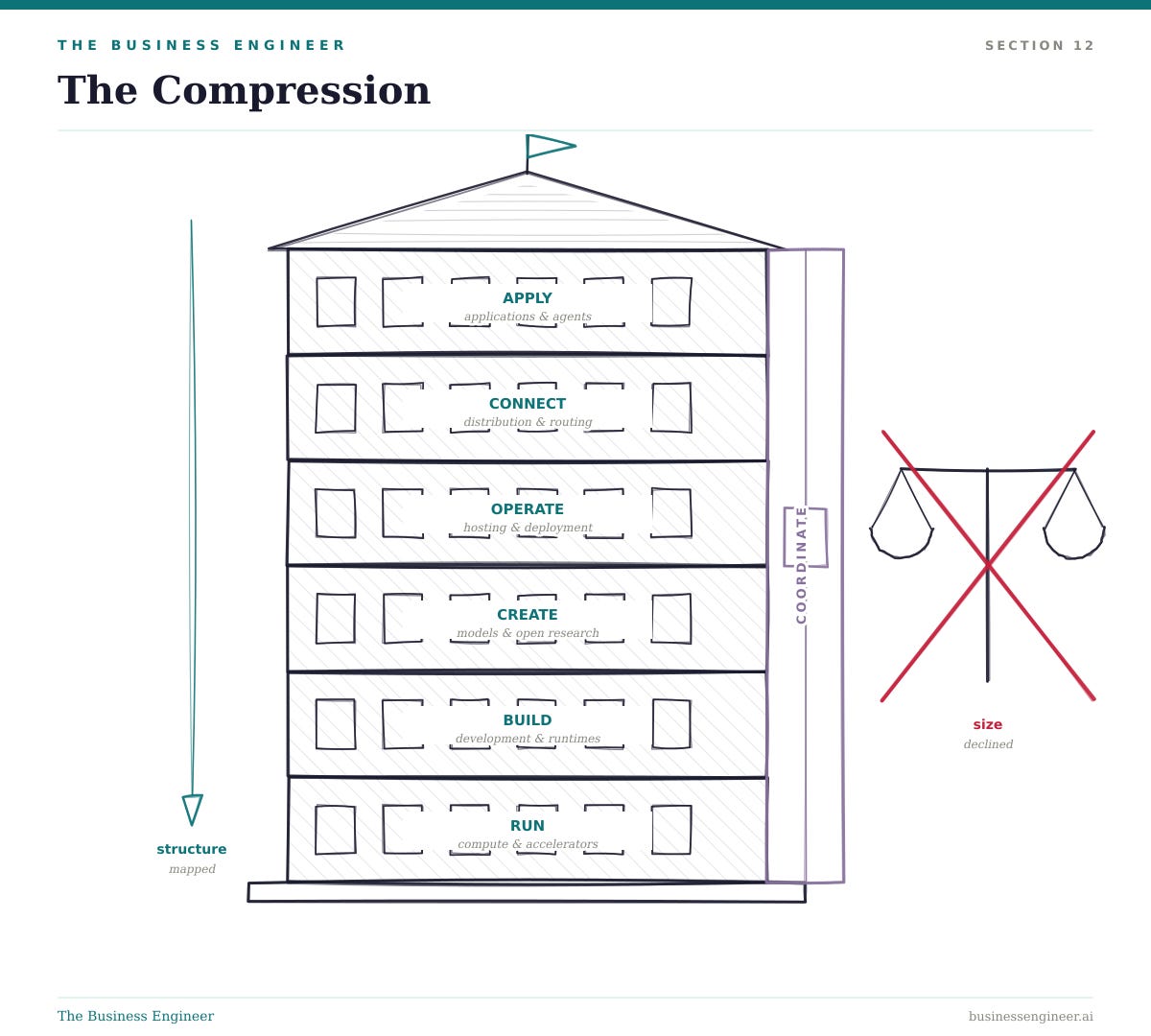
The open-AI ecosystem is much easier to understand once it is broken into layers:
Compute → Development → Models → Hosting → Routing → Applications
with institutions, licences, and protocols coordinating across all of them.
The most important lesson is that “open AI” is not one type of company or one licensing model.
A model can be open while the hardware underneath it is proprietary.
The software used to run it can be open while the hosted service is commercial.
A closed application can contribute data or evaluations to an open-model coalition.
A regional model can be locally controlled while depending on a base model trained elsewhere.
A company can simultaneously participate in open-source software, permissive model releases, custom-licensed weights, and proprietary services.
That is not a contradiction.
That is the ecosystem.
The weights are only one piece. Around them sits an industrial stack that trains, adapts, serves, routes, integrates, evaluates, and governs those weights.
And once those layers are separated, the real question becomes much clearer:
Which parts of the AI stack are actually open, which parts are commercial, which parts are replaceable, and where does control really sit?
The Mental Models
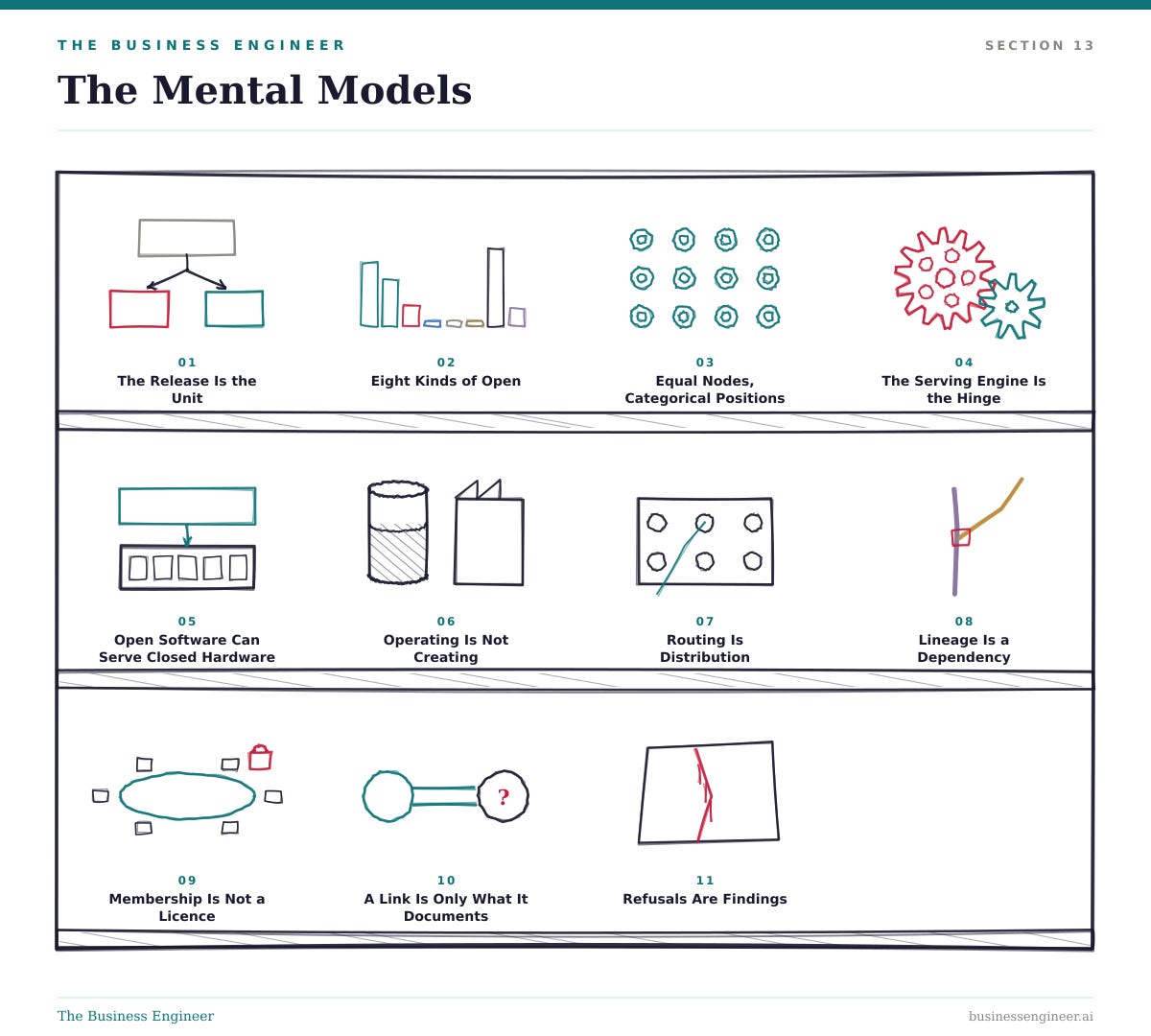
The Release Is the Unit. Do not ask whether a company is open. Ask what the terms are for the specific model, repository, or service you are using.
Open Has Several Meanings. Open-source code, downloadable weights, permissive commercial rights, public data, and open research are different things.
Weights Are Not a System. A model becomes useful only when training, serving, evaluation, and runtime software can actually operate it.
Open at One Layer Can Strengthen Closed Economics Elsewhere. Open models can increase demand for proprietary chips, clouds, or commercial hosting.
Creating and Running Are Different Businesses. The company that trains the model does not have to be the company that serves it.
Routing Is a Distribution Layer. The API you call can be separate from the company performing the inference.
Lineage Matters. A local or sovereign model may still depend on somebody else’s base-model training run.
Membership Is Not a Licence. A company joining a coalition does not change the terms of its products.
A Link Means Only What It Proves. Compatibility is not usage. Access is not revenue. Membership is not control.
The Missing Claims Matter Too. When public evidence cannot establish something, the atlas leaves it out rather than pretending certainty.
With massive ♥️ Gennaro Cuofano, The Business Engineer